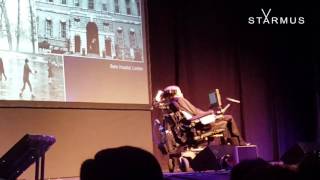
Stephen Hawking on No-Boundary Universe
Hawking’s no-boundary view says the universe is finite but has no edge, so asking what came before the Big Bang is like asking what lies south of the South Pole.
- The universe’s boundary condition is that it has no boundary.
- On this view, there was no ordinary time before the Big Bang.
- Asking what came before is like asking for a point south of the South Pole.
- Hawking thought the beginning should still obey science, not mark a breakdown of law.
- He tied the origin question to quantum theory as well as relativity.

“Space and time were no longer absolute, no longer a fixed background to events.”Hong Kong UST Stellar Lecture, 2009 · 15:11
The core idea: the universe can begin without having an edge
Hawking’s central claim is that the universe does not need a boundary or edge at its beginning. He described the right starting point for cosmology as the boundary condition that the universe has no boundary.12
That means the origin of the universe should not be pictured as a sharp border where physics stops and something outside takes over. Instead, he argued that the universe should be self-contained and determined completely by the laws of science.345
Why Hawking says there was no 'before' the Big Bang
Hawking’s answer to the question of what came before the Big Bang is that the question misfires if it assumes ordinary time already existed. He said that time began at the big bang, and he also stated directly that nothing was around before the Big Bang.67
His favorite way to make this intuitive was the South Pole comparison. If time is part of the universe rather than an outside stage, then asking what happened before the beginning is like asking for a point south of the South Pole.8910
The reasoning behind it: space and time are part of the universe
Hawking’s no-boundary view depends on a deeper change in how physics treats space and time. In relativity, space and time are not fixed containers sitting outside the universe; they are dynamical and defined within it.1110
That shift matters because if time belongs to the universe itself, then the universe’s beginning is not an event inside a preexisting clock. Hawking stressed that it makes no sense to talk of a time before the universe began once space and time are understood this way.1011
“Space and time were no longer absolute, no longer a fixed background to events.”Hong Kong UST Stellar Lecture, 2009 · full transcript →
Why he thought science should apply at the beginning too
Hawking resisted the idea that the beginning of the universe had to be a place where science fails. He argued that the laws of science may hold even at the beginning of the universe, and that this is exactly what a no-boundary approach aims to preserve.45
This is part of a larger conviction running through his cosmology: the universe is governed by rational laws that we can discover and understand. He saw the origin of the universe as a scientific question, not one that must be handed off once conditions become extreme.1213

“…the laws of science may hold even at the beginning of the universe…”Hitchcock lecture, Berkeley, 1988 · full transcript →
How the proposal connects relativity, quantum theory, and our existence
Hawking did not think relativity alone was enough to explain the origin. He said that to understand the origin of the universe, general relativity must be combined with quantum theory, and he pointed to Feynman’s sum over histories as the best route.15
In that broader picture, the early universe is not just a philosophical puzzle but the source of the structures that later formed stars, galaxies, and us. Hawking said we are the product of quantum fluctuations in the very early universe.16
So the no-boundary idea is not only about closing off the question of a time before time. It is also meant to show how a lawful, quantum universe can give rise to the world we observe without needing a boundary where explanation stops.31516
Hawking on no-boundary universe, in his own words
“…the laws of science may hold even at the beginning of the universe…”
“Space and time were no longer absolute, no longer a fixed background to events. Instead, they were a dynamical one that was warped by the matter and energy in the universe. They were defined only within the universe, so it made no sense to talk of a time before the universe began. That would be like asking for a point south of the South Pole.”
Where to watch
 Stephen Hawking on Origin of the Universe: No-Boundary Cosmology1988 · 60 min · full transcriptHis most direct full treatment of no-boundary cosmology and why the beginning should still obey physical law.
 Stephen Hawking on Cosmology and Time: The Universe, No Boundaries, and Time Travel2014 · 47 min · full transcriptA concise, accessible explanation of why there was no 'before' the Big Bang in the ordinary sense.
 Stephen Hawking on the Origin of the Universe2007 · 68 min · full transcriptA clear lecture linking the South Pole analogy, the early universe, and the wider origin question.
 Stephen Hawking on the Origin of the Universe2009 · 67 min · full transcriptUseful for seeing how relativity and quantum theory fit together in Hawking’s account of cosmic origins.
 Stephen Hawking on Big Bang and God: The Universe, Time, and Science1988 · 52 min · full transcriptBest for understanding how Hawking ties the beginning of time to bigger questions about law, explanation, and existence.
Questions people ask
- What did Stephen Hawking say about how to judge a theory of the universe?
- What did Stephen Hawking say about time before the universe began?
- What did Stephen Hawking say about whether God intervenes in the universe?
- How did Stephen Hawking think we should understand the origin of the universe?
- What did Stephen Hawking say about the big question in cosmology?
- What did Stephen Hawking say are the big questions left in cosmology?
Sources
Every quote above, word for word from the transcripts. Numbers match the text.
“…the boundary condition of the universe that it has no boundary…”
“…the boundary condition of the universe is that it has no boundary…”
“…the universe ought to be self-contained and determined completely by the laws of science…”
“…the laws of science may hold even at the beginning of the universe…”
“…the laws of physics would hold even at the beginning of the universe…”
“…time began at the big bang.”
“Nothing was around before the Big Bang…”
“There is nothing south of the South Pole…”
“It would be like asking for a point south of the South Pole.”
“Space and time were no longer absolute, no longer a fixed background to events. Instead, they were a dynamical one that was warped by the matter and energy in the universe. They were defined only within the universe, so it made no sense to talk of a time before the universe began. That would be like asking for a point south of the South Pole.”
“Space and time were no longer absolute, no longer a fixed background to events.”
“In the last 300 years, we have discovered the laws that govern the universe in all but the most extreme conditions.”
“…we live in a world, governed by rational laws that we can discover and understand.”
“In order to understand the origin of the universe, we need to combine the general theory of relativity with quantum theory. The best way of doing so seems to be to use Feynman's idea of a sum over histories. Richard Feynman was a colorful character who played the bongo drums in a strip joint in Pasadena and was a brilliant physicist at the California Institute of Technology. He proposed that a system got from a state A to a state B by every possible path or history.”
“We are the product of quantum fluctuations in the very early universe.”
How this guide was made: drafted with AI from the full transcripts of the recordings cited, then checked: every quotation must match a transcript word for word and be the speaker's own words, and an independent review gates accuracy. Methodology and corrections.