Stephen Hawking on Hawking Radiation
Hawking’s view is that quantum effects make black holes emit radiation, lose mass, and eventually evaporate, which turns them from perfect prisons into a deep test of thermodynamics, quantum theory, and information.
- Black holes are not completely black; they emit radiation because of quantum effects near them.
- That radiation means black holes can lose mass and are not eternal prisons.
- Hawking saw this as the link between black holes, entropy, and temperature.
- The idea creates the information paradox, but Hawking argued information is not lost, only extremely hard to recover.

“The message of this lecture is that black holes, as they are painted, they are not the eternal prisons they were once thought.”Roger Penrose Lecture, Oxford, 2017 · 55:01
Hawking radiation means black holes are not truly black
Hawking’s central claim is simple but shocking: a black hole does not merely absorb. It also emits. He repeatedly presented this as the decisive correction to the older picture of a black hole as a one-way trap from which absolutely nothing can come out.123
He described his result as showing that a black hole creates and emits particles and radiation the way a hot body does. That makes Hawking radiation not a metaphor but a physical prediction: black holes have a temperature-like behavior and radiate rather than remaining perfectly dark forever.4
Why he thought the result was real
Hawking explained that he did not set out expecting black holes to emit. He expected incoming waves to be partly absorbed and partly scattered, but instead found emission from the black hole itself. The surprise mattered because it shows this was not a decorative add-on to black-hole theory but a result that emerged against his expectations.5
What convinced him was that the emission fit the earlier idea that a black hole’s horizon area behaves like entropy. In his account, the radiation was exactly what was needed to connect black holes to thermodynamics in a consistent way, tying together gravity, quantum theory, and entropy.5
How quantum theory changes the event horizon
Hawking still defined a black hole in the usual way: a region where gravity is so strong that light cannot escape, bounded by an event horizon. Hawking radiation does not erase that picture; it modifies it by showing that quantum theory changes what is possible around that boundary.7
In one of his public explanations, he pointed to the uncertainty principle as allowing particles to travel faster than light for a very small distance. In his broader explanation of black-hole escape, this quantum behavior is what opens the door to radiation from objects that classical general relativity alone would treat as perfectly black.82
Radiation means black holes can evaporate
Once a black hole emits radiation, it cannot remain unchanged. Hawking’s view was that this radiation carries energy away, so the black hole loses mass and can eventually disappear. He emphasized that black holes are therefore not eternal prisons, but objects with a long-term fate.9
He also stressed that the effect depends on size: smaller black holes radiate faster, while very large ones radiate much more slowly. So Hawking radiation is universal in principle, but its practical importance varies enormously from one black hole to another.
The deepest issue is what happens to information
For Hawking, Hawking radiation mattered not only because it makes black holes glow, but because it raises a basic question about predictability. If a black hole forms, radiates, and disappears, what happens to the information about what fell in? He stated the stakes plainly: if information were truly lost in black holes, physics could no longer predict the future in the usual way.10
His later position was that information is not lost, but it is returned in a form that is extremely hard to reconstruct. He compared it to burning an encyclopedia: the information still exists in principle, but it is no longer readable in any useful way. That is how he framed the resolution of the paradox created by Hawking radiation.1112
Hawking on hawking radiation, in his own words
“The message of this lecture is that black holes, as they are painted, they are not the eternal prisons they were once thought.”
“If information were lost in black holes, we wouldn't be able to predict the future…”
Where to watch
 Stephen Hawking on Black Hole Information: Things Can Get Out2015 · 34 min · full transcriptBest single overview of Hawking’s mature view that black holes radiate, can evaporate, and force the information question.
 Stephen Hawking on Black Holes: Information, Entropy, and Escape2017 · 57 min · full transcriptGives the clearest compact statement of his prediction that black holes emit particles and radiation like hot bodies.
 Stephen Hawking on Black Holes: Baby Universes and Time2004 · 70 min · full transcriptUseful for seeing how he explained to a broad audience why black holes are not completely black and how quantum theory changes the story.
 Stephen Hawking on Cosmology and the Future: Live Q&A2017 · 89 min · full transcriptShows how Hawking himself told the story of discovering the effect and why it connected horizon area with entropy.
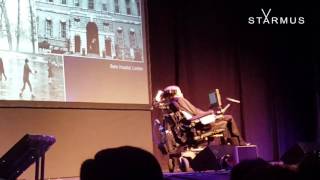 Stephen Hawking on Cosmology and Black Holes: From Big Bang to Future Humanity2016 · 25 min · full transcriptConcise account of why Hawking radiation became central to the information paradox and Hawking’s later view on information.
Questions people ask
Sources
Every quote above, word for word from the transcripts. Numbers match the text.
“…black holes ain't as black as they are painted.”
“Things can get out of a black hole…”
“…black holes, which ain't as black as they are painted…”
“My calculations predicted that a black hole creates and emits particles and radiation just as if it were an ordinary hot body…”
“I was expecting that part of an incident wave would be absorbed and the remainder scattered. But to my great surprise, I found there seem to be emission from the black hole itself. At first, I thought this must be a mistake in my calculation. But what persuaded me that it was real was that the emission was exactly what was required to identify the area of the horizon with the entropy of the black hole that is summed up in this simple formula which expresses the entropy in terms of the area of the horizon.”
“A black hole is a region where gravity is so strong that light cannot escape.”
“…the uncertainty principle allows particles to travel faster than light for a small distance…”
“The message of this lecture is that black holes, as they are painted, they are not the eternal prisons they were once thought.”
“If information were lost in black holes, we wouldn't be able to predict the future…”
“Information is not lost but it is very hard to read.”
“Information is not lost, but it is very hard to read.”
How this guide was made: drafted with AI from the full transcripts of the recordings cited, then checked: every quotation must match a transcript word for word and be the speaker's own words, and an independent review gates accuracy. Methodology and corrections.

