Stephen Hawking: How to Escape Out of a Black Hole
On Black Hole Information: Things Can Get Out

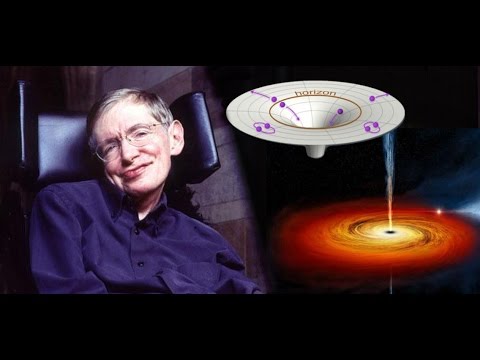
What Hawking talks about
Stephen Hawking gave this lecture in 2015 at a science venue likely the Royal Institution, explaining how black holes can emit radiation and why that matters for the information paradox and determinism.
Also known as: Stephen Hawking Lecture - How to Escape Out of a Black Hole.
Hawking argues that black holes are not absolute prisons: quantum effects let particles escape, so they can slowly radiate, lose mass, and eventually disappear. He explains why this matters for the information paradox and for whether physics remains deterministic.
He also connects the lecture to broader cosmology, discussing extra dimensions, the Large Hadron Collider, the Higgs field, and the possibility of micro black holes. In his view, the universe is governed by scientific laws, but those laws may allow many possible states rather than one unique beginning.
Howard Gilman and Nick Warner introduce Hawking; students ask two prepared questions after the lecture.
In his words
“Black holes ain't as black as they are painted.”
“Things can get out of a black hole”
“If information were lost in black holes, we wouldn't be able to predict the future”
“So if you feel you are in a black hole, don't give up.”
Key points
- Black holes have an event horizon, but quantum effects can let particles escape.
- Smaller black holes radiate faster; very large ones radiate much more slowly.
- If black holes destroy information, that would challenge scientific determinism.
- Hawking argues information is preserved through multiple possible histories, though not in a useful form.
- He says black holes may not be one-way prisons and could, in theory, connect to other universes.
- He expects the LHC to help test ideas like the Higgs field and possible superpartners.
- On creation, he says science governs the universe, but not through a single predetermined state.
Full transcript: Stephen Hawking, How to Escape Out of a Black Hole (2015)
Good evening, everyone. Thanks for being here. My name is Howard Gilman. I am the dean of the College of Letters, Arts, and Sciences, and it is my very great pleasure to welcome you to tonight's extraordinary event where we will soon hear from world-renowned physicist Stephen Hawking. It's exciting, exciting. Tonight's lecture is a signature event of a new program for the College of Letters, Arts, and Sciences. It is known as The College Comment. USC College is a large and diverse place, with over 30 academic departments representing traditional and emergent disciplines across the Natural Sciences.
The social sciences and the humanities. But what unites us as a community is a shared love of intellectual exchange, a shared commitment to the pleasures and mysteries of inquiry and discovery, and a shared belief that our world of ideas enriches the human mind and spirit, and is foundational for any other contribution a person may want to make in life. But there is one person that I would like to draw your attention to, who is primarily responsible for making tonight's event possible, and I want to introduce him. He is Professor Nicholas Warner. There you go, Nick. Dr. Hawking was Dr. Warner's PhD adviser.
At the University of Cambridge. Dr. Warner has been a professor of physics in USC College since 1990 and a professor of mathematics since 2003. He's published approximately 150 papers in theoretical physics and mathematics. He's received awards both for his teaching and his research, including an Alfred P. Sloan Fellowship, the USC Associates Award for Creativity and Research and Scholarship, the Robin Heimer Distinguished Faculty Award, and a general education teaching award. He conducts research at the cutting edge of physics and mathematics, and is a leading expert on the conditions inside of black holes, and has also played a key role in the development of string theory. Dr. Warner is also one of the key figures in
creating a new mathematical field of mirror symmetry, which allows physicists to determine quantities that were previously incalculable by invoking the mirror descriptions in a given situation, which makes it easier. Anyway, please join me in welcoming you have to have. He will explain why the mirror makes it easier, one way or the other. We have him here not as a mirror of himself, but as himself, actually. Ladies and gentlemen, please welcome Dr. Nick Warner. Thank you.
Howard, as a scientist, I admire simplicity and brevity. Stephen Hawking is quite simply a man who needs no introduction, but as a professor, I can't possibly let you get away so easily. There will also be homework later. Stephen Hawking is the Lucasian Professor at the University of Cambridge, a fellow of the Royal Society, a member of the US National Academy, and the recipient of many other academic honors and accolades. Steven is also the Sherman Fairchild Distinguished Scholar at Caltech, a position that, to our very good fortune, brings him to Southern California for a month every year. Steven is not only a superb scientist but a
major force in supporting and popularizing science. His book A Brief History of Time is in its 21st edition and sold approximately 10 million copies, and its staggering success has redefined the notion of what a popular science book can be and showed many very surprised publishers that a popular book on science can be really, really popular. Steven is probably the best known theoretical physicist on the planet, and to some extent off the planet, having appeared in Star Trek, Futurama, and The Simpsons. He has become no less than a cultural icon in science. Steven is best known for his work on cosmology and black holes. He was a central figure in creating a dramatic shift in our view
of the universe by showing that event horizons and singularities are real, natural phenomena. The true recognition of this great piece of work is that it has moved away from being speculative thinking to something that is truly part of our scientific infrastructure. Having shown that black holes are a part of nature, Stephen turned to the extremely difficult problem of understanding the quantum properties of gravity and black holes. The result was the discovery of what is now called Hawking radiation, and defining one of the crucial guideposts in making a theory of quantum gravity, the information paradox. As theoretical physicists strive to complete a quantum theory of gravity, we know that we will ultimately have to
answer to Steven and the questions raised by his paradox. Unlike the black holes of Wall Street, physicists will truly have to account for all the stuff that falls into all the black holes all throughout the universe. We are thus extremely fortunate to have Steven here in person to shine some light on this dark and difficult subject and to give his talk entitled Out of a Black Hole.
(applause) It is said that fact is sometimes stranger than fiction, and nowhere is this more true than in the case of black holes. Black holes are stranger than anything dreamed up by science fiction writers, but they are firmly matters of science.
Fact. Not that science fiction was slow to climb on the bandwagon. After black holes were discovered, I remember going to the premiere of a Walt Disney film, The Black Hole, in the 1970s. It was about a spaceship that was sent to investigate a black hole that had been discovered. But it wasn't a very good film, but it had an interesting ending. After orbiting the black hole, one of the scientists decides the only way
to find out what is going on is to go inside. So he gets into a space robe and dives into the black hole. After a screenwriter's depiction of hell, he merges into a new universe. This is an early example of the science fiction use of a black hole as a wormhole, a passage from one universe to another or back to another location in the same universe. Such wormholes, if they existed, would provide shortcuts for interstellar space travel, which otherwise would be pretty slow and tedious if one had to keep to the Einstein speed limit and stay below the
Speed of light, in fact, science fiction writers should not have been taken so much by surprise. The idea behind black holes has been around in the scientific community for more than 200 years. In 1783, a Cambridge Don, John Mitchell, wrote a paper in the Philosophical Transactions of the Royal Society of London about what he called dark stars. He pointed out that a star that was sufficiently massive and compact would have such a strong gravitational field that light could not escape any light emitted from the surface of the star.
Would be dragged back by the star's gravitational attraction before it could get very far. Mitchell suggested that there might be a large number of stars like this, although we would not be able to see them because the light from them would not reach us. We would still feel their gravitational attraction. Such objects are what we now call black holes because that is what they are: black voids in space. A similar suggestion was made a few years later by the French scientist Le Marle, apparently independently of Mitchell. Interestingly enough, Le
Included it only in the first and second edition of his book, The System of the World, and left it out of later editions. Perhaps he decided that it was a crazy idea. Both Mitchell and Le Marle thought of light as consisting of particles rather like cannonballs that could be slowed down by gravity and made to fall back on the star. But a famous experiment carried out by two Americans, Michelson and Morley, in 1887 showed that light always travelled at a speed of 186,000 miles a second, no matter where it
Came from. How then could gravity slow down light and make it fall back? This was impossible according to the then accepted ideas of space and time. But in 1915 Einstein put forward his revolutionary general theory of relativity. In this, space and time were no longer separate and independent entities. Instead, they were just different directions in a single object called spacetime. This spacetime was not flat but was warped and curved by the matter and energy in it. In order to understand this, consider
The sheet of rubber with a weight placed on it to represent a star. The weight will form a depression in the rubber and will cause the sheet near the star to be curved rather than flat. If one now rolls marbles on the rubber sheet, their paths will be curved rather than being straight lines. In 1919, a British expedition to West Africa looked at light from distant stars that passed near the Sun during an eclipse. They found that the images of the stars were shifted slightly from their normal positions. This indicated that the paths of the light from the stars had been
Bent by the curved spacetime near the Sun. General relativity was confirmed. Consider now placing heavier and heavier and more and more concentrated weights on the rubber sheet. They will depress the sheet more and more. Eventually, at a critical weight and size, they will make a bottom hole in the sheet that particles can fall into but nothing can get out of. What happens in spacetime according to general relativity is rather similar. A star will curve and distort the spacetime near it more and more the more massive and more compact the star
Is. If a massive star that has burned up its nuclear fuel cools and shrinks below a critical size, it will quietly, really, make a bottomless hole in spacetime that light can't get out of. Such objects were given the name black holes by the American physicist John Wheeler, who was one of the first to recognize their importance and the problems they (music) pose. The name caught on quickly. It suggested something dark and mysterious but the French, being French, saw more going for years. They resisted the name,
True noir, claiming it was sub, but that was a bit like trying to stand against Le Weekend. Another frankly, in the end, they had to give in. Who can resist a name that is such a winner? From the outside, you can't tell what is inside a black hole. You can throw television sets, diamond rings, or even your worst enemies into a black hole and all the black hole will remember is the total mass and the state of rotation. John Wheeler called this a black hole has no
Hair. To the French, this just confirmed their suspicions. A black hole has a boundary called the event horizon. It is where gravity is just strong enough to drag light back and prevent it escaping. Because nothing can travel faster than light, everything else will get dragged back also. Falling through the event horizon is a bit like going over Niagara Falls in a canoe. If you are above the falls, you can get away if you paddle fast enough, but once you are over the edge, you are lost.
There's no way back. As you get near the falls, the current gets faster. This means it pulls harder on the front of the canoe than the back. There's a danger that the canoe will be pulled apart. It is the same with black holes. If you fall towards a black hole feet first, gravity will pull harder on your feet and your head because they are nearer the black hole. The result is you will be stretched out lengthwise and squashed sideways. You would be torn apart and made into spaghetti before you reached the
Horizon. However, if you fell into a much larger black hole with a mass of a million times the Sun, you would reach the horizon without difficulty. So, if you want to explore the inside of a black hole, choose a big one. There is a black hole of about a million solar masses at the center of our Milky Way galaxy. Although you wouldn't notice anything particular as you fell into a black hole, someone watching you from a distance would never see you cross the event horizon. Instead, you would appear to slow.
Down and over outside, you would get dimmer and dimmer and rder and rder until you were effectively lost from sight. As far as the outside world is concerned, you would be lost forever because black holes have no hair, and where phrase one can't tell from the outside what is inside a black hole apart from its mass and rotation. This means that a black hole contains a lot of information that is hidden from the outside world, but there's a limit to the amount of information one can pack into a
region of space. Information requires energy, and energy has mass by Einstein's famous equation E equals M c². So if there's too much information in a region of space, it will collapse into a black hole, and the size of the black hole will reflect the amount of information. It is like piling more and more books into a library. Eventually, the shelves will give way, and the library will collapse into a black hole. If the amount of hidden information
inside a black hole depends on the size of the hole, one would expect from general principles that the black hole would have a temperature and would glow like a piece of hot metal. But that was impossible because, as everyone knew, nothing could get out of a black hole. Or so it was thought. But I discovered that particles can leap out of a black hole. The reason is that on a very small scale, things are a bit fuzzy. This is summed up in the uncertainty relation discovered by Werner Heisenberg in 1923, which says that the more precisely
you know the position of a particle, the less precisely you can know its speed, and vice versa. This means that if a particle is in a small black hole, you know its position fairly accurately; its speed, therefore, will be rather uncertain and can be more than the speed of light, which would allow the particle to escape from the black hole. The larger the black hole, the less accurately the position of a particle in it is defined, so the more precisely the speed is defined and the less chance there is that it will be more than the speed of light. A black hole of the mass of the
Sun would leap particles at such a slow rate, it would be impossible to detect. However, there could be much smaller, were many black holes. These might have formed in the very early Universe if it had been chaotic and irregular. A black hole of the mass of a mountain would give off X-rays and gamma rays at a rate of about 10 million megawatt, enough to power the world's electricity supply. It would be easy, however, to harness a manyi black
hole. You couldn't keep it in a power station because it would drop through the floor and end up at the center of the Earth. About the only way would be to have the black hole in orbit around the Earth. People have searched for many black holes of this mass but have so far not found any. This is a pity because if they had, I would have got a Nobel prize. Another possibility, however, is that we might be able to create micro black holes in the extra dimensions of spacetime. According to some theories, the Universe we experience is just a
four-dimensional surface in a 10 or 11-dimensional space. We wouldn't see these extra dimensions because light wouldn't propagate through them, but only through the four dimensions of our Universe. Gravity, however, would affect the extra dimensions and would be much stronger than in our Universe. This would make it much easier to form a little black hole in the extra dimensions. It might be possible to observe this at the LHC, the Large Hadron Collider at CERN in Switzerland.
This consists of a circular tunnel 27 km long. Two beams of particles travel around this tunnel in opposite directions, and they are made to collide. Some of the collisions might create micro black holes. This would radiate particles in a pattern that would be easy to recognize. So I might get a Nobel prize after all. As particles escape from a black hole, the hole will lose mass and shrink. This will increase the rate of emission of particles. Eventually, the black hole will
lose all its mass and disappear. What then happens to all the particles and unlucky astronauts that fell into the black hole? They can't just reemerge when the black hole disappears. The particles that come out of a black hole seem to be completely random and bear no relation to what fell in. It appears that the information about what fell in is lost, apart from the total amount of mass and the amount of rotation. But if information is lost, this raises a serious problem that strikes at the heart of our understanding of
science. For more than 200 years, we have believed in scientific determinism, that is, that the laws of science determine the evolution of the Universe. This was formulated by Laplace as if we know the state of the Universe at one time, the laws of science will determine it at all future and past times. Napoleon is said to have asked Laplace how God fitted into this picture. Laplace replied, "Sire, I have not needed that hypothesis." I don't think that Laplace was claiming that God didn't
exist. It is just that he doesn't intervene to break the laws of science. That must be the position of every scientist. A scientific law is not a scientific law if it only holds when some supernatural being decides to let things run and not intervene. In Laplace's determinism, one needed to know the positions and speeds of all particles at one time in order to predict the future. But according to the uncertainty relation, the more accurately you know the positions, the less accurately you can know the speeds, and vice versa.
Versa. In other words, you can't know both the positions and the speeds accurately. How then can you predict the future accurately? The answer is that, although one can predict the positions and speeds separately, one can predict what is called the quantum state. This is something from which both positions and speeds can be calculated to a certain degree of accuracy. We would still expect the universe to be deterministic in the sense that if we knew the quantum state of the universe at one time, the laws of science should enable us to predict it at
any other time. If information were lost in black holes, we wouldn't be able to predict the future because a black hole could emit any collection of particles. It could emit a working television set or a leather-bound volume of the complete works of Shakespeare. Though the chance of such exotic emissions is very low, it is much more likely to be thermal radiation, like the glow from red-hot metal. It might seem that it wouldn't matter very much if we couldn't predict what comes out of black holes; there aren't any black holes near us. But it is a matter of
principle. If the terminus breaks down with black holes, it could break down in other situations. There could be virtual black holes that appear as fluctuations out of the vacuum, absorb one set of particles, emit another, and disappear into the vacuum again. Even worse, if determinism breaks down, we can't be sure of our past history either. The history books and our memories could just be illusions. It is the past that tells us who we are. Without it, we lose our identity. It was therefore very important
to determine whether information really was lost in black holes or whether, in principle, it could be recovered. Many people felt that information should not be lost, but no one could suggest a mechanism by which it could be preserved. The argument went on for years. Finally, I found what I think is the answer. It depends on the idea of Richard Feynman that there isn't a single history but many different possible histories, each with their own probability. In this case, there are two kinds of
history. In one, there is a black hole into which particles can fall, but in the other kind, there is no black hole. The point is that from the outside one can't be certain whether there is a black hole or not. So there is always a chance that there isn't a black hole. This possibility is enough to preserve the information, but the information is not returned in a very useful form. It is like burning an encyclopedia. Information is not lost if you keep all the
smoke. K Thor and I had a bet with John Pres that information would be lost in black holes. When I discovered how information could be preserved, I conceded a bet. I gave John Pres an encyclopedia. Maybe I should have just given him the ashes. But does this tell us about whether it is possible to fall in a black hole and come out in another universe? The existence of alternative histories with black holes suggests this might be
possible. The hole would need to be large, and if it was rotating, it might have a passage to another universe. But you couldn't come back to our universe. So although I'm keen on space flight, I'm not going to try that. The message of this lecture is that black holes ain't as black as they are painted. They are not the eternal prisons they were once thought. Things can get out of a black hole, both of the outside and possibly to another universe. So if you feel you are in a black hole, don't give
up. There's a way (applause) out. In addition to giving his lecture, Stephen also agreed to answer some questions, provided we gave them to him sufficiently far in advance. We decided to solicit one question from the Los Southern California area high school students and one question from a USC undergraduate, and so opened up a website or two websites for that purpose. A couple of weeks ago, there were subtle
questions that we doubted even Professor Hawking could answer, like, "Stephen, why are you so cool?" But there was one very important question and simple question that was asked by three high school students. And I'd like to ask Ben Gross of the Wildwood School, Anders Woods, and James Gimona of La Jolla High School to come on stage to ask their question. And by, uh, by random draw, we agreed that it was—I think, was it Ben Gross who was going to ask the question? (applause) So my question to Professor Hawking
is, what do you think the experiments from the Large Hadron Collider at CERN will reveal about the universe? LHC will solve is why particles have mass. Our best guess is that it is due to something called the Higgs field. In that case, we should detect the Higgs particle in the LHC. If we don't find it, we will have to think again. Another question and my answer is whether there are superpartners. These would be partners for each particle with a spin that is greater or less by half a unit. They are a key prediction of string
theory, and they may make up the missing mass in the universe. (applause) The question we selected from a USC student found a rather provocative new spin on an ancient fundamental question, and I'd like to invite Kar Nike, a major in mechanical engineering at USC, to pose this question. First of all, Dr. Hin, thank you for taking the time to do this. Uh, it's a real honor for all of us. My question is one of the most compelling or at least seductive of arguments for the existence
Of a Creator is the so-called argument from first cause or cosmological argument. Uh, now, within the past decade, it seems like you've embraced the notion that developing a Theory of Everything, uh, as it were, might be impossible. Uh, does making such statements, what some might consider concessions, give the religious fundamentalists in society, especially here in America, license to promote and project their beliefs about creation and cosmological initial conditions? Thanks. I still believe that the creation of the universe was governed by the laws of science. It is just that the laws do not
dictate a unique state for the universe. Instead, they give the probabilities of many different possible states. There is no state for a (applause) creator. That concludes our program. I'd like to thank Professor Hawking again for (applause). Thank you all for coming to this
exceptional lecture hosted by the USC College Commons. Good night.
From YouTube captions, lightly punctuated for readability. Timestamps link to the video above. Errors are possible.
Cite this recording
Stephen Hawking, “How to Escape Out of a Black Hole (2015)”, Royal Institution or similar science venue, 2015. Transcript and video: Thinkers Archive, https://thinkersarchive.com/stephen-hawking/black-hole-information-usc-lecture-2015/
Quoting a passage? Link to its exact moment: every timestamp above has its own anchor (for example https://thinkersarchive.com/stephen-hawking/black-hole-information-usc-lecture-2015/#t-141).