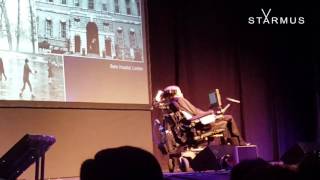
Stephen Hawking on Black Holes
Stephen Hawking saw black holes as real physical objects that simplify matter at the horizon, radiate because of quantum effects, and probably do not destroy information even though they scramble it beyond practical recovery.
- Black holes are real regions where gravity is so strong that light cannot escape.
- They are remarkably simple from the outside, described only by mass, spin, and charge.
- They are not completely black: quantum effects make them emit radiation and slowly evaporate.
- Black hole physics links gravity, thermodynamics, and quantum theory through entropy and horizon area.
- Hawking came to think information is not destroyed, but returned in a scrambled, practically unreadable form.

“Black holes are stranger than anything dreamed up by science fiction writers, but they are firmly matters of science fact.”Roger Penrose Lecture, Oxford, 2017 · 0:41
Black holes are not science fiction but part of ordinary physics
Hawking treated black holes as genuine objects predicted by relativity and belonging squarely inside science, not fantasy. He described them as among the strangest things in nature, but still governed by discoverable laws.123
At the most basic level, a black hole is a region where gravity becomes so strong that light cannot get out. The event horizon matters because it marks the boundary beyond which escape is impossible.45
“Black holes are stranger than anything dreamed up by science fiction writers, but they are firmly matters of science fact.”Roger Penrose Lecture, Oxford, 2017 · full transcript →
From the outside, a black hole becomes extremely simple
One of Hawking's central themes is the no-hair picture: after collapse, a black hole rapidly settles into a state described by only a few properties. The rich details of the original star or matter do not remain visible from outside in any ordinary way.
In his account, the surviving external parameters are mass, angular momentum, and electric charge. That is why black holes are both simple and puzzling: they seem to hide almost everything about what formed them.
Black holes are not perfectly black
Hawking's most famous claim is that quantum theory changes the classical picture. A black hole can emit particles and radiation like a hot body, which means it can lose mass over time rather than remain an eternal one-way trap.10
This was surprising even to Hawking himself. He connected that emission to the idea that the horizon has entropy, turning black holes into thermodynamic objects rather than merely geometric ones.11
The practical picture is striking: black holes can slowly evaporate, and the smaller they are, the faster that process goes. That made black holes a meeting point for gravity, quantum mechanics, and heat.
“My calculations predicted that a black hole creates and emits particles and radiation just as if it were an ordinary hot body…”Roger Penrose Lecture, Oxford, 2017 · full transcript →
Entropy and horizon area reveal deep order
Hawking emphasized that black holes obey a kind of thermodynamics. The horizon is not just a boundary in space-time; its area behaves like entropy, which gives black holes an internal physical meaning even when they appear simple from outside.11
This mattered because it showed that black holes are not exceptions to the rest of physics. Instead, they force gravity to fit together with the same statistical and thermal ideas used elsewhere in science.113
He also treated these results as testable science rather than pure speculation. Even broad principles like the area theorem and no-hair theorem, in his view, should face observational checks.

“I was expecting that part of an incident wave would be absorbed and the remainder scattered. But to my great surprise, I found there seem to be emission from the black hole itself. At first, I thought this must be a mistake in my calculation. But what persuaded me that it was real was that the emission was exactly what was required to identify the area of the horizon with the entropy of the black hole that is summed up in this simple formula which expresses the entropy in terms of the area of the horizon.”Ideas at the House live conversation and Q&A, 2017 · full transcript →
The real puzzle is whether information survives
Once black holes radiate and can eventually disappear, a hard question follows: what happens to the information about what fell in? Hawking framed this as a challenge to determinism, because if information truly vanished, physics would lose predictive power in a deep way.13
His later position was that information is not actually lost. Instead, it comes back in a form so scrambled that it is effectively unreadable for practical purposes.141516
That view preserves the idea that nature follows rational laws even when black holes seem to erase history. Black holes still hide information from us, but they do not force physics to give up on order altogether.316
“Information is not lost but it is very hard to read.”Ideas at the House live conversation and Q&A, 2017 · full transcript →
Hawking on black holes, in his own words
“Black holes are stranger than anything dreamed up by science fiction writers, but they are firmly matters of science fact.”
“My calculations predicted that a black hole creates and emits particles and radiation just as if it were an ordinary hot body…”
“Information is not lost but it is very hard to read.”
Where to watch
 Stephen Hawking on Black Holes: Information, Entropy, and Escape2017 · 57 min · full transcriptBest single overview of Hawking's mature view: what black holes are, why they radiate, and how the information problem changed the subject.
 Stephen Hawking on Black Holes: Do Black Holes Have No Hair?2007 · 30 min · full transcriptClear introduction to event horizons, no hair, and why black holes seem to erase details.
 Stephen Hawking on Black Hole Information: Things Can Get Out2015 · 34 min · full transcriptFocused explanation of why black holes are not absolute prisons and why information loss matters.
 Stephen Hawking on Black Holes: Baby Universes and Time2004 · 70 min · full transcriptAccessible public lecture on how quantum mechanics makes black holes emit radiation and evaporate.
 Stephen Hawking on Cosmology and the Future: Live Q&A2017 · 89 min · full transcriptUseful for hearing Hawking reflect on his own discovery and his later view that information is preserved.
Questions people ask
Sources
Every quote above, word for word from the transcripts. Numbers match the text.
“Black holes are stranger than anything dreamed up by science fiction writers, but they are firmly matters of science fact.”
“In the last 300 years, we have discovered the laws that govern the universe in all but the most extreme conditions.”
“…we live in a world, governed by rational laws that we can discover and understand.”
“A black hole is a region where gravity is so strong that light cannot escape.”
“It is where gravity is just strong enough to grab light back and prevent it escaping.”
“My calculations predicted that a black hole creates and emits particles and radiation just as if it were an ordinary hot body…”
“I was expecting that part of an incident wave would be absorbed and the remainder scattered. But to my great surprise, I found there seem to be emission from the black hole itself. At first, I thought this must be a mistake in my calculation. But what persuaded me that it was real was that the emission was exactly what was required to identify the area of the horizon with the entropy of the black hole that is summed up in this simple formula which expresses the entropy in terms of the area of the horizon.”
“If information were lost in black holes, we wouldn't be able to predict the future…”
“Information is not lost but it is very hard to read.”
“Information is not lost, but it is very hard to read.”
“But if you get stuck, it's no good getting furious you just have to keep thinking about the problem while working on something else. Eventually, I found what I think is its resolution. Information is not lost in black holes but it is not returned in a useful way. It is like burning an encyclopaedia. Information is not lost but it is very hard to read. [ Laughter ] In fact, Kip throne and I had a pack with Sean Preskill on the information paradox.”
How this guide was made: drafted with AI from the full transcripts of the recordings cited, then checked: every quotation must match a transcript word for word and be the speaker's own words, and an independent review gates accuracy. Methodology and corrections.