Stephen Hawking on Space
For Hawking, space is both a scientific key to understanding the universe and humanity’s best long-term chance of survival.
- Space is not an empty stage; space and time change with matter and energy.
- To understand space, you must ask how the universe began and evolved.
- Black holes reveal that space-time has extreme behavior and deep links to quantum theory.
- Earth and life emerged from cosmic processes in space, from stardust to stars to planets.
- Humanity’s future depends on expanding into space, not remaining only on Earth.

“The universe was not unchanging with time, as everyone had thought previously.”Hong Kong UST Stellar Lecture, 2009 · 19:28
Space is dynamic, not a fixed backdrop
Hawking’s starting point is that space is not just a passive container where events happen. In modern cosmology, space and time are part of the physical universe itself, shaped by matter and energy rather than standing outside the action12.
That shift changes the kind of questions we can ask. If space and time belong to the universe, then asking what happened before the universe began can be a mistaken question, because time itself is part of what began with the cosmos we are trying to explain2.
He also treats unusual ideas like imaginary time as serious tools for thinking about the structure of reality, linking time to directions in space rather than treating it as completely separate3.
Space matters because it carries the story of the universe’s beginning
For Hawking, space is inseparable from cosmology: to understand space, you need to understand how the universe changed over time. He emphasizes that the universe is not eternal and unchanging in the old sense, but has a history, expansion, and an early state very different from today’s4.
That is why the Big Bang matters so much in his view. Space as we know it developed through cosmic evolution, and the universe’s large-scale structure can only be understood by tracing that history back toward its hot, dense beginning46.
This is also where his broader outlook appears: the universe is intelligible. He believes the cosmos follows rational laws that can be discovered, so space is not chaos beyond understanding but a domain where theory and observation can meet78.
“The universe was not unchanging with time, as everyone had thought previously.”Hong Kong UST Stellar Lecture, 2009 · full transcript →
Black holes show how strange space can become
Hawking’s work on black holes pushed his view of space to its limits. In black holes, space-time is so distorted that nothing, not even light, can escape, making them crucial tests of gravity and quantum theory together9.
But he is famous for showing that black holes are not completely inert. Quantum effects alter the picture, which means the structure of space near a black hole is more subtle than classical physics alone suggests910.
He also argues that information is not simply erased in these extreme regions, even if recovering it is profoundly difficult. That idea matters because it suggests the deepest parts of space still obey underlying physical order117.
Our place in space is natural, cosmic, and deeply connected
Hawking presents Earth not as an isolated exception but as a product of ordinary cosmic processes. The planet and the rest of the solar system were formed from material forged in earlier stars and then gathered by gravity1213.
That means human life is connected to the wider universe all the way down to its ingredients. In his account, the same space that contains stars and nebulae also supplied the matter from which Earth formed and the conditions that later allowed life to emerge1214.
He extends that connection even further in cosmology, arguing that our existence traces back to processes in the very early universe. Space is therefore not just where we live; it is part of the chain of events that made us possible1514.

“…built of stardust and assembled by gravity.”Lecture on formation of the solar system, 1999 · full transcript →
Going into space is necessary for humanity’s future
Hawking does not treat space exploration as a luxury or a symbol of prestige. He sees it as a practical long-term necessity because humanity is vulnerable if it remains confined to one fragile planet1617.
His argument is not mainly about dramatic asteroid scenarios. He points instead to a broader range of risks and says that independent, self-sustaining colonies in space would help ensure the survival of the human race if disaster struck Earth17.
He also stresses that reaching this future requires cheaper and broader access to space. That is why he sees private space ventures as important: they can help lower costs and make expansion into space more realistic16.

“I don't think the human race has a future if it doesn't go into space.”Headway Suffolk conference talk, 2016 · full transcript →
Hawking on space, in his own words
“I don't think we will survive another thousand years without getting off our fragile planet…”
“I don't think the human race has a future if it doesn't go into space.”
“…built of stardust and assembled by gravity.”
Where to watch
 Stephen Hawking on Space Exploration: Humanity Must Go Into Space2016 · 55 min · full transcriptBest for Hawking’s direct case that humanity must go into space to have a future.
 Stephen Hawking on the Origin of the Universe2009 · 67 min · full transcriptBest for understanding his view that space and time are dynamic parts of the universe.
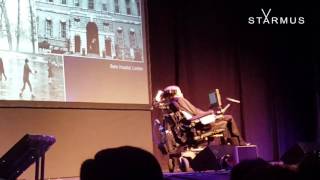 Stephen Hawking on Cosmology and Black Holes: From Big Bang to Future Humanity2016 · 25 min · full transcriptConnects cosmology, black holes, and humanity’s future off Earth in one talk.
 Stephen Hawking on Solar System Formation1999 · 4 min · full transcriptA short, clear explanation of how planets and Earth formed from material in space.
 Stephen Hawking on Black Holes: Baby Universes and Time2004 · 70 min · full transcriptBest for seeing how black holes changed Hawking’s understanding of space-time.
Questions people ask
- What did Stephen Hawking say about time before the universe began?
- Why did Stephen Hawking think humanity should become multi-planetary?
- What did Stephen Hawking say Einstein had opened up about the universe?
- What did Stephen Hawking say about looking at the stars?
- What did Stephen Hawking say about the future of humanity?
Sources
Every quote above, word for word from the transcripts. Numbers match the text.
“Space and time were no longer absolute, no longer a fixed background to events.”
“Space and time were no longer absolute, no longer a fixed background to events. Instead, they were a dynamical one that was warped by the matter and energy in the universe. They were defined only within the universe, so it made no sense to talk of a time before the universe began. That would be like asking for a point south of the South Pole.”
“Imaginary time is just time measured with imaginary numbers instead of real numbers…”
“The universe was not unchanging with time, as everyone had thought previously.”
“Time's not a universal quantity.”
“…we live in a world, governed by rational laws that we can discover and understand.”
“Cosmology is a very exciting and active subject.”
“…black holes, which ain't as black as they are painted…”
“…the uncertainty principle allows particles to travel faster than light for a small distance…”
“Information is not lost, but it is very hard to read.”
“…built of stardust and assembled by gravity.”
“A new star, our sun, was coming to life.”
“…long enough to allow the next development to take place—life.”
“We are the product of quantum fluctuations in the very early universe.”
“I don't think the human race has a future if it doesn't go into space.”
“I don't think we will survive another thousand years without getting off our fragile planet…”
How this guide was made: drafted with AI from the full transcripts of the recordings cited, then checked: every quotation must match a transcript word for word and be the speaker's own words, and an independent review gates accuracy. Methodology and corrections.