Stephen Hawking on Cosmology and Black Holes: From Big Bang to Future Humanity
What Hawking talks about
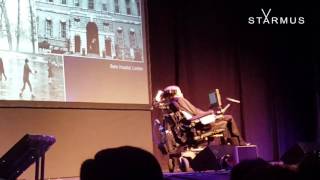
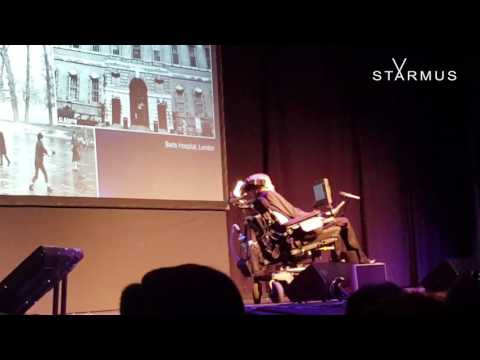
Stephen Hawking gave this keynote at the Starmus Festival in 2016, reflecting on cosmology, black holes, the origin of the universe, and humanity’s future in space.
Also known as: Stephen Hawking's Lecture - Starmus Festival 2016 Tenerife.
Hawking traces his scientific journey from Oxford and Cambridge to his work on singularities, black holes, and cosmology. He explains how general relativity, quantum theory, and inflation shaped modern ideas about the universe.
He also describes the black hole information paradox, his work on black hole entropy and radiation, and why the universe may have no boundary. The talk matters because it connects deep theoretical physics to the origin, structure, and fate of the cosmos.
He closes by urging people to look to the stars and arguing that humanity must expand into space to ensure its long-term future.
Hawking speaks throughout.
In his words
“Every new day became a bonus”
“I am proud to have discovered it.”
“Information is not lost, but it is very hard to read.”
“We live in a world, governed by rational laws that we can discover and understand.”
“I don't think we will survive another thousand years without getting off our fragile planet”
Key points
- The universe may have a beginning, but the most general cosmological solutions require careful handling of singularities.
- Penrose’s singularity ideas helped Hawking extend the logic to the expanding universe and the Big Bang.
- Black hole area theorems and Hawking radiation connected gravity, thermodynamics, and quantum theory.
- The black hole information paradox led him toward the idea that information is encoded, not destroyed.
- Inflation explains density fluctuations that seed galaxies and large-scale structure.
- The no-boundary proposal replaces a singular beginning with a smooth spacetime geometry.
- Humanity should go into space; he warns we may not survive another thousand years without leaving Earth.
Full transcript: Stephen Hawking, Starmus Festival keynote (2016)
One tells me, when I look back over my life, discuss our understanding of the state of the universe, that shape. I will also try to learn for working on a present horizon. I was born on February 8th, 1942, exactly 300 years after the death of Galileo. At that time, during an attack from the war, my kid was married with a number of scientific and academic people living in another country. They would have been.
Called intellectuals, but the English had never admitted to having any intellectuals. All these parents sent their children to higher high school, which was a very progressive goal for those times. I remember complaining to my parents that they weren't teaching me anything; they didn't believe in what wasn't the accepted way of building things into you. Instead, you were supposed to learn to read without realizing you were being taught. At the end, I did mercury, but not until the thoroughly laid a debate. My father was very cheap that I could go to.
Oxford or Cambridge himself at Mountain College, Oxford, so he thought I should apply there. But at that time, University College had no fellow in mathematics, so I had little option but that. My birth, no worship in Natural Science. I surprised myself by being successful. In the end, I had wound up being a professor of mathematics, but I had not had any formal instruction in mathematics since. I let say no, it's true. At the age of 17, I had to pick up what mathematics I know as I
Went alone when ladies to supervise maths undergrad was. I would keep one leap ahead of them in the course. At Oxford, the physics course was written in a way that made it twisted. For EEG to avoid work, I did one accent before I went up and had three years at Oxford with just the final exams at the end. By let's chow elated that I did about a thousand hours Birkin for three years. I was there an average of an hour a day. I'm not proud of this; I'm just describing my ADD method I shared by.
Most of my fellow students, because of my lack of work, I had planned to get the final exit by the wind problems in theoretical physics and avoiding questions that require actual knowledge. But I didn't sleep the night before the exam because of nervous teddy, and so I didn't do very well. I was on the borderline between the first and second-class degree when I had to be interviewed by the examiner to determine which I should get. When he asked me about my future class, I replied that.
I wanted to do research. If they gave me first, I would go to Cambridge. If I only got a second, I was in Oxford. They gave me first. I was when in October 1962, when I arrived in Cambridge at the Department of Applied Mathematics and Theoretical Physics. I had a meeting with Fred Hoyle, the most famous British astronomer of the time. I see his manner because pathology then was hardly.
Recognised s of the Kidman feel. However, I will get enough students already. So, to my great disappointment, I was assigned to head Sharma, of whom I had not heard. But it was just as well I had been a student of coil, because I would have been drawn into different in a steady state theory, but asked, which would have been harder than saving a euro. I had done much mathematics in the very easy physics course. Alistair, so Sharma suggested I work on s purposes, but having to cheated out of working.
With oil, I was going to do something more. We played fair with imitation. I had combined technique with little cosmology, and cosmology I was determined that who had been claimed cosmology and reputation burning lady feels and were right for development. So amenable textbooks on general relativity and traveled up the near relativity lectures at King's College London. Each meeting, I followed the worsened equations, but I didn't really get a good feel for the subject at that time. It became clear.
Something was not quite right with me already. Oxford, I had noticed that I could no longer rise or move properly, but with mass. After arriving in Cambridge, I went home. It was a very cold lunar, and my mother persuaded me to go skating on the lake in St. Albans. Even though I knew I was not up to it, I fell over and had great difficulty getting up again. My mother realized something was wrong and took me to the doctor. I spent weeks in the first hospital and had many tests. He never actually told me what was wrong.
But I guess not. It was really bad, so I didn't want to ask. In fact, the doctor who diagnosed me wanted his hands off me and I never saw him again. He felt that there was nothing that could be done. In fact, my father became my doctor and it was him that I turned to for advice. At first, I became depressed. I seemed to be getting worse pretty rapidly. There didn't seem to be any point in working on my PhD because I didn't know if I would live long enough to.
Finish it, but the condition developed more slowly, and I began to make progress in my work. After my expectations had been reduced to zero, every new day became a bonus, and I began to appreciate everything I did. Well, there was my periscope, and there was also a young woman called Kate, whom I had met at a party. Getting engaged lifted my spirits, and I realized if we were going to get married, I had to get off and finish my PhD. I began to hurt her, and I enjoyed it.
The big question in cosmology in the early sixties was that the universe had a beginning. But it was clear that a solution about was the most general one. A new approach must be introduced by Roger Penrose which didn't require solving the field equations explicitly, just certain general properties such as he is positive and gravity is subtracted generals had shown that once a dying star had contracted to a certain radius, there will inevitably be a singularity, a point where space and time came to an end. I realized that similar arguments
Could be life on the expansion of the universe. In this case, I could prove there were similarities. Where's Casement at the beginning? So Lipschitz and Galactic over on general relativity predicted that the universe would have activity. Of the 1970, my major search was blessed by Big Bang singularity of mythology, rapper, and the singularity served black holes that Petros had shown would occur in collapsing stars. My work on black holes began with the Eureka moment shortly after the birth of my
daughter Lucy. While getting into bed with my disability, makes a slow process, I realized the area theory that general relativity is correct. When the energy density is positive, a surface area of event horizon, the boundary of a black hole, has the property that it always increases when additional matter or radiation falls with a black hole. Moreover, that through black holes collide and merge to form a single black hole, the area of event horizon around the resulting flagpole that river, and the sum of the areas of the event
horizons around the original black holes. The area theory can be tested experimentally by LIGO. On the 14th of September 2015, and again he W 150914 with LIGO for the first time detected gravitational waves from the collision and murder of a black hole binary from the wave four one. Can estimate the masses and more momentum the black holes, and by the null air theory has determined of the rice various. LIGO has opened a new window in our universe, and with many
more detections expected, I am excited by the possibility of new discoveries. The properties of Magpul suggested that the area of that hole was there, what is called the entropy. In thermodynamics, entropy can be regarded as a measure of the disorder of a system, or equivalently as electro knowledge of his precise state. That would be a measure of how many states of that pole could have on either side for the same appearance on the outside, but the area commute actually be the entropy because I said
we would thought into black holes were completely black and could build in Bolivia with her no radiation. There was a golden age in which we solved most of the major prophets in black hole theory. This was before there was any observational evidence for black holes. In fact, we were so successful with the classical general theory of relativity, and I was a bit of a loose end. In 1973, after the publication with George Ellis of our book, The Large-Scale Structure of Space-Time, my word with tendrils had
shown that general relativity brought down its similarities. So the obvious next step would be to find general relativity, the theory of the very large, with quantum theory, a theory of the very small. I have no background in quantum theory, and the singularity problem seemed too difficult for a frontal assault at that time. So as a warm-up exercise, I considered how particles and fields covered by quantum theory would be a layer of black hole. In particular, I wondered, can one have atoms in which a nucleus is a highly primordial black
hole? Or in the early universe? But what personated me, that it was real, was that the emission was exactly what was required to identify the area of the horizon with the equity of a black hole. It is summed up in this simple formula which expresses the equity in terms of the area of horizon, and the three fundamental constants of nature: C, the speed of light; G, Newton constant of gravitation; Planck's constant. I am proud to have discovered it. Later work and
covered a deep reason for his portlet. General relativity can be combined with quantum theory in you know matter is what replaces ordinary type by imaginary type. This is called the Euclidean approach because it makes time to come before directionless case. The new Glidden space-time is smooth and contains no singularity at which the invasions of physics could not be defined, but solve the fundamental problem at the singularity theorems of tendrils and myself had raised that predictability would break down because
of the singularity. The radiation from a black hole will carry away energy, so the black hole will lose mass a change. Eventually, the seeds of that coal will evaporate completely and disappear. This raised the problem that strike at the heart of physics. My calculations show that the radiation was exactly thermal and random as alpha being the area of horizon. That'll be the entropy of the black hole. So not with the radiation left over. Karen all the information
about what may the black hole, but if information is lost, assess it compatible with one of mechanics. This paradox had been argued for thirty years without much progress, which is what often happens in research. But if you get stuck this door, you'll get furious. You just have to keep thinking about the problem while working on something else. Eventually, I found what I think is this resolution, and for me, has not lost black holes. But it is not return cannons away. It is like burning
an encyclopedia. Information is not lost, but it is very hard to read. In fact, this morning, I had a bandwidth on for school on the information paradise. I can't find a baseball encyclopedia. Maybe I should have just given him the ashes return me. I'm working with my favorite colleague Malcolm Perry and Andy Stronger from partner on a new theory based on a mathematical idea called supertranslations to explain the mechanism by which information is returned out of the black hole. The
information is encoded on the horizon of the black hole. Watched a space during the 1970s, I have been working million black holes, but my interest in cosmology was intrude by the suggestions and the early universe had gone through a period of inflationary expansion, and which a size drew an ever-increasing grid like the wait why should go up in the shops. In early 1982, I wrote of a trip proposing that machines first lectures in our universe could be created by quantum
Effects during inflation, this was basically the same mechanism as radiation from a black hole horizon. They set Timon came from the cosmological horizon. I had new clinic methods earlier with Gary Gibbons to work out the temperature of the center space. We know enough, no workshop in Cambridge that summer attended by all the major players in the field. At this meeting, we established most of our present picture of inflation, including the all-important density fluctuations, which give rise to galaxy
formation and so to our existence. Several people contributed to the final answer. This was 10 years before fluctuations in the microwave background were discovered by the COBE satellite in 1993. So, here he was way ahead of experiment. Cosmology became a precision science. Another 10 years later, in 2003, with the first results from the WMAP satellite, WMAP produced a wonderful map of the temperature of the cosmic microwave background — a snapshot of the universe at about one
hundredth of its radius. These regularly smushy were predicted by inflation and they'd be met. Some regions of the universe, Penna, slightly higher density. And of Earth, but gravitational attraction of the extra density slows the expansion of that region and can eventually cause it to collapse, the for galaxies and stars. So look carefully at the map of the microwave light. It is a blueprint for all the structure in the universe. Superseding WMAP, today there is a Planck satellite with a much higher resolution map of the universe received
here at stage that will test our theories in earnest and may detect the imprint of gravitational waves predicted by inflation. This would be bottom gravity written across the sky. The original scenario for inflation was that the universe began with a mid-back singularity. As the universe expanded, that was supposed somehow to get into an inflationary stage. But I thought this was unsatisfactory. But this one came out of the initial singularity. One could not count only how the universe
would develop. Cosmology would not have any predictive power. What was it that was a spacetime without singularity? Likely related variant of a black hole. After the 1984 workshop in Cambridge, I spent time at the Institute of Theoretical Physics and said forever I thought that infertile about how to apply the new Glidden approach. Their apology according to this approach, the one-way function of the hole differs as given by a vitamin sum over a certain class of hysteresis in imaginary
fight, because imaginary time behaves like another direction in space. As very soon, imaginary time can be both surfaces like the surface of the earth with no beginning or end. Then when I concluded that this must be the only natural choice, we formulated the no boundary proposal. The boundary condition of the universe is added as no boundary. We had science net the scientific philosophical difficulty of time making of beginning by turning it into a direction in space. In this picture, the universe will be
spontaneously created out of nothing. That will start out almost completely smooth except for the tiny departure predicted by inflation, which can give rise to all the structure of the universe. See, about us, around the time of my no boundary work, I decided to write a pop good. I thought I might become honest about to help suffering my children at school and the rising costs of my care. But the major reason was because I enjoyed it. While I was writing it, I visited Surrey and I became critically ill with pneumonia but lost my voice due
to with rajasahib. But I kept putting a lot of effort into the book because I think it's important for scientists to explain their work. But Hitler needed Christology. I never expected A Brief History of Time to sell as well as it did. Not everyone made that, finished it or understood everything they read, but they at least brought the idea that we live in a world, governed by rational laws that we can discover and understand. There are many ambitious experiments planned for the future. We will map positions of billions of galaxies and, with the help of
supercomputers like Cosmos, we will better understand our place in the universe. Perhaps one day we will be able to use gravitational waves to look right back into the parts of the Big Bang. Most recent advances in cosmology have been achieved from space, where there is uninterrupted use of our vast and beautiful universe. But we must also contend to go into space for the future of humanity. I don't think we will survive another thousand years without getting off our fragile planet right. Therefore, I want to encourage public
interest in space and I've been getting my training in early. So let me finish by reflecting on the state of the universe. That after the Lord is tied to me, light of doing your search in theoretical position, our picture of the universe has shaped a great deal in the last 50 years and I'm happy if I had made a small contribution. The fact can be humans who ourselves are collections of fundamental particles of nature have been able to come as close to an understanding of the laws governing us
another universe is a great triumph. I want to share my excitement and enthusiasm about this quest. So remember to look up at the stars and not down at your feet, try to make sense of what you see and wonder about what based in universe existed you.
From YouTube captions, lightly punctuated for readability. Timestamps link to the video above. Errors are possible.
Cite this recording
Stephen Hawking, “Starmus Festival keynote (2016)”, 2016. Transcript and video: Thinkers Archive, https://thinkersarchive.com/stephen-hawking/cosmology-black-holes-starmus-2016/
Quoting a passage? Link to its exact moment: every timestamp above has its own anchor (for example https://thinkersarchive.com/stephen-hawking/cosmology-black-holes-starmus-2016/#t-137).