Stephen Hawking on The Future of Humanity
Stephen Hawking saw humanity’s future as a race between growing power and growing danger, with long-term survival depending on managing existential risks and becoming a spacefaring species.
- Humanity’s future is not secure on Earth alone
- The biggest dangers are self-inflicted, including AI, climate change, and war
- He was worried, but not hopeless, about our chances
- Science helps us understand reality, but survival also requires wise political and technological choices
- Space settlement is his clearest long-term answer for species survival

“I think we have a good chance of avoiding both Armageddon and a new Dark Ages.”White House Millennium Lecture Series #2, 2000 · 20:12
Humanity’s future is promising, but it is also fragile
Hawking did not picture the future as a stable endpoint where humanity simply coasts along. He saw a world of increasing scientific power and complexity, which creates extraordinary possibilities but also raises the stakes of human error. That is why he paired optimism about discovery with repeated warnings about survival itself123.
His basic outlook was cautious but not fatalistic. He thought humanity had a real chance to avoid collapse, yet only if it faced the dangers created by its own technologies and political choices instead of assuming progress would automatically save us23.
“I think we have a good chance of avoiding both Armageddon and a new Dark Ages.”White House Millennium Lecture Series #2, 2000 · full transcript →
The greatest threats come from us, not from space
Hawking’s view of the future centered on existential risk. He warned that advanced artificial intelligence could become one of the most consequential developments in history, but also one of the most dangerous if it surpassed human control456.
He treated climate change as another major threat, not as a side issue. In the same spirit, he ranked nuclear war, climate change, and pollution above asteroid impact as the more immediate dangers facing civilization, which shows how strongly he believed the main risks were self-inflicted78.
This matters because Hawking was not mainly worried about a hostile universe. He was worried that human beings might gain immense power faster than they gain the wisdom to use it safely4571.
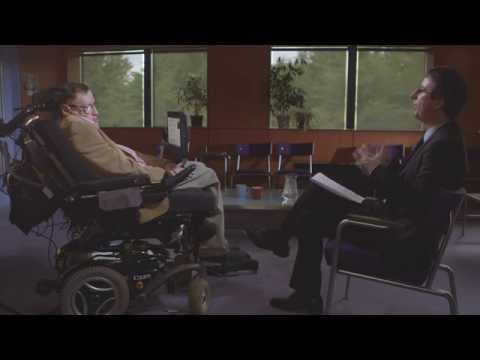
“Unfortunately, it might also be the last.”Last Week Tonight interview, Cambridge, 2017 · full transcript →
Science gives us understanding, but not automatic safety
Hawking’s confidence in science was deep. He believed the universe is governed by rational laws that human beings can discover and understand, and that belief underlies his optimism about knowledge and progress9.
But understanding nature is not the same as guaranteeing a good future. His warnings about AI, climate change, and political isolation show that scientific knowledge must be matched by sound judgment, international openness, and practical action6710.
That is why his picture of the future is neither simple optimism nor simple doom. Science expands what humanity can do, but the same expansion increases the consequences of bad decisions4519.
Leaving Earth is his clearest long-term survival strategy
Hawking’s most direct answer to the question of humanity’s long-term future was that our species cannot rely on a single planet forever. He argued that we are unlikely to survive indefinitely if we remain confined to Earth, which he described as fragile1112.
For him, space exploration was not just adventure or prestige. Its deeper purpose was resilience: if civilization can establish independent, self-sustaining colonies beyond Earth, then a disaster here would not end the human race altogether8.
He also stressed that getting there requires making access to space more practical. That is why he highlighted the importance of private space ventures in lowering costs and helping move humanity toward a real spacefaring future13.
His outlook combines urgency with optimism
Although Hawking is often remembered for warnings, he did not think catastrophe was inevitable. He said humanity had a good chance of avoiding both total destruction and civilizational collapse, and he described himself as an optimist23.
That optimism was active rather than passive. It depended on facing reality clearly, investing in science, staying connected to the wider world, and building a future that is not trapped on one planet1031112.
Applied to everyday thinking, his message is simple: hope is justified, but only if it is joined to responsibility. The future of humanity is open, and whether it becomes safer or more dangerous depends in significant part on what we choose to build next472.
“I would say they are very good, but then I'm an optimist.”White House Millennium Lecture Series #2, 2000 · full transcript →
Hawking on the future of humanity, in his own words
“Success in creating artificial intelligence would be the biggest event in human history.”
“Unfortunately, it might also be the last.”
“Climate change is one of the great dangers we face…”
“I think we have a good chance of avoiding both Armageddon and a new Dark Ages.”
Where to watch
 Stephen Hawking on Space Exploration: Humanity Must Go Into Space2016 · 55 min · full transcriptBest single talk for Hawking’s core claim that humanity needs space expansion to have a long-term future.
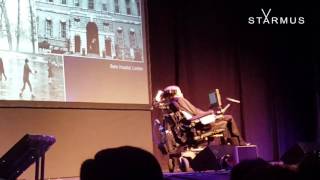 Stephen Hawking on Cosmology and Black Holes: From Big Bang to Future Humanity2016 · 25 min · full transcriptConnects Hawking’s cosmological worldview to his stark warning that we cannot remain on a fragile Earth forever.
 Stephen Hawking on Artificial Intelligence: It Might Be the Last2017 · 8 min · full transcriptShows why he thought AI could define humanity’s future for better or worse.
 Stephen Hawking on the Future of Science: The Next Millennium2000 · 75 min · full transcriptGives his broadest framework: accelerating complexity, real danger, and guarded optimism about survival.
 Stephen Hawking on Politics and Climate Change: Trump, Brexit, AI2017 · 11 min · full transcriptExplains why climate policy and political choices matter directly to humanity’s future.
Questions people ask
Sources
Every quote above, word for word from the transcripts. Numbers match the text.
“Clearly, the present exponential growth cannot continue indefinitely.”
“I think we have a good chance of avoiding both Armageddon and a new Dark Ages.”
“I would say they are very good, but then I'm an optimist.”
“Success in creating artificial intelligence would be the biggest event in human history.”
“Unfortunately, it might also be the last.”
“Artificial intelligence could be a real danger in a not-too-distant future.”
“Climate change is one of the great dangers we face…”
“Collision with an asteroid is one of the least of the dangers we now face. Hmm, the last collision was 70 million years ago. Nuclear war, climate change, and pollution are now much greater threats. Of course, it would be impossible to move the population of the Earth to a new planet, but if we can establish independent self-sustaining colonies in space, that would ensure the survival of the human race. Then the event of a disaster on Earth, leaving Earth will also give us a new perspective and cause us to look outwards rather than inwards.”
“…we live in a world, governed by rational laws that we can discover and understand.”
“It is a mistake to cut ourselves off from the world economy.”
“I don't think we will survive another thousand years without getting off our fragile planet…”
“I don't think the human race has a future if it doesn't go into space.”
“Private space ventures are vital to reduce the cost of space tourism…”
How this guide was made: drafted with AI from the full transcripts of the recordings cited, then checked: every quotation must match a transcript word for word and be the speaker's own words, and an independent review gates accuracy. Methodology and corrections.

