Stanley Druckenmiller on AI
Stanley Druckenmiller sees AI as a genuinely transformative force with major implications for productivity, disinflation, and stock picking, but he approaches it through forward-looking judgment, position sizing, and open-mindedness rather than hype.
- He views AI as a major structural technology shift with very large economic implications.
- He thinks the biggest effects may be in productivity and disinflation, not just excitement around one stock.
- He invests by looking 18–24 months ahead, which fits how he approaches AI opportunities.
- He pairs AI enthusiasm with risk control: conviction matters, but sizing matters more.
- He stays flexible because the macro backdrop is unusually hard to forecast, even when a big theme is real.
He thinks AI is bigger than a passing fad
Druckenmiller does not talk about AI as a speculative craze that investors should automatically fade. He says it has the potential to be as transformative as, and even bigger than, the internet, while stressing that he is not usually someone who buys into fads. That combination matters: he is signaling that AI stands out even to an investor who is naturally skeptical of fashionable themes.1
His excitement is rooted in the scale of the consequences, not in novelty for its own sake. He describes the implications as enormous and mind-boggling, especially at the economic level. That frames AI as a deep structural shift rather than a short-term market story.1

“I think it has the potential to be as transformative and bigger and bigger than the internet. And I'm not a fad buyer, you know, quite the contrary, to see opposite. But the implications of this thing are just mind-boggling. They're mind-boggling for macro in terms of disinflation, in terms of productivity. It turns out the internet didn't turn out to be very productive because everybody's on their phone, you know, for two hours a day not doing work. This, this stuff, this stuff is just amazing.”USC Marshall keynote, May 2023 · full transcript →
The economic case is productivity first
The center of Druckenmiller's AI view is that it could materially lift productivity and contribute to disinflation. In other words, he is not only interested in which companies sell AI-related products; he is focused on what the technology can do to the broader economy. That is a macro investor's lens applied to a technological change.1
He contrasts AI with the internet era, arguing that the internet did not ultimately deliver the kind of productivity payoff many expected. His point is that AI may be different because it can directly improve work and output rather than simply capture attention. That is why he sees AI as relevant to inflation, growth, and market leadership all at once.1
He applies AI by looking ahead, not by analyzing the present
Druckenmiller's investing framework is explicitly forward-looking: he says investors should avoid investing in the present and instead picture the world 18 to 24 months from now. That is especially important with AI, where current earnings and current headlines may understate what adoption looks like after businesses actually deploy the technology.
This also helps explain why he can engage with a fast-moving theme without reducing it to short-term momentum. He is trying to identify whether future conditions will look meaningfully different from today's and whether prices already reflect that. AI fits his style when he believes the future is arriving faster than the market appreciates.
He treats AI opportunities as conviction bets, but only with disciplined sizing
Druckenmiller's core rule is that investing success comes less from being right all the time than from making more when right than losing when wrong. Applied to AI, that means the challenge is not merely spotting the theme; it is sizing exposure properly when the upside is unusually large.3
He also emphasizes decisive action. He says his edge is not raw IQ but the willingness to pull the trigger, which matters when a technological shift is obvious enough to act on but still uncertain enough to scare people. AI may be a big opportunity, but his framework still demands courage paired with risk control.53
If the reason for owning something changes, he moves on without attachment. That discipline is crucial in AI-related investing, where narratives can outrun fundamentals and the facts can change quickly.67
He stays enthusiastic on AI while remaining humble about the macro backdrop
One of the most important features of Druckenmiller's thinking is that he can hold a strong view on AI without pretending the whole macro picture is easy. He says this is the most challenging forecasting period of his career, which means even a powerful structural theme has to be weighed against recession risks, banking stress, and policy uncertainty.9
That is why open-mindedness is central to his approach. He explicitly says the most important answer he gives is to keep an open mind, and that mindset prevents a real long-term theme like AI from turning into dogma. He wants to be early to change, but also ready to change his mind.10
Druckenmiller on ai, in his own words
“I think it has the potential to be as transformative and bigger and bigger than the internet. And I'm not a fad buyer, you know, quite the contrary, to see opposite. But the implications of this thing are just mind-boggling. They're mind-boggling for macro in terms of disinflation, in terms of productivity. It turns out the internet didn't turn out to be very productive because everybody's on their phone, you know, for two hours a day not doing work. This, this stuff, this stuff is just amazing.”
Where to watch
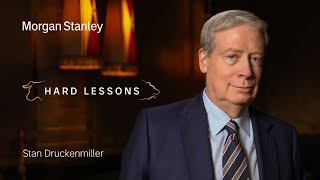 Stanley Druckenmiller on Investing Lessons: Invest, Then Investigate2024 · 28 min · full transcriptBest for how he turns big themes like AI into actual positions through conviction, sizing, and decision-making.
 Stanley Druckenmiller on Macro Investing: Inflation, Fed Mistakes, AI2023 · 52 min · full transcriptBest for understanding his forward-looking process and why he focuses on what markets will look like 18–24 months ahead.
 Stanley Druckenmiller on Macro Investing: Hard Landing Risks, AI, and the Dollar2023 · 63 min · full transcriptBest for seeing how he balances enthusiasm about AI with caution about a very difficult macro environment.
Questions people ask
- What did Stanley Druckenmiller say about generative AI?
- What did Stanley Druckenmiller say is the biggest mistake investors make?
- How does Stanley Druckenmiller decide when to sell a loser?
- What did Stanley Druckenmiller say he lost as he became a more experienced investor?
- What did Stanley Druckenmiller learn from George Soros about investing and position sizing?
- What did Stanley Druckenmiller say about handling mistakes and drawdowns?
Sources
Every quote above, word for word from the transcripts. Numbers match the text.
“I think it has the potential to be as transformative and bigger and bigger than the internet. And I'm not a fad buyer, you know, quite the contrary, to see opposite. But the implications of this thing are just mind-boggling. They're mind-boggling for macro in terms of disinflation, in terms of productivity. It turns out the internet didn't turn out to be very productive because everybody's on their phone, you know, for two hours a day not doing work. This, this stuff, this stuff is just amazing.”
“It's not whether you're right or wrong, it's how much you make when you're right and how much you lose when you're wrong.”
“My advantage is not IQ. It's trigger pulling.”
“If the reason I bought a stock is no longer the case, I don't care what I paid for it. And if I bought it at 60 and it's 50, because the markets discovered the problem before me, I have no emotion whatsoever. Soros was the same way. I didn't really learn it from him, but it was certainly reinforced.”
“Just get over it and move on.”
“I think it's naive to not be open-minded to some sort of possibility that affects the banks…”
“I would say the most important answer I give that is keep an open mind…”
How this guide was made: drafted with AI from the full transcripts of the recordings cited, then checked: every quotation must match a transcript word for word and be the speaker's own words, and an independent review gates accuracy. Methodology and corrections.