Sam Altman on OpenAI
Sam Altman sees OpenAI as a mission-driven effort to build AGI, make intelligence broadly useful, and learn how to deploy powerful systems safely while keeping people in control.
- OpenAI’s founding bet was to pursue AGI directly, with unusual conviction and a focus on scaling.
- Altman thinks OpenAI wins by turning frontier models into useful products, not by research alone.
- He argues for iterative deployment: release systems, learn from use, and improve safety and behavior over time.
- He believes OpenAI should make intelligence widely available while avoiding dangerous concentration of power.
- The board crisis reinforced his view that OpenAI needs resilient governance and better incentives as AGI gets closer.

OpenAI started with a direct bet on AGI
Altman describes OpenAI’s core idea as unusually simple and unusually ambitious: go straight after AGI. He presents that as the company’s founding thesis, not a later rebrand, and connects it to a willingness to focus on one big bet instead of spreading effort across many smaller ones.12
That ambition was paired with a strong belief in deep learning and scale. In his account, OpenAI kept pushing because the scaling results were strong enough to override prior intuition, and that pushed the company toward larger, more compute-intensive efforts earlier than many others were ready for.34
This helps explain many later OpenAI choices. If you believe frontier intelligence can improve rapidly and become historically important, then securing compute, concentrating top talent, and staying focused on the frontier all look less like overreach and more like mission execution.54
“We're gonna go after AGI…”YC AI Startup School interview, San Francisco, 2025 · full transcript →
For Altman, usefulness matters as much as raw model capability
Altman does not frame OpenAI’s success as just building a smarter model. He repeatedly points to ChatGPT as the key turning point because usability, interface, and post-training made advanced AI valuable to ordinary people in a way prior systems were not.67
That view says a lot about how he thinks OpenAI should operate. The company is not just a lab chasing benchmarks; it has to turn capability into something people can actually use, trust, and incorporate into daily work. Alignment work like RLHF matters in this picture because it changes the quality of the interaction, not just the abstract capability of the system.87
That also explains OpenAI’s growing emphasis on products, developers, and platforms. Altman increasingly talks about OpenAI as a provider of broadly useful intelligence that others can build on, rather than as a company that must own every end application itself.91011
OpenAI’s operating philosophy is iterative deployment with safety work alongside it
Altman’s basic theory of deployment is to release systems, watch how people use them, learn quickly, and improve. He still endorses iterative deployment, which means OpenAI should not wait for perfect certainty before shipping, but it also should not treat shipping as the end of the job.12
At the same time, he is explicit that the hardest safety problem is not solved. He says current methods can align models better with human intent, but he also says there is not yet a known way to align a truly super powerful system. That creates the tension at the heart of his view: move forward through real-world use, but do so with humility about what remains unknown.814
He therefore talks about safety as something that must happen during building and deployment, not after the fact. That includes testing, incentives, public input, and preserving human control as systems become more capable.151617

“I still believe in iterative deployment.”Stanford GSB View from the Top talk, 2025 · full transcript →
Broad distribution matters because concentration of AI power is dangerous
Altman’s preferred outcome is not a narrow monopoly on intelligence. He talks about OpenAI’s role as providing a platform and making intelligence abundant and cost-effective, which implies broad access rather than tightly rationed elite access.918
His concern is not only economic scale but political and social concentration. He says concentration of power with AI is frightening, and he links legitimacy to systems reflecting the will of the people who use them and are affected by them.1916
This is why he can sound supportive of both frontier centralization and wider distribution at the same time. OpenAI may need massive compute and tightly run frontier development, but in his view the benefits should diffuse outward through products, APIs, developers, and eventually much cheaper intelligence for everyone.11189
Governance and incentives became a central OpenAI lesson
Altman treats the OpenAI board crisis as more than a personal ordeal. He says it was the most painful professional experience of his life, but he also presents it as a warning about what fragile governance can look like under extreme pressure.2021
His takeaway is that OpenAI needs structures that are resilient, incentive-aware, and capable of handling even greater stress as AGI approaches. He emphasizes the leverage of getting incentives right and suggests governance for AGI-era organizations will require a different paradigm than standard company thinking.222321
This does not make him reject governance; it makes him want better governance. He says he feels good about the new board, but the deeper point is that OpenAI cannot rely on ordinary startup assumptions when the stakes involve systems with large societal consequences.2421
OpenAI is becoming a platform company for builders, agents, and personalized AI
Altman increasingly describes OpenAI as infrastructure for a much larger ecosystem. He says AI has shifted from something people merely experiment with to something they build with every day, and he wants ChatGPT and the API to be places where developers can reach users and launch products.1011
His product vision is not just a chatbot that obeys commands. He points toward assistants and agents that can reason, collaborate, and even push back rather than act as blind tools, which suggests a future where OpenAI’s systems become deeper working partners.2627
He also expects the economics to change fast. As intelligence gets cheaper, durable value moves toward personalization, integration, and products built on top of improving models. That is why OpenAI keeps pushing model quality and cost down while also opening more ways for others to build on the platform.182829
“AI has gone from something people play with to something people build with every day.”OpenAI DevDay opening keynote, 2025 · full transcript →
Altman on openai, in his own words
“We're gonna go after AGI…”
“I think if I had to pick some moment from what we've seen so far, I'd sort of pick ChatGPT. You know, it wasn't the underlying model that mattered. It was the usability of it, both the RLHF and the interface to it.”
“I do not think we have yet discovered a way to align a super powerful system.”
“Concentration of power with AI is a terrifying thing…”
“We must build, release, and use AI safely.”
“That was definitely the most painful professional experience of my life…”
Where to watch
 Sam Altman on OpenAI Governance: The Board Saga and AGI2024 · 115 min · full transcriptBest for understanding Altman’s view on OpenAI’s governance, board crisis, incentives, and institutional pressure.
 Sam Altman on GPT-4 and AI Safety: Usability, Alignment, and AGI2023 · 144 min · full transcriptBest for why ChatGPT mattered, how OpenAI thinks about alignment, and why usability changed the company’s trajectory.
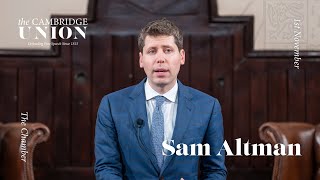 Sam Altman on AI Safety and AGI: Cambridge Union Hawking Fellowship2023 · 64 min · full transcriptBest compact overview of OpenAI’s mission, structure, safety philosophy, and public-benefit framing.
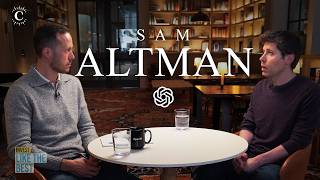 Sam Altman on AGI and Compute: Why the Frontier Matters2025 · 56 min · full transcriptBest for OpenAI’s current strategic focus: platform, compute, abundant intelligence, and why the frontier matters.
 Sam Altman on AI Apps and Agents: Build in ChatGPT2025 · 53 min · full transcriptBest for where OpenAI is going as a developer platform centered on apps, agents, and distribution through ChatGPT.
Questions people ask
- How does Sam Altman think AI will change jobs?
- What did Sam Altman say about OpenAI governance after the board crisis?
- What did Sam Altman say about building with AI in 2025?
- What did Sam Altman say about jailbreaking and model control?
- What did Sam Altman say about scale and why OpenAI focused on it?
- What does Sam Altman worry about most at OpenAI?
Sources
Every quote above, word for word from the transcripts. Numbers match the text.
“We're gonna go after AGI…”
“Most of the world still does not understand the value of, like, a fairly extreme level of conviction on one bet.”
“Then we got the scaling results. It just kinda breaks my intuition even now. And at some point, you have to just look at the scaling loss and say, we're gonna keep doing this, and this is what we think it'll do. And it also... It was starting to feel at that time like something about deep learning was just this emergent phenomenon that was really important. And even if we didn't understand all of the details in practice yet, which obviously we didn't and still don't, that there was something really fundamental going on. It was the PG isn't for this as we had, like, discovered a new square in the periodic table. Yeah. And so it... We just... We really wanted to push on that. And we were far less resourced than DeepMind and others. And so we said, okay. They're gonna try a lot of things, and we've just gotta pick one and really concentrate.”
“I don't, it took us a little while to realize just the new avenues of research this was going to open up and how quickly the models were likely to improve post GPT-4 and that we could do what became the chain-of-thought work and the reasoning models. And we then decided we were going to go make a very big bet on compute because we saw that we could continue to scale models and that the value of these models would be really important, but it was new and the rest of the world wasn't there yet. They hadn't even seen GPT-4. They had not internalized what it, what we thought it could do. And so we decided we would bet the…”
“I think this will be the greatest thus far technological achievement of human history…”
“I think if I had to pick some moment from what we've seen so far, I'd sort of pick ChatGPT.”
“I think if I had to pick some moment from what we've seen so far, I'd sort of pick ChatGPT. You know, it wasn't the underlying model that mattered. It was the usability of it, both the RLHF and the interface to it.”
“RLHF is how we align the model to what humans want it to do.”
“…we really wanna just provide that platform…”
“AI has gone from something people play with to something people build with every day.”
“We’re opening up ChatGPT for developers to build apps inside of ChatGPT.”
“I still believe in iterative deployment.”
“I do not think we have yet discovered a way to align a super powerful system.”
“We must build, release, and use AI safely.”
“The idea that the system represents the will of the people who are going to use it and be impacted by it, I think that's quite important.”
“…people always should be in control of the future…”
“The cost of intelligence is about to get really really cheap.”
“Concentration of power with AI is a terrifying thing…”
“That was definitely the most painful professional experience of my life…”
“Definitely learned a lot about structure and incentives and what we need out of a a board. And I think that is... It is valuable that this happened now in some sense. I think this is probably not, like, the last high stress moment of open AI, but it was quite a high stress moment. Like, company very nearly got destroyed. And we think a lot about many of the other things we've gotta get right for AGI, but thinking about how to build a resilient org and how to build a structure that will stand up to, like, a lot of pressure in the world, which I expect more and more as we get closer, I think that's super important.”
“In fact, so much so that any time you can spend thinking about how to correctly set the incentives on a person, a team, an organization, whatever, that's like probably the highest leverage thing you can do.”
“I think there will be a new paradigm for that kind of thinking.”
“I feel great about the new board.”
“I definitely want that kind of vibe, which not not just like this thing that I task and it blindly does.”
“I think voice is a hint to whatever the next thing is.”
“The long term differentiation will be the model that's most personalized to you.”
“When we just do our fundamental job, we're gonna steamroll you.”
How this guide was made: drafted with AI from the full transcripts of the recordings cited, then checked: every quotation must match a transcript word for word and be the speaker's own words, and an independent review gates accuracy. Methodology and corrections.