Sam Altman on Politics & Government
Sam Altman argues that AI governance should protect human control, require serious safety standards for the most powerful systems, and be built iteratively with broad public input so innovation can continue.
- Altman sees AI as hugely beneficial, but says governments must step in as models become more powerful.
- He supports testing, red teaming, audits, and in some cases licensing for frontier systems above a high capability threshold.
- His core governance principle is that people should stay in charge and AI should increase human freedom, not replace human judgment.
- He favors iterative, practical rulemaking: deploy carefully, learn from use, and adjust instead of relying on one fixed framework.
- He thinks the strongest oversight should be international for very powerful future systems, not broad restrictions on current or smaller models.

“However, we think that regulatory intervention by governments will be critical to mitigate the risks of increasingly powerful models.”U.S. Senate Judiciary Subcommittee hearing, 2023 · 22:44
AI governance starts from both promise and risk
Altman does not treat governance as an attempt to stop AI. He sees AI as a transformative technology with enormous upside, on the scale of the printing press or the internet, and thinks broad access to intelligence could materially improve life and accelerate discovery1234.
That is exactly why he thinks governance matters. In his view, the combination of rapid capability gains and broad societal impact means public institutions cannot stay on the sidelines; stronger systems require stronger guardrails as the stakes rise56.
“However, we think that regulatory intervention by governments will be critical to mitigate the risks of increasingly powerful models.”U.S. Senate Judiciary Subcommittee hearing, 2023 · full transcript →
His preferred model is safety standards first, licensing for the frontier
Altman's clearest governance proposal is targeted oversight for the most powerful models. He has argued for licensing and testing requirements at the frontier, not as a blanket regime for every AI system, but as a way to govern systems with unusually high capability and impact89.
The practical pieces of that framework are consistent across his appearances: extensive pre-release testing, red teaming, dangerous capability evaluations, external review, independent audits, and safety thresholds that must be passed before deployment101112.
He also prefers standards over symbolic pauses. His view is that what matters is whether a model meets concrete safety requirements, not whether the calendar says development has stopped for a fixed number of months13.
Human control is the principle underneath the policy
The deepest theme in Altman's governance view is not bureaucratic process but human control. He says AI should be built for people, should expand freedom, and should never become an excuse to hand over core judgment or social power to machines141516.
That principle also shapes how he talks about competition. He explicitly rejects the idea that rivalry between firms or countries justifies unsafe deployment, arguing that convenience for any one actor is not a good enough reason to cut corners17.
He is also wary of governance failures that concentrate power. For him, one danger is loss of control to autonomous systems; the other is allowing a small number of institutions or people to decide too much about how AI works for everyone else1418.
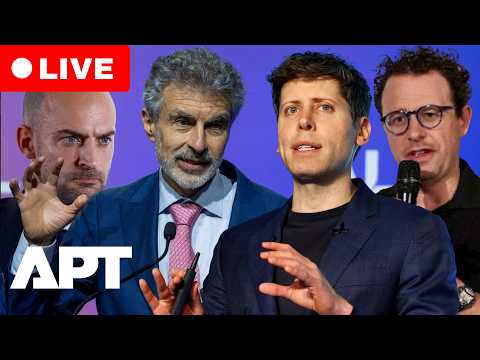
“AI should be built for people, not simply to turn the crank of the machines faster for their own sake.”UN Security Council meeting, 2024 · full transcript →
Governance should be democratic, iterative, and grounded in real use
Altman does not present AI governance as a one-time law written in advance of experience. He favors an iterative approach: release useful systems carefully, observe how people actually use them, learn where they fail, and update both product guardrails and policy over time192013.
That same logic is why he often emphasizes broad input rather than narrow elite decision-making. He thinks systems should reflect the values of the people who use and are affected by them, and he has argued that developers need to learn from users when apparently simple restrictions create real tradeoffs in practice182122.
This leads to a middle position on speech and behavior: adult users should have wide freedom, but there must be clear boundaries around serious harms, especially when misuse could endanger vulnerable people or enable dangerous activity232422.

“…we're all writing the rule book together…”World Governments Summit, Dubai, 2024 · full transcript →
He wants global coordination for very powerful AI, not heavy-handed limits on everything
Altman draws a line between today's systems and much more powerful future ones. He argues that international coordination becomes necessary as AI approaches extremely high capability, because the risks and geopolitical consequences stop being local or company-specific2526.
At the same time, he does not argue that every model or startup should face frontier-style regulation. He has said smaller-scale innovation should continue, that open development has benefits, and that governments should also focus on adoption and capacity-building rather than defaulting to bans26274.
So his governance approach is layered: broad deployment and experimentation for useful current systems, stronger standards for frontier models, and eventually coordinated international oversight for systems with truly exceptional power19826.

“Uh So in terms of what we'd like to see from governments, uh I think we've been like very mischaracterized here. We do think that international regulation is gonna be important for the most powerful models. Nothing that exists today, nothing that will exist next year. Uh But as we get towards a real super intelligence, as we get towards a system that is like more capable uh than like any humans. Um I think it's very reasonable to say we need to treat that with like caution and uh and a coordinate approach. But like we think what's happening with open source is great. We think start ups need to be able to train their own models and deploy them into the world and a regulatory response on that would be a disastrous mistake for this country or others. Um So the message we're trying to get across is you gotta embrace what's happening here.”WSJ Tech Live panel, 2023 · full transcript →
Altman on politics & government, in his own words
“However, we think that regulatory intervention by governments will be critical to mitigate the risks of increasingly powerful models.”
“AI should be built for people, not simply to turn the crank of the machines faster for their own sake.”
“We have to reject that logic even when it's convenient for any one actor.”
“…people should run the future, not AI…”
“…we're all writing the rule book together…”
Where to watch
 Sam Altman on AI Safety Regulation: Licensing Powerful Models2023 · 176 min · full transcriptBest single source for Altman's concrete governance agenda: licensing, testing, audits, and government intervention.
 Sam Altman on AI Risks and Governance: Human Control First2024 · 159 min · full transcriptBest statement of his governing principle that AI must preserve human control and avoid concentration of power.
 Sam Altman on Global AI Governance: Trust, Safety, and AGI2024 · 61 min · full transcriptBest for his iterative approach to trust, safety thresholds, and why regulation should evolve with real-world use.
 Sam Altman on Global AI Governance: Build the Rule Book Together2024 · 21 min · full transcriptBest short watch on building rules collaboratively and using policy sandboxes instead of premature rigid regulation.
 Sam Altman on AI Safety and AGI: Cambridge Union Hawking Fellowship2023 · 64 min · full transcriptBest for how he connects safety, incentives, public input, and the long-term mission of beneficial AI.
 Sam Altman on the Future of AI: AGI, safety, and scale2024 · 33 min · full transcriptBest for his view that international oversight should focus on very powerful future systems rather than today's models.
Questions people ask
- What did Sam Altman say about AI regulation and licensing powerful models?
- What did Sam Altman say about pausing AI training or deployment?
- What did Sam Altman say about privacy and government access to AI chats?
- What does Sam Altman think ChatGPT should reflect morally?
- What does Sam Altman think governments should do about AI regulation?
- What does Sam Altman say about user freedom and privacy in ChatGPT?
Sources
Every quote above, word for word from the transcripts. Numbers match the text.
“We think it can be a printing press moment.”
“I believe this will be at least as big as the Internet, maybe bigger.”
“AI can significantly accelerate the pace of scientific discovery.”
“…the benefits to humanity of making intelligence broadly available…”
“However, we think that regulatory intervention by governments will be critical to mitigate the risks of increasingly powerful models.”
“This moment calls for extreme care.”
“For example, the US government might consider a combination of licensing and testing requirements…”
“Where I think the licensing scheme comes in is not with... Not for what these models are capable of today because as you pointed out, you don't need a a new licensing agency to do that. But as we as we head, and, you know, this may take a long time. I'm not sure. As we head towards artificial general intelligence Mhmm. And the impact that will have and the power of that technology, I think we need to treat that as seriously as we treat other very powerful technologies. And that's where I personally think we need such a such a scheme.”
“Before releasing any new system, OpenAI conducts extensive testing, engages external experts for detailed reviews and independent audits, improves the model's behavior, and implements robust safety and monitoring systems. Before we released GPT-four, our latest model, we spent over six months conducting extensive evaluations, external red teaming, and dangerous capability testing. We are proud of the progress that we made. GPT four is more likely to respond helpfully and truthfully and refuse harmful requests than any other widely deployed model of similar capability. However, we think that regulatory intervention by governments will be critical to mitigate the risks of increasingly powerful models. For example, the US government might consider a combination of licensing and testing requirements for development and release of AI models above a threshold of capabilities.”
“External testing helps us find things that we may have missed internally.”
“We must build, release, and use AI safely.”
“So first of all, we... After we finished training GPT four, we waited more than six months to deploy it. We are not currently training what will be GPT five. We don't have plans to do it in the next six months. But I think the frame of the letter is wrong. What matters is audits, red teaming, safety standards that a model needs to pass before training. If we pause for six months, then I'm not really sure sure what we do then. Do we pause for another six? Do we kind of come up with some rules then? The standards that we have developed and that we've used for GPT four deployment, we wanna build on those, but we think that's the right direction, not a calendar clock pause. There may be times... I expect there will be times when we find something that we don't understand and we really do need to take a pause, but we don't see that yet. Never mind all the benefits.”
“AI should be built for people, not simply to turn the crank of the machines faster for their own sake.”
“AI should give people more power over their own lives, more freedom to live lives the way they want.”
“…people should run the future, not AI…”
“We have to reject that logic even when it's convenient for any one actor.”
“The idea that the system represents the will of the people who are going to use it and be impacted by it, I think that's quite important.”
“…a system that is sometimes right, sometimes creative, often totally wrong…”
“…we're all writing the rule book together…”
“I think our. The world, like our user base, is going to approach the collective world as a whole. And I think... what we should do is try to reflect... the moral. I don't want to say average, but the collective moral view of that user base. I don't There's plenty of things that ChatGPT allows that I personally would disagree with. the, but, I don't, like obviously I don't wake up and say, I'm going to impute my exact moral view and decide that this is okay, and that is not okay, and this is a better view than this one, what I think ChatGPT should do is reflect that like weighted average or whatever of humanity's moral view, which will evolve over time. And we are here to serve our users.”
“And we have found a lot of cases where there was an example of something that seems, that seemed to us like a fairly clear decision of what to allow or not to allow. Where users convinced us like, hey, by blocking this thing that you think is an easy decision to make. you are not allowing this other thing, which is important. And there's a difficult trade off there... in general the attention that. So a principle that I normally like is to treat our adult users like adults. Very strong guarantees on privacy, very strong guarantees on individual user freedom. And this is a tool we are building... You get to use it within very broad framework.”
“We need to give adult users a lot of freedom to use AI…”
“I think we should have the same concept for AI…”
“We need to work together to find a totally new approach.”
“Uh So in terms of what we'd like to see from governments, uh I think we've been like very mischaracterized here. We do think that international regulation is gonna be important for the most powerful models. Nothing that exists today, nothing that will exist next year. Uh But as we get towards a real super intelligence, as we get towards a system that is like more capable uh than like any humans. Um I think it's very reasonable to say we need to treat that with like caution and uh and a coordinate approach. But like we think what's happening with open source is great. We think start ups need to be able to train their own models and deploy them into the world and a regulatory response on that would be a disastrous mistake for this country or others. Um So the message we're trying to get across is you gotta embrace what's happening here.”
“I think it would be approximately as bad of an idea to say we're not going to have AI in our country as it was to say we're not going to have electricity in our country…”
How this guide was made: drafted with AI from the full transcripts of the recordings cited, then checked: every quotation must match a transcript word for word and be the speaker's own words, and an independent review gates accuracy. Methodology and corrections.


