Sam Altman on ChatGPT
Sam Altman sees ChatGPT as the breakthrough that made AI broadly useful by combining strong models with alignment, usability, and a new interface to intelligence.
- Altman treats ChatGPT as the key breakthrough because usability and interface mattered as much as the model
- He thinks RLHF and steerability make AI much more useful by aligning it closer to what people want
- He favors gradual deployment: release, learn from users, and improve while staying cautious about bigger risks
- He wants ChatGPT to be broadly empowering, customizable, and eventually agent-like, not just a passive chatbot
- He believes freedom for users should be wide, but bounded by safety, privacy, and clear limits on harm

“I think our. The world, like our user base, is going to approach the collective world as a whole. And I think... what we should do is try to reflect... the moral. I don't want to say average, but the collective moral view of that user base. I don't There's plenty of things that ChatGPT allows that I personally would disagree with. the, but, I don't, like obviously I don't wake up and say, I'm going to impute my exact moral view and decide that this is okay, and that is not okay, and this is a better view than this one, what I think ChatGPT should do is reflect that like weighted average or whatever of humanity's moral view, which will evolve over time. And we are here to serve our users.”Tucker Carlson interview, 2024 · 16:55
ChatGPT mattered because it turned AI into something people could actually use
Altman’s core view is that ChatGPT was the important moment not because it unveiled a single magical model, but because it made advanced AI usable for ordinary people. He points to the combination of interface design and post-training as the thing that changed public adoption and made the system feel helpful in practice, not just impressive in demos12.
That view explains why he talks about ChatGPT less as a research artifact and more as a product breakthrough. In his framing, the leap was turning intelligence into a conversational tool people could reach, understand, and immediately apply to real tasks23.
Alignment is what makes the model useful, not just smart
Altman repeatedly stresses that raw capability is not enough. His explanation of RLHF is simple: it is the mechanism for getting the model to do what people actually want, and even a relatively small amount of this kind of human feedback can transform the experience of using the system42.
He also wants ChatGPT to become more steerable by users rather than locked into one default personality or behavior. In his view, better prompting, more user control, and better handling of preferences should reduce the pressure people feel to jailbreak the system, while still keeping broad safety bounds in place5.
ChatGPT should reflect broad human values, not pretend to be alive or all-knowing
Altman rejects mystical claims about ChatGPT. He does not present it as alive, conscious, divine, or spiritually aware; he frames it as a powerful tool trained on human language and then shaped to behave within an explicit behavioral framework678.
That leads to a hard product question: whose values should the system reflect. His answer is that ChatGPT should aim toward a broad, collective moral view of its users rather than one executive’s beliefs, while accepting that this is difficult and that many edge cases will stay contested910.
He is especially sensitive to the cumulative effect of small behavior choices at scale. Because so many people interact with ChatGPT, he worries that minor design decisions about tone or boundaries can have large social consequences when repeated across hundreds of millions of conversations11.
“I think our. The world, like our user base, is going to approach the collective world as a whole. And I think... what we should do is try to reflect... the moral. I don't want to say average, but the collective moral view of that user base. I don't There's plenty of things that ChatGPT allows that I personally would disagree with. the, but, I don't, like obviously I don't wake up and say, I'm going to impute my exact moral view and decide that this is okay, and that is not okay, and this is a better view than this one, what I think ChatGPT should do is reflect that like weighted average or whatever of humanity's moral view, which will evolve over time. And we are here to serve our users.”Tucker Carlson interview, 2024 · full transcript →
User freedom matters, but safety and privacy set real limits
Altman’s default instinct is to give adult users broad freedom and strong privacy protections. He argues that conversations with AI about medical, legal, or personal issues should receive protections closer to what people expect when speaking with a human professional, and he thinks public policy has not caught up yet1213.
At the same time, he does not argue for unlimited permissiveness. He has said responsibility for difficult boundary decisions sits at the top, and he describes those calls as consequential because the system must draw lines around dangerous or harmful use while still staying broadly useful1011.
This balance is one reason he prefers gradual iteration over a single grand release. Put a system in the world, observe how people use it, discover where blocks are too strict or too weak, and update from there1413.
“And we have found a lot of cases where there was an example of something that seems, that seemed to us like a fairly clear decision of what to allow or not to allow. Where users convinced us like, hey, by blocking this thing that you think is an easy decision to make. you are not allowing this other thing, which is important. And there's a difficult trade off there... in general the attention that. So a principle that I normally like is to treat our adult users like adults. Very strong guarantees on privacy, very strong guarantees on individual user freedom. And this is a tool we are building... You get to use it within very broad framework.”Tucker Carlson interview, 2024 · full transcript →
The future of ChatGPT is agents, voice, and doing real work
Altman sees ChatGPT evolving from a chatbot into a system that helps carry out tasks on a user’s behalf. He describes GPTs and related tools as early steps toward agents, and he expects people to increasingly ask computers for outcomes rather than manually execute each step themselves1516.
In that future, ChatGPT becomes more than a place to ask questions. It becomes a workspace, a layer for knowledge work, and a platform where developers build apps directly inside the conversational experience31718.
He also points to voice and richer interaction modes as clues to the next interface. And he wants future assistants to have judgment and pushback, not just obediently complete commands without reasoning about what the user is trying to do1920.

“These are our first steps towards AI agents…”OpenAI Dev Day keynote, San Francisco, 2023 · full transcript →
He is optimistic about ChatGPT’s value and uneasy about its risks
Altman is highly optimistic that AI will become one of humanity’s most powerful tools and dramatically expand what people can create and accomplish. He connects ChatGPT to a larger vision of abundant intelligence that helps people do better work, solve problems, and express themselves in new ways2122.
But his optimism is not relaxed. He openly says current systems are not yet where they need to be on reliability, and he is clear that humanity still does not know how to align a truly super-powerful system2324.
He is also worried about near-term harms such as persuasion, misuse, and the speed with which AI can reshape society. That is why he talks about discomfort as a necessary part of building these tools responsibly rather than a reason to stop building them altogether27.
Altman on chatgpt, in his own words
“RLHF is how we align the model to what humans want it to do.”
“…we really believe that gradual iterative deployment is the best way to address the safety issues…”
“I think our. The world, like our user base, is going to approach the collective world as a whole. And I think... what we should do is try to reflect... the moral. I don't want to say average, but the collective moral view of that user base. I don't There's plenty of things that ChatGPT allows that I personally would disagree with. the, but, I don't, like obviously I don't wake up and say, I'm going to impute my exact moral view and decide that this is okay, and that is not okay, and this is a better view than this one, what I think ChatGPT should do is reflect that like weighted average or whatever of humanity's moral view, which will evolve over time. And we are here to serve our users.”
“I definitely want that kind of vibe, which not not just like this thing that I task and it blindly does.”
Where to watch
 Sam Altman on GPT-4 and AI Safety: Usability, Alignment, and AGI2023 · 144 min · full transcriptBest single overview of why Altman thinks ChatGPT was the breakthrough: usability, RLHF, interface, and safety all in one place.
 Sam Altman on AI Morality: Privacy, Power, and Suicide2024 · 57 min · full transcriptBest for his thinking on whether ChatGPT is alive, how it should reflect values, and where freedom and limits should sit.
 Sam Altman on AI Agents: GPTs, Assistants, and the Future2023 · 46 min · full transcriptBest for understanding how ChatGPT grows into GPTs and early agents through gradual deployment.
 Sam Altman on AI Productization: Next Models, Workflows, and Safety2024 · 23 min · full transcriptBest for his view that AI assistants will become a new environment for knowledge work.
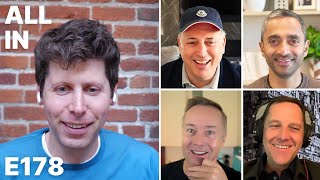 Sam Altman on OpenAI Strategy: Agents, Safety, and Scale2023 · 103 min · full transcriptBest for his product intuition about voice, lower-friction assistants, and AI that can push back intelligently.
 Sam Altman on AI Apps and Agents: Build in ChatGPT2025 · 53 min · full transcriptBest for the latest platform vision: ChatGPT as a place where developers build apps people use inside conversations.
Questions people ask
- What did Sam Altman say about building a GPT in plain language?
- What did Sam Altman say about building with AI in 2025?
- What did Sam Altman say about jailbreaking and model control?
- What did Sam Altman say about moving carefully toward AI agents?
- What did Sam Altman say about privacy and government access to AI chats?
- What does Sam Altman say about user freedom and privacy in ChatGPT?
Sources
Every quote above, word for word from the transcripts. Numbers match the text.
“I think if I had to pick some moment from what we've seen so far, I'd sort of pick ChatGPT.”
“I think if I had to pick some moment from what we've seen so far, I'd sort of pick ChatGPT. You know, it wasn't the underlying model that mattered. It was the usability of it, both the RLHF and the interface to it.”
“…we're heading towards this new way to kind of do knowledge work…”
“RLHF is how we align the model to what humans want it to do.”
“Keep asking questions, prompting. We want users to have a lot of control and get the models to behave in the way they want within some very broad bounds. And I think the whole reason for jailbreaking is right now, we haven't yet figured out how to, like, give that to people. And the more we solve that problem, I think the less need there will be for jailbreaking. Yeah. It's kinda like piracy gave birth to Spotify. People don't really jailbreak iPhones that much anymore, and it's gotten harder for sure, but also, like, you can just do a lot of stuff now.”
“No, and I don't I don't think they seem alive.”
“There's nothing to me at all that feels divine about it or spiritual in any way.”
“…we're really training this to be... the collective of all of humanity.”
“I think our. The world, like our user base, is going to approach the collective world as a whole. And I think... what we should do is try to reflect... the moral. I don't want to say average, but the collective moral view of that user base. I don't There's plenty of things that ChatGPT allows that I personally would disagree with. the, but, I don't, like obviously I don't wake up and say, I'm going to impute my exact moral view and decide that this is okay, and that is not okay, and this is a better view than this one, what I think ChatGPT should do is reflect that like weighted average or whatever of humanity's moral view, which will evolve over time. And we are here to serve our users.”
“The person I think you should hold accountable for those calls is me.”
“There's a lot. Look, I don't sleep that well at night. There's a lot of stuff that I feel a lot of weight on, but probably nothing more than the fact that every day hundreds of millions of people talk to our model. And I don't actually worry about us getting the big moral decisions wrong. Maybe we will get those wrong too. But what I worry, what I lose much sleep over, is the very small decisions we make about a way a model may behave... slightly differently, but it's talking to hundreds of millions of people. So then that impact is big.”
“Whatever. right I think we should have the same concept for AI... I think when you talk to an AI about your medical history or your... legal problems or asking for legal advice or any of these other things, I think the government owes a level of protection to its citizens there that is the same as you'd get if you're talking to the human version of this... And right now we don't have that... And I think it would be a great, great policy to adopt. So the feds or the states or someone in authority can come to you and say, I want to know what so. And so was typing into the. Right now. They could. Yeah. And what is your obligation to keep the information that you receive from users and others... private? Well, I mean, we have an obligation, except when the government comes calling, which is why we're pushing for this. And I was actually just in D.C... advocating for this. I think I feel optimistic that we can get the government to understand the importance of this and do it.”
“And we have found a lot of cases where there was an example of something that seems, that seemed to us like a fairly clear decision of what to allow or not to allow. Where users convinced us like, hey, by blocking this thing that you think is an easy decision to make. you are not allowing this other thing, which is important. And there's a difficult trade off there... in general the attention that. So a principle that I normally like is to treat our adult users like adults. Very strong guarantees on privacy, very strong guarantees on individual user freedom. And this is a tool we are building... You get to use it within very broad framework.”
“…we really believe that gradual iterative deployment is the best way to address the safety issues…”
“These are our first steps towards AI agents…”
“Eventually, you'll just ask the computer for what you need and it'll do all of these tasks for you. These capabilities are often talked in the AI field about as agents. The upsides of this are going to be tremendous. At OpenAI, we really believe that gradual iterative deployment is the best way to address the safety issues, the safety challenges with AI. We think it's especially important to move carefully towards this future of agents. It's going to require a lot of technical work and a lot of thoughtful consideration by society.”
“AI has gone from something people play with to something people build with every day.”
“We’re opening up ChatGPT for developers to build apps inside of ChatGPT.”
“I think voice is a hint to whatever the next thing is.”
“I definitely want that kind of vibe, which not not just like this thing that I task and it blindly does.”
“Our uh abundant and inexpensive intelligence. Um The more powerful, the more general, the smarter, the better. Uh I think that is A G I and then, and then abundant and cheap energy. And if we can get these two things done in the world, then uh it's almost like difficult to imagine how much else we could do. Uh We're, we're big believers that you give people better tools and they do things that astonish you. And I think A G I will be uh the best tool humanity has yet created uh with it, we will be able to solve all sorts of problems. We'll be able to express ourselves in new creative ways. We'll make just incredible things um for each other, for ourselves, for the world, for, for kind of this unfolding human story.”
“AI will be about individual empowerment and agency at a scale that we've never seen before.”
“…we're not where, where we need to be…”
“I do not think we have yet discovered a way to align a super powerful system.”
“…we have to be somewhat uncomfortable as as a tool builder here…”
How this guide was made: drafted with AI from the full transcripts of the recordings cited, then checked: every quotation must match a transcript word for word and be the speaker's own words, and an independent review gates accuracy. Methodology and corrections.
