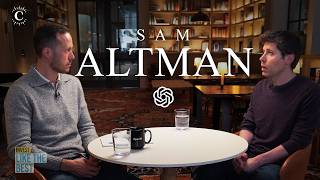
Sam Altman on Leadership
Sam Altman treats leadership as a compound of mission clarity, talent density, fast execution, structural discipline, and the willingness to slow down when responsibility demands it.
- Leadership starts with picking an important mission and staying intensely aligned to it.
- The leader’s first practical job is talent: choose cofounders carefully, hire slowly, and never accept mediocre early hires.
- Culture follows founder behavior, so leaders must personally model speed, focus, intensity, and execution.
- As an organization grows, leadership becomes building structure, delegation, and resilience rather than doing everything yourself.
- Good leaders do not treat momentum as an excuse for recklessness; they slow down when safety, control, or power concentration are at stake.

“You should trade being short-term low status for being long-term high status.”Raj Shamani interview, 2025 · 10:33
Leadership begins with mission and long-term conviction
Altman’s leadership style starts with choosing a problem important enough to deserve sustained effort and tradeoffs. He repeatedly frames his work around building broadly useful intelligence as a platform and betting on human creativity and usefulness, which means leadership is not mainly about status or control but about committing to a consequential direction for a long time.123
That long-term orientation also shapes how a leader handles reputation and uncertainty. Altman’s view is that leaders should accept looking wrong in the short run if they believe they are right in the long run, and should keep acting even when there is no authority figure with perfect answers.4
“You should trade being short-term low status for being long-term high status.”Raj Shamani interview, 2025 · full transcript →
The first leadership job is getting the people right
Altman is unusually hard-line on talent. He says getting the best people should be the top priority, especially early on, because weak early hires damage a company far more than short-term losses in speed or customers.678
He applies the same standard to cofounders. His advice is not to choose cofounders casually or through random matching, but to work with people you know well, trust under pressure, and deeply respect. He also emphasizes that you should want to spend a lot of time with them or at least strongly value their judgment.
This focus on talent is not delegated away. Altman describes hiring as a time-intensive leadership responsibility with no shortcut, which shows how seriously he treats talent density as a direct function of leadership attention.
Leaders set culture by how they work, not what they say
A central Altman idea is that everything in a startup gets modeled after the founders. If the leader wants a culture of hard work, detail orientation, customer focus, frugality, and speed, the leader has to embody those traits daily.12
This is why he puts so much weight on execution over ideas. In his view, ideas alone have little value; what matters is the ability to turn them into reality, maintain momentum, and keep growth alive. Leadership therefore means creating an organization that moves decisively instead of admiring its own concepts.13
That same bias toward action explains his comfort with imperfect launches. Shipping early, learning from users, and improving quickly is part of leading a team toward reality rather than waiting for internal perfection.15

“The way to have a company that executes well is to execute well yourself. Everything in a startup gets modeled after the founders. Whatever the founders do becomes the culture. So if you want a culture where people work hard and pay attention to detail and focus on the customer and are frugal, you have to do it yourself. There is no other way. You cannot hire a COO and have them, you know, do this while you go off to conferences. The company just needs to see you as like this maniacal execution machine. As I said in the first lecture, there's like a 100 times at least more people with great ideas than people that are willing to put in the effort to execute them well. Ideas by themselves are not worth anything. Only executing well is what what adds value or what creates value.”Stanford CS183B lecture 2, 2014 · full transcript →
As companies grow, leadership shifts from heroics to structure
Altman draws a sharp distinction between leading before and after product-market fit. Early on, the founder’s core job is product, but later the job becomes building the company itself: management, delegation, communication, and operating rhythm.16
He thinks growing organizations need simple, clear reporting lines and strong alignment. Flatness works only for a while; after that, ambiguity becomes a tax on execution. Leadership at scale means making responsibilities legible so teams can move without constant founder intervention.18
This also requires giving up hero mode. Leaders must trust strong people to make decisions, tolerate some short-term inefficiency from delegation, and build an organization that can keep functioning under stress.
Real leadership includes resilience under pressure
Altman’s comments on setbacks are blunt: hard situations are painful, but leaders keep going. He treats endurance as part of the job, whether the pressure comes from startup struggle or from an institutional crisis.2021
The OpenAI board episode appears to have deepened his view that leadership is not just about vision and execution but also about structure, incentives, and resilience. He says the experience changed how he thinks about boards and about building an organization that can stand up to extreme pressure rather than nearly breaking under it.2122
His lesson is that stress reveals weaknesses in governance long before it reveals them in public. So leaders should design for worst cases, not just normal operations, and should choose governing structures that combine technical understanding, judgment, and broader societal responsibility.23
Responsible leaders know when to slow down
Altman does not define leadership as maximum speed at all times. He explicitly argues that safety can outweigh other pressures and that slowing down is sometimes the right decision when capabilities are outrunning alignment, security, or control.25
This matters because he rejects the common excuse that competition justifies unsafe deployment. In his view, leaders have to refuse that logic even when it is convenient, and keep human welfare and human control at the center.2728
That perspective broadens leadership beyond company performance. He warns against concentration of power and argues that builders are not the main characters; the point is to increase people’s freedom and agency. For Altman, the best leaders remember they are serving a larger public, not merely winning a race.2931
Altman on leadership, in his own words
“You should trade being short-term low status for being long-term high status.”
Where to watch
 Sam Altman on Team and Execution: Hire Slow, Execute Fast2014 · 46 min · full transcriptBest single talk on Altman’s operating style: cofounders, hiring standards, founder behavior, and execution.
 Sam Altman on Later-Stage Startup Advice: Scaling After Product-Market Fit2014 · 48 min · full transcriptBest for how his idea of leadership changes as a company scales from product focus to management and alignment.
 Sam Altman on OpenAI Governance: The Board Saga and AGI2024 · 115 min · full transcriptShows how crisis changed his thinking about trust, governance, resilience, and leadership under extreme pressure.
 Sam Altman on AI Safety and Alignment: Why OpenAI Slowed Down2024 · 69 min · full transcriptBest for Altman’s view that strong leadership includes slowing down when safety and alignment lag capability.
 Sam Altman on AI Risks and Governance: Human Control First2024 · 159 min · full transcriptBest statement of his public philosophy: human control, responsibility, and rejecting unsafe competitive logic.
 Sam Altman on AI Progress: Superintelligence, Scale, and Risk2025 · 68 min · full transcriptUseful for his bias toward shipping, long-term conviction, and making high-stakes bets before consensus forms.
Questions people ask
- How does Sam Altman decide who to hire at OpenAI?
- What did Sam Altman say about OpenAI governance after the board crisis?
- What did Sam Altman say about early hires and remote cofounders?
- What did Sam Altman say about who to hire and employee equity?
- What does Sam Altman say about how startup culture is created?
- What does Sam Altman worry about most at OpenAI?
Sources
Every quote above, word for word from the transcripts. Numbers match the text.
“…we really wanna just provide that platform…”
“…human ingenuity, creativity, desire for stuff, desire to be useful, that's a very good thing to bet on…”
“I think this will be the greatest thus far technological achievement of human history…”
“You should trade being short-term low status for being long-term high status.”
“It should be your number one priority to get the best people.”
“If you compromise and hire someone mediocre, you will always regret it.”
“If you have to choose between hiring a suboptimal employee and losing your customers to a competitor, what do you do? If it would be one of the first five, say, employees of a company, I would lose those customers. I just... I think the damage that it does to the company, you know, you don't wanna... It's better to lose some customers than kill the company. Later on, I might have a slightly different opinion, but it's really hard to say in the general case. How about one more question? I'll keep going. Yes. What's your experience with cofounders who aren't working in the same location? I'm gonna get to that later. The question is, what about cofounders that aren't working in the same location? Don't do it. I am skeptical of remote teams in general, but in the early days of a startup, where communication and speed outweigh everything else, for whatever reason, video conferencing or calls just don't work that well.”
“The way to have a company that executes well is to execute well yourself. Everything in a startup gets modeled after the founders. Whatever the founders do becomes the culture. So if you want a culture where people work hard and pay attention to detail and focus on the customer and are frugal, you have to do it yourself. There is no other way. You cannot hire a COO and have them, you know, do this while you go off to conferences. The company just needs to see you as like this maniacal execution machine. As I said in the first lecture, there's like a 100 times at least more people with great ideas than people that are willing to put in the effort to execute them well. Ideas by themselves are not worth anything. Only executing well is what what adds value or what creates value.”
“Ideas by themselves are not worth anything.”
“If you're not a little embarrassed of your first version, you're waiting too long to launch…”
“…your only job that matters is to build a great product…”
“…the single word that matters most, I think, to keep the company productive as it grows is alignment…”
“The answer to this is just that it sucks and you keep going.”
“That was definitely the most painful professional experience of my life…”
“I feel great about the new board.”
“I think there will be a new paradigm for that kind of thinking.”
“This moment calls for extreme care.”
“We have to reject that logic even when it's convenient for any one actor.”
“AI should give people more power over their own lives, more freedom to live lives the way they want.”
“Concentration of power with AI is a terrifying thing…”
“…we are, like, very proudly on team humanity.”
How this guide was made: drafted with AI from the full transcripts of the recordings cited, then checked: every quotation must match a transcript word for word and be the speaker's own words, and an independent review gates accuracy. Methodology and corrections.