Sam Altman on Democratic Oversight
Sam Altman argues AI should be governed through public accountability, government rules for the most powerful systems, and broad input from the people affected by it.
- AI governance should not be left to a few companies or elites alone.
- The most powerful AI systems need government oversight, including testing and possibly licensing.
- AI should reflect the values of the people who use and are affected by it, not one leader’s personal views.
- Oversight should preserve user freedom and privacy while enforcing limits on serious harms.
- Rules should be built iteratively through deployment, feedback, and coordination rather than by guessing everything in advance.
Altman’s basic principle: AI should answer to people
Altman’s starting point is that AI is a tool for human benefit, not a force that should run ahead of public judgment. He says AI should increase people’s power over their own lives rather than concentrate power in machines or institutions12.
That leads directly to a democratic idea of oversight: the people affected by AI should have a say in how it behaves. Altman says it matters that an AI system represent the will of the people who will use it and be impacted by it3.
He also pushes back on the idea that a small set of insiders should make the key moral choices alone. He says AI governance has too often been shaped by elite rooms, and he prefers learning the collective value preferences of broad populations4.
He wants government oversight for the most powerful models
Altman does not think company self-regulation is enough as AI capabilities rise. He says government intervention will be critical to reduce the risks of increasingly powerful models6.
His preferred tools are concrete, not vague. He points to testing requirements and a possible licensing regime for systems above a capability threshold, especially as AI approaches much more general and powerful forms78.
This is not a call to regulate every current model the same way. He draws a distinction between today’s systems and future systems with much greater power, arguing that the strongest oversight should match the highest-stakes capabilities89.
Public input should shape model behavior and moral boundaries
Altman says he does not want AI systems to simply reflect his personal moral views. Instead, he wants them to track the broader moral views of their users and society, even when that differs from his own preferences14.
He connects that to how these systems are built and aligned. He describes alignment as steering the model toward what humans want, and elsewhere says OpenAI is trying to train systems on the collective record of humanity rather than treating one authority as morally final1516.
He also says user feedback changes company decisions in practice. In some cases, users persuaded OpenAI that a blocked behavior also prevented something important, which shows his view that oversight should include real feedback from the public, not just top-down restrictions17.
Oversight must balance freedom, privacy, and safety
Altman’s version of democratic oversight is not just about restrictions. He says adult users should be treated like adults, with strong privacy protections and broad freedom to use AI within wide bounds17.
At the same time, he thinks some limits are non-negotiable when serious harms are involved. He supports decisions that block dangerous uses and says governments should provide privacy protections for sensitive AI conversations comparable to those people expect in other high-trust settings.
He frames this as a difficult balancing problem, not a slogan. He worries that even small design choices can matter when hundreds of millions of people use a system, which is why oversight has to be careful, accountable, and responsive20.
Why he thinks democratic oversight is urgent
Altman believes AI could be enormously beneficial, even transformative, for science, education, health, and living standards212223. But that upside is exactly why the governance question matters so much.
He is explicit that alignment is not a solved problem, especially for far more capable systems. He says we do not yet know how to align a super powerful system, which makes public oversight and external checks more important, not less24.
He also warns against the excuse that competition justifies unsafe deployment. In his view, leaders must reject that logic, use extreme care, and slow down when needed rather than letting pressure from rivals erase public accountability202511.
Altman on democratic oversight, in his own words
“The idea that the system represents the will of the people who are going to use it and be impacted by it, I think that's quite important.”
Where to watch
 Sam Altman on AI Risks and Governance: Human Control First2024 · 159 min · full transcriptBest single statement of his political philosophy: human control, anti-concentration of power, and the need for democratic oversight.
 Sam Altman on AI Safety Regulation: Licensing Powerful Models2023 · 176 min · full transcriptMost concrete on regulation, with licensing, testing, audits, and the government’s role for powerful models.
 Sam Altman on Global AI Governance: Build the Rule Book Together2024 · 21 min · full transcriptShort, clear explanation of why AI governance should be built collaboratively and iteratively.
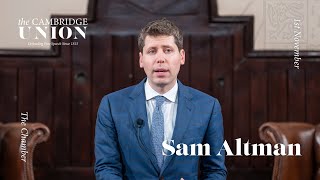 Sam Altman on AI Safety and AGI: Cambridge Union Hawking Fellowship2023 · 64 min · full transcriptUseful for understanding why he ties legitimacy to the will of the people affected by AI.
 Sam Altman on AI Morality: Privacy, Power, and Suicide2024 · 57 min · full transcriptBest for how public values, privacy, user freedom, and moral boundaries should shape model behavior.
Questions people ask
- What did Sam Altman say about AI regulation and licensing powerful models?
- What did Sam Altman say about pausing AI training or deployment?
- What did Sam Altman say about privacy and government access to AI chats?
- What does Sam Altman think ChatGPT should reflect morally?
- What did Sam Altman say about using public opinion to set AI safety rules?
- What does Sam Altman say about user freedom and privacy in ChatGPT?
Sources
Every quote above, word for word from the transcripts. Numbers match the text.
“AI should be built for people, not simply to turn the crank of the machines faster for their own sake.”
“AI should give people more power over their own lives, more freedom to live lives the way they want.”
“The idea that the system represents the will of the people who are going to use it and be impacted by it, I think that's quite important.”
“Of course, but I'm much more interested in what our hundreds of millions of users want as a whole. I think a lot of the room has historically been decided in small elite summits. One of the cool new things about AI is our AI can talk to everybody on Earth, and we can learn the collective value preference of what everybody wants, rather than have a bunch of people who are, like, blessed by society to sit in a room and make these decisions, I think that's very cool. (Applause) And I think you will see us do more in that direction. And when we have gotten things wrong, because the elites in the room had a different opinion about what people wanted for the guardrails on image-gen than what people actually wanted, and we couldn't point to real-world harm, so we made that change. I'm proud of that.”
“However, we think that regulatory intervention by governments will be critical to mitigate the risks of increasingly powerful models.”
“For example, the US government might consider a combination of licensing and testing requirements…”
“Where I think the licensing scheme comes in is not with... Not for what these models are capable of today because as you pointed out, you don't need a a new licensing agency to do that. But as we as we head, and, you know, this may take a long time. I'm not sure. As we head towards artificial general intelligence Mhmm. And the impact that will have and the power of that technology, I think we need to treat that as seriously as we treat other very powerful technologies. And that's where I personally think we need such a such a scheme.”
“Uh So in terms of what we'd like to see from governments, uh I think we've been like very mischaracterized here. We do think that international regulation is gonna be important for the most powerful models. Nothing that exists today, nothing that will exist next year. Uh But as we get towards a real super intelligence, as we get towards a system that is like more capable uh than like any humans. Um I think it's very reasonable to say we need to treat that with like caution and uh and a coordinate approach. But like we think what's happening with open source is great. We think start ups need to be able to train their own models and deploy them into the world and a regulatory response on that would be a disastrous mistake for this country or others. Um So the message we're trying to get across is you gotta embrace what's happening here.”
“We must build, release, and use AI safely.”
“So first of all, we... After we finished training GPT four, we waited more than six months to deploy it. We are not currently training what will be GPT five. We don't have plans to do it in the next six months. But I think the frame of the letter is wrong. What matters is audits, red teaming, safety standards that a model needs to pass before training. If we pause for six months, then I'm not really sure sure what we do then. Do we pause for another six? Do we kind of come up with some rules then? The standards that we have developed and that we've used for GPT four deployment, we wanna build on those, but we think that's the right direction, not a calendar clock pause. There may be times... I expect there will be times when we find something that we don't understand and we really do need to take a pause, but we don't see that yet. Never mind all the benefits.”
“…we're all writing the rule book together…”
“We need to work together to find a totally new approach.”
“I think our. The world, like our user base, is going to approach the collective world as a whole. And I think... what we should do is try to reflect... the moral. I don't want to say average, but the collective moral view of that user base. I don't There's plenty of things that ChatGPT allows that I personally would disagree with. the, but, I don't, like obviously I don't wake up and say, I'm going to impute my exact moral view and decide that this is okay, and that is not okay, and this is a better view than this one, what I think ChatGPT should do is reflect that like weighted average or whatever of humanity's moral view, which will evolve over time. And we are here to serve our users.”
“RLHF is how we align the model to what humans want it to do.”
“…we're really training this to be... the collective of all of humanity.”
“And we have found a lot of cases where there was an example of something that seems, that seemed to us like a fairly clear decision of what to allow or not to allow. Where users convinced us like, hey, by blocking this thing that you think is an easy decision to make. you are not allowing this other thing, which is important. And there's a difficult trade off there... in general the attention that. So a principle that I normally like is to treat our adult users like adults. Very strong guarantees on privacy, very strong guarantees on individual user freedom. And this is a tool we are building... You get to use it within very broad framework.”
“This moment calls for extreme care.”
“We think it can be a printing press moment.”
“AI can significantly accelerate the pace of scientific discovery.”
“…the benefits to humanity of making intelligence broadly available…”
“I do not think we have yet discovered a way to align a super powerful system.”
“We have to reject that logic even when it's convenient for any one actor.”
How this guide was made: drafted with AI from the full transcripts of the recordings cited, then checked: every quotation must match a transcript word for word and be the speaker's own words, and an independent review gates accuracy. Methodology and corrections.

