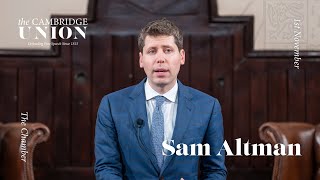
Sam Altman on AI Safety and AGI: Cambridge Union Hawking Fellowship

What Altman talks about
Sam Altman took questions at the Cambridge Union, University of Cambridge, in November 2023 after receiving the Hawking Fellowship, discussing OpenAI, AGI, and AI safety.
Also known as: 2023 Hawking Fellow; Cambridge Union Hawking Fellowship; Sam Altman & OpenAI.
Sam Altman uses the Cambridge Union Hawking Fellowship talk to explain OpenAI’s origins, its shift from a nonprofit to a capped-profit structure, and why he thinks scaling compute and data has transformed AI capabilities. He frames the company’s work as a balance between maximizing benefits and managing serious risks.
A major theme is AI safety: Altman argues that powerful systems need testing, alignment, public feedback, and eventually global regulation. He also discusses what AI means for education, scientific discovery, accessibility, and the role of young people in adapting to new tools.
A Cambridge Union host introduces the fellowship and moderates the Q&A; audience members ask questions after Altman’s remarks.
In his words
“We must build, release, and use AI safely.”
“In fact, so much so that any time you can spend thinking about how to correctly set the incentives on a person, a team, an organization, whatever, that's like probably the highest leverage thing you can do.”
“AI can significantly accelerate the pace of scientific discovery.”
“We need another breakthrough.”
“The idea that the system represents the will of the people who are going to use it and be impacted by it, I think that's quite important.”
Key points
- OpenAI began as a nonprofit pursuing AGI for the benefit of all humanity, but scaling requirements led to a capped-profit structure to fund compute and talent.
- Altman says the main lesson of the last few years is that scale matters enormously, and that ChatGPT changed public perceptions of AI.
- He argues that AI safety must be developed alongside capability, through testing, alignment work, and coordination with governments and civil society.
- He believes AI could accelerate science dramatically, improve healthcare and education, and unlock major gains in quality of life.
- Altman says universities should teach students how to learn and how to generate new ideas, while embracing AI tools rather than banning them.
- He thinks a global regulatory body may eventually be needed for the most capable systems, without stifling small-scale innovation.
- For founders, he emphasizes determination, internal conviction, obsession with the problem, and clear communication.
Full transcript: Sam Altman, Hawking Fellowship Q&A (2023)
(music) (music) Good evening, ladies and gentlemen. Six years ago, in 2017, the union professor Steven Hawking came together to establish the fellowship we celebrate tonight, with the idea of bringing individuals distinguished in the STEM fields to Cambridge to discuss and debate their work and achievements. Since his passing shortly after, the fellowship
has taken on much greater meaning. And we are here tonight not just to celebrate the achievements of the fellows, but to pay tribute to Professor Hawking, his legacy, and his close connection to the students of Cambridge. And to do so, we're delighted to have with us the Hawking family, particularly Jane and Lucy Hawking. Thank you for being here. (music) Tonight, as I'm sure you all know, this year the fellowship committee have voted to award the fellowship for 2023 to the OpenAI team. The models that OpenAI have developed, in particular DALL·E and ChatGPT, represent the first time that we, the general public, have truly
felt and understood the monumental changes that AI will bring. What attracted the fellowship committee to OpenAI in particular, though, is the positive and responsible vision for AI that OpenAI espouses. Its commitment to open source and public access to AI has, in Sam's own words, successfully shifted the Overton window on AI and AGI in a way that little else has previously been able to do. Combined, this is exactly what the Hawking Fellowship is about: recognizing achievements that have had and will have an exceptional impact, but that are also done in the best interests of humanity, with the aim of improving the human condition and our understanding of the world. This is the first time that the fellowship has been conferred on a group rather than an individual, but the committee feel this
is the most appropriate way of recognizing the collaborative nature of the achievement. Without further ado then, here to receive the fellowship this evening and on behalf of his team and to deliver the lecture, please put your hands together for Mr. Sam (music) (applause) Altman. (music) Thank you, thank you very (music) much. Thank you, Lucy and the entire Hawking family for the warmth and hospitality extended to me and OpenAI. My colleagues and I are truly honored to be selected as this year's Hawking
fellow, and I'm thrilled to be here representing the team. We're deeply grateful to the Hawking Fellowship committee, the Cambridge Union, and the Hawking family. I mostly came here to have a discussion. I'd love to answer a lot of questions. I'll try to keep my remarks short. It is truly humbling to be here at the University of Cambridge, a place where Professor Hawking's profound insights into the universe have left an indelible mark on all of us and been a huge inspiration to me personally. As many of you probably know, he was deeply engaged with issues around AI and its potential impact on society. Many of Professor Hawking's early comments on AI are remarkably prescient, and they've deeply influenced our perspective and our work. We believe that the potential for
AI to improve our lives, our societies, and the world is immense, and we think that Professor Hawking agreed, as he put it, "We cannot predict what we might achieve when our own minds are amplified by AI." I think this amplification is in its very early stages. It is going to surprise, uh, hopefully all of us. He went on to say, "Perhaps with the tools of this technological revolution, we'll be able to undo some of the damage done to the world by the last one — industrialization. We will aim to finally eradicate disease and poverty. Every aspect of our lives will be transformed." At OpenAI, we're very inspired by this outlook. We know that to achieve this future, we must build, release, and use AI safely. We must do
what we can to prepare for its impacts and play our part in helping our society and government prepare as well. So that's why we at OpenAI strive to research, develop, and release cutting-edge AI technology, as well as tools and best practices for safe, aligned AI. I would like to tell the story, uh, of how OpenAI began, and I hope this will be some inspiration for all of you that go through hard times and failures with whatever you try on next — you sometimes do get out the other side. In 2015, eight years ago, I co-founded OpenAI with my colleagues. We started as a nonprofit with the mission of creating artificial general intelligence that benefits all of humanity. Uh, at the time, AGI was considered like a bad word to say, and we were sort of laughed at by
all serious professors in the field. Professor Hawking would not have, but the rest of them, um, and people doubted the vision. Uh, they labeled it a wild goose chase and, uh, there was a lot of skepticism and raised eyebrows, with with good reason. We were saying that we were going to try to do something audacious that probably wasn't going to work, and we didn't know how we were going to do it. We just thought we would try to figure it out, but we were fueled by this vision. Um, like many Silicon Valley startups, our first office was an apartment with no air conditioning. Um, in those early years, we hit many roadblocks. We stumbled. We had trouble making progress. We were discouraged. Not very much was working. In 2017, I watched Professor Hawking say at the Web Summit conference, "I'm an optimist, and I believe we can create AI
for the good of the world, that it can work in harmony with us. We simply need to be aware of the dangers, identify them, employ the best possible practice in management, and prepare for its consequences well in advance." I'm an optimist too. Uh, this inspired all of us. This, this came in a dark time. Fast forward a year to 2018, we introduced the very first GPT, GPT-1. Looking back, it was really not very good. It could barely do anything at all. It got very little notice; the paper got rejected from conferences, all of that. But we believe that if we continue to scale it, scale data and scale compute, we could create more and more capable systems, and we started to work on the scaling laws. At that same time, we started doing the math on how much all this was going
To cost, and we realized it was going to be very, very expensive to make AGI. So we created a cap-profit subsidiary that is governed still by our nonprofit. Today, we limit financial returns to employees and investors. We return future profits above that limit to our public charity. This corporate structure lets us secure necessary capital for compute and talent, and it also lets us put our mission ahead of profits. So this scaling formula worked. In 2019, we introduced GPT-2. In 2020, we followed it with GPT-3. ChatGPT was released in 2022, and GPT-4 in 2023. When we put out ChatGPT, we weren't sure how much people were going to care. We called it a low-key research preview, and that's what most of us believed.
Would happen. It's now used by hundreds of millions of people around the world less than one year later. Maybe more importantly than that, it's shifting perceptions about what AI is, what AI will be. But it's not merely enough to develop more capable systems. In keeping with our mission, we've made them safer and more aligned. We have more work to do. We believe that learning from and responding to feedback from society, from everyone, is a critical component of building safe AI systems over time. Through our alignment and safety techniques, we've been able to instill human values into our models. This is something that many people, myself included, thought might be much harder than it has so far turned out to be. We conduct rigorous testing. We engage
external experts for feedback. We build and reinforce safety monitoring systems, and we provide resources to help people use our technology responsibly. All of that said, we recognize that there are huge risks and potential downsides to AI. In this field, unlike any other I know, you have to balance these huge risks to enjoy these tremendous upsides. They really go together. In that same keynote address from 2017, Professor Hawking said AI could be the worst invention in the history of our civilization. So why do we do this at all? Back to what I said a second ago: AI has extraordinary, extraordinary potential, probably more than any single piece of technology humans have yet invented. It
can be the conduit that amplifies human capabilities, expands our understanding, and solves complex problems that, without AI, will remain beyond our reach. It's a tool that could redefine the way we understand and solve our biggest problems. It's a tool that I think can lead to more scientific advancement and understanding than anything that's come before. Consider healthcare. AI can improve our global healthcare infrastructure, especially in regions where medical resources are scarce. Years down the line, AI can maybe solve every disease. In education, tailored learning experiences facilitated by AI can cater to the unique aptitudes and interests of every student, democratizing access to knowledge. And I mentioned this before,
but I want to say it one more time because it's the thing, to me, that is most exciting: AI can significantly accelerate the pace of scientific discovery. We, on our own, maybe, can accomplish a certain rate. With AI, maybe we can make that rate 10 times or 100 times faster. And I think all real human progress comes from deepening our scientific understanding of the world. So I'm incredibly excited for this. As we work towards this future, we must take seriously the full spectrum of safety risks related to AI, from the systems we have today to the systems that will come in the future—and maybe not the distant future—that we'll all call superintelligence. So this is why, at OpenAI, we're working to develop a quantitative,
evidence-based methodology to evaluate, forecast, and protect against the risks of highly capable AI. The sort of current rhetoric where we just say it's, you know, all going to be horrible and there's nothing can be done is not very productive and certainly not very scientific. We are committed to developing a solution to make superintelligent AI safe in the coming years, and we're talking with people across governments and civil society about how to harness and adapt to AI. We can't do this alone. Building AI, AGI safely for the benefit of humanity is a collective endeavor that will transcend organizations and country borders. It will require the brightest minds, curiosity, integrity, and a shared commitment to the greater good. Here at
Cambridge, you are at the vanguard of academic and intellectual discovery, embodying a tradition of inquiry that shapes the future. I am envious that we have no place like this in the United States. I invite each of you to join us in this mission, whether through research, policy advocacy, or developing beneficial applications of AI. You can and will help steer this technology towards a positive outcome. I encourage you to dig into the tough questions, challenge the status quo, and work across disciplines and cultures. It is through this concerted effort that we will unlock the potential of AI while ensuring that its benefits are realized safely and equitably. I think both of these are moral imperatives. I want to close with the words of Professor Hawking once more: we
need to take learning beyond the theoretical discussion of how AI should be and take action to make sure we plan for how it can be. He continued: You all have the potential to push the boundaries of what is accepted and to think big. We stand on the threshold of a brave new world. It is an exciting yet precarious place to be, and you are the pioneers. I wish you well, and I wish you well too. Thank you again for this incredible honor. I'm excited to talk more, and thank you for listening. Thank you again for being here tonight. Sam, uh, we're immensely grateful
that you've taken time out of your schedule to be here. Um, so for the audience, the way this is going to work, I'm just going to leave sort of 10 minutes of discussion and then very much over to the audience, so please do rethink what questions you want to ask. And when time comes, just stick up your hand and we'll go straight to you. Sam's been very generous in taking open questions tonight. Um, so you're here representing OpenAI, so I think that's the most appropriate place to start. Um, you talked earlier about, uh, how the corporate structure, um, defines, um, OpenAI, um, but one of the reasons that the fellowship committee was so interested in OpenAI is the philosophy behind the company. So can you talk a bit about what differentiates OpenAI's approach to that of other companies researching the same area? Yeah, when when we started work
On this, we were very unsure about where AI was going to go and if we could be able to move it forward to the degree we hoped at all. And we were thinking about different structures, and we thought, you know, the worry with a nonprofit was not enough would happen, the worry with a company was too much would happen, and the worry with the government was not enough would happen and then way too much would happen. And we decided, of all of those things, given the sort of landscape of balance and the research that had to happen, a nonprofit was great. And so we went with that. We really just totally underestimated how, even though we knew scale was going to matter, how much scale mattered. And so then, all of a sudden, we were like, "Well, can we raise tens or hundreds of billions of dollars as a nonprofit?"
Turned out the answer was no. And so we tried to come up with a new structure that maintained this ability to have nonprofit governance, where we could sort of turn this over to humanity at some point, but still work within the confines of capitalism, which I think is great to do what we needed to do. Of the just unbelievable scale of these systems — this will be OpenAI alone, not to say anything of all the other AGI efforts — this will be like the most expensive engineering project in human history by the time it's done, I'm pretty sure. So given the magnitude of that, given the ability, the sort of tremendous benefit that's here and also the risks, we wanted to set an incentive system that
would engender the culture and reinforce the culture we hoped for, which is successfully navigate the risks, act — act with the duty that that requires, but figure out how to broadly distribute the benefits of this. And in the conversation of the risk, I think the benefits have gotten pretty lost. But if you think what will happen to quality of life in the world if the abundance and the quality of intelligence starts going up by, like, a factor of 10 every year, that's like pretty amazing. And I think we have a moral duty to make life better. Like, that is the — that is the human quest. So we knew we wanted to do that while navigating this potentially dangerous
path. And a thing that I deeply believe — like, one of the sort of, I think, good rules of life is that incentives are superpowers. In fact, so much so that any time you can spend thinking about how to correctly set the incentives on a person, a team, an organization, whatever, that's like probably the highest leverage thing you can do. And I think some of the tech companies, the big tech companies, the generation before us, got stuff very wrong, not because they were bad people, but because they put very well-meaning people in a system with screwed up incentives. We didn't want that. We did not want an incentive for, you know, using this technology for unlimited profit or to maximize sort of like our own interest in any way. And I think this idea of the cap and the impact that has on the
decisions people make, you know, hour to hour, day-to-day, has been super powerful. You spoke there about the previous generation of tech founders, of tech companies. Obviously, Elon Musk was one of your co-founders. He since left the company and has gone on to cause for pause in social development. So what do you think differentiates his approach from yours? I saw Elon today at the UK Safety Summit. I have tremendous respect for him. I think we share much more in common than we think differently about this, and I, you know,
look forward to productive collaboration in the future. I think we're fine. I think we're fine. So productive collaboration in the future? Yeah, yeah, super. So we haven't reached AGI yet, but can you reflect on perhaps the progress so far? What has been unexpected, maybe, about the rollout of ChatGPT? We definitely have not reached AGI yet, but if you went back in time five years and showed people a copy
of GPT-4 and told them this was like a real thing that was going to come, I think they would tell you that that's closer to AGI than they thought it was going to be, that there is — there is novel understanding in these systems to some degree. Now, it's very weak, and I don't mean to make too much of it, but I don't want to undersell it either. Like, the fact that we have a system that can understand the subtleties of language, combine concepts in novel ways, do some of the things that many of us associate with general intelligence, that's a big deal. And the rate of improvement in front of us is so steep that we can see how good
it's going to be in just, you know, a small handful of more years. I think the best test of all of this is just a utility to people. So again, GPT-4 embarrasses us. Like, we kind of just feel bad that it's out in the world because we know what all the flaws are, but it adds like value to hundreds of millions of people's lives, more than that, people who benefit from the products and services other people are building with it. And so I think we're getting close enough that the definition of AGI matters. People have very different opinions of what that's going to be and when we cross a thing that you call AGI or superintelligence or whatever, but a thing that is in the rearview mirror is AI.
Systems that are tremendously useful to people and that I think came sooner than a lot of people thought. So then, in 10 years' time, what would you say success for OpenAI looks like? Um, I mean, fundamentally, like other technologies, we are tool builders, and we build tools to make humans more productive and able to do more. And if the tools are so good that they are enabling us to live much better lives, too, if someone can go discover the grand theory of all of physics in 10 years using our tools, that would be pretty awesome. Uh, high ambitions.
Um, looking perhaps to AI in general, then the Hawking Fellowship—it's by its nature about young people, it's about the next generation. Um, people, ideas, impacts on the next generation. Uh, so my question, I guess, is how can our generation, which is really going to feel the impact of this AI revolution, what would your advice to us be in terms of how can we adapt? Young people always adapt to new technology the best. This is like guaranteed, it’s automatic, happens every time. Uh, in fact, I've heard more recently from CEOs of large tech companies. This is just like one example of many, but, you know, they used to be able to, like, measure the productivity…
…of their programmers. And 22-year-olds would come in after college and they get, like, predictably 30% better each year until they're, like, in their late 20s, whatever, and then people go on different tracks. For the first time, uh, these CEOs have observed that the younger people are outperforming the older people as programmers. What they lack in experience, they make up for with familiarity with AI tools, and this is, like, I think, a bigger deal than it sounds on the surface. I've never heard of something quite like this before. Um, so young people will embrace the technology the most, almost for sure, certainly the fastest. The thing that I hope will happen is we will return to a world where young…
…people aggressively drive the innovation and change in the world. I think that's been the case on and off throughout human history. It’s, I think, the way things are supposed to go. It’s been the case a little bit less the last decade than I would hope for, and I hope with this new technological revolution, which I think is usually like the ground is shaking a little bit, it's, you know, we can change a lot of things that have been a little stuck. I hope young people will really lead the way there. MH. Um, so you spoke about how young people are embracing the technology, and I think being sat in University here, we'd all very much agree that perhaps young people are maybe too much embracing the technology. Um, how do you think—so, we're sat in Cambridge University right now, over 800 years old, over that…
…centuries, not much has changed in how we learn and what we learn. How do you think universities need to adapt to AI in terms of what they're teaching? Uh, young people, I—I think that this, the skill, the main thing that I learned in school, maybe the main two: uh, one was like the meta skill of how to learn something new, and that was super valuable. Um, and the second was how to think of something that I couldn't go learn anywhere else, like genuine new ideas, creativity, whatever else. All of the specifics of what I learned were useful…
…as, like, training data for the algorithm of actually learning. But learning how to learn and then learning how to come up with these new ideas, that was where all the value was. And that part, I think, is not going to change at all. So sure, the way people write essays is going to change. I—I was a little bit too young for this, but I heard these stories of kids that were older than me in school or that graduated, like, you know, five years before me, who were kind of in school when Google got popular and their teachers would ban Google and say this is going to destroy education, you know, if you can, like, go look up any fact, this is the whole thing. So you have to, like, sign a pledge not to use Google, um, which was obviously ridiculous. And there was a moment like that with ChatGPT. Now people have decided that they’re going to embrace it and learn how to use…
…it, and that I think is a much better idea. But, like, the tools of education adapt. The tools that we have after we complete our educational experience and have to go do stuff in the world adapt. But you have got to teach people to fully use all of the tools that are available, otherwise they will just underperform everybody else. So there's no way other than embracing this, and the core of the value of, like, what you get out of your time here—that’s not going to change at all. Um, moving perhaps to AI safety, which you talked about a lot in your—and your talk at the beginning. Um, you’ve come straight from Bletchley. Yeah, can you talk a bit about, um, what's happening there? What progress has been made? Yeah, I…
…I think that there's much better alignment than I would have thought at this point, and certainly there were, there was a couple of years ago about the need to have safety and regulation for powerful systems, starting with the systems we already have and ramping up a lot as the risk level of these systems increases. So countries around the world—I think with more unity than I have ever seen on any other technology topic—are acknowledging this, and people want to work together. All of the key companies, key leaders, everybody is sort of saying the same thing. I think it’s going to happen. Uh, I think very reasonable things are getting passed — not perfect but reasonable — around the world. I think we…
We will at some point need a global regulatory body, which we don't get often. But, you know, we had one for atomic energy. Uh, I think we'll decide we need something like that as we get closer to AGI. But the conversations have been productive. There's real things happening, and people are committed to more. Um, I have—I'm not sure what that paper people dropped is, but I assume it's like something about AGI being really horrible and we should just stop it or whatever. And, um, I actually have sympathy. I have empathy to that position. Um, I understand, and I think there have been people who react out of understandable fear for this about every technological revolution. Um, but the default state of
the world is that things decay and get worse and worse, and the only way that not only do we make life better—which, again, I think is a moral obligation for all of us—but even keep, keep push against that decay and all, like, you know, kill each other, destroy each other, is with progress, with increasing quality of life. And the only way we get that is through technology. And so, as good as it sounds on paper to say just stop AI development, again, it's totally naive. Everyone knows it's not going to happen. But even, even if it could happen and sounded good, you can't miss out on the, like, unbelievable benefits. And so there's just got to be a balance and a way through this where we are safe and responsible and all, you know, get the elevation of humanity we all
deserve. Um, and then it's happening in Britain. It's the UK IIA Safety U Conference. Um, what would you say the British government is getting right and wrong, um, in terms of its approach to AI? I was going to say this thing and then I was like, oh, I can't say because it might offend people. And then I was like, oh, but because of what I'm saying, it's actually going to be okay. So, let's hope. Um, one of the things that I really admire about British culture is I think British people, British society, British institutions—there's just, they're very reasonable. There's like a very, um, and I think that's really coming through
in the UK's approach to all of this. You know, you have some countries who have said we should do nothing, like, anything. You can't on technology. Governments, you know, do way too much. You have other countries who are like, you know, we don't know much about technology, we do know how to regulate, we're just going to stop this. And then I think like the British approach has been thoughtful and nuanced and like very happy to be here participating. And I think it's been like a quite positive development for the world as a whole. It's, it's just, it's like been done well and thoughtfully and avoided either pitfall super. Um, I think finally from me, if you'll forgive us for a moment, I'd just like to touch on entrepreneurship. Um, as a former
president of Y Combinator, uh, so you've had the opportunity to work with a huge number of startups, so what qualities do you look for, um, in founders when selecting companies you want to look invest in? There's all the obvious things you want: like a good idea, smart founders, uh, determined founders. Like, a lot of those things are very clear, and everyone said them. It doesn't mean they're less important, but I'm just going to try to answer this with sort of like less obvious things. Um, I will though just like emphasize the determination point. I think that is, that is like difficult to overstate how important that is to being
a successful founder. Um, willingness to be misunderstood for a long period of time—that the best companies are not the ones that are the most fashionable. Probably this means that starting like an AI application company today is not the best thing to do because everybody else is doing it. Um, that's a little sad, but maybe, maybe, maybe AI is just so big and so powerful it still is the best thing to do. But founders that have like deeply held conviction and are willing to commit for a long time without a lot, without a lot of positive external reinforcement, that's a huge deal. Um, founders, so like true, genuine, internally driven commitment: super, super powerful. Um,
obsession with a problem and the ability to like just grind it out for a long time on this internal drive: super powerful. Uh, clear communication is a really important skill. This comes up like a lot more in the job of being a founder than you would think. If you can't be an effective evangelist, sort of, like, hard to do a lot of the big parts of the job: raising money, recruiting, um, like explaining to the world what you're doing and why. I guess those are, those are like something we could—I could do for like three hours, so I'll make myself stop there. Super. Okay. I think we're going to go into the audience now. Yes, we already have lots of questions on the floor. Um, where shall we
go first? Should we go right next to you, Leaness? Can we just—you need this microphone? Much hi, Sam. Uh, I'm Amy. I'm the head of social media at Cambridge. Um, over the summer my colleagues and I, we've come up with some guidelines about how to use ChatGPT. So we use it for, uh, getting inspiration for campaign, for emails to students, social media quizzes, that kind of thing. But one question that we have come up against, um, that I'm asking your advice on is, um, should we keep open the University of Cambridge website to ChatGPT and other, uh, AI, uh, crawlers? Or should we close it, like New York?
Times and Guardian and others have—thanks. I think that really depends on how you want future versions of GPT to work. Like, do you prefer that in GPT-5 and 6, all the information on that website is included or not? Um, there are some companies that have a business model where they prefer that not to be the case unless they're getting paid for it, and there are many content owners who say, "No, I totally want this accessible." So that's how I would think about the question. Name? Yes. Great, thank you. Super, right at the front here. Good evening, Sam. Thank you for joining.
Us, um, I wanted to ask you what, um, what steps are you taking in the OpenAI team to ensure that AI remains truly accessible, especially for those with disabilities like myself? Thank you. So the first thing is we want to make sure that we economically are able to make a great free version of ChatGPT available to anybody who wants, uh, and also that the price of access to the latest models comes down a lot. So, you know, the number one developer request on us is just, can you make GPT-4 cheaper? Because I can do all these things with it, but, like, I, you know, can't afford it in this country for this use case, whatever. So we're working on that, um, for
people for accessibility, uh, and for people with disabilities. We keep adding new modalities. Uh, so we started off just with text, but we'll have images, uh, audio in and out, we'll have others in the future. And we want this to be something that you can kind of like use passively throughout your entire life or in whatever way you can best use a service. As the model gets smarter and smarter, uh, it will be able to, I think, help with its own accessibility. Super, um, right at the back there, standing up. Hello, uh, thank you. So imagine someone manages to invent a time machine and a future version of yourself ends up
walking right through that door and says, "In spite of OpenAI's best efforts at doing safety research and so on and so forth," which have been significant so far, uh, and they sort of revealed that somehow, in sort of 15 years, uh, there's been a lot of control problems or something has happened with AI to cause a significant number of people—let's say on the order of a billion—to sort of lose their lives or something like that, uh, what's your best thinking of how we've gotten to that point in spite of current safety efforts across the board from OpenAI and other companies? And, like, what would you do on the margin to try and make that less likely or to change that future? I think the most likely way something like that happens is intentional misuse. So a person who is using the tools to intentionally cause
harm. I think the accidental misuse is also something we have to be very careful about. You know, an accident during training or some subtle persuasion of the model, but since you asked about the most likely, uh, you know, someone gets a hold of this and uses it for a terror attack with a bioweapon or a cyberattack or something like that. I think that, that, you can imagine that being quite bad without too many, too many deductive leaps, sure. And how would you stop that? I think that a global regulatory body that is inspecting systems above a certain run power and a sort of testing requirement for those—I think
can have a very positive impact in reducing the chances of that. It'll be important that we design anything like that in a way that does not slow down innovation on small-scale models and open source. But the compute threshold for a model to have the capabilities that we'd really worry about for a question like this, I hope it's going to be high. And if it turns out that because of algorithmic progress, it's not, uh, then we're definitely going to have some challenges as a world. Thank you. Um, let, let's head to the back over there, back corner. Thank you. Uh, thank you for your
insights tonight. Uh, you mentioned that your team wants to make AI ethical, um, based on the approach of value alignment. How do you choose, uh, which values make AI ethical? Um, how do you determine the hierarchy of values for situations of ethical dilemmas? And if you want to benefit humanity overall, how do you represent a pluralistic world? Great question. Um, I think, yeah, part one of our challenge is to solve the technical alignment problem, and that's what everybody focuses on. But part two is, to whose values do you align the system once you're capable of doing that? And that may turn out to be an even harder
problem. Um, I'm going to, like, speak out loud with current thoughts that I may disevaluate as I learn more, but I, one superpower that we have to answer this question is that the system itself can talk to a lot of people and learn. And so you can imagine something like ChatGPT talking to all of its users or maybe everybody on Earth or whatever we all decide is fair and asking to weigh in on a bunch of values questions. And this can, this can be where do we set the default behavior of ChatGPT? What are the outside edges? How much can an individual user customize it? I think we'd all agree, like, probably a lot, but you can't ask it to go kill somebody else. And then in between, you know, where we're going to
put that line, um, and how do we resolve some of these trade-offs and hierarchies like you were asking about? How much are we—how much do we want to use the system to educate people as they're answering questions about other people's views and where they might be, you know, not taking into account all of the trade-offs and the impacts it might have on other people? Um, how do—how do we want or not want these systems to, like, nudge people towards ward moral progress, but the technology is capable of doing that in a way that I think is quite interesting. And the idea that AGI reflects the collective moral preferences of everyone on Earth seems to me like at least a good baseline to start with. Um, let's go.
Just, is that me? That's you? Okay, thanks. Um, hi. Um, so you mentioned that you want people using the AI to bring the future scientific discoveries. Um, and I was wondering where would you advise young people aiming to do this to go and do such things? Because, for instance, I'm doing a PhD and sometimes I feel like the rate at which academia advances knowledge is a bit glacial, and it seems like in industry where the exciting things are actually happening right now. So I wonder what your take on this is. Um, well, I'm biased because I thought when I was a kid that I wanted to be an academic and then I decided to go work in industry and I've
been like super happy about that reroute. So you shouldn't, like, listen too much to me because I worked this way for me and it works this other way for others. But I'm certainly biased to thinking that you can do amazing knowledge advancement work, um, in industry and in startups in particular. Uh, but I think you got like discount that close to 100% coming from me. Um, wherever you do the work, I would say getting great at being a thoughtful, careful, creative scientist and understanding AI tools, um, do both of those things and you'll be pretty happy. I'm a big believer that if you can, if you can get really good at two
things with an important intersection, that's when you can, like, massively contribute to the world. There are a lot of people who are, like, good at one thing and, you know, you'll find that, like, very competitive with, like, narrow experts. But when you can bring these, like, two or more things together and be pretty good at both, um, that's super powerful. Um, and front middle here, yes. So first, congrats. I think your technology and your teams, it's extraordinary. My question concerns self-inflicted harm. I'm not afraid of the harm that this type of technology can cause on
others. I think that the major incentive is to use AI and AGI to replace our own critical thinking. And when, according to Marcus Aurelius, intelligence dies, there will be only dead bodies working around. How then can you mitigate this with advancements in this type of technology? I actually think it's going to go the other way. The reason I'm excited about this is I think if you give people better tools, they operate at higher levels of abstraction. They can keep more of a problem in their heads. They free up more of their cognitive capacity. There are plenty of
people always who, if you give them the choice, they will, like, do drugs and play video games all day. But most people, that's not how they spend their time. Most people want to create something, want to contribute to society, want to feel useful, want to, like, satisfy curiosity however they do it. And so a world with AI does let people who want to do less do less and I'm totally fine with that. It lets the people who want to do more do much more. And the things that people of the future will be able to do will make all of us feel like I think a little bit sad that, um, uh, you know, we did not grow up in the time of superintelligence. But we all
still will to some degree, hopefully. And I think it's always tempting to say that when tools do something that humans used to do, we've taken something away and it's all going to be worse, and there's a moral panic like this that you can find if you read a contemporary history of every technological revolution before. And what happens is with the new tools, with the new societal scaffolding that we build up, uh, we can just do so much more. Like think about what you can do relative to a person that lived a couple hundred years ago and think about all of the humans, the hard work they had to pour into creating stuff knowing they were never going to meet you. But they
were, like, compelled to do it anyway and they were hoping that someone like you would come along in the future and, like, see to far greater heights, think harder, be able to, like, be smarter, actually be smarter with better healthcare and better nutrition and whatever else. Um, but with the tools of the computer and the internet, no, no, people worked on that knowing that they were never going to realize the full benefit of it, but the people that came after them in the future would do even more amazing things. And I don't think AI makes us dumber. I think it's going to turn out to make us much, much smarter, but it is going to be different. Thank you for instilling hope in
me. Um, can we go, man in the green shirt, middle here, please? You spoke a little bit about aligning incentives. So how can we as a society ensure that, like, computer scientists, engineers, AI experts are efficiently distributed across development, alignment, and government policy when probably most of the private money and kind of private investment is in the development space? You know, I, I used to think this way too. I, I sort of used to think there were people that work on capabilities and people that work on alignment and their orthogonal vectors. And now I think, like, deep learning just wins the day and
the same techniques that we develop for capabilities are the way that we will successfully align these models. Goes the other way too. The biggest things that people thought they were doing for alignment turned out to be how we made the biggest capability gains. And, and so I, I think of, I think of it as like a sort of surprisingly one-dimensional vector of progress, which is how good are we at pushing back the veil of ignorance on deep learning. And then we can use that to make a successful system, which is a combination of capabilities and alignment. Um, the government, the state capacity question is a little bit different, which is how do we make sure that, like, governments hire smart, thoughtful people that'll do well here, uh?
Smart people really want to go work on this at the government. So, what the government normally says, which is they want to go in industry, is absolutely not true. The governments have to just commit to do it here, and it'll happen. Thank you. And shall we go? Right here. Hi. You had came up with quite a utopian vision for the progress of AI, but if we interrogate it more carefully, many people were saying the same utopian things about the effect of social media on democracy, democratization of knowledge. That's not how it panned out. What you had was big corporate companies taking control of the reign of information, aggressively monetizing them, and selling them to the highest bidder. AI has the potential to be a much more effective way of doing so, especially.
Through, for example, bombarding people with fake news, targeting messages en masse. Your own funding often came from the very richest in the world. If you seek to really enhance these data operations—so don't you sometimes worry that you've sacrificed democracy on an altar of utopianism? No. Um, I think the—I feel legitimately unsure. Actually, I don't feel that unsure. I would not push a button to undo social media. It's come with huge costs. I think it's been badly implemented. Uh, I think it has.
Still been a net positive force for the world, but it happened so quickly we didn't have time to build the guardrails and understand all the impacts. And I think our institutions and our governments really failed at their responsibility to mitigate the harms. I don't think social media is an inherently evil thing, and I think, you know, all of us can probably point to really good things that it's done for us. But it does seem to be a really bad thing in some cases, uh, if you look at the impact that it has on young people, or if you look at the impact it has on radicalization. Um, but I don't — you said a bunch of things that I
I take that. I just disagree with, but one that I think is important is this issue of who gets to decide what real information is or not. And I do believe that democratizing that is a net good for the world. Now, there are a lot of people, many of them who go to elite universities, that think they just know better. That's not the way I-- that's not the way I look at the world. I do, to talk about places where I agree with you, I do think that advertising as a business model, I'm not totally against it, but I think it has deep fundamental challenges and is a misalignment most of the time of the incentives of a company with the incentives of its users. And when people
Use advertising. Uh, I think we need more care than we have, um, and I think there's, like, a whole bunch of other things about attention hacking with social media that are bad. And the way that I think things get better is we try to learn the lessons of the past and not make those mistakes again. We will do new bad things with AI for sure, and we won't know what they are ahead of time, um, but we'll try not to make the same mistakes that social media companies did. Okay, um, man holding water bottle there, please. So my question is on the leading number of researchers. So Andrew Ng and Yan LeCun, for example, are talking about how a lot of the fears behind AGI are
Just a method of trying to reduce the amount of open source, um, control over AI and trying to close AI essentially so that only a few corporations have a lot of power. What's your take on that? I think open source is good and important. Um, I think that open sourcing models at a reasonable scale, uh, with some testing and studying so that we are not making a kind of irreversible mistake, that's really great. Uh, and I think it's going to come with downsides like social media does, but I think when we look at the current scale models, uh, I believe in individual empowerment and I believe that society stumbles with correction to the right place and, uh, I believe that the risks
The benefits outweigh the risks here, but I can—I also believe that precaution is really good. And although I—Andrew was my, like, undergrad professor, I have respect for him, but I also respectfully disagree that we should just instantly open source every model we train. I think that would be insanely reckless, and we're not going to do it. So I think there's just a balance, and it's how you calibrate on the risk and how much risk you're willing to take with society. But I do see the benefits of open source, and I think for sure it has a place. Thank you. Um, now let's head to that hand just there, please. Um, I'm Pantira. I'm signing.
Finance, I want to ask, when can we expect, uh, OpenAI to launch— [music] Hardware? Um, possibly never, unfortunately. We will only do—you mean like a piece of consumer hardware, not like our own chips, right? Consumer hardware like—like when we'll design our own chips? Like robots? Like robots. What kind of hardware? Um, I'm not sure I totally understand, but.
Uh, if we can't do things in the physical world eventually, that'd be a little bit sad. Although probably cognition is the most— is the high bit here. Um, and then in terms of new consumer hardware, if we can figure out what the right form factor for the AI age is. And I am a believer that every major new enabling technology does probably mean you get a new crack at a new kind of computer. And again, if we can't figure out some new hardware idea for the fact that computers can now understand us and do very complex things with much less interaction, that would be a little bit sad. Um, the phones are really great at a lot of things and super general purpose.
So, it's like a very high hurdle for us to beat, but we'll try. Thank you. Um, this hand right here, please. Hey Sam, thanks for accepting the fellowship. Um, I would like to start with a definition from the Oxford Dictionary about Consciousness: the state of being aware of and responsive to one’s surroundings. I would be interested to know your definition of the word Consciousness and, uh, as you mentioned, there's already been sparks of AGI in GPT-4. Um, how far are we from having a model that's actually conscious and would you even tell us if you had one?
Already? Like, you have one? Do you have one at your home right now? Or, like, we would definitely tell the world if we had one we thought was conscious. Uh, I've only ever heard one good proposal for how we'd know that. It’s really—and this comes from Ilia Sutskever, my co-founder and our chief scientist—it’s a really hard thing to talk about measuring. But the sort of thought experiment is: you carefully, very precisely curate a giant training dataset that has everything in it that the normal training set has but no mention of Consciousness—nothing about it, nothing
about the subjective experience; nothing that's even like a little, a few steps away from it. And then you also pick some other experience as a control that you also just leave totally out. And the thought experiment is, you then train the model. You first ask it about the control; it says, “Uh, I don't know anything about that,” or it’s clearly nonsensical. And you know that makes sense because it was just completely absent from the training mix and there was no other part of the training process that would have let it develop that. And then you say, “Okay, there's this thing called Consciousness,” and it says, “I've never heard that word. What is that?” And you explain it, you explain your own subjective experience, and it’s like, “Oh yeah, I know exactly what you mean but I've never heard that word before.” You know, that would at least be
worth paying attention to. Thank you. Right here, please. Hi Sam, um, I'm wondering what your view is of the smaller models. We've seen a lot of them being released recently, and whether running smaller models, you know, fine-tuned on phones, iPads, uh, you know, what’s the future you view of that? Especially when applications where there's no internet connection and it can't be done in the cloud? Or do you think, you know, in order to get great performance it's going to have to be done in the cloud with the large scaled-up models? I—I think the future will be a hybrid. There will be small models on devices. Uh, we think that's important, we're excited to support that.
And still, the most valuable work—the actual, like, cognitive—the stuff that people really want—will be giant models in the cloud. So I think we’re headed towards that vacation and hybrid. Um, thank you, and let's go on the end there. Um, do you think there's any way that the AI technical revolution is incompatible with potentially another future revolution around abundant energy? And the reason I say this is because you talked about one of the major scary things is actually GPU intensity, and the cost of compute goes down, and that's the scary scenario. But one of the reasons
it's so expensive is energy. And so in a world where energy is more abundant and cheaper, is that incompatible with a safe kind of, you know, enormous AI revolution? Um, AI and energy are the two things that I think about. So, I—I spend a lot of time thinking about, you know, where we're going to have the limits in the supply chain. Um, and I think we are just a few years from like very cheap, very abundant fusion, to say nothing of what's almost certain to happen with solar and storage—even if our most wild predictions about what the economics of fusion can look like all come true. Um, we will still be limited by the chips we can make and the entire supply chain there for a long time. That—it does
not change the physics of this MH. Um, and at the front here, please. Hi there, Jay here, studying the ethics of AI. Um, yesterday, the Center for the Future of Intelligence here at Cambridge published a rapid review of numerous companies’ safety policies and their compliance with the UK Government’s guidelines. And you'd be pleased to hear rock bottom was the lizard company, i.e., Meta, Um, who achieved a score of 48% compliance. Um, at—do, sorry, how do we do? Uh, yeah, so Anthropic was at the top. Sorry about that, 82%, and OpenAI was at 74%, uh, probably for reasons you may know. Uh, so, my—I’m
curious about what your approach to responsible scaling will be in the next few months. For example, will you commit to pre-publishing your risk thresholds, and will you sensitize that to democratic input? Or will you leave it to your small technical RDP teams? Yeah. Um, so my colleague Alexander MRE is here; he runs our preparedness team which, uh, handles our RDP. Um, we will publish that. Uh, but: A, it’s a living document; and the importance will be not what we publish but how much we upgrade it and how much we learn along the way. Um, and B, I think what you were getting at is fundamentally companies shouldn't regulate themselves here. Like, we’re going to contribute what we think,
other companies are going to contribute what they think, but eventually this like global, i.e., IAEA-like body or whatever we decide on has got to say, "Okay, you all have these drafts, that's great, thank you for doing that, but like here's what we're going to agree to as a society." And that's a part of why I'm, like, at this UK summit is—I think this is like—give me a time for me—but I came anyway because I think this is going to be an important step towards governments around the world doing that. Should we try and get to the back middle over there? Yes. What—while we're waiting, the thing I'd add to that is like safety, in theory...
Is easy. The hard thing is to, like, make a system that is really useful to hundreds of millions of people and is safe. And that is where I think OpenAI can contribute the most to the conversation in the world. We've been releasing products longer than anybody. We have way more users than anybody, and even a lot of our, like, harshest critics are saying nice things about the safety of our latest models. It is easy to be safe by not releasing things, but you actually know nothing about how to make the world safe that way. This kind of work only can, only do it with contact, with reality, and that's the hard part. Hi there. Hi Sam, and thank you so much for joining us. I was hoping to change the topic slightly and ask you about your interest in longevity science. So, I know you've invested a fair...
Amount of resources into sort of the development of longevity drugs, and I'm curious to just know more about your interest in the industry, where you see it going, and perhaps what you think government can do to sort of accelerate the development of these treatments. Yeah, um, I view this as still very much in the like moonshot category. It's still very risky science, but there's something real going on there. We don't understand it yet, but it looks like there's something real going on there. I think it is worthy of much more research. I think partial reprogramming is one of the coolest things I've seen in BIO in the last decade, and it does not seem to be getting as
Much attention and study as I think it deserves. So many diseases are age-related that if we could sort of figure out fundamentally what's happening there and push that back, I think it would dramatically reduce healthcare costs, increase quality of life, bunch of other good things. Um, and so this is honestly not something I spend a lot of time on and very far from an expert. It just seemed like a high leverage thing to support. Hope it works, of course. Thank you. Um, let's go right here. Thank you so much. Um, I wanted to go back to your answer on the question on values hierarchy, which is really interesting. And I mean, your answer was essentially majoritarian to get users to
Weigh in and construct kind of this, uh, morality of the majority. Um, obviously that's kind of skewed to the people who do engage, and it can replicate things that I think most of us would say are undesirable: sexism, racism. You see all these gotas on Twitter where HBT thinks that the doctor's a man, that kind of thing. Um, and then meanwhile, there are all these global human rights frameworks, kind of different models for, uh, moral morality, like effectualism. Whatever. Would you ever consider integrating these? I mean, essentially, do you want AI to be prescriptive or only ever descriptive, is my question. Yeah, you clearly will have to design such a system in a way that it does integrate human rights frameworks and also that it
It's aware of and compensates for, to a degree that some set of people agree on, the fact that different people participate at different rates. And as I said earlier, like, I might disavow everything I say here because this, like, getting the design of this system right is so difficult. But as a principle, the idea that the system represents the will of the people who are going to use it and be impacted by it, I think that's quite important. And the challenge is, you know, what is exactly the protocol that is going to get closest to that platonic ideal of how to represent it? And I, I...
I think people who ask a question like you just asked are super well-meaning, and I can tell that you're genuine in that. But there always is this tinge of, like, we know better what other people want than they do. And one thing that I hope for with this is that, as has been the sort of this part of the story of human progress, that we can get closer to an accurate fidelity of what the people who are going to be impacted by the technology actually want — not other people saying, "Well, they don't really know what they want. This is the answer." And I think the system can play a role in helping educate people and get them closer to figuring out the truth there.
And of course, it'll evolve over time. Okay, thank you. I think we have time for one more question, so let's make it a good one. I don't know anyone with their hands up, so this is going to be complete pool luck. This chap here has been very keen all the along. Um, I'm by no means an expert in the field of AI, so like completely correct me if I'm wrong, but as I understand it, the largest leap forward in the past decade, in terms of getting to something that looks like an AGI, or these large language models like ChatGPT and whatever the other companies are doing or whatever. Um, but I've honestly, like, playing around
With it myself, I found it to, like, like you said, there are obvious faults that make it seem like that's not really an AGI, even though it is quite impressive. And so, I'm just wondering, do you think the step forward to getting to an AGI is, did you just kind of like continue mid maxing large language models, or is there another breakthrough that we haven't really found yet to really get to something that could actually be called a general intelligence? I, I think we need another breakthrough. Um, I, I think we still, we can push on large language models quite a lot, and we should, and we will do that. You know, we can take our current—the hill that we're on—and keep climbing it, and, like the...
Peak of that is still pretty far away, but within reason. I mean, you know, if you push that super, super far, maybe all this other stuff emerged, but within reason, I don't think that will do something that I view as critical to an AGI. To stick with that example from earlier in the evening, in physics, if let's use the word superintelligence now—as superintelligence can't discover novel physics, I don't think it's a superintelligence. And training on the data of, what you know, teaching to like clone the behavior of humans and human text, I don't think that's going to get there. And so there's this question, which has been debated in the field for a long time, of what do we have to do in
addition to a language model to make a system that can go discover new physics? And that'll be our next quest. That is a great thing to end it on. That's a fantastic thing to end it on. Um, so thank you so much, Sam, for being here tonight. Thank you for giving up evening, and thank you to you and your team for accepting the fellowship. Thank you very much. (music) Thank you. Thank— (music) (applause) You
From YouTube captions, lightly punctuated for readability. Timestamps link to the video above. Errors are possible.
Cite this recording
Sam Altman, “Hawking Fellowship Q&A (2023)”, Cambridge Union, University of Cambridge, November 2023. Transcript and video: Thinkers Archive, https://thinkersarchive.com/sam-altman/ai-safety-agi-cambridge-union-2023/
Quoting a passage? Link to its exact moment: every timestamp above has its own anchor (for example https://thinkersarchive.com/sam-altman/ai-safety-agi-cambridge-union-2023/#t-134).