Sam Altman on Open Source
Sam Altman supports open source and broad access, but he pairs that with a strong view that the most powerful AI systems need careful, staged release and safety work.
- Altman is positively disposed toward open source and wants strong local models available to users.
- He separates ordinary and startup AI development from the very strongest future systems, which he thinks may need coordination and caution.
- His core release philosophy is iterative deployment: put systems into use, learn from real-world feedback, and improve.
- He thinks usability and alignment matter as much as raw model capability, which shapes how open models become useful in practice.
- He wants AI systems to reflect what users broadly want, not just elite decisions made in closed rooms.
Altman is not anti-open-source
Altman’s baseline position is supportive of open source rather than hostile to it. He has said open source is good, startups should be able to train and deploy their own models, and regulatory overreach on that would be a mistake.1
He also describes a concrete ideal: a highly capable open-source model that can run on a phone. That shows he does not see openness as a fringe idea, but as part of the future of personal AI access.2
His real distinction is between broad access and frontier risk
Where Altman becomes cautious is not open source in general, but the release of extremely powerful systems. He argues that international coordination may be important for the most powerful future models, especially as systems approach or exceed human-level capability in critical ways.1
That caution follows directly from his safety view. He says there is not yet a discovered method to align a super powerful system, so the strongest capabilities create a different category of risk than today’s tools.3
This is why his stance can sound mixed from the outside: he wants wide distribution of AI benefits, but he does not treat every level of capability as equally safe to release in the same way.43
He prefers iterative release over one big reveal
Altman’s preferred way to handle powerful AI is iterative deployment. Instead of waiting for perfect certainty, he wants systems released in stages so people can learn from actual use, spot problems, and improve safety and usefulness quickly.54
That philosophy also explains why release formats may change. He has said future models may be released differently from past ones, which suggests he sees distribution as a strategic choice tied to capability and risk, not a fixed ideology.6
In practice, this means the question is not simply open versus closed. The more important question is what release pattern best expands access while preserving the ability to learn, steer, and reduce harm.54
For Altman, usefulness depends on alignment and interface, not just open weights
Altman repeatedly emphasizes that the biggest breakthroughs have come from making AI usable, not just more powerful in the abstract. He points to ChatGPT as the key milestone because usability mattered more than the underlying model alone.78
He makes the same point through alignment: RLHF helps tune models toward what people actually want them to do. That means an open model is not automatically the most helpful model unless it is also steered well and easy to use.98
So his view of open source is practical, not romantic. Openness matters, but product design, alignment, and user control are what turn raw capability into broad public value.910
He wants AI shaped by users broadly, not a small governing class
A deeper thread in Altman’s thinking is that AI systems should reflect the preferences of the people who use and are affected by them. He says it is important that systems represent the will of those impacted, which fits naturally with broader access and less centralized control over acceptable use.11
He contrasts that with decisions made only in elite rooms. In his view, AI creates a new chance to learn collective preferences at large scale, and that is a better guide for many product and guardrail choices than narrow gatekeeping.12
This does not mean no limits. It means he wants the default direction of AI development to be broad participation, wide benefit, and user influence, with tighter caution reserved for the most dangerous levels of capability.121

“Of course, but I'm much more interested in what our hundreds of millions of users want as a whole. I think a lot of the room has historically been decided in small elite summits. One of the cool new things about AI is our AI can talk to everybody on Earth, and we can learn the collective value preference of what everybody wants, rather than have a bunch of people who are, like, blessed by society to sit in a room and make these decisions, I think that's very cool. (Applause) And I think you will see us do more in that direction. And when we have gotten things wrong, because the elites in the room had a different opinion about what people wanted for the guardrails on image-gen than what people actually wanted, and we couldn't point to real-world harm, so we made that change. I'm proud of that.”TED2025 live interview · full transcript →
Altman on open source, in his own words
“I want an open source model that is as good as it can be that runs on my phone.”
Where to watch
 Sam Altman on OpenAI Strategy: Agents, Safety, and Scale2023 · 103 min · full transcriptBest single conversation for his practical stance: he values open source, wants broad access, and thinks release methods should vary by context.
 Sam Altman on GPT-4 and AI Safety: Usability, Alignment, and AGI2023 · 144 min · full transcriptBest for understanding why usability, RLHF, and alignment matter as much as raw model openness.
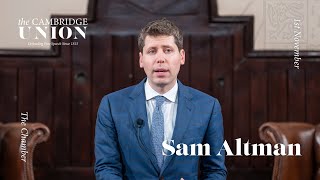 Sam Altman on AI Safety and AGI: Cambridge Union Hawking Fellowship2023 · 64 min · full transcriptBest for his general framework on safety, public benefit, and why powerful AI should be built and released cautiously.
 Sam Altman on Agentic AI: Safety, Power, and the Next Leap2025 · 48 min · full transcriptBest for how his open-source thinking fits the next era of agentic systems, where capability and safety become even more tightly linked.
Questions people ask
Sources
Every quote above, word for word from the transcripts. Numbers match the text.
“Uh So in terms of what we'd like to see from governments, uh I think we've been like very mischaracterized here. We do think that international regulation is gonna be important for the most powerful models. Nothing that exists today, nothing that will exist next year. Uh But as we get towards a real super intelligence, as we get towards a system that is like more capable uh than like any humans. Um I think it's very reasonable to say we need to treat that with like caution and uh and a coordinate approach. But like we think what's happening with open source is great. We think start ups need to be able to train their own models and deploy them into the world and a regulatory response on that would be a disastrous mistake for this country or others. Um So the message we're trying to get across is you gotta embrace what's happening here.”
“I want an open source model that is as good as it can be that runs on my phone.”
“I do not think we have yet discovered a way to align a super powerful system.”
“We must build, release, and use AI safely.”
“I think we've been pretty consistent on our beliefs about safety, but willing to adapt when we've been wrong. But, you know, when we started this strategy of iterative deployment, that was, like, deeply hated by the AI safety community, and I think in retrospect, it was obviously correct. Um, and I'm glad we've had the courage to do the things we really believe in even when they're very unpopular and that we've mostly been right and that we've adapted when we've been wrong. I think that is, you know, I think that is the way to build sort of safe and robust systems. And so I hope, I hope we continue to do that and people, uh, you know, recognize it.”
“We may release it in a different way than we've released previous models.”
“I think if I had to pick some moment from what we've seen so far, I'd sort of pick ChatGPT.”
“I think if I had to pick some moment from what we've seen so far, I'd sort of pick ChatGPT. You know, it wasn't the underlying model that mattered. It was the usability of it, both the RLHF and the interface to it.”
“RLHF is how we align the model to what humans want it to do.”
“Keep asking questions, prompting. We want users to have a lot of control and get the models to behave in the way they want within some very broad bounds. And I think the whole reason for jailbreaking is right now, we haven't yet figured out how to, like, give that to people. And the more we solve that problem, I think the less need there will be for jailbreaking. Yeah. It's kinda like piracy gave birth to Spotify. People don't really jailbreak iPhones that much anymore, and it's gotten harder for sure, but also, like, you can just do a lot of stuff now.”
“The idea that the system represents the will of the people who are going to use it and be impacted by it, I think that's quite important.”
“Of course, but I'm much more interested in what our hundreds of millions of users want as a whole. I think a lot of the room has historically been decided in small elite summits. One of the cool new things about AI is our AI can talk to everybody on Earth, and we can learn the collective value preference of what everybody wants, rather than have a bunch of people who are, like, blessed by society to sit in a room and make these decisions, I think that's very cool. (Applause) And I think you will see us do more in that direction. And when we have gotten things wrong, because the elites in the room had a different opinion about what people wanted for the guardrails on image-gen than what people actually wanted, and we couldn't point to real-world harm, so we made that change. I'm proud of that.”
How this guide was made: drafted with AI from the full transcripts of the recordings cited, then checked: every quotation must match a transcript word for word and be the speaker's own words, and an independent review gates accuracy. Methodology and corrections.