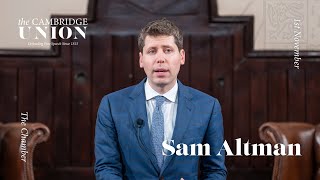
Sam Altman on Startups
Sam Altman sees AI startups as a rare chance for small teams to build faster than ever, but only if they create durable product value beyond temporary model gaps.
- He thinks this is an unusually strong moment to start an AI company.
- Small teams gain leverage from better models, coding tools, and agents.
- Founders should assume models will keep getting much better and cheaper.
- A startup is fragile if its edge depends on models staying weak.
- The durable moat is product depth, personalization, integration, and fast iteration.

This is one of the best moments ever to start an AI company
Altman’s basic view is highly optimistic: AI has shifted from a curiosity into a practical building layer, and that makes this a particularly good time for founders. He describes the current window as unusually favorable for builders because AI is now useful enough to turn ideas into products much faster than before.123
He also treats AI as a broad platform shift, more like infrastructure than a niche tool. That matters for startups because platform shifts create openings for new companies, new workflows, and new categories before markets fully settle.45
“It's the best time yet.”YC AI Startup School interview, San Francisco, 2025 · full transcript →
AI gives tiny teams outsized leverage
A central part of Altman’s argument is that modern models dramatically increase what one person or a very small team can do. He points to systems that can write, code, answer technical questions, and increasingly act like on-demand software creation, which compresses the path from idea to prototype to product.67
He sees coding agents as especially important because they change the economics of startup building. When software creation becomes faster and more agentic, founders can test more ideas, serve customers sooner, and compete with organizations that used to have a major headcount advantage.8
Build for a world where models improve fast
Altman repeatedly warns founders not to anchor on today’s model limits. His strategy assumption is that models will continue to improve through scaling and related advances, so businesses built on the belief that model capability will stay mostly flat are exposed.91011
He pairs that with a pricing view: intelligence is likely to get much cheaper over time. If capability rises while cost falls, then simple access to AI will not stay scarce, and products that depend only on being early with AI features can be overtaken quickly.1211
Using AI is not a moat
Altman is explicit that merely adding AI to a product is not enough to create lasting defensibility. Startups can get a burst of growth by adopting a new technology early, but that does not repeal normal business rules around product quality, competition, and customer value.13
His implied test for founders is simple: if your edge disappears when frontier models get better, cheaper, or built into major platforms, then you do not yet have a real moat. The startup has to offer something enduring that survives rapid model progress.1112
The better moat is personalization, integration, and iteration speed
Where does Altman think durable value will live? Not mainly in the raw model, but in products that are deeply personalized and embedded in real user workflows. He suggests long-term differentiation will come from systems tuned to individual users and contexts, not generic intelligence alone.16
He also emphasizes iteration speed. As models keep changing, the winning startup is not the one that predicts the future perfectly, but the one that learns fastest, ships fastest, and improves cheaply from user feedback.177
This leads to a practical founder strategy: pick a strong wedge, build close to the user, integrate where work already happens, and keep refining as capabilities expand. Conviction matters, but so does humility, because the exact path forward is uncertain even while the overall trend is clear.18719

“…the companies that have the quickest iteration speed…”Snowflake Summit keynote, San Francisco, 2024 · full transcript →
Platforms and distribution are becoming part of the startup opportunity
Altman’s startup view is not only about model capability; it is also about new routes to reach users. He highlights a world where developers can build inside ChatGPT and tap into built-in distribution, which lowers the friction between product creation and product discovery.20
That suggests a broader lesson for AI founders: look for startup ideas that match the native surfaces where users already interact with AI. If AI becomes a daily interface for work and consumer tasks, products that fit naturally into those interfaces may have an advantage over standalone tools with high adoption friction.220
“We’re opening up ChatGPT for developers to build apps inside of ChatGPT.”OpenAI DevDay opening keynote, 2025 · full transcript →
Altman on startups, in his own words
“This is the best time in history to be a builder.”
“It's the best time yet.”
“When we just do our fundamental job, we're gonna steamroll you.”
“…the companies that have the quickest iteration speed…”
Where to watch
 Sam Altman on AGI and Startup Building: Build the Future2025 · 47 min · full transcriptBest single discussion of why Altman thinks this is a great startup moment, and why conviction still has to be paired with real business building.
 Sam Altman on OpenAI's Strategy: Models Will Steamroll Startups2024 · 53 min · full transcriptBest warning on why startups built on static-model assumptions are vulnerable as frontier models improve.
 Sam Altman on AI Reasoning and Agents: Build Fast, Iterate Faster2024 · 58 min · full transcriptBest on the operating style Altman recommends: iterate quickly, learn cheaply, and build with today’s tools instead of waiting.
 Sam Altman on AI and Career Leverage: Build Faster, Learn Faster2024 · 45 min · full transcriptBest on how AI increases individual leverage and what that means for small teams and founder skill-building.
 Sam Altman on AI Apps and Agents: Build in ChatGPT2025 · 53 min · full transcriptBest on new distribution and product opportunities as AI apps and agents move into ChatGPT.
 Sam Altman on GPT-5 and Superintelligence: What's Next2024 · 65 min · full transcriptBest for understanding the capability trend behind Altman’s advice to founders: models are improving, but still uneven in important ways.
Questions people ask
- What did Sam Altman say about building with AI in 2025?
- What warning does Sam Altman give about building an AI startup?
- Why does Sam Altman say an AI startup still needs a moat?
- What did Sam Altman say about how much innovation current AI models can unlock?
- What did Sam Altman say about peer groups and choosing good people around you?
- What did Sam Altman say about Codex in 2025?
Sources
Every quote above, word for word from the transcripts. Numbers match the text.
“This is the best time in history to be a builder.”
“AI has gone from something people play with to something people build with every day.”
“It's the best time yet.”
“I think it would be approximately as bad of an idea to say we're not going to have AI in our country as it was to say we're not going to have electricity in our country…”
“I think the same thing is going to happen with AI…”
“…one piece of software that can do all of these things…”
“No one knows what happens next.”
“…the coding agent we just launched called Codex has been one of my, like, feel-the-AGI moments…”
“…this model is quite remarkable in many ways quite limited in others…”
“…we just need to keep scaling the models…”
“When we just do our fundamental job, we're gonna steamroll you.”
“The cost of intelligence is about to get really really cheap.”
“…using AI itself does not create a defensible business…”
“The long term differentiation will be the model that's most personalized to you.”
“…the companies that have the quickest iteration speed…”
“Most of the world still does not understand the value of, like, a fairly extreme level of conviction on one bet.”
“One of the many things that I'm very grateful about getting exposure to from the world of startups is how many times you see that again and again and again. And before... I think before YC, I I really had this deep belief that somewhere in the world, there were adults in charge, adults in the room, and they knew what was going on. And someone had all the answers. And, you know, if someone was pushing back on you, they probably knew what was going on. And the degree which I now understand that... You know, to pick up the earlier phrase, you can just do stuff. You can just try stuff. No one has all the answers. There are no, like, adults in the room that are gonna magically tell you exactly what to do. And you just kinda have to, like, iterate quickly and find your way. That was, like, a big unlock in life for me to understand. There is a difference between being high conviction just for the sake of it.”
“We’re opening up ChatGPT for developers to build apps inside of ChatGPT.”
How this guide was made: drafted with AI from the full transcripts of the recordings cited, then checked: every quotation must match a transcript word for word and be the speaker's own words, and an independent review gates accuracy. Methodology and corrections.