Sam Altman on AI For Science
Sam Altman sees AI for science as one of AI’s highest-value uses: a way to make discovery faster by giving researchers far more capable, widely available intelligence, while improving safety and governance as systems grow more powerful.
- Altman is personally most excited about AI for science because he sees scientific discovery as a main driver of human progress.
- He thinks better, cheaper, more widely available intelligence can help science, medicine, climate work, and invention.
- He expects AI to make scientists more productive before it fully automates discovery.
- He also thinks true scientific discovery is among the hardest remaining frontiers for AI.
- As AI becomes more agentic and powerful, he argues science gains must be paired with strong safety and coordinated rules.

“…abundant intelligence, and closely related to that, abundant energy…”World Governments Summit, Dubai, 2024 · 0:43
AI for science is one of the outcomes Altman cares about most
Altman treats AI for science as a top-tier use case, not a side benefit. He says he is personally most excited about it and ties that excitement to a broader belief that new scientific discovery is one of the biggest reasons life gets better over time.1
In his view, science matters because it expands what humanity can do. He connects discovery to doing more with less, pushing back constraints, and opening new frontiers of possibility rather than just making existing work cheaper or faster.1
That is why he repeatedly places scientific discovery alongside healthcare, education, and climate work when describing the upside of advanced AI. He sees broad access to intelligence as a tool that can raise capability across many of the fields that most shape human welfare.234
His core mechanism is abundant intelligence
Altman’s basic model is that progress accelerates when intelligence becomes far more available and far less expensive. He often pairs this with abundant energy, arguing that those two inputs together could unlock unusually large gains across science and the rest of the economy.546
Applied to science, that means many more people and institutions can work with stronger reasoning, better technical assistance, and faster iteration. Instead of reserving elite analytical capacity for a few labs, AI can spread it broadly as a general-purpose tool.36
He does not frame this as magic. He frames it as a powerful tool whose value comes from what people do with it, and he expects researchers to use better tools to produce results that surprise us.768
“…abundant intelligence, and closely related to that, abundant energy…”World Governments Summit, Dubai, 2024 · full transcript →
Near term, AI helps scientists become more productive
Altman’s near-term view is practical: scientists using current models can already become more productive. He says researchers are reporting that newer systems are helping enough to matter for what they can discover, which suggests the first impact is amplification of human researchers rather than replacement of them.1
This fits his broader description of modern AI as already impressive but still uneven. He describes current systems as remarkable in some ways and limited in others, which implies that scientific use today is real but not complete.9
He also points to plausible high-value areas where faster discovery would matter enormously. In discussing what AI might help uncover, he entertains breakthroughs such as superconductors as being within the realm of physical possibility, showing that he thinks AI could contribute not just to paperwork or literature review but to frontier invention.1

“…this model is quite remarkable in many ways quite limited in others…”Huge Conversations interview, 2024 · full transcript →
Long term, genuine discovery is one of the hardest and most important frontiers
Altman does not suggest that science is easy for AI. He explicitly places genuine scientific discovery among the hardest remaining challenges, which makes progress here especially meaningful in his overall picture of AI development.9
That matters because his definition of more advanced AI is not just a chatbot that answers questions better. He is interested in systems that grow steadily more capable, more general, and eventually better than top humans at difficult research tasks.11
So in his framework, AI for science is both a test and a payoff. If systems can help produce real discovery, that demonstrates a deeper level of capability; and if they do, the benefits could spill into medicine, materials, energy, and climate work at large scale.246
Scientific upside does not remove the need for safety
Altman consistently pairs optimism about scientific acceleration with caution about how these systems are built and deployed. His position is that AI should be built, released, and used safely, not that benefits justify moving recklessly.12
This becomes even more important as systems shift from answering questions to acting in the world. He calls the rise of agentic AI the most consequential safety challenge yet, which matters for science because the same systems that can run more ambitious research workflows may also create larger risks if they are unreliable or misused.13
He also emphasizes that today’s systems are not yet where they need to be on reliability. So his case for AI in science is not that the problem is solved, but that the capability trend is strong enough to pursue while improving safeguards, incentives, and oversight.1415
He wants the gains from AI for science to be broadly shared
Altman’s science vision is tied to a distributional vision. He talks about making intelligence broadly available, which means the benefits of AI-enabled discovery should not stay trapped inside a few firms or countries.3
He also supports a collaborative approach to governance as capability rises. His view is that society is collectively writing the rule book, and that public institutions should learn from real deployment instead of responding only with bans or closed-door decisions.1617
That matters for AI for science because the upside is largest when powerful tools spread into education, public services, medicine, climate work, and research communities widely. In his framing, broad access is not separate from scientific progress; it is part of how progress turns into human benefit.342
Altman on ai for science, in his own words
“…abundant intelligence, and closely related to that, abundant energy…”
“Our uh abundant and inexpensive intelligence. Um The more powerful, the more general, the smarter, the better. Uh I think that is A G I and then, and then abundant and cheap energy. And if we can get these two things done in the world, then uh it's almost like difficult to imagine how much else we could do. Uh We're, we're big believers that you give people better tools and they do things that astonish you. And I think A G I will be uh the best tool humanity has yet created uh with it, we will be able to solve all sorts of problems. We'll be able to express ourselves in new creative ways. We'll make just incredible things um for each other, for ourselves, for the world, for, for kind of this unfolding human story.”
Where to watch
 Sam Altman on Agentic AI: Safety, Power, and the Next Leap2025 · 48 min · full transcriptBest single watch for why Altman is personally excited about AI for science right now, including how current models are already helping scientists.
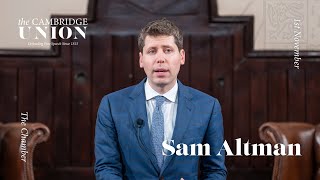 Sam Altman on AI Safety and AGI: Cambridge Union Hawking Fellowship2023 · 64 min · full transcriptStrong overview of his view that AI can accelerate scientific discovery, but only with safety built into deployment.
 Sam Altman on Global AI Governance: Build the Rule Book Together2024 · 21 min · full transcriptShows how he connects scientific progress to broadly available intelligence, energy, climate, and public policy.
 Sam Altman on GPT-5 and Superintelligence: What's Next2024 · 65 min · full transcriptUseful for understanding his belief that true scientific discovery is a hard frontier even as models become much more capable.
 Sam Altman on the Future of AI: AGI, safety, and jobs2023 · 50 min · full transcriptHelpful for the limits side of the story: reliability still needs work even as AI grows more useful and general.
Questions people ask
- What did Sam Altman say about AI for science?
- How does Sam Altman define AGI?
- What did Sam Altman say about whether AGI will be good for society?
- What does Sam Altman think governments should do about AI regulation?
- Why does Sam Altman think AGI matters so much?
- What did Sam Altman say about how much innovation current AI models can unlock?
Sources
Every quote above, word for word from the transcripts. Numbers match the text.
“The thing that I'm personally most excited about is AI for science at this point. I am a big believer that the most important driver of the world and people's lives getting better and better is new scientific discovery. We can do more things with less, we sort of push back the frontier of what's possible. We're starting to hear a lot from scientists with our latest models that they're actually just more productive than they were before. That's actually mattering to what they can discover. CA: What’s the plausible near-term discovery, like, room temperature -- SA: Superconductors? CA: Superconducting, yeah. Is that possible? SA: I don't think that's prevented by the laws of physics. So it should be possible. But we don't know for sure.”
“AI can significantly accelerate the pace of scientific discovery.”
“…the benefits to humanity of making intelligence broadly available…”
“…abundant intelligence, and closely related to that, abundant energy…”
“…the cost of intelligence and the abundance that comes with that, the cost dramatically falls…”
“Our uh abundant and inexpensive intelligence. Um The more powerful, the more general, the smarter, the better. Uh I think that is A G I and then, and then abundant and cheap energy. And if we can get these two things done in the world, then uh it's almost like difficult to imagine how much else we could do. Uh We're, we're big believers that you give people better tools and they do things that astonish you. And I think A G I will be uh the best tool humanity has yet created uh with it, we will be able to solve all sorts of problems. We'll be able to express ourselves in new creative ways. We'll make just incredible things um for each other, for ourselves, for the world, for, for kind of this unfolding human story.”
“It's fascinating intellectually, and I also think it is one of these things that will be tremendously net beneficial. Yeah. Like, you know, we've been talking a lot about problems in the world, and I think that's just always a nice reminder of how much we get to improve, and we're gonna get to improve a lot. And this will be... I think this will be the most powerful tool we have yet created to help us go go do that.”
“…this will be the most powerful tool we have yet created to help us go go do that…”
“…this model is quite remarkable in many ways quite limited in others…”
“What I think matters though, and what people want to know is not where is this one, you know, magic moment of, “We finished.” But given that what looks like is going to happen is that the models are just going to get smarter and more capable and smarter and more capable, on this long exponential, different people will call it AGI at different points. But we all agree it’s going to go way, way past that. You know, to whatever you want to call these systems that get much more capable than we are. The thing that matters is how do we talk about a system that is safe through all of these steps and beyond, as the system gets more capable than we are, as the system can do things that we don't totally understand.”
“We must build, release, and use AI safely.”
“I think the most interesting and consequential safety challenge we have yet faced.”
“…we're not where, where we need to be…”
“In fact, so much so that any time you can spend thinking about how to correctly set the incentives on a person, a team, an organization, whatever, that's like probably the highest leverage thing you can do.”
“…we're all writing the rule book together…”
“The idea that the system represents the will of the people who are going to use it and be impacted by it, I think that's quite important.”
How this guide was made: drafted with AI from the full transcripts of the recordings cited, then checked: every quotation must match a transcript word for word and be the speaker's own words, and an independent review gates accuracy. Methodology and corrections.
