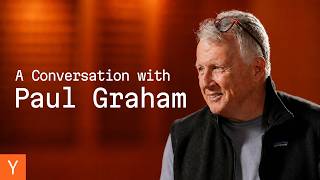
Paul Graham on Y Combinator
Paul Graham sees Y Combinator as a founder-focused, batch-based way to fund and help startups early, built to give ambitious builders speed, peers, and practical advice rather than bureaucracy.
- YC was built for very early founders who needed small checks, fast decisions, and real help, not long VC processes.
- Its key innovation was funding many startups at once, which gave founders peers, reduced loneliness, and improved learning.
- Graham thinks the decisive variable is founder quality more than the initial idea, especially ambition, authenticity, and evidence of building.
- YC worked and grew largely because it helped founders a lot, and those founders told other founders.
- As YC became larger, Graham believed it needed to outgrow its original one-person style and become a durable institution.

“…when you fund an early stage startup it's more about the founders than the idea…”Leap Forward podcast episode, 2026 · 0:01
YC started as a practical fix for a broken early-stage funding process
Graham’s basic view is that Y Combinator was created to solve an obvious problem for very early founders: they needed small amounts of money, quick decisions, and useful advice, while traditional venture processes were too slow and mismatched to that stage1. He describes YC as serving the earliest phase rather than acting like a conventional VC fund waiting for more proof2.
Just as important, he says YC was not originally conceived as a grand institution or a money machine. It began as an experiment to help founders in a way he and Jessica Livingston wished had existed when they were starting a company themselves342.
“…when you fund an early stage startup it's more about the founders than the idea…”Leap Forward podcast episode, 2026 · full transcript →
The batch model was YC’s real breakthrough
Graham thinks the defining innovation in YC was not merely writing small checks but funding many startups at the same time56. He repeatedly frames YC as a batch system: many companies apply, interviews happen quickly, and accepted founders go through an intense shared period together78.
Why does that matter? Because startups are lonely, and batches give founders colleagues, comparison points, and a place to trade solutions in real time69. In his account, the group structure benefits investors, but it also gives startups some advantages of a company environment without taking away their independence6.
He also ties the batch model to speed and early learning. YC compresses the first phase of a startup into a short, focused period with dinners, advice, and pressure to launch and learn from users fast107.

“The most critical innovation with the YC model is to fund a bunch of startups at once.”Bloomberg Studio 1.0 interview, 2014 · full transcript →
YC bets on founders more than ideas
Across his comments on YC, Graham returns to one principle: the biggest outcomes come from the right founders, not from selecting the perfect idea on paper111. He explicitly says early-stage investing is more about founders than ideas, which explains why YC selection puts so much weight on the people in the room1.
What kind of people does he mean? Founders need ambition because startup work is too hard for duty alone, and much of the day-to-day drive comes from not wanting to fail121314. He also values authenticity and evidence that someone has made things because they genuinely wanted to, not because a résumé demanded it1516.
This founder-first view also explains why short interviews can work in his eyes. He believes you can learn a lot by working with founders immediately, even for a few minutes, because the interview is already a sample of what it is like to engage with them17.

“The answer to your question, where the next giant company comes from is it comes from the right founders.”YC discussion, 2026 · full transcript →
YC helps by pushing focus, candor, and fast contact with users
Graham’s picture of YC is intensely practical. He emphasizes release, learning from users, and doing the most important thing rather than getting distracted by status activities such as casual investor meetings at the wrong time1018.
He is skeptical of polished long-range plans at the earliest stage, because startups change too much for that to be the center of judgment19. What matters more is whether founders can build, stay determined, tell the truth about their situation, and keep going long enough to evolve the company2021.
This is why YC in his telling is not just capital. It is concentrated advice during the first months, pressure to make something users want, and direct conversations with founders about their actual problems2223.
YC spread because founders trusted it and told each other
Graham does not present YC’s growth as the result of clever marketing. He says they did not consciously optimize for more applicants; the main driver was that founders felt genuinely helped and passed that on to friends242526.
That growth pattern fits his larger worldview about startup communities: peers matter enormously, and trust often travels through founder networks faster than through formal promotion252627. YC’s alumni network became powerful for the same reason the batch model worked in the first place: founders learn from and believe one another256.
He also connects YC’s appeal to environments where ambitious people collide and help one another. His comments about Silicon Valley make clear why a program like YC benefits from density, serendipity, and a culture where people help for no immediate reason272829.

“I think people who did YC would tell their friends, "Yeah, we did this thing, it was really good.”The Social Radars podcast, 2023 · full transcript →
As YC grew, Graham wanted it to become a lasting institution
Graham’s later comments show a shift from founder-operator to steward. He says plainly that he was no longer running YC day to day, and the reason was not loss of interest in founders but the belief that the organization had become too large for its earlier style of management3031.
He still loved the core work of talking with founders and helping with ideas, but he wanted someone else to run the larger institution as YC expanded222331. That fits his stated goal that YC should persist for a long time rather than remain a personality-driven project32.
So his view of YC is not static. It began as a small, founder-centered experiment, succeeded because its design matched startup reality, and then had to mature organizationally in order to preserve that mission at larger scale33132.
“I want YC to be like this institution that persists for a long time.”Bloomberg Studio 1.0 interview, 2014 · full transcript →
Graham on y combinator, in his own words
“The most critical innovation with the YC model is to fund a bunch of startups at once.”
“We are applying mass production techniques to venture funding.”
“…when you fund an early stage startup it's more about the founders than the idea…”
“If you had to boil it down into one word, what you're looking for, it's authentic.”
“The answer to your question, where the next giant company comes from is it comes from the right founders.”
“I think people who did YC would tell their friends, "Yeah, we did this thing, it was really good.”
Where to watch
 Paul Graham on Y Combinator Origins: Step-Down and Handoff2014 · 21 min · full transcriptBest short overview of why YC started, what its main innovation was, and how Graham thought about founder selection.
 Paul Graham on Startups and Innovation: How Y Combinator Works2009 · 63 min · full transcriptBest explanation of how the YC model actually works as a batch-based seed fund and why it differs from traditional VC.
 Paul Graham on Y Combinator Origins: Why Jessica Mattered2026 · 39 min · full transcriptBest on the original problem YC was built to solve and why Jessica Livingston’s judgment mattered so much.
 Paul Graham on Y Combinator Growth: Why Sam Altman Took Over2014 · 55 min · full transcriptBest for understanding how YC evolved from a small experiment into a larger institution and why Sam Altman took over.
 Paul Graham on Early-Stage Investing: Build, Survive, Be Honest65 min · full transcriptBest on what YC looks for in founders and why building ability and candor matter more than forecasts.
 Paul Graham on YC Growth and Early Days: From Word of Mouth to Scale2023 · 63 min · full transcriptBest on how YC grew mostly through founder word of mouth and the strength of its alumni network.
Questions people ask
- What did Paul Graham say about Y Combinator and mass production?
- What did Paul Graham say was the biggest innovation of Y Combinator?
- What did Paul Graham say was the secret to Y Combinator's success?
- Why does Paul Graham say YC interviews work?
- Why does Paul Graham say founders need to be ambitious?
- Was Y Combinator started to make money?
Sources
Every quote above, word for word from the transcripts. Numbers match the text.
“…when you fund an early stage startup it's more about the founders than the idea…”
“It's not about the money.”
“It was not supposed to grow into this big thing.”
“People just do not realize how, like, not interested we were in making money. I'm thinking of all these people saying on forums, oh, it's so self serving. But, honestly, in the beginning, we were not trying to make money.”
“The most critical innovation with the YC model is to fund a bunch of startups at once.”
“The most critical innovation with the YC model is to fund a bunch of startups at once. So it's better for the investor, but also better for the startups because they have colleagues. That is the big thing you're missing in a startup. It's so lonely, and now it's like it has some of the advantages of being part of a company without the disadvantages.”
“We are applying mass production techniques to venture funding.”
“There are patterns, but not not in ideas. We screen them... We we do everything in batch, what what computer people call batch mode. What we're doing, if you wanna if you wanna understand what we're doing in one sentence, it is we are applying mass production techniques to venture funding. Right? Now, we didn't set out to be doing this. We realized about six months in, you know, what we've been doing is we've been applying mass production to venture funding. Right? There's this pattern you see over and over again in economic history where there's something that's made one at a time very expensively and unreliably. Right? And someone comes along and figures out how to, like, rationalize the process and produce a whole bunch of them all at once using standardized procedures and stuff like that. Right?”
“The best answer you can give is like, we're on the smear.”
“The point of releasing is to start learning from your users…”
“The answer to your question, where the next giant company comes from is it comes from the right founders.”
“The obstacles are too fearsome for mere dutifulness to do it.”
“What actually motivates founders day to day? The fear of failure.”
“When did I figure out that founders had to be really ambitious? I think, um, I already knew that before we started YC because when we started YC we already had all this experience of doing a startup ourselves, right? And so we knew that it was grueling. And you need, you need something to drive you through all those obstacles and honestly being dutiful is not enough. The obstacles are too fearsome for mere dutifulness to do it. So there's got to be something driving you and you call it ambition.”
“If you had to boil it down into one word, what you're looking for, it's authentic.”
“What have you made outside of school or work because you liked it?”
“The weird thing about YC interviews is in a sense, they're a negotiation, right? And in a negotiation, you're always saying Oh, I'm not going to pay a lot for that. It's terrible. It's worthless, right? And yet in YC interviews, the founders often walk out thinking Wow! Our idea is a lot better than we thought! Just because what we do. You know what we do in YC interviews? We basically start YC. The first ten minutes of YC is the interview. So you see what it's like to work with people by working with them for ten minutes. And that's enough, it turns out.”
“You know, there's a meta answer to that. Let me... Most important thing for startups to do is to focus. Ah. Right? Because there's so many things you could be doing. One of them is the most important. You should be doing that and not any of the others. Right? So you should not be grabbing coffee with investors. Right? When you wanna raise money, you shift into fundraising mode and you go and raise money. You do not, like, promiscuously meet with investors in the middle of the day when you should be working simply because they, like, send you an email saying, hey. Let's grab coffee. Right? Right. And there's there's, like, a thousand things you could be doing, and only one of them is the most important. You do the most important thing. It's like optimizing software. There is something that is currently the bottleneck to making the software faster. You work on that.”
“…five-year plans aren't worth the ink cartridge that they are that they're written with…”
“The better the investor, the more it should be like going to the doctor…”
“As long as the founders haven't given up, they can morph the company into anything…”
“That's what it's like. They're like, here's what we're working on. How can we get users? What could this idea be? They don't usually ask me that. I just tell them. And so, that's why I have so much energy. That's why I always liked working on YC. That's the part I like. I don't like arguing with people who are trying to maltreat the startups. Um— >> That's Garry's job now. >> Yeah. [laughter] Yeah. Poor Garry. Um, only someone who's done it knows what it's like. But, I love—I don't think I would ever get bored of talking to founders about their ideas.”
“Well, the reason I have so much energy is not because I'm benevolent and have infinite desire to help them. I mean, I want to help them, but the thing that really makes me energetic is that I'm interested in their ideas. It's like… It's like imagine if you were into puzzles of some kind, and people came and supplied you with a constant stream of new puzzles, right?”
“…we never did anything all that consciously to get more people to apply…”
“I think people who did YC would tell their friends, "Yeah, we did this thing, it was really good.”
“I think we actually helped the startups a lot. And so they would tell one another. Like, if we had sucked, it would be like, you know, your friends go to a restaurant, right? And if the food's really good, they tell you, "Hey, you should go to this restaurant, the food's really good." I think people who did YC would tell their friends, "Yeah, we did this thing, it was really good. They helped us a lot. They helped us get investment. Look how they incorporated our startup. They did all this, like, stuff for us." I think it was simply that it helped them a lot and they would tell their friends, and then their friends would do it, too. And then, you know, well, that's a recipe for exponential growth because then their friends do it and then there's more people out there.”
“There's nothing in the world that's better than serendipitous meetings with people who are working on the same stuff.”
“In Silicon Valley, people help you for no reason.”
“And the answer is the same now as it always is. Yes, you should. You can go there for a bit and then come back, but you should at least go. The reason is the same reason it's worthwhile to move within one country. If you were living in a small village and you were interested in startups, obviously, you'd benefit from moving to the capital, right? Where there'd be a lot of other people doing it or at least somebody else doing it. Well, that doesn't change when you're moving across a dotted line on a map, right? That reasoning doesn't even know the dotted line is there.”
“I'm not running the show anymore.”
“Y Combinator's gonna have to grow.”
“I want YC to be like this institution that persists for a long time.”
How this guide was made: drafted with AI from the full transcripts of the recordings cited, then checked: every quotation must match a transcript word for word and be the speaker's own words, and an independent review gates accuracy. Methodology and corrections.