Paul Graham on Risk
Paul Graham sees risk as the engine of startups: society gets more innovation only when founders, employees, and investors have enough upside to justify taking hard, uncertain bets.
- Risk and reward have to stay proportionate or people stop taking ambitious startup bets.
- Startups are one of the clearest cases where capped upside means fewer founders, investors, and early employees will take the leap.
- The right response to startup risk is not bureaucratic safety but many small bets on exceptional founders.
- Big opportunities often feel scary at first, and founders need real ambition to push through fearsome obstacles.
- Early-stage risk is manageable less through prediction than through building, learning from users, and backing founders who can adapt.

“The problem here is not wealth but corruption.”DEF CON 13, Alexis Park, Las Vegas, 2005 · 18:11
For Graham, risk is not a flaw in startups but the point
Graham’s core claim is simple: high-risk work needs high potential reward. If the upside is reduced, people become less willing to take uncertain bets, and some categories of ambitious work stop happening at all. That is especially true in startups, where the odds are uncertain and the payoff has to compensate for that uncertainty.12
He pushes this argument further than most people do. In his view, if you try to eliminate the economic differences produced by successful startups, you also eliminate much of the reason to found or fund them in the first place. That is why he treats startup inequality less as a social accident than as part of the incentive structure that makes innovation possible.34
Why limiting upside kills innovation
Graham connects inequality to innovation through incentives. Founders, venture investors, and early employees all accept serious uncertainty, and they do so because the reward can be disproportionately large if things work. Remove that possibility and many rational people will choose safer paths.32
That is why he thinks attacks on wealth often miss the real problem. The target should be corruption, not the rewards from creating valuable companies. In his framing, wealth from risky creation and wealth from hidden influence are different things, and confusing them leads to policies that make a country poorer without fixing abuse.5
“The problem here is not wealth but corruption.”DEF CON 13, Alexis Park, Las Vegas, 2005 · full transcript →
Big startup ideas are supposed to feel scary
Graham does not treat fear as evidence that an idea is bad. He says the biggest startup ideas are often frightening, which means founders should expect strong ideas to feel uncomfortable rather than safe. The risk is psychological as well as financial: big opportunities can threaten your identity because they force you to attempt something that seems beyond you.7
His practical advice is not to predict the whole future in detail. Instead, start with a small but intense wedge and grow from there. He prefers concrete entry points over grand forecasting, because early-stage success comes from finding a live edge of demand and moving into it.8
Founders take risk because they are driven, not because they like danger
Graham thinks startups are too hard for shallow motives. Founders need ambition because the obstacles are severe, and ordinary dutifulness will not carry them through. Risk-taking in startups is therefore less about thrill-seeking than about having a strong enough internal drive to keep going.10
He also gives a more realistic picture of day-to-day motivation. Founders are often propelled less by fantasies of wealth than by the fear of failure. That matters because it explains why risky work can be sustained over long periods: people endure uncertainty not because it feels good, but because they care intensely about making something work.1213
This is also why he keeps returning to founders rather than ideas. Ideas can change, but the people taking the risk are the fixed asset. In uncertain environments, the quality of the founders matters more than the initial plan.15
The right way to handle startup risk is many small bets and fast learning
Graham’s investing model does not try to remove risk. It tries to deal with it intelligently by making many early bets and standardizing the process. He describes this as applying mass-production techniques to venture funding, which means accepting that individual outcomes are uncertain while building a system that can discover rare big winners efficiently.1718
This approach fits a world where startups are cheaper to start and easier to test. When computers are cheaper, distribution is easier, and software can be built faster, investors can fund more experiments and founders can learn sooner whether they are onto something. That lowers the cost of taking a shot without changing the basic uncertainty of the shot itself.19
At the company level, he distrusts elaborate forecasts. He prefers releasing, learning from users, and staying flexible. Since founders can morph the company as long as they have not given up, resilience and adaptation matter more than pretending the future is predictable.202122
Graham on risk, in his own words
“If that kind of risk doesn't pay, venture investing, as we know it, doesn't happen.”
“Eliminating economic inequality means eliminating startups.”
Where to watch
 Paul Graham on Inequality and Risk: Why Startups Need Upside2005 · 26 min · full transcriptHis clearest statement of why startup risk requires large upside and why safety-first economics damages innovation.
 Paul Graham on Startups and Innovation: How Y Combinator Works2009 · 63 min · full transcriptShows how to respond to startup risk in practice: fund many bets, release early, and learn fast.
 Paul Graham on Startup Investing: It’s About the Founders2010 · 10 min · full transcriptExplains why, under uncertainty, founders matter more than initial ideas in early-stage investing.
 Paul Graham on Big Startup Ideas: Seven Huge Bets2009 · 47 min · full transcriptExplains why the best startup opportunities often feel frightening and how to attack them with a small wedge.
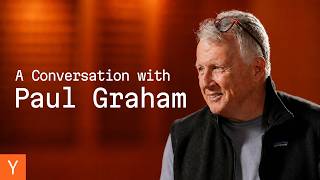 Paul Graham on Startups and Ambition: Great Founders Win2026 · 21 min · full transcriptBest for understanding the founder psychology behind taking and surviving serious startup risk.
 Paul Graham on Early-Stage Investing: Build, Survive, Be Honest65 min · full transcriptAdds the operating view: ignore fake certainty, be candid, and keep adapting as long as the founders persist.
Questions people ask
- How does Paul Graham think startups should tackle huge ideas?
- What did Paul Graham say about Y Combinator and mass production?
- What did Paul Graham say about economic inequality and risk?
- What does Paul Graham say matters most when choosing startup founders?
- Why does Paul Graham say founders need to be ambitious?
- How does Paul Graham think wealth becomes power?
Sources
Every quote above, word for word from the transcripts. Numbers match the text.
“The problem is risk and reward have to be proportionate.”
“The problem is risk and reward have to be proportionate. A bet with only a 10% chance of winning has to pay a lot more, in fact, somewhat more than five times more than a bet with a 50% chance of winning. So if you lop off the top of the possible rewards, you decrease people's willingness to take risks. Transposing into our original expression, we get decreasing economic inequality means decreasing the risk people are willing to take. There are whole classes of risks that are no longer worth taking if the maximum return is decreased.”
“If that kind of risk doesn't pay, venture investing, as we know it, doesn't happen.”
“Eliminating economic inequality means eliminating startups.”
“The problem here is not wealth but corruption.”
“The biggest startup ideas are frightening…”
“…the best way to do these big ideas is not to try and identify a precise point in the future…”
“The obstacles are too fearsome for mere dutifulness to do it.”
“What actually motivates founders day to day? The fear of failure.”
“It's not about the money.”
“What you can't change is the founders.”
“We are applying mass production techniques to venture funding.”
“There are patterns, but not not in ideas. We screen them... We we do everything in batch, what what computer people call batch mode. What we're doing, if you wanna if you wanna understand what we're doing in one sentence, it is we are applying mass production techniques to venture funding. Right? Now, we didn't set out to be doing this. We realized about six months in, you know, what we've been doing is we've been applying mass production to venture funding. Right? There's this pattern you see over and over again in economic history where there's something that's made one at a time very expensively and unreliably. Right? And someone comes along and figures out how to, like, rationalize the process and produce a whole bunch of them all at once using standardized procedures and stuff like that. Right?”
“Moore's law has made computers effectively free…”
“The point of releasing is to start learning from your users…”
“…five-year plans aren't worth the ink cartridge that they are that they're written with…”
“As long as the founders haven't given up, they can morph the company into anything…”
How this guide was made: drafted with AI from the full transcripts of the recordings cited, then checked: every quotation must match a transcript word for word and be the speaker's own words, and an independent review gates accuracy. Methodology and corrections.