Neil deGrasse Tyson on Quantum Gravity: Space-Time May Be Emergent
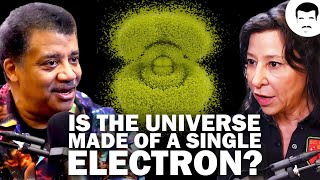

What Tyson talks about
Neil deGrasse Tyson joined Janna Levin for a StarTalk Q&A interview in 2021 on quantum gravity, emergent space-time, entanglement, and related questions from modern physics.
Also known as: Neil deGrasse Tyson & Janna Levin Answer Mind-Blowing Fan Questions; StarTalk Q&A; Janna Levin fan questions interview.
Tyson argues that space-time may not be fundamental at all, comparing gravity to water: a real phenomenon that could emerge from many smaller interactions. He says a deeper theory might reveal quanta of space-time or, even more radically, only quantum mechanics with gravity emerging from collective behavior.
He also explains why the Planck scale matters, why quantum gravity is tied to questions about quantizing space, and how Einstein’s general relativity can be rewritten in particle-field language. Along the way, he uses analogies like molecules, origami, and embroidery to make abstract physics more intuitive.
The conversation widens into entanglement, Bell experiments, and quantum teleportation, showing how modern physics challenges everyday ideas of locality, reality, and what it means for something to be 'real.'
Tyson speaks throughout, with Janna Levin and a StarTalk host joining the discussion.
In his words
“Reality isn't overrated, but realism is.”
“I'm saying gravity might not exist as a fundamental thing in the universe.”
“We might look deeper and deeper, and instead of finding quantum bits of spacetime, we will only find pure quantum mechanics with no gravity in it whatsoever.”
“Quantum gravity requires that spacetime be quantized.”
Key points
- Space-time may be emergent rather than fundamental.
- Gravity could arise from collective quantum interactions, like temperature or water.
- The Planck length marks a scale where current ideas about space-time may break down.
- Quantum gravity may reveal discrete bits of space-time, or may show gravity is not fundamental.
- Bell-type experiments support the non-local character of quantum mechanics.
- General relativity can be recast in field-theory language without leaning on geometry.
- Quantum teleportation uses entanglement plus prior communication, not sci-fi transport.
Full transcript: Neil deGrasse Tyson, StarTalk Q&A with Janna Levin (2021)
So, Janet, your field of study, most people would say, would be the most mind-blowing science that anyone does. You know, I could talk about stars and planets, and there's a tangibility to that. The expanding universe, it's a little weird, but it doesn't blow your mind. You think about stuff that's like, what if time is a dimension, the fourth dimension? Can you make a hypercube where time is the fourth dimension? Usually, we don't try to compactify time. I'm not saying no. Tried it is H2O, water. Everything we know and understand and love about water requires an ensemble of H2O. If you pull out one of them, do you get to call that water? We might look deeper and deeper and instead
of finding quantum bits of spacetime, we will only find pure quantum mechanics with no gravity in it whatsoever. One of my favorite experiences is when I have a huge shift, when I'm shocked, and I realize I've had some kind of preconceived notion that has just been shattered. Reality isn't overrated, but realism is. So there's a reality out there, but our attachment philosophically to realism is misplaced. All right. I have to like digest this for a moment. I'm telling you right now, this should be the end of the show right now. This is Star Talk. Neil deGrasse Tyson, you're a personal astrophysicist. We've got a Star Talk Cosmic Queries today.
With one of our favorites, or Chuck is she our very favorite. Uh, she's our very favorite theoretical physicist, that's for sure. That is for sure. Totally. I want to know who's on this list. So Jan 11, welcome back to Star Talk. Always fun to be here. Yeah, very glad. Chuck was saying we're getting closer and closer together here. Love it. Just for the video. For the video, you know why? Because we spent three years zoomed away in our— in our— so you're a theoretical physicist, and you're a professor. A tow professor, that's the founder of your endowed
chair, I guess. Yes. I think we say TOA, TAA, to Professor. Not get in trouble if I don't say it right. Yeah, not T, just to—to—the—to professor of astronomy and physics at Barard at Antic Columbia University, which is up the street here in New York City. And, uh, you've written several books, and forgive me, but all the titles of your three books have merged into one flow of words. You say them better than anybody else on the planet. So one of them is How the Universe Got Its Spots. How the Universe Got Its Spots, okay. The other one was Black Hole Survival Guide, yes. And the third one was Black Hole Blues. The Black Hole Blues, excellent. There's one more. I wrote a
novel. What? Yeah. I won—I won like a Pen Award for not for fiction. Yeah. You guys, you guys know 1% about me. I'm sorry. I am going to be your favorite by the end of today. W, what's the novel? So what's the novel? A Madman Dreams of Turing Machines. Maybe the title's too long. Wow. A Madman Dreams of Turing Machines. Allan, yeah. Okay. It's a little trippy. Wow. Sounds a long time ago. Oh wow. So it's—it's a—it's—a I thought it was something that was relatively new. No, it's not. It's where you started. So that's where your heart is. Yeah. Well, every once in a while, I dabble with unfinished fiction. What a sentence that is. Oh my
gosh. How many people get to say that? Very cool. Very cool. Well, all right. It's a—it's a Cosmic Queries, where our fan base knows you, and we left it wide open. Fun. Just have to be in your belly. Wick is theoretical cosmological relativistic physics, and she—she's ready for she-ing, ready to throw down. But before we do, I just want to catch up on a few things. Um, you are also very active in Pioneer Works. Just remind people briefly what that is. Pioneer Works is a cultural center. It's pretty new. It's for arts and sciences. It was founded by artist Dustin Yellen, and the founding artistic director is Gabriel Florence, and then I came in as the founding director of sciences. We're kind
of a triad, and we really have science and art really rubbing together. So we have exhibitions for artists rubbing in a good way, rub together in a bad way. You want—you Chas some WD4, but this one is rubbing so that they can influence. Yeah, and we're, you know, we're not crowbar things together in a—in a—I—I hope not a fake way. It's very, uh, genuine and spirited. It's a real labor of love. So we have organic—we've had you, Ne, we've had you, Chuck, and we performed. We performed a live Star Talk at your space and absolutely. I wasn't there for that. You were not there for that. I did something totally different. Paul Marcero, believe, was our PA, M
was. Yeah, we do, uh, like we'll have an exhibition about—we had one for the Hiroshima panels, which were made in 1945, and then we had conversations with scientists about nuclear energy and nuclear weaponry and the history of things like containment. And so we, we riff off each other, and you have a social conscience in—yes, definitely def. We're not, uh, we don't prescribe anything politically, morally, socially. It's—it's radical, as all art spaces have to be, in challenging, challenging even to our own ideas. And—but it very much is a place for community. I really believe that science is part of culture. It's at
the forefront of culture along with art, music. It doesn't have to be hidden like a wall inside the walnut of those other things that we have a community around inside the walnut. That's good, right? That's good. So I believe, like, people need a place to gather and to be together and to break bread and to talk about things and think about things. So I'm very much central to sort of our thinking around the place. If you come to an event, you'll stay after, you'll hang out in our garden. We often have telescopes. Scientists will mill around so you can ask them questions, and telescopes, because you have a relationship with the amateur astronomies. Yes, the New York City amateur, yes. The Amateur Astronomers Association of New York are tried and true. They're wonder member of them AMing.
10 years old? Yeah, they bring out the telescopes rain or shine. They're always there. They're terrific. For a while, I was getting test—well, they come out in the rain because even so, they'll be like, "I'll show you what a telescope looks like or how it operates." Like, they're really not observing shine, but they're there. Not observing rain or shine, right? But they'll—they—they hold great events around the city too if you join, like if you just want to look through a telescope and see, you know, celestial bodies. Like, they set up on The High Line and it's amazing. Go there. Now, you know, we're trying to build an observatory on top. IAU, wind of it? This is our big aspiration. Oh yeah, yes. And, you know, I know you and I were talking about it and there is a sense like, "Ah, I could buy a telescope for a couple of grand and—
It'll be great, right? And that is true. Okay, but we have this old telescope from 19, from 18, uh, 9395 that is being refurbished and it's just a stunning museum-quality piece and it's very inspiring to have that. And, of course, we'll have modern telescopes available, but that kind of central piece is going to be part of arts and performances around it, exhibition, ethos of what you're about. Yes. It's Rance. When you, when you refurbish it, but you—you put in like new glass and better? Actually, no. The glass is so excellent. We know the provenance of the, uh, of the lenses and they're incredible. They were made by kind of people at the peak of
that kind of engineering and craftsmanship. Cool. Very neat. That's—that's amazing stuff. That's amazing. All right, let's hope we hoist it up on the building without incident. So Jan, your field of study is—I bet most people would say—would be the most mind-blowing science that anyone does. Wow. Because it's just out—it's out there. Yeah. You know, I can talk about stars and planets and there's a tangibility to that, even the—even the expanding universe. It's a little weird but it's not—it doesn't blow your mind. You think about stuff that's like
what? One of my favorite experiences when I'm doing research is when I have a huge shift, when I'm shocked by something and I realize I've had some kind of preconceived notion that has just been shattered. Nice. And it's really amazing. I'm following the science. I'm not dragging it along, right? Right. And, um, yeah, it totally blows your mind. Many people who don't know the moving frontier of science think—and I think want to believe—that somehow we all sit around wanting to agree with one another, right? But in fact, the advance has come when someone says, "I have—I have an idea." Was it, uh, Isaac Asimov who said that true scientific discovery is never Eureka—
right? It's—that's odd. Yes. Just a little thing totally AB that doesn't fit that. Yeah. And I love—I really appreciate what you're saying. I really feel that debate is not actually how scientists operate. They don't sit there trying to win an argument. That would be so unscientific to do that. No, not at all. You want to say, "Wait, what? What are you—what are you talking about?" And basically it's, uh, I call BS. Yeah. That's really in a nutshell: I call BS and then you gotta set about to prove it. So Jenna, what I think you're saying is the way I've described it is two scientists in argument, there's an unwritten contract between them. Okay. Okay. Either I'm right and you're wron—you’re right and I'm
wrong, or we're both wrong. Both right. And if we can't agree at the end of that conversation, we do agree that more or better data will resolve it. Absolutely. In which case you could both be right. Well, so yes. So there are the rarer cases where we're both right. Right. If in the, in the classic example of the blind people touching an elephant, they give completely disparate accounts. Right. Okay. One is the trunk, one is the leg, one is the toenails, one is the tail, the tusk. And we can argue what the actual nature of that animal is, but at the end of the day we're all correct because it's all part of the same animal. And then there's a bigger vision—a bigger vision. So the bigger
visions are often very hard to reach, but that can happen, and it—it does—it can and does happen. I totally agree with you. One thing that drives me a little CRAZY is when people say, "Oh, science is always overturning what came before completely and rewriting, so why should I believe in it?" And that's not true. It's—it's—it's not only not true, it's very false. It's very false, very false. So, so if we were logicians, we would care about that distinction. So if I look back at what Newton did, it is absolutely a part of the elephant. An excellent description of a part of the elephant that he was able to palpate at the time. Einstein comes along and it's bigger. The no, right? Okay. So, you know, Einstein comes along and has a bigger vision, but he absolutely requires of his
work that it match Newton, right? Not that it has nothing to do with Newton. Suddenly when I pour my coffee, it doesn't go upward, right? Right. So, um, so cumulatively, Newton is a special case B within a larger understanding of the world, right? It was not overthrown, it was, uh, extended. Extended. Right. Cool. Right. We don't always—anything that was experimental determined to be true MH previously does not all of a sudden become false, right? It becomes embedded in a deeper truth. And that's true even— even when you look at continental drift, which famously had delayed acceptance among geologists, all the while they're still trying to understand.
Volcanoes and, and, and, they're still trying, and, and, and so they're coming up with local accounts for what would happen in a volcano when they had continental drift that just attached to the continental drift. And there's a lot of that science that was completely portable into the new idea that the surface of the Earth moves within itself. You ever wanted one of your questions on the universe answered? We all have questions about the universe: black holes, to quasars, quantum entanglement, wormholes. There is no end to the depths of cosmic curiosity. Well, the entry level of Patreon membership with StarTalk gets you just that.
I think it starts at $5 a month. You have access to the question line that reaches our Cosmic Query programming. And not only that, we produce a special Cosmic Queries installment just for Patreon members. If you were the director of the Hayden Planetarium, what do you think you would be doing? What? Okay, but this would have to be another universe. It wouldn't happen in this universe. Okay, I'd be, I'd be a songwriter for Broadway musicals. Oh. So that's the entry level, and the perks ascend from there. There's a level, in fact, where we send you an autographed copy of one of my
latest books. Right now, it's Star Messenger: Cosmic Perspectives on Civilization, and it's signed with my fancy fountain pen with purple ink. So, I invite you to just check the link below, and all of that money goes to our ability to experiment with new ways of bringing the universe down to Earth. So, thank you to those who have already joined, and we welcome others to participate in this grand adventure of what it is to bring the universe down to Earth. As always, keep looking up. So, I wonder, I wonder if we have any mind-blowing questions that await us. Well, we have questions now. Whether or not
mind-blowing, that remains to be seen. We're not going to blow Jan's mind, blow other people's mind. Oh, maybe that's what we'll find. See if we can find a—I'm susceptible, you know, I'm vulnerable to that. Find a question that blows Janna's mind, and we'll send you a special gift, which is a piece of my debris from the explosion. There you go. All right, this is David Garvin, and David says, "Hello, Neil deGrasse Tyson," Lord. Nice. I'm David, a mechanical engineer in Seattle. Now, we know that spacetime can stretch. Is there anything within known physics which requires that spacetime be infinitely elastic? Could dark matter observations be plastic deformation of spacetime dimples, as you
will, in spacetime, which would be non-interactive but are in two things we now call galaxies? Wow. Okay, so yeah, tell me about the stretchability, yeah, of space. Start there. Well, let's start there. Really, I think it's more of a dark energy tie-in than a dark matter tie-in. So, is there anything that requires space to be infinitely elastic, that can be stretched forever? Probably not. Just like when I look at the continuum of water, as I get closer and closer and higher energy and more microscopic, I realize it's actually not a continuous medium; it's made up of discrete pieces—molecules—and so it's
not infinitely smooth. There’s a big, big debate. I don't know if it's still raging, but it was for a while in deep philosophy literature: Is H2O water really fascinating? Okay, right, because everything we know and understand and love about water requires an ensemble of H2Os, right? But if you pull out one of them, do you get to call that water, right? Yeah. So, interesting philosophical challenge. That's where they're going. Yeah, so, so, so you know water is not infinitely stretchable in that sense, in that sense, right? And so, if I looked at spacetime at higher and higher energies and smaller and smaller scales, much, much smaller than what I need to look at for water—like trillions and trillions and
trillions of times smaller—is something we will never reach, even in the most powerful accelerators on Earth, but probably smaller than the atoms, smaller than the nucleus, smaller than the particles in the nucleus, absolutely. And, probing energies we really haven't seen since the Big Bang. But because it takes high energy to get to those— that's right—to those regimes, absolutely. And because that's not always made obvious when people talk about, why do you need a bigger accelerator, right? Why do you need high energy to look small? Right, but, but, but you do, because you need to get really in there. You need to get really high energies to probe into the tiniest regions. You've got to bust in. Otherwise, you're just kind of big and lumbering and low energy. You're not sufficiently powerful to do so at those scales. We do think it's completely conceivable that spacetime
will start to come in individual quanta, just like particles, and that we will find there are little bits of spacetime. So, could it be like, almost like little manifolds? It could be all big origami. So, that would mean that there's space in between spacetime? Well then, you have a hard time—see, that's a very interesting question, because then you can't really talk about space and time between. If there's space and time between, then that is part of the universe that we're talking about. So now you're just talking relationally in, like, an abstract space that they relate to each other, but I can no longer think of the distance between them in any realistic way. So, isn't it true that quantum physics requires that space be
quantized at some quantum—uh, an excellent question too. Quantum gravity requires that spacetime be quantized, but there might not be a theory of quantum gravity. We might look deeper and deeper, and instead of finding quantum bits of spacetime, we will only find pure quantum mechanics with no gravity in it whatsoever and that gravity emerges only out of the collective of tons and tons of these quantum interactions. That's crazy. So, that just, like, water. Yeah, it's crazy. So, the quantum interactions manifest as what we call gravity, the way the ensemble of H2O manifest as water. And right, and the same way you
Would pull out a single molecule, you're not necessarily looking at water at that point. The same thing with the, you're tell you can't pull out a quantum, uh, and say is this gravity? Is this space-time anymore? Space anymore? Exactly. Chet, you're saying gravity might not exist as a fundamental thing in the universe. I'm saying gravity might not exist as a fundamental thing in the universe. Wow, let's keep that between us. Everybody else, you didn't hear that. You didn't hear that 'cause I don't want to turn on the internet. You know, there's no such thing as gravity now. We're all, well, there's no such thing as gravity. I heard it. J11 told me there's no such thing as gravity. Okay, I'm right now FL, we don't even know that we're floating. So, so I would say, you know, there is such a thing.
As gravity, it's just a, it only emerges out of the collective ensemble. And just like the temperature in this room only emerges out of the collective ensemble of bunches of particles. But another analogy I'd like to give is if we imagine quantum interactions or even quantum entanglement, complex things like that, as like threads sewn between quantum interactions. Out of those threads like embroidery from a, from a macroscopic distance, it might look like there's a black hole event horizon, for instance, out in space-time. But if I look very closely, I realize, oh, it's just sewn together quantum entangled threads, and it's not fundamentally... Is love real? Is... Yeah, yeah, love is real, but it's a thread that goes
Around your neck and slowly chokes you. It's a black hole. It's a black hole in your heart that can never be filled. It's a branch of strength theory that... So, as somebody said to me recently, um, reality isn't overrated but realism is. Wow. So there's a reality out there, but our attachment philosophically to realism is misplaced. All right, I, I have to like digest this, man. I'm telling you right now, this should be the end of the show, right? CU, that's... I'm seriously, that's enough to think about for the next... I got, I gotta like digest this. Wa wait, so Janet, so why isn't or might it why the Planck length? Why isn't that the
Quantum of space-time? 'Cause I've read, 'cause I try to trail behind you guys as you think about this, that I've heard that there's nothing in principle asserting that that is a quantization of space and time. It's just a convenient metric for us to talk about things that small. And once I found out what it actually is, I'm like, that ain't even real. Like, let's be honest. Well, I think what the Planck length tells you is the scale at which we really have to be concerned about these things, where the universe is behaving in a way that these questions are revealed. And until then, it's really hard to say what's going on because it's okay. But that
Itself is not the limit of your stretch ability, right? No, no. Well, it, yes, I think in some sense it will tell you the scale at which these ideas break down. You make it sound like it's setting the perspective. But yeah, so once you set the perspective... Okay, okay. And now we know, can we then say, all right, half a Planck length? Well, what we can say is when we, if we were looking get there, and then you might get there. If you get there, you know what I'm saying? If you're in the Big Bang unhappily. And, uh, that happens at the Planck energy scale where the energies can probe Planck lengths, you will either probably, as far as we can understand, find individual bits of space-time that are quantized via a quantum gravity, uh,
Description would be correct for that, or you will only find, for instance, little loops of string from string theory. And they're all... they're not yet. Space-time hasn't yet emerged. So I, I'm saying it's setting the scale at which we would have the answer to that question. Space is not even real. I'm telling you, gravity is not real. Space-time's not real. I don't know what to believe anymore. Well, to make it worse, even in Einstein's description to make it work... No, all right, I'll cover my ears. Okay. I'm even looking at books on your shelf that might even talk about this. So even at the scales of big astrophysics where space-time seems to be doing really well as a description, you can rewrite the entire theory of general relativity just
In terms of particle interactions. You don't have to resort to the geometry of space-time. It's my preferred language, but, uh, as we say, there's a lot of extras that are required in that description that aren't necessary. I can simply look at it like I would any particle interaction. Two particles exchange a graviton, something happens. I don't ever need to resort to the whole beautiful geometry. I like to. I prefer it, but I can cast it as what we would call a field theory just as easily. Oh wow. So, so, and that's how field theory, um, because there's no field... Well, the gravitational field would be a, you know, it has a spin-two particle associated with it, just like there's an electromagnetic field with a spin. Einstein had none of that
Knowledge or awareness. He's saying we have curvature, and so, and it worked. And it worked. It worked. What you're saying even that is a manifestation, is a macroscopic manifestation of something more fundamental. Yeah. You can think of that as a quantum field theory in a sense. And if you look at Steven Weinberg and the great geniuses like Feynman from that era that were developing a quantum description of matter, to my high school, just out, just an amazing sound. Yeah, I mean, you can brag Steven, that's a nice association. So he, he, you know, showed that you can rewrite, uh, Einstein's theory of general relativity strictly in a field theory language. Okay, it's very nice. And so then, like photons
are replaced by gravitons. Particle charges, electric charges, are replaced by mass charges, and it works. Wow. All Chuck, what's next up? All right, thank you, David Gin. I don't if I brain left for any, yeah. Um, uh, this is Judy. Sad, sad, I'll say, or Sade. Okay, whatever. Judy, hey, Judy. Uh, she says, I—you can't say "whatever" about someone's name. Their name—I gave her a new last name; it's called "whatever." All right, go on. No, S-A-D-H, so Sade I will say. Uh, she says, "Hi, my name is Judy. I'm a second year Ohio State
student with an inquiry. What are your residual thoughts on the Clauser entanglement experiment and how it disproves our local Universe? Do you still believe we exist, and does this theory change how physicists can view topology of the observable universe?" That question is so easy even my driver knows the answer. You know that story with Einstein? You don't know that story? So back in, you know, Einstein was getting famouser by the day when relativity was published, but there weren't many photos of people. Newspapers, you—you couldn't put photos in a paper yet. Really? Not really. So no one knew what he looked like; he didn't have that classic W we hear. Plus, he was very
young. He was 20, he was 30 years old. Oh my gosh. And so he would went around to give his tour, and this is probably just apocryphal, but it's fun nonetheless. And the driver sits in every one of his talks, and the driver—they come to some new location, the driver says, "You know, I've heard your talk. I think I could deliver your talk. Oh my God. And give you a day off." And—"Okay." And so you come, you sit in the back. "I'll give your talk, no one will know the difference." He gives the talk to resounding applause, and then someone says, "Dr. Einstein, could you comment on the topological deformation in the field of the high density, uh, manner?" He
says, "That's such an easy question, but my—my driver can answer that question." Poor driver in the back, "Einstein? Who's Einstein?" That's fantastic, that's classic. Yeah, while you're mentioning Einstein it reminds me that what catapulted his fame in the English-speaking world was the eclipse of 1919. And, you know, less than six months after World War I, Europe's devastated, Germany and England were at war, and Edington, as a pacifist, the first astrophysicist really of the century, yeah, and a British scientist, went on an expedition off the coast of Africa, off the coast of Principe—not Principe—that's the—that's Newton's
Principia. Newton's greatest work is called Principia. So they're off the coast of Principe, and they're observing the eclipse, and what Edington's trying to do is look for a star cluster behind the sun because the light will be bent by the curved spacetime of the sun, but you need to block out the blinding solar rays to do so. You need a total eclipse to make this measurement, and in fact, he sees that a cluster that should be behind the sun in fact is visible, meaning that the rays have made it around and into their telescopes, and it catapults Einstein's fame in the English-speaking world. And I always think
of it as like, you know, shadow of war, and I really feel like Edington did this intentionally as a pacifist, a British person confirming a German scientist's work because that transcends all. Wow, good story. That's a good—I don't know if it'll make it into our Cosmic Queries. And by the way, there was a total solar eclipse in 1918 where they could have done this a year earlier, but the war conditions prevented it. It wasn't safe to travel. Oh wow. Yeah, crazy. All right, well, I feel like—yeah, I was going to say basically what Judy is saying is, do you have any thoughts on the Clauser experiment and how it disproves the local universe, and do you believe that this theory
would change how physics can view the topology of the observable universe? So I'm not going to speak directly to that particular experiment, but there was a kind of thought experiment that I know that it must be referring to, which is the Einstein-Podolsky-Rosen argument, that quantum mechanics is absurd with those three names, and often called EPR. Their argument really—Einstein was very much trying to show that quantum mechanics was absurd, and an argument he gave for the absurdity of quantum mechanics is that it wasn't local because let's say I entangle two particles. Think of it as the quantum
version of a wishbone, right? Wishing bone, right? Experiment. A wishbone. A wishbone, and two people break it apart. One person has the big piece, one little piece. But the quantum version, you—they're permanently entangled. I put my particle, my part in my pocket; you put yours in your pocket, but they're still entangled. They are neither in either state, yet there's still the potential for both, right? You haven't disturbed it; they're entangled. There are two possibilities: I've got the big piece, you've got the little piece, vice versa, but it hasn't assumed either of those two possibilities. We don't know, right? I travel to Andromeda, and it's still like that. Now, the absurdity, they said, is now let's say I look at my experiment, find
out I have the big piece, then you automatically have the little piece, or the other person. Do exactly—we know this, we all—we know this; we know this with certainty, and that's highly unlocal. It seems like information traveling faster than the speed of light because that would mean that you're breaking the speed of light law. Now Bell came along, and I assume that this experiment is in that spirit, and showed that in fact Einstein was right and wrong. They were right: that experiment shows that it's non-local, and all the statistics of the experiment are consistent with the non-locality of quantum mechanics. So it's not local. What does that say about anything that we think of as local? You know, most of the stuff we think of as local is because it's big, lumbering, lots of particles, and that experiment is impossible because it requires such
Delicacy, and, uh, even the temperature in this room, the particles bouncing around would collapse any attempts. You can imagine a world where we are not these lumbering macroscopic things. We are particles that are entangled with something else at an addition distance, so that in that way, the entire universe would be holding hands with itself. Yeah, I mean, there's lots of great science fiction, uh, plots that hinge on these simultaneous things existing at once, seemingly in conflict. And of course, this goes back to Schrödinger's famous cat, which is simultaneously alive and dead. So, I think that the question about how does it affect the topology of the
universe, I don't think it's going to affect the observable topology for all the same reasons. Topology is the connectedness of the space-time, not just its local curves. But like, if I found that the universe wraps back onto itself and it has handles and holes, it's like, if you're local, you step away, but you see the local region. But if we're connected to another local region, you're not seeing the whole picture. Yeah, you can't see the whole picture, so it's like looking at a little patch of the earth and not realizing, oh, if I walk in a straight line, I'm going to actually come all the way back to where I started. Many people saw a little patch of the earth and didn't know it was round. Yeah, correct. So it's topology is simply connected but compact and finite. The earth's surface isn't infinite, and no, it is not flat, and no, you will not sail off the edge. You
got that. So that is the topology of the earth you were arguing it was flat. I still stand by that. So what I will say is that if you looked at the topology of possibly small extra dimensions, um, we might see some curious quantum effects there. Okay, so it's possible that there's a whole bunch of other dimensions are just really teeny tiny wrapped up real small. Hello, Star Talk-averse! Neil deGrasse Tyson here, your host of the Star Talk podcast. I'm here to announce that we just opened a brand new channel on YouTube called Star Talk Plus, and that's where we're going to bring all kinds of innovative
content that doesn't quite fit on our flagship channel, but they will involve experiments in what we create, what your reaction might be to what we create, and it's going to be our Skunk Works, as it were, to borrow a term from aerospace. So I look forward to sharing all of this new content with you, and check it out if you have a chance. Oh man, that takes us to our next question. You just walked right into William Walker's question, and he says, "Hello to you all. Lord Nice, Dr. Tyson, Dr. Len. I've read that the consensus among professionals is that the math supports a universe of 11 dimensions. Assuming this is generally
accepted, even if we cannot observe these other dimensions, have they been described or labeled? I've always been confused about how a tesseract is supposedly a fourth-dimensional object when we also describe time as the fourth dimension. Thanks for all you do." Yeah, I love that. So, so not to repeat his question, but I want to sharpen it in a different way. When we talk about hypercubes, those are four spatial dimensions. Time is not one of those dimensions. But if time is a dimension, the fourth dimension, can you make a hypercube where time is the fourth dimension? Or do you need four spatial dimensions for that? Uh, well, that's a tricky question. So I just to
clarify, in the Marvel series, the Tesseract that they describe and they look at and they bring out, it's a mathematically real, right? So usually, we don't try to compactify time. I'm not saying no one's tried it. The problem with compactifying time is, so when I compactify space, we try not to compactify time. It's frowned upon. Yes. So, you know, if space sometimes fail, right? So, you know, on the earth I can talk about my local left and right, but there's no global left and right, right? If I go to the right, I'll just come back on the left again. So left is really, really far to my right, make a right, but three right to make a left. So in time, you don't want to be
able to come back to where you started. You don't want to be able to travel forward and that it's wrapped back into your past and connected. They did that in the movie Arrival. Yeah, they do that in movies. It was so weird. It was weird. That was a weird-- it has been tried, and sometimes it has some very cool implications, but, um, so you say it's fun, Al, a different kind of dimension? Yes, it is fundamentally a different kind of dimension. You can, though tell us, and all my relativity professors told me, it's just another dimension. You calculate with it, and so still a little different. I know exactly what you mean. It is another dimension, but one way to say it is, sometimes we call Euclidean space to
be space. It means all the dimensions are on equal footing. I can rotate between them just by doing a normal rotation that we're used to doing. I can rotate my left into your left just by physically rotating. Okay, right. But in, so in other words, you're facing him and put these two hands together, it's my left hand against his right hand, but I can turn around and now my hand is lined up with... So we know a spatial rotation aligns things, and that's great. With time, you can't do a spatial rotation. I can't spatially rotate into time. I have to do something called, um, sometimes a Lorentz boost. It's a kind of a rotation in space-time. Lorentz boost, a Lorentz boost. Theim in the health store, it's next to the
Testosterone boost, right? Len boost, boost right, and if you're at a restaurant, it's right before the AM boo. Well, if you do one of these, you can rotate space and time into space and different spacetimes, and we can, you know, if you're traveling past me and I say your clock is running slowly relative to mine, etc., I can realign us by doing a boost. It's equivalent to me coming up to your speed in some sense. I got you. But all that to say is it's much harder to compactify spaces that have this space-time difference. You can do it mathematically, but the question is, will physics allow it? Can I make sense of physics on
a space that also has a compact time? I can certainly make the mathematical object, but, um, you know, of course, the problem is the famous grandfather paradox, where I could go back and murder my grandfather before my parent was born and thereby violate, right? So just, just have not meet each other. So, well actually, that's actually part of the resolution is that, well, what would be consistent with that compact time would be if I tried to go back in time and I tried to murder my grandfather, right? But I just injured him severely so that he was neurologically damaged and had terrible children, and I therefore was so deranged that I went back and tried to
injure him, right? It's odd that it's not the grandmother because you could still kill the grandfather and have it make no change in you having been born. That's right, that's the truth. You could. So you end up still being born. You're just like, "Oh my God, my grandmother cheated on my..." That's what I'm saying. It's the milkman. All right, you keep going. Okay, this is Morgan Fiser. He says, "Hi Dr. Tyson, Dr. L. Lord. Nice Morgan. He/him here from Waterloo, Ontario, where Dr. Levan gave a brief talk at the Perimeter Institute back in 2017, and I was honored to attend." Wow, look at that. You made an impression 2017, and he's still like, "I'm still thinking about it. Still a fan, still a
fan. Can you please explain in layman's terms the fundamentals of Hugh Everett's many worlds interpretation? From what I understand, every quantum fluctuation could mean the spawning of an entire new universe, while the universes are under no obligation to us, as Dr. Tyson says. Makes sense. This seems so bizarre, so peculiar, so outlandish. Wow, that was very, uh, William Shatner of me. Uh, it seems to defy every bit of both common sense and physical reality. For instance, where does all this new mass come from when the new universe is
created? Wow. Yeah, I, so there, there, I will say I am not an avid proponent of the many worlds interpretation of quantum mechanics. Well, there you go, Nei. But I am surprised at how many of my peers are. And I did a kind of anecdotal survey amongst friends, and I was surprised how many said, "Oh yeah, yeah, I really think it's the many worlds interpretation." I do not think that, but let's just quickly describe the many worlds interpretation. It says it doesn't even have to be as fancy as quantum entanglement, just says a particle can be in more than one state. So the analogy I like to give, I don't know if I've done it here before, is chords in music
versus individual notes in music. Okay, so let's say I play a chord, and it's a definite chord, right? That is a superposition of certain notes. So I can't simultaneously be in a single state of one note and in the state of the chord, correct? Right, so particles can be like this. If they're in a particular place. What an eloquent depiction. That's because I live with musicians. That is amazing what you just said there. I mean, that is beautiful. It's almost painterly the way, because when you—you don't think of a musical chord as something physical, but it is indeed physical. It is the reverberation of the sound, and at the
same time they coexist as one. However, you can identify every note in the chord at the same time. That is freaking amazing. Yeah, isn't that amazing? I am surrounded by musicians. I myself can't play but, but in the universe it's just like this. If I have a particle in a particular state, right, it's like a chord where there is superposition of momentum states. I no longer have a precise definitive state of its motion, right? And so it's like positions are chords where momenta are the notes, or vice versa. I can have an exact location on its momentum, but now I don't know where it is in space. It's
like a chord. It has a superposition of positions. Pretty crazy, man. It's pretty nice. That is, that's, that's wow. So the many worlds interpretation says, okay, now let's say it assumes a definite position state. It's in, like, the superposition of locations this particle, but now I get it to assume a specific state, and it could have assumed any one. Let's pretend with equal weighting. It doesn't really matter. The many worlds says, well, every one of those things happened. It's just there's a you in one world which found the particle over here to the left, let's say, and there's a you in another world which found the particle to the right, and they branched off, and now there's just two worlds. Isn't this
their attempt to try to make sense, classical sense, of something that is inherently non-classical? I think that's true. I think there is a deeper thinking to it that is intriguing, which is to say, if we really believe Schrödinger's equation, which describes these superpositions, if we really believe quantum mechanics as it is now with no added ingredients, it is actually the barest interpretation. It's the most minimal interpretation of quantum mechanics. Now, these questions are great about what does that mean about all the mass of the entire universe reproduced. It, it, it doesn't, it's, it's hard to talk about it in that way, but see if you're from the way you just explained, if this
Is, uh, we'll call it a superstate where these positions are already assumed. You're not really creating a new universe; you're just realizing a universe at that particular point where you, ni, say, where you actually make, uh, take the position. So when you assume the position, uh, when you do that, state now becomes solidified, we'll say. That's all. So you didn't create a new universe? No, you didn't. You didn't do anything; you were always in a superposition yourself of finding it here and there. Exactly. So again, this is a kind of Schrödinger cat argument, but it's not as though part of the mass of the particles over here and part of the mass of the particles over there—that's not.
The whole particle is either here or there, and, and in fact, the particle isn't real back to realism in the way that we used to think. The only thing that's real and deterministic and, and has all the properties we used to assign to particles is the probability, what we call the wave function. And, uh, well, remind me the next time we have Janet in here to make sure I take an edible before I do the show, 'cause I can't smoke in this office, but I can, dog on, sure, swallow a gummy before I come in here. That is something else, man. Well, one more small thing about this if I could: it means that if you're doing this with a coin toss, like a particle, heads up or heads down, it means that there is factually a world, if this were true, in
which somebody every single coin toss gets heads, right? And they have to walk away and say, oh, I'm just that unlucky guy in the Multiverse who happens to get heads every time, right? Because that would be harder to swallow than... Yeah, it doesn't sound great, but, but, uh, then again, I don't think nature cares about our plans for understanding the world. So I don't use that as my argument for why I don't think it's true. But, um, but it certainly would be peculiar. Cool. Chuck, we hardly have any time left. Let's see if it's possible for us to answer two questions in, in half the time. Yeah. All right, do the math, right? Two questions in half the time. Does that work out? Works. Number two? In
two locations. Well then, uh, it'll be a little bit more than that because Logan Davis has a two-parter. He says, "Greetings from Alabama. I have two questions that are somewhat related. One, if, uh, if you were at the mass of a black hole, would your gravity affect your flow of time? And two, does the speed of an object's vibration affect its flow of time?" I love that. Look at that. Well, this is an intriguing question. Different observers around a black hole experience a different passage of time. It's not as though the black hole sets an absolute notion of time. So let's say I'm hovering right outside the event
horizon of a black hole, and I'm firing like crazy and I'm trying to escape. I will measure a very, very different time than somebody who's passing right by me. We can look each other in the eye, and it's like I'm just going to succumb to the fall, and I'm going to go right through the event horizon. We will not agree on the passage of time. So it's not as though at a particular space-time point the black hole fixes the passage of time. Got to. So it certainly affects the passage of time of anyone trying to navigate or explore, but how they navigate and explore matters. Okay. Um, so that's maybe a partial answer to that one. And, um, does the speed of an object's vibration
affect its flow of time? That's interesting because it seems to me if you have a vibrating membrane or drum, then the middle is moving faster than the outer edges. So, yeah, so whatever the relativistic effects are will affect the middle of the drum more than the edges of the drum. I agree. So I would, yeah, I would say, you know, it's always relative to something, as Neil just cautiously laid out, because it's not as though the person with the clock in the middle is going to say, "Hey, my time's funky." Everyone always thinks their time's fine. Yeah, right. Your time is messed up. It's your time that's messed up. So it's the relative vibration to some other part will, yes, be for sure affected by any
motion. Mhm. Wow. That's great stuff. All right, last question. This is Lyn Newton. Lyn says, "Hello, Dr. Levan. Dr. Tyson, your lordship. Uh, I saw Dr. Levan a post on Twitter recently about quantum teleporting of a molecule that was achieved, and I'm wondering if you can tell us a bit more about what that is in layperson's terms." Well, this is related to quantum entanglement. Okay, so in quantum teleportation, what they're trying to do is entangle two particles and, uh, and then, and it gives you a mechanism by which you can throw information from one particle to the
other without, you know, clumping in between, and, uh, the non-locality that we were talking about in the previous question. So, um, in those entanglements, you still have to sometimes communicate information ahead of time. So it's a little bit sneaky, like you have to send— you have to send plans, you know, through the mail, which is slower than light, but you don't have to send 100% of the information. You just have to have a plan, and you send it across, and then you kind of have to break, crush some of the information on one side to get it out, and it gets tossed or reappears in some sense as though the molecule itself was.
Teleported. So if you were talking about this with a person, you basically have to destroy Chuck and Neil here and to reproduce them on the planet. Allowed to say it was teleported, it's not just some try that would be quantum teleportation. I mean, if it's exactly, you know, I, if you give me an electron, I can't tell you which electron it is in the universe. It's just, there's no experiment I can perform. It's identical to every other electron, and so it might as well be exactly the same electron. I don't know what it means to say, no, this one's not the same electron. Wow! So if I quantum teleport it, I have no logical way of saying it's not exactly the same particle. Did you hear about the idea where the universe
repeats, but there's a soul electron that is going forward and then backwards through time that fleshes out the existence of every other electron so that the reason why the electrons are identical is because it's the same electron, and it has gone through the universe this many times to then populate, right? Yeah, yes. It's just so, it's doing a lot. It's doing a lot here. So everything, so basically everything we see, there’s just one electron all around us. All ID. A whole chapter in my quantum physics book called identical particles, right? Just to get you to understand what that mean. And in the context of this conversation, the reason why black holes are so odd and
you were talking about this earlier, you talk about stars and planets and things. Black holes are peculiar because they are like fundamental particles. They have something in common with fundamental particles, and that is that they are flawless and indistinguishable. So once a black hole is—you can throw things on it and it can be active—but once it settles down to a pure, bare black hole with nothing else going on, it is indistinguishable. There's no experiment I can perform to tell me which one it is from every other black hole with that mass, charge, or spin. And in that sense, it shares more in common with fundamental particles than it does with matter. Look at—I mean, I'm sorry— with physical things like stars and planets. Look at that. Yeah, that's pretty wild. Yeah, it's pretty weird. So we think black holes were
created as quantum particles in the Big Bang: very, very small Planck scale black holes. They would evaporate quickly. They would evaporate very quickly, yeah, so through Hawking radiation. The smaller the black hole, the hotter they are, so they actually explode. Mh, yeah. Well, ow. Yeah, Fact—I think his original paper was primordial black—no, I don't know what the original paper is. One of his papers described the search for evaporating black holes as bursts of gammas. That's the last gasp of a black hole as it dies, and I think the wavelength of the light that it emits is the diameter of the event horizon, right? As it gets smaller and smaller, the wavelength gets smaller and smaller and the energy of the light gets higher and
higher. Exactly. Wow, yeah. Exactly. That's all the time we have. That's it. Damn. How you guys feeling? I'm exhausted. I'm so tired. My God. I just stocked some got me bear for you. Edibles, so Janice, it's—you don't come by often enough. I think I—yeah, it's always fun to be here. All that far away. We got to make sure. And we were delighted to do that event at Pioneer Works. Oh, I'm so glad. Yeah, that was—so we should collaborate more on that. Absolutely. Love it. All right. All right, guys, so let me just reflect on this for a moment. When we think about life and everything that matters to us, we think
about tangible objects. I'm speaking to a microphone. I'm wearing clothing. I'm—but there are some people among us who think way deeper thoughts than that, like how does it all work and why does it work in that way? And much of it sounds completely irrelevant. It'll probably forever be irrelevant. However, let's remind ourselves what it is to be human. We are comfortable sleeping on our backs and we sleep at night. If we wake up at night, what are you looking at? You're looking at the night sky, looking at objects that are
there one night and move the next night. There's a curiosity that we can natively embrace that other animals have no access to because they never look up. There's a beetle ever look up? Do I? Don't know. I've never asked one, but I don't think so. We look up and we see things change, and it stimulates our curiosity. A curiosity about things that have nothing to do with life on Earth, not directly or maybe not ever. But that curiosity is fundamental to what it is to be human. And when we study cosmology, the origin of the universe, the birth, the death—that is a fulfillment of what it
is to be human in the first place. And I wouldn't trade that for anything. That's a cosmic perspective. Neil deGrasse Tyson coming to you from my office at the Hayden Planetarium right here at the American Museum of Natural History. I thank Chuck Danana for being on. A pleasure. And as always, I bid you to keep looking up. (music)
From YouTube captions, lightly punctuated for readability. Timestamps link to the video above. Errors are possible.
Cite this recording
Neil deGrasse Tyson, “StarTalk Q&A with Janna Levin (2021)”, Book promotion / podcast circuit, 2021. Transcript and video: Thinkers Archive, https://thinkersarchive.com/neil-degrasse-tyson/quantum-gravity-startalk-qa-2021/
Quoting a passage? Link to its exact moment: every timestamp above has its own anchor (for example https://thinkersarchive.com/neil-degrasse-tyson/quantum-gravity-startalk-qa-2021/#t-130).