Neil deGrasse Tyson: Joe Rogan Experience #919
On Science Skepticism: Why Truth Needs Literacy

What Tyson talks about
Neil deGrasse Tyson joined The Joe Rogan Experience podcast in 2017 for a long-form conversation about science literacy, skepticism, astronomy, physics, and why evidence matters.
Also known as: JRE #919; Joe Rogan podcast #919.
Neil deGrasse Tyson spends the conversation arguing for science literacy as a defense against bad ideas, misinformation, and confident nonsense. He uses examples from flat Earth claims, moon-landing denial, and viral pseudoscience to show why evidence and the scientific method matter.
He also ranges widely through astronomy and physics, explaining exoplanets, biomarkers, infinity, quantum measurement, and why Pluto was demoted. Across the discussion, he keeps returning to the same theme: real understanding comes from evidence, not conviction.
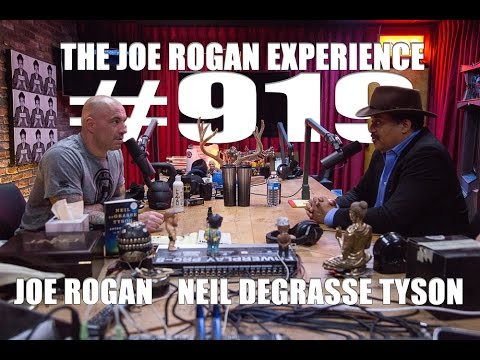
Tyson and Joe Rogan speak throughout the podcast conversation.
In his words
“The universe is under no obligation to make sense to you.”
“One of the great challenges in life is knowing enough to think you're right but not enough to know you're wrong.”
“I just don't put them in charge of anything, that's all.”
“What is your best single bit of evidence for what you're claiming, and what would it take to show that you're wrong?”
Key points
- Science literacy helps people spot when a persuasive story is not actually true.
- Flat Earth claims fail against simple observations and evidence from space and flight.
- The moon landing can be verified with independent imagery, yet some people reject even direct evidence.
- Pluto was demoted because better measurements showed it was too small relative to the other bodies in its region.
- Exoplanet science has advanced enough to infer atmospheres and possible biosignatures from starlight.
- Quantum measurement changes what is being measured, but not because of consciousness or mysticism.
- The universe may not make intuitive sense, so people need humility before declaring something impossible.
Full transcript: Neil deGrasse Tyson, Joe Rogan Experience #919 (2017)
Four, three, two, and boom. That's a nice hat. I've told you, ready but alive, I gotta tell you, that's a nice—it's very kind of Indiana Jones, but it's not quite that. It's like, yeah, that's chi, you're like in the middle of it. Yeah. Yeah, dancing on the edge. Well, I have a really fat head, and so there's a website called like bigheads.com, there's a website, a total website for my friend Bert Kreischer. I had then put his hat on, I couldn't believe how big his head was. There was like an inch gap. Yeah. So if you know your head—your head size, do you know your head size? No, I do not.
So, so it turns out if you know your head size, that number comes from somewhere. I tell you what it is? Sure. So if you measure the circumference of your head, just get a tape measure like you're measuring your waistline but do it around your head and take that number, divide it by pi, then that's your hat size. Whoa. Yeah. Just seems complicated is what it is, right? Just, why can't it just be the circumference, right? So what it turns out to be, so what that means is if you're dividing by pi, you're getting the diameter of the circle that has the same dimension as the circumference of your head. So if you—
have an oblong head, then what's doing is finding out what the circle is, the diameter of the circle that has that same circumference as your head. Oh, okay, that's what that's doing for whatever without whether that helps the hat, the hat maker. So immediately I start thinking about Dan Aykroyd and Sia at Live as a Conehead. Oh, with an idiot, a tall hat. Yeah. So dude, average I, you still doing stand-up? That's great. Constantly. Loving it. Yeah, and I caught you a few months ago, you were M-seeing some MMA, was it? What was—well, I'm always doing that. Yeah, stated shape because I'm a fat slob, right? You are ripped back in the day, man.
I tried. It's not that I don't have the energy to, it's trying to find the chance you back in the day. Look at you shredding. How much the way back then? Go on. 176? No, no, no. I'm six-two, so I'm 190 pounds in that. Oh, exactly. I have big thighs and stuff. Other wrestlers would have skinnier thighs and things, so I was also taller than anyone I wrestled. So since we're the same height, it meant they had bigger muscles actually. So, 'cause we're the same weight, right? But I did say that right, I'm taller, right? But we're the same weight, so that means they have bigger muscles, right, because none of us have fat, right? So I had to do things—
that my lanky limbs would enable me to do and to accomplish that they couldn't. So I have long reach, you know, this sort of a scoop ankle, that kind of thing. There's great advantages to having long limbs in martial arts, particularly in wrestling, grappling, because of leverage. Yeah. Also, if you're quick and with long limbs, and I was both, but if they got me in their grip, it was hard for me to get out. So what kind of exercise do you do these days? No, I'm trying. You know, I guess. Yeah, I'm trying. I'm trying up when I'm in—I'm good, but I've just got so much going on. Yeah, you like make the time. That's a problem, right, when you become a little bit successful. For you, some food, there's a lot of food documentaries, you know, trying to get you—
to eat differently. So I thought I'd watch The Wall. I binge-done them one weekend while I was doing other stuff, and I got hungry. Know one of it. One of the guys, he was trying to lose 100 pounds or something, so every 15 pounds he lost, he put a bowling ball up on the counter and said, "That is what I'm not carrying around with me." Whoa, because the bowling ball's about 15 pounds. I said, "Wow, he's measuring weight in bowling balls." That's something because we said, "I'm three pounds less than two pounds." That doesn't hit you emotionally the way a bowling ball does, yeah. After you've lost 15 pounds because no one wants to be carrying that around. So psychologically, I thought that was quite potent. That is potent. Anyway, I think we do need—so I usually use like plates. I think of weight plates or dumbbells. Okay. Yeah.
Yeah, yeah, yeah. I started doing intermittent fasting pretty recently where I only allow myself to eat ten hours in a day. Oh, wow. That's—and I was out of the 24 hours, yes. So I mean, I had Terry Crews on my radio show. Another talk that boys, my boys ripped. Yeah, looks great. He's still—and he's like 47 or something. I mean, he's so—he doesn't eat until 12 noon. Ah, until after 10 o'clock. That's right. Yeah, he doesn't eat after 10. There's a 10-hour thing. And so he has to—he's watching everyone else have brunch and breakfast, and so he's got to overcome that. But so it's a little bit of fasting. Yeah, and today intermittent fasting just to keep the discipline. I think at the end of day it's really—
just discipline. What is that? It also forces your body to burn fat instead of carbohydrates, and what forces your body to burn fat—that state of ketosis is actually easier to maintain because you don't—you don't get hungry. Yeah, then you look, there's no roller coaster, yeah, crash. The carbohydrate crash that you get—is that outside of the realm of possibility for you know? I can totally. I'm a ketosis guy. It's in there. I once got raked over the coals, not by everyone, but I tweeted once I said, "If there was a diet book written by a physicist it would contain one sentence: consume calories at a lesser rate than at a—"
Greater rate, no consume calories at a lesser rate than you burn them. That is sort of true. That's the one sentence, yeah? No, it's more complicated than that. And if we just try to get all no words—this is that, in that—and one of the great things of physics when you do physics is all the details are just cut off. It's window dressing, and you get down to the window itself, and that's what the analysis works on. I have rarely seen you attacked, but I did see you attacked when you were celebrating Sir Isaac Newton's birthday. Oh, I was like, that people were so mad they might've lost their mind when you were, by the way, incorrect in the date of Jesus's birthday. That is not the date of Jesus did not...
...was not born on the 25th route. It's just—I didn't even mention it. So what I said was, but to this day is my highest retweeted tweet. I tweeted it, so you remember this, actually, a couple years ago. Yeah, so it was a—so on December 25th comes, there it is. Oh, you get—you got, on this day long ago, a child was born who, by age 30, would transform the world. Happy birthday Isaac Newton, born December 25th, 1642. Seventy-nine thousand retweets. Oh yeah, thousand. Like, people just lost, they were so mad. They were angry. And I thought, well, interesting, because I'm just speaking the truth here. Yes, he...
...transformed civilization by, actually, he did it by the time he was 26. So yes, it's provocative because you're expecting that Jesus is gonna end that, but I thought I'd share some actual truth with people. And so some people celebrated it. Deeply religious people, one had a headline saying Neil deGrasse Tyson is trolling Christians on Christmas Day. Well, I said, I said Newton at least has the benefit of actually having been born that day. Then later on, it's actually more subtle than that with Newton because he was on the Julian calendar, which was, which is ten-day shifted from the Gregorian calendar. So if you ask what would his birthday be today, it would be January 4th, not...
...December 25th. So yeah, but when he was born, his mother was celebrating Christmas, so that's really what matters for that tweet. Well, it's such a bizarre thing anyway, because if you're a real Christian, you would understand that the birthday was shifted in order to comply with pagan religions. That's exactly—it was—it landed. I don't know how many people know that actually. I mean, you're a well-read guy. But so if you give me a minute to just explain that. So December 21st, we know, is the first day of winter, shortest day of the year. And what makes it short? Shortest daylight of the year. And what makes it short? The arc of the Sun across the sky is very low. The Sun doesn't get very high, and it doesn't stay up for very long, and it's been coming at a lower and lower arc every...
...day en route to December 21st. The ancient peoples were worried about this because everyone worshipped the Sun because it made your crops come and gave you warmth. And you say, wow, if this keeps going lower and lower in the sky, we're gonna lose the Sun entirely. December 21st, the Sun slows down and it stops this low, this drop in its moving across the sky from day to day. So that stopping of the Sun is solstice—that's Latin: the stationary Sun—like armistice, stationary arms, right? From the end of the First World War, weather November 11th—that was Armistice. Solstice. So, so the movement of the Sun lower in the sky stops, but that doesn't mean it's gonna come back. It takes a few...
...days for it to slow down, stop, and then reverse. These, oh, it is coming back. Let's celebrate that. And that's a few days after December 21st. There's about December 25th, a pagan holiday celebrating the return of the Sun. Christianity is trying to take foothold where there were pagans once roamed, and you put celebrations that match theirs just so that the shift is not as hard for you. And the unknown birthday of Jesus was then assigned this pagan day of celebration to make that transition easier for the pagans to become Christians, and sure enough, it remained Christmas Day, the birth of Jesus. The speculated birthday of Jesus is, like the spring—the spring, there's...
...some passages, of course, in the New Testament that reference when the sheep were doing, plus there's a census being taken by the Romans, you know, which is what. And Mary goes to the manger; the animals are not in the manger, not at so there's secondary evidence for that probably happened in the spring. Now with the advent of commercial space travel, it seems, seems inevitable, right? Love your segways, don't you think that it's possible that maybe you can even offer up a flat earth believer tour where you take them, like, at the very least, take them up to Alaska where it's light show 23 hours, calling in to you...
...this is tweeting me constantly, to me constantly. Yeah. Call me a sellout. I'm a, sell—I'm a round earth sellout, like as if there's some round earth money you're on the payroll check, I'm getting some round earth—round earth paola for your show. I'm sure you seen the basketball player who graduated from Duke, from Duke, that was hit in the news last couple of days, believes that dinosaurs are fake, mm-hmm, and that the world is flat. Okay, so here's the thing, Joe, yeah, I've thought about this. I bet you have as an educator. I've thought about this. Okay, so here's, here's what matters. We live in a free country. People should be able to...
Think whatever you want, whenever you want, provided it doesn't subtract away from someone else's rights. Okay, so if thinking the earth is flat doesn't harm anyone, unless you want to run for office or you want some position of power over other people. That's when it's dangerous. I thinking of elevator banks where they have numbers. You know, I have a photo essay with what elevators look like inside. I know it's just, I mean the gears—no, no, no, no, no, no, not even that geeky, just what are the numbers on the panel without the 13, you mean? Yeah, yeah, exactly. So about 80% of buildings taller than 12 stories don't have a 13th floor.
Okay, and so this tricks a deca-phobia. Yeah, it's again, in a free country, if you want to be afraid of the number 13, go right ahead. It just seems to me you should not be tasked with designing elevators if that's your fear. Find something else to do. Holding aside the fact that I'm a little scared that in this 21st century United States of America we have people walking among us afraid of the number 13, what does that mean? I don't know in the long run. But if you keep to yourself and don't harm others, think whatever you want. So that the rubber hits the road is if you now have power over others and
That's where the failure of the educational system actually manifests. Well then societies and cultures laugh. But it's not that they don't know that there's a 13th floor and that you're just calling it the fourth A sharpie, cross off the four, deuce. That's the 13th floor. You're not fooling anybody. Now, when you see it on an elevator and you're like, you see no 13, and plus they try to fake you out. How do you do that? So they go 1, 2, 3, 4, 5, 6, 7, 8, 9, 10, 11, 12, and then you have to go to the next row to begin to four, the whole team. So you don't see 12 right next to 14. And some other, some modern buildings will put their heavy machinery, like the HVAC, on the 13th
Floor so that there's no residency, right? But they could still say it's the 13th floor, and then there's a 14th floor. Yeah, yeah. Does anybody ever have a dummy 13th button where you press it, it never lights up? Like, I don't get it, I can't get in. That's interesting. That's what I would do. Oh, you just put it there to satisfy me, but still nobody lives there. Exactly. What? That's too clever. Oh, this is one of the 20% of people that make sense. This is what a great building. I mean, while there is no 13th floor, it's just a dummy button. That Twilight Zone episode with the mannequins—they went up to the 11th floor, but there is no 11th floor, and the mannequins come to life at night. Ooh, I forgot about that. Yeah, they leave the store floors and they all go up to 11, then have a cocktail party, and they vote which one of them is gonna go out and become human for a day. The Twilight Zone was so good. Who's the best
Television there ever was? Like, still to this day, ever used up so many great premises, great premises, great actors, great cinematography, and was in black and white so shadows were completely dark. Yeah, because shadows don't have much meaning when you're filming color, because everything is just there. But in black and white, the shadows create mood. And yeah, so I watched "To Serve Man," the other—I had it on the DVR, on my collection plate, Lurch. Yes, yes, on The Addams Family. Yeah, that was a great one because it was just like it had all the elements of people going, "Well, you know, they seem nice, they seem nice." Yeah, yeah, and they solve all of our war
And our—yeah, that was great. That's another good one. It was "The Invaders" too. Remember this one? Knew this was a one-woman performance. And I forgot who it was. It was—it not Agnes Moorehead? One of these women of that era. It'll come to me in a minute. And she's living alone in a farmhouse, no electricity, she's got a farm, and she's alone. And some alien spacecraft lands on a roof, and it's got these devices, it's got these saws and blazars cutting through things, and she's freaking out. She's got the pan and the pots and the rolling pin, and then she gets the goods, the shotgun, and she's attacking this thing. It's—and
You don't know what it is, and it's got lights and a thing, and it's this tiny little thing. It's like three inches across, right? And it turns out that's the thing that's attacking her. And then she finally, like, comes— that's it—see the little, little robot? Okay, and inside she said, and then I got to give it—this show’s 40 years old, I can give the punchline. Okay, so she actually successfully damages the thing, and then you zoom in on it, right? And then you hear a radio transmission from the aliens that are inside, and it says, "Yeah, hello, hello Houston, there's a giant who's trying to attack us, we need help.
Send backups." Oh, it was great, like, whoa, we were the invaders. That was us landing on her home on some other planet or some parallel Earth from some other dimension. Service, we are—we, no, no, no, no. Oh, she—okay, yeah, I get it. No, she's—oh, it's another planet. She's that Chinese the giant. But they're saying there's a giant attacking us, right? But the whole show you have her pointed means these aliens are trying to hurt her, when they're just—it was our space probe just trying to explore its environment. But isn't it possible that it's like another dimension? It's us in another dimension, and they are landing on Earth accepted it. Hmm. No, no, I mean, they were.
They were speaking English. I couldn't. Isn't that the definition of infinity? That somewhere, if there is really an infinity, there is not only you and I, but there's you and I and everybody else we've ever met, and all the exact events in the exact same order have gone down an infinite number of times, including this conversation. Okay, except—except there is—I don't know how many people know this, but often it's mind-blowing when you learn that some infinities are bigger than others. Joe Rogan just leaned two feet away from the microphone. Not all infinities are the same size. It's infinity, then it's infinities. Well...
What is no? Okay, don't you remember when you were a kid I said, "What's the biggest number you know?" A million was a million and one, right? How about a billion? Was a billion and one. Who, the annoying kid always added one, too. Okay, how about infinity? Well, infinity and one. Friday? Well, turns out infinity and one and any are the same number. Okay, so here's the—so, for example, the number of counting numbers. So, 1, 2, 3, up to infinity. Okay, right? The numbers you would use to count things, that's infinite. The number of irrational numbers—so the numbers that you cannot represent as a fraction, okay.
That there's more, there are more of those than there are counting numbers. Whoa, by 4. So these are orders of infinity. Then there are more transcendental numbers than there are irrational numbers. What's a transcendental number? So that's a number that you'll never find as a solution to an algebraic equation. So pi is a transcendental number. e is transcendental. These are magic numbers that show up in mathematics, and it turns out there's like an even bigger infinity of those than there is of these other two classes of numbers. And they use the, the, the, the...
Hebrew letter Aleph in, in, in ranking, so LF one, L F2, L F3, elephant. I think there are five levels of infinity. So, my point is, just because there's infinite universes, to me, doesn't mean there's infinite conversations that have happened. And I'd want to really explore the depths of infinities before I say and agree with you that this conversation has happened a million, you know, an infinite number of times in just this way, except you have a different engineer sitting next to us, or an infinite number of times where it's been Jamie too. Right? Yeah, that's the argument that's given. But I think that we, there's some nested infinities in there that deserve some explanation. My Phoenix region is not handling this well. Well.
That's fine. As I've said, as I say in the epigraph of the book—book is not available yet, but I have a copy—haha, *Astrophysics for People in a Hurry*. Astrophysics for People in a Hurry. Astrophysics for People in a Hurry. Oh, you can say quick, you gotta say there 'cause you're in a hurry. So the epigram on that is: "The universe is under no obligation to make sense to you." That's a rational I have time for. And so it makes sense to you that the universe is under no obligation to make sense. So it's okay if your brain hurts when I say there's a ranking of infinities, but you shouldn't say...
That doesn't make sense; therefore, it is not true. I definitely wouldn't say that. But what confuses me is the word infinity, because I had always taken the word infinity to mean something that has no end. So how can something that has no end be larger than something else? So the way they do that mathematically, the way to demonstrate that mathematically, is used—you map one item in the set of this infinity to corresponding items in the set of the other infinity. So you do this: you take the one and you map it to, like, the first transcendental number; take the two to the second; you just keep doing this. And when you do that mathematically, what you find is that one infinity outstrips the other infinity. Wow. And then you're left with more numbers. So that shows you that you have
A bigger infinity. Now, when you find—I mean, there's a new NASA announcement that's supposed to—is it Monday? That's supposed to be announced, or attention tomorrow. The exoplanets, Wednesday? Yep, so it's Wednesday. I don't—do you have details? I'm not authorized to see details. Okay, let me invent some juicy details that it could be. So, NASA—so he's been good at segueing lately. He doesn't jump in; he's just jumping. I know, you get that? Just—yeah. I'm flying back, too. Thanks for fitting this in, Joe. I opened this place up at 3 in the morning. Oh man, I'm very—I feel the love, so thank you. So, here's—
Some things that could, because NASA is saying that it's a—it's a stunning new announcement. Well, what could be more than the fact that we already know that there are Earth-like planets orbiting in the Goldilocks zone of the nearest star to the Sun, Proxima Centauri? Can you do better than that for me, NASA? I don't think so, unless you got some extra stuff you're going to tell us. Like, what's been a cottage industry in the last couple of years is the observation of planet atmospheres, as the planet passes in front of the host star. Light from the host star passes through the atmosphere, and it is all, and the light signature's altered by the...
Chemistry of the atmosphere. So, depending on what the chemicals are, it'll influence the spectrum that you get. And when you do that, you can say what the chemical composition of the atmosphere is, that's of that star is. There's certain, there's a certain combination of elements that we would call biomarkers. No, we can't look down to the surface of the planet and look at cities if there are any, but there are consequences in the atmosphere to there being life on the surface, such as is there oxygen there? I used to think, when I was watching Star Trek when I was a kid, because I saw it in real time — that's how old I am — when it first came out, original series, yep, Star Trek characters never wore spacesuits. Yeah, you ever wonder? I mean, you ever thought?
About that. Okay, what happens is they visit planets. They have nitrogen-oxygen atmosphere. Jim, alright, well, that's what our atmosphere is—nitrogen, right? So they find planets with nitrogen-oxygen. They go down. They don't need a spacesuit. So I've actually thought about that, and that's their solution. So that must mean there'd be planets that you could find that that—well, here's the thing: we have oxygen on Earth only because there is life on Earth, not any kind of life. Photosynthesizing life. We have life that takes sunlight, turns it into chemical energy into itself, into wood, into plants, and one of its byproducts is oxygen. Oxygen is chemically active. If you took away all plants tomorrow, that oxygen—
Would slowly get absorbed chemically into the environment, and then you would not have oxygen there to be viewed by aliens trying to see if we have life here. And it's pretty surprising to people to note that we're mostly nitrogen in our—oh yeah, we're 78% nitrogen in our atmosphere. So I— you know what happens if you have too much oxygen? If you have like, let's say, 50% oxygen, you're really high, right? What happens is like a forest fire would never go out. Oh yeah, yeah, because oxygen feeds combustion, and so you could basically burn all vegetation in the world if the oxygen went above certain thresholds. So you need it high enough so that you can still have oxygen metabolism but not so high that it's bad
For lightning-triggered forest fire. So if there—if in this—if I don't know the announcement, but I'm just guessing here because it's been a cottage industry the last couple of years: let's find these biomarkers. Do you have unstable chemistry going on in that atmosphere? Because if you do, it means something's generating it, and certain combinations of chemistry tells you there's likely to be life of some kind. Now just a couple decades ago, we had speculation of other planets, but we really didn't have any tangible proof. In fact, any one any time I give a public talk—you do this at your gigs—that's who—here's born since 1995, okay? And your audience leans young.
So there'll be some fraction of the audience. It'll raise their hand. And so what I do is I knight them as Generation Exoplanet because 1995 was the first year that a planet outside of our own solar system was discovered. So they have been alive only during a time we've known of other star systems. That's so crazy. Generation X? Oh wow, that's what I want to start, that movement. So it's so crazy. That's so recent. I mean, it is. Oh yeah, I was living out here—yes, 20 is 24 years ago, 22 years ago. Yeah, that's it. That's insane if you stop and think about how what a short period of time it is. And in that period of time, there's like rising through 3,000 exoplanets. This is the advance of tape—that's not just science advanced. That's—
That's engineering and technology and intelliscan and imaging quality, and it is a lot that goes on to the advance of science. It's not just how clever you are in an Einsteinian way. It's do you know good engineers to build a device to make the measurement? This is how we discovered gravity waves. Now, what's your take on that planet that's supposed to be outside the Kuiper belt? That's Planet Nine so far. Yeah, yeah, all the data look convincing. So what they've done is they've looked at other objects in the Kuiper belt and looked—these are colleagues of mine at Caltech—so it's Mike Brown, who, you know, I get blamed for killing Pluto but I was an accessory for sure. But I definitely didn't kill that dude. Kill Pluto? Alright, he found another object
That was basically the size of Pluto out there. So either you make that a planet, or you demote Pluto. And how much smaller is Pluto, and say, our moon? Oh, so—so don't get me started. Our moon has five times the mass of Pluto. So the moon—the Pluto's was lame from the beginning. Alright, we thought it was big. We wanted it to be big. We—we—we made it one of us, one of the nine, and its size didn't settle out until the late 1970s when we had better and better more accurate ways to measure its size. And that's when we learned it's small even compared to our own. But granted, we have a big moon. If you're not gonna think our moon is a planet, you're certainly not gonna think Pluto is a planet. So this hop—let me just tell you how they did: so they found these other objects out there.
The same team: a Constantine—I'm not sure how to pronounce his last name—but Ding Jian and Mike Brown, both at Caltech, and they found these objects in the outer—so the Kuiper belt of icy bodies, of which Pluto is a member. You track their motion, and you say, okay, if I add up all the gravity that's affecting them, they should move this way, but they don't. They move another way, a different way. So either Newton's laws of gravity are failing in the outer solar system, or this is some object out there whose gravity you have yet to reconcile with the motions of these objects. So they said, let's assume Newton is right. What object do we have to put out there at what distance and at what size to influence the movement of these Kuiper belt
Objects in the way we see it? And do they do this through Bode's law? No. No, we're way past Bode. No, we—wait, wait, thanks for remembering Bode's law. Bode's law was an early measure of where you might find a new planet. It was based on mass and gravity. No, no, Bode's law was a simple arithmetic tool. All it did was basically double the distance with a certain additive parameter, double the distance of some planets. So, for example, you know, and there was a little—there's a factor in there that helped the inner planets come out right. But let's look at Mars. Mars is like two and a half times Earth's distance from the Sun. What comes after Mars? Jupiter. Jupiter is five times her assistants. Ah.
Saturn is 10 times 1 to the 5 to 5 to 10. So, Bob's law is just a simple arithmetic scheme. It's not based in any known physics; it was only based on the solar system. In the solar system itself, that's right, so—and it worked. And yet, you have to fudge your way to get Mercury to work in that. Oh, really? And it wouldn't—didn't have Pluto, of course. Pluto wasn't a planet in any way. But anyhow, it was a—it was a fudgy way that was mostly right by accident. And this was in, like, what year was this? Oh, that was 1800s. Oh, yeah, yeah. So, now we have advanced computer programming, very high precision modeling, and there's got to be a planet somewhere here in this arc of the sky. Let's look for it because we think that's what's affecting—
—the orbits of these other objects. And that is a completely noble way to discover a planet. That's how Neptune was discovered. And because now everyone looked at the orbit of Uranus and said, you know, Uranus is not following Newton's laws. Maybe Newton's laws don't work that far out; it's never been tested that far. And they said, well, let's assume it works and ask what would have to influence it. And whether it's a difficult mathematical calculation because you're not saying, "Here's the object, what's the gravity field?" You're saying, "Here's the gravity field; I need where must the object be and how massive must it be." That's a much harder mathematical problem to solve. And so, once the errant orbit of—
—Uranus was known and calculated, they started looking for another planet. And that's how they discovered planet Neptune. Wow. So, now when they're looking at this planet nine—I hope I said that right—it was the movement of Uranus's orbit was not following proper laws, and they inferred the presence of Neptune. They said, "Look here tomorrow night," and they looked there and they found it. Wow. Yes, it was a brilliant display of—and no, we're going back to the 19th century. So, I mean, people, people were badass. That every generation got their badass scientists. Now, how much further out from the known solar system is this planet?
So, I'm not quick to call it planet nine because so far it's twenty thousand times farther away from the Sun than the Earth is, so I'm not—sorry, you're not? Sorry. I'm not feeling like calling Connecticut New York City. But it's something massive, right? It's like six times the mass of—yeah, I forgot what mass they were assigning it, but yeah, it would, if that were in our solar system, be no question. You would label it as a planet. And it wasn't there one time. Speculation that it was some sort of a burnt-out star? No, not that mass. No, no, no, no. You might be thinking—if that's what I think you're thinking—you got good memory. The long ago in a galaxy far away. So, I'm talking about 1970s. People looked at the extinction record on Earth, and every 20,000 years they—
—found a little blip, a little dip in the fossil record where we lost some species. And people were wondering why. Could there have been some flux of comets raining down periodically on the Earth, wreaking havoc on the ecosystem, rendering species extinct in these periodic intervals? If there is, maybe there's some double star to the Sun. Binary star system. So, they invoked it and then they called it—they gave—it became a name. What they called it? Nemesis. They gave it a name. And so, you know what period orbital period that object must have—it has got to match the extinction periodicity. And so, it's got to be a 20,000-year period. And so, but people looked for it; they couldn't find it. And—
—then you reanalyze the extinction records and it was—you had to fudge it to make it look like it was periodic. So basically, we've abandoned the idea of Nemesis. And aren't binary star systems really common? Yeah, more than half the stars you see in the night sky are binary or multiple systems. In fact, the iconic image from Star Wars, the original Star Wars movie, before they numbered them—I think what? Star Wars four, right? Well, yeah, whatever. Whatever that desert planet that Luke was on. And he comes out after visiting his—was—it was his step-parents? No, his adoptive parents were—yeah, where he was visiting, he comes out and you see a double sunset. So, that's basically the—
—only accurate science in the entire series. I really enjoyed you taking apart gravity. Gravity. And how many people got mad at me? Yeah, you know, so I stopped Comic-Con movies. I don't need to piss people off when I watch a movie. I'm having those thoughts anyway, so I might as well share them with people if you're interested. So, I did just that, and then people—the last time I did it was for Star Wars: The Force Awakens, Star Wars 7. I had a series of tweets. You know, one of them was BB-8, a smooth rolling metal spherical ball would have skidded uncontrollably on sand—
—people got angry. So much someone tweeted back, "Shut the [ __ ] up." Okay, that's so—so I said, okay, I'm not here to get people angry. I'm just here to enlighten, to help people enhance their movie-going experience. But to the extent it is not accomplishing this, I don't need to do it. I'm just saying I don't—I'm an educator. I thought I was being nice. I don't need to do—so I haven't tweeted about a movie since then. I got tweets. I could watch them stop you. I have tweets I could post about Arrival, please. Dear, why? I didn't watch—watched a little bit of a shudder off. Okay, no, you got to give it a chance. As soon as I see a movie that starts out—I don't spoil—or it starts out with a sick kid, I'm like, [ __ ] you. No, no. In fact, it's very not about the kid. I'm sure.
That's what I keep. It's totally not about the kid. Jamie hated it. Oh, yeah, yeah, okay. So you just give it a chance. But anyhow, so I just stopped. Maybe I'll come back, but I'm, no it. Yeah, people need to know. Raveh, that was good that you explained that. Not only is it not plausible, those two satellites aren't anywhere near each other. Oh my God, worse said, "Oh, there's the International Space Station and I'm on the Chinese Space Station. Let me just jetpack my way there." Yes, do you really, excuse me, lady, do you—hey lady, do you know how far away these are from one another? You're gonna jet around from one space station to the other? No, can't do it. Tens of thousands of miles from one another for goodness' sakes. Oh, Betty, I'm—
So yeah, you remember, please, it was like 15 tweets and I didn't know that. That's what I realized, like the press was reading my movie tweets and those tweets. It's now a couple years ago when Gravity came out with Sandra Bullock and, and, and what's the news name? George Clooney. So I eated it and they got talked about on the on The Today Show, sent the set, the weekend Today Show on NBC. Then it was talked about on NBC Nightly News. Then my tweets were talked about on Saturday Night Live's The Weekend Update. It was like the NBC trifecta, and I said, "Oh my gosh, this was—I had not, that was not the point. I didn't seek this." Did fine. I'm—
glad they are reacting this way because that means they care about the science. Maybe, but what Seth Meyers did, 'cause he was doing Weekend Update at the time, he said, "Astrophysicist Neil deGrasse Tyson harshly criticized the movie Gravity, saying it contains a number of scientific inaccuracies. For example, there is no way George Clooney would have spent that much time talking to a woman his own age." That's hilarious. I think Sandra Bullock is still younger than George Clooney though, so they should have got their facts. But yeah, but not by much. I mean, yeah, they're in the same neighborhood. Yes, yeah. I think it's important. I think you enjoy the movie. It's great, it's fun and everything like that, but it's important to point out what the science errors are. I think I—
think, I think the movie could have done better, honestly. The things that could have made this a movie—why did people think I didn't like the movie when all I was doing is pointing out things they got wrong? By the way, they did some stunning things correctly. For example, this is brilliant: if you're in zero-g, a fire basically puts itself out. So think about when you burn a candle on Earth. So you like the wick—if there's people have candles anymore, they forgot what a candle is. You light it with a match that you used to get from smoking lounges at bars. All right, so you light the candle and it stays lit. The fuel is the wax. The oxygen continually comes in because it—
heats the air around it and the air rises. Hot air rises and fresh air comes in from below and has fresh oxygen. So the candle will stay lit until it burns all the way down. In space, if you light a candle, you can light the candle, it'll heat the air but the air will not know where to go because it's not lighter than everything because it's in zero-g. It'll stay clustered around the candle. The candle will use up all the oxygen in that bubble and then it'll put itself out. They did this in the movie. So why do they have some good sense? Because they may—you can't think of everything, so they just have you on staff. Well, no, they can't. You can't think of everything, so that wasn't judgmental so much as this movie, the fact that it got so much right—
is what put it on my map to criticize what it got wrong. That make sense? Does that make them a—yes, okay, yeah. Oh, the hair, her bangs should have been floating. Now if you might think I'm being nitpicky, no, because if you look at any picture somebody with hair, okay, in space, in zero-g, their hair is flying everywhere. It's the first thing you notice about them. It is so obvious, like, wow, that's cool. You're not thinking about the spaceship or the technology, you're looking at the hair doing stuff you will never see happen on Earth unless someone is like underwater and they're jiggling their head. So they would have to film it all in zero gravity. They would have to film it on one of those drop things. Yeah, or the drop thing, you'd—they'd have to be clever about it, and she only had bangs—
that's all you have to figure out. They did other clever things. So anyway, that's all I did. Please, by the way, in all fairness to movies, I'll call out something that's good, the science that movie got right that otherwise got no science right. I'll be I'm the first in line to do that. Like, what? Oh, in the movie Monsters, Inc., oh my gosh, those doors were four-dimensional portals to another—that's possible. Well, if you had four dimensions, that's what it would look like. Do you remember the movie? Yes, they take the doors home. Yes, they opened the door and they're in the closet of the kid that they're gonna terrorize. Yes, you, that's a wormhole. That's what it is. What access to the—
fourth dimension looks like. Do you think scientifically that's possible one day? Yes, I hope so. I hope so really because here's the example: we've got a nice broad desk, we hear it—this interview, right? So desk is two dimensions, it's got length and width, and I can start putting papers on this desk and I can lay them out mosaic style, and then all of a sudden I have no more room to put a sheet of paper. If I'm an ant living in this surface of the desk I say, no more room. But wait a minute, we are three-dimensional people and I can put an organizer and stack things vertically. So I can take a sheet of paper and I can put it higher up than the surface of the desk. The ant will say, where did it go?
Oh my gosh, it disappeared in some portal. We know, now, what? What is that? It went into the third dimension in the ant bound, and obviously is a three-dimensional thing, right? Imagine it only lives in two dimensions. You would have made that paper disappear into a third dimension and it will have no clue where it went because you had a portal, you had access to that extra dimension. So look at how much you can store on a desk when you have access to a third dimension above it—vastly more than just papers mosaicked out on the surface. So now let's up this example by a dimension: you're storing boxes in a room or—I ran out of room? No, you didn't. Let's open
this four-dimensional door. You open it, put the boxes through the door, close the door. Box is gone. They'll be awesome for hoarders. You look around the other side of the bottle, that the door—there's nothing there, right? Though your side of the door, nothing there. Just a door that is a portal to a fourth dimension that can hold vastly more content than what you’re stuck storing in the three-dimensional space of your room. Now, that’s a concept. So that’s a brilliant concept and even though it has monsters that don’t exist that all speak English, and to one of them is a cyclops and one of them is a—you know, I’m not judging the bio-physiology of these creatures, but they got the physics of four-dimensional portals completely accurate. Now, the concept of dimensions is work, it’s
really abstract with people. I love me some dimensions, and it is abstract; it is. Yeah, that’s why you’ve let the math take you into those higher dimensions, because our intuition will not—will fail for us, right? Well, that’s where it gets weird. Oh, and when you say ‘take the math,’ let the math take you. So like when quantum physicists use these legal and notepads, those yellow pads, and write all that crazy stuff down that nobody but you and maybe them understand. And when you look at all those equations, notes them maybe me, maybe new then you probably understand it, right? But I definitely don’t. My point is: what are they exactly figuring out that allows them to say there are—I think they say at one point time was 11, but I think they’ve expanded
that, right? I don’t have the latest dimension on the universe, but what the way it works is you try to make sense of the world, right? And so you take some leaps, some philosophical leaps, some mathematical leaps. You say, all right, maybe all particles that manifest as an electron, a proton, a neutron, maybe quarks, maybe—they’re just strings of energy vibrating at different frequencies and we sense these different frequencies as different particles. Let’s just go there for—okay, well if you’re going to do that, what are the consequences to it? Then how many dimensions do these vibrating
strings require to have the properties that we see in our dimensionality? So the exercise of explaining what you see takes you to places that you’ve never been before, and that’s fine. Places at intellectual places that you’ve never been, previously unplumbed. There’s nothing wrong with that. We’ve done that before, that’s why we know what is happening in the center of the Sun. Have we ever been there? No. No. But we know how matter behaves under pressure and temperature. We can do that in a laboratory. We’ve got a Sun sitting out there with a surface temperature, a mass, a certain luminosity, and we say, what must be going on down in the core? Let’s bring our best physics, a quantum physics,
our chemistry, our nuclear physics, bring it all together and we have a complete understanding of what’s going on in the center of the Sun and we’re on to other problems now, even though we’ve never visited there. So when they’re going over this math of the mathematics and like observable things that we have right now or at like the atomic and subatomic level, we don’t—you can’t see. Do you realize the electron just—okay, so I buy—I mean, I did a whole series of this. There’s something called the Great Courses lecture series, it’s a—yeah, it was a sponsor of this podcast for a while. Would really, okay, Great Courses, so cool. So I was once invited to be one of their professors for the Great Courses and I taught a very short—most of them are
like 30 lectures. It’s like a whole college semester. So, and I don’t have the time, the energy, so they let me do like short bits. So one of them is only six parts and it’s called *The Inexplicable Universe* and it’s six parts of everything about which we know nothing in this universe. You might say, well that’s a pretty easy course to give. Okay, on to the next one. You might be something Dark Matter. We don’t know. Stay tuned. So, but it’s interesting to learn how we come to know what we don’t know. And so it’s an exploration of our ignorance and I’m very proud of it because it’s not what you’d normally find in a lecture series, and it’s still out there. But one of
the things I will tell you, then I’ll tell you now: the electron has no known dimension. It is smaller than the smallest we have ever had the capacity to measure. So as far as we are concerned, it is infinitely small. Well, we have no way to even know how to measure. By the way, how do you measure something small? You get something smaller and find out how many of those it is. Think about the challenges at each extreme. Ask me how big is the universe and I’ll say it’s as big as—well, I got nothing. What am I gonna say, right? There’s nothing as big.
As the universe, so at the biggest engine, at the littlest end, there's not something else. It doesn't work as well, okay, to try to say what it is relative to something else. Do you entertain the possibility that the biggest and the littlest end are the same thing, meaning that at the smallest measurable point, that literally might be a whole other universe, that, like, might be fractal? It's fun to think about it, I mean, all the way down. Yeah, it's fun to think about again, finally down like that. However, and people, by the way, in the 1920s, when we discovered the atom and its structure, and that there's an electron, him, quote, orbit around a nucleus, it was that way—we've been there before. We got planets.
Orbiting the Sun, and so this, this, so maybe it's a mini solar system, maybe it's solar systems all the way down. Well, I'm glad you brought this up. I'm glad we brought this up because I wanted to bring this question; I almost forgot. There's a photograph of a brain cell, and side by side with a photograph of the known universe, and they look eerily similar. So you're talking about the large-scale structure? Yeah, the universe with large-scale structuring of galaxies. So I'll get to that in a minute. Okay, so I'll get to that. So you ever tell him just pull up his own damn images? So you... so why that's not likely.
Okay, it was an entertained idea, but here's why it's not likely. The manifestation of the laws of physics are different at the atomic scale than they are at the macroscopic scale. They're just simply different. A planet can take any orbit sensible for its velocity around a host star. An electron cannot; its energy levels are predetermined and quantized, hence the word quantum, the prefix quanta in quantum physics. So if it was a continuum of matter and energy following the same laws of physics, then I would say, then it's solar systems all
the way down, but the rules completely change. And so things can, on the surface, seem similar, but when it comes time to understand them, and to analyze them, and to manipulate them, and to exploit their conduct and their behavior for other means, as we have done with atoms and molecules for the entire IT revolution, you no longer are they the same, and you abandon this romanticized concept. So now with the neurons, the network of neurons, and they cluster, the clusters of galaxies and galaxy superclusters, that would be on the right, neurons on the left. That's so eerie. Yes, so, so yeah, they can look the
same, but they are operating under completely different laws of physics. So, in other words, the laws of physics that dictate what's going on in brain cells have no relationship to what's going on in the universe. Brain cells, you're undergoing—we can tell you what forces are operating. It's, it's, it's electromagnetic forces. Brain cells use electrical impulses, chemical impulses. This is why drugs can affect the brain, all right? They're chemically—there's chemistry going on in the brain in its natural state. You disrupt that, enhance it; you just put, you just put down some chemistry in your stomach that's now affecting your brain. What you just drank there? What was it? Alpha Brain. Okay, yeah, so you're entering the chemistry, so it's chemistry. What's going
on, on the large-scale structure, the universe is not chemistry, right? There's some chemistry deep within, but it's not the chemistry that's making that pattern, and because of that it becomes an artistic curiosity, not something that has any kind of deep scientific insight. So it's just a fascinating similarity. Yes, it's a fascinating similarity. Put them up together, and it's fun to think about it, but it's not—it's fun to think about it artistically but not scientifically. No, it's great if you're hanging out with your friends going, "Wow, man." Now when you're looking at subatomic particles, excuse me, and you’re looking at these, like when they observe particles in superposition where they're moving and stationary at the same time, or they
blink in and out of existence, like when you get down to that. And I repeat, the opening page of the book: The universe is under no obligation to make sense. So at that scale, things that go on with atoms and molecules fall outside of your life experience. You don't hang out at the bar with protons, neutrons, and nucleons or, you know, other nucleons or molecules. You just don't. So what they do in their day is completely foreign to you. So now you shrink down to that size, and particles are popping in and out of existence, they're—they become conjoined, quantum mechanically conjoined, and it's
completely weird, and you would say this is none of this makes sense, and this is observable? Oh, in a visual sense? Well, it depends, depending on how big the phenomena is. Otherwise, you can see other things that would happen that, you know, that are the manifestations of that happening, right? But yeah, so an electron is smaller even than that? Oh yes. By how many factors? No, no, we don't even know. We don't know the size of an electron. The concept of superstring theory—so a super vibrating string—you’re smaller than that? Yes, the strings would have to be smaller, thinner, smaller than the electron itself by many, many—that I don't—I couldn't quantify. For bringing a string theory
person. So it's like at the bottom of what we can observe. Well, that's a great question, what is the bottom? And you know the word "atom," which was introduced by the Greeks—you know what atom means in Greek? It has a translation. You know it means "not divisible." So they imagined that all matter—you'd come down to something that was indivisible. How about that? Oh, they figured that out, they supposed it, and it was the first day we, you know, they were wealthy and had free time, and you know, when they weren't waging war, you could think, and you know what we think of as philosophy—it was traceable to a lot of what they were doing back then, and the origins of what science is are traceable back to back.
Then that, you'd have an idea that applies to what the universe does that enables you to predict future behavior. That is science. And so, the atom, it turned out, is divisible. It's divisible into subatomic—sub-atom particles. So you get electrons, protons, and neutrons, and a whole host of other particles less familiar: there are neutrinos and other things. Then it turns out protons and neutrons are further divisible. There you get quarks out of those. And as far as we know, there are only four fundamental particles in the universe: the photon, which is light; the electron, of which there are several species; there's the anti-electron in this; and, but just these are just a simple here, the photon, the
Electron, then the quark and the neutrino. That's it. Everything in the universe that we've ever observed is made out of that stuff. So those are, quote, the atoms of the universe, the indivisible parts if you will. Now, this no dark matter could be made of yet another kind of thing that we don't know yet, but we got top people trying to figure out what dark matter is. We've measured it out there, we just don't know what it is. Well, it's something like 90-something percent of the universe. Dark matter and dark energy, it's 95% of all that drives the universe, and we can measure the existence of both, yet we have no idea what's driving them. This is an awesome opportunity for you to illuminate this often. It's all in astrophysics for.
People in a hurry, it's all it may come down. May you can pre-order it, which, by the way, publishers love. If you preorder it, an adorable, beautiful—it's a good size, it's adorable. You're gonna pre-order it on Amazon. You know the reason why the publishers like you to preorder it? So that they can thank you. How many? Yeah, they just don't want to overprint; they don't want to underprint. So they get a sense of the pre-ordering because you're not charged until they ship it. So it's a pretty harmless exercise. While we're on this subject of subatomic particles and weirdness, I wanted to—I wanna, if you could, illuminate this often misused explanation for the observer effect. Because, you know, the particles, waves, and you watch them and observe them, and it changes the reaction.
It is heavily misunderstood. It's misunderstood because people want to attribute it to magic, the magic design and the consciousness looking at it. But isn't it, in fact, just measuring it? Yes, thank you. Please explain, because I'm so tired. Joe, you're good. It just tries. You carry your people with you. I try. When I'm—where you pulling, what, where you getting your people? I don't know, I don't own them for sure. Definitely not my people. Very great. You have an admirably diverse following, and not many people can claim that, and it's probably 'cause of your diverse profile, right? I mean, why? Miss open-minded as I can. But
Top about you: smart, and you'd read, and you're thoughtful, and on some level, respect—you'll hear it—somebody out, and you're, you know, you did, you got, ummm, anything. So no, you're in a lot of places, in a lot of spaces, and that's a good thing. I mean, we need more unity in this world. So, so, well, thank you. Yeah, thank you. So, please explain what people are getting wrong. Okay, so very simple. It's much simpler than you think. Okay? All right, you ready? Yes. So, I'm looking at you. The only reason why I can see you is because there's light reflecting off of your face, your body, into my eyes. So, there's light. Oh, yeah. Those are Hubble photographs. Oh my gosh. Yeah, those are.
Images from their sheets that you put over the fluorescent light cover, and so when we look up, we actually see the result, real images. People pretending it's the nice recording studio? Well, what I want to do in the future studio, I want to actually build a glass ceiling and have a full-scale image, high-resolution image of the stars, a planetarium. Yes, you're describing a pointer. Exactly, call it that. It's a planetarium. Well, something like, but I just wanted an image. Sure, you can—you know, what, you know, do it. Don't do better than that. You get a—you just, you get a curved version of those very high-resolution LEDs first. Yeah? Okay, then you put any.
Image up there, you want the night sky tonight? It's what the sky looks like from Alpha Centauri. Oh, like when you go to see one of those star shows at a planetarium and they show it on the ceiling above you? Well, yes. So, but nowadays, the ceiling itself is the source of light rays, not projected from something. So then you just feed that with image data, and then it becomes whatever you want. Yeah, I could totally. Yeah. You don't know Peter, I got people—I mean, people that lend you my people. It's Harry. I mean, my people for me while you're—you know, you happy. But you know, the people of the past would teach the people. So okay, so here, what sound looking at you? Okay, all right. Yes, and I see you. I want to know where.
You are. So I turn on the lights and I say, there you are. All right, now let's make you tinier. Let's make you mini-me. Okay, like in the movie, right? So now is a tiny version of you, a mini-me version of Joe Rogan. Now you're little. I turn on—what? You're still there. Okay, okay, because if the lights are not on, I can't see you. I don't know where you are, right? It's that simple. Okay, okay. When you start becoming the size of molecules, right? On down to the size of an atom, and I ask the question, where is Joe Rogan the atom? And I turn on the light to see.
You there because I think you're there. The light, the photon comes in, hits your atom and pops you into another location. Mmm. The very act of trying to measure your position prevents me from measuring your position, and as have Jack [ __ ] to do with your consciousness or your mind or your eyes or anything. It has to do with the fact that to know you're there, some information has to come from you to me, like shining a light on you. And the smaller you are, the more susceptible you are to the energy of the light changing your position in space. So my
question is, I was like, you know, it's like, you ever—I don't know if this still happens—you have a quarter spills out of your pants pocket on the backseat of a car and is there in the wedge between the bottom and the backseat. And so you try to reach in to get it and the act of reaching for the coin makes the coin move farther away from you. The act of reaching for it, right? You're separated and it just slides down even further. That's not your mind making that happen. It's the—it's the act of the measurement that is affecting what it is you're trying to measure. And this was discovered in quantum physics, to the point where that's actually—it's the Heisenberg uncertainty principle. It's one of the basic foundations of all of quantum physics. Now when it's just
ground it. But when it's described in the woo-woo way, you—they show these particles going through these slots, and then observing them changes the pattern that they go through. And there's a—there's a horrible cartoon that you see in that movie What the Bleep. I couldn't get through that movie. I tried. Did you go crazy with the bad science? No. Can I tell you where I turn? Maybe. I mean, well, here's what people don't know: a lot of that is from a cult. The woman that—I didn't know—the woman who is the—I don't mind a cult movie, you know. She's a channeler. She's speaking as a character. Like, do you know that one blonde woman, older blonde woman, that's in that movie? Okay, and she speaks—
when she speaks, she's speaking as a character. Okay, I didn't know it. You have to, like, she's—she's a part of, like, this very bizarre sort of cult. Okay? And should I tell you where I tuned out, or you want to finish? Okay, so I tried to—I just couldn't watch it. Right? There's a point where they were talking about natives in the Caribbean seeing European ships. Yes. And then they said, "Well, because they'd never seen a ship before, their brain didn't register it as anything," and then it just disappeared [ __ ]. And I'm thinking, no, that's not half the brain warehouse. Excuse me, that's not how this works. Okay, what would happen is they might not know what they're looking at, but they'll know they're looking at something, and they've had ships. They—they went from island to island. That's
how you get from island to island. Is it, "Well, that's a really big version"? Yeah. "We've never seen anything that big before. I don't know what it is. I don't know where it came from, but I want to find out why. I want to study it. I want to protect myself." Whatever. So just because you've never seen it doesn't mean you're not gonna register it. Excuse me, no. It's—no, I said no. But I can't waste my—got other things I got to devote my brain energy to instead of this. But someone else it—oh, it gets better later on. So I said maybe I'll ba—it gets more confusing later on, and it does a better job of confusing you as to what science has shown and what they haven't shown. Now, by the way, just in all fairness to what they think that the point they were trying to make, there are things that if
you don't know to recognize them, they would go undiscovered. Yes, okay. But that doesn't mean you wouldn't see them. Okay, so for example, let's say you're walking and you didn't know that you were walking over this huge burial mound because the slope was really shallow, and you're just walking. Okay, well, you just did—you did—you didn't notice that. Okay, so you need a different way to see it in order to know. So a thumb from space from an angle can measure the height, whatever. So there are ways to miss things. That's—and that—and that happens all the time, right? But if it's something there on the horizon, my gosh, this is why we have eyes. Okay,
now they're not the best data-taking devices, but it's come time to tell you where there's a ship or not a ship that you've never seen before. It's a ship of cork—just so much evidence of that. When people discover new animals, yes, before anything—anything—there's no record of it whatsoever. People find it and they can still see most scientific discoveries. You discovered some we've never seen before. Ramtha, that was the woman's name. That was the person that she was. Double check. That's a cult channeling name. Yeah, channeling name Ramtha. Ram power Chandler. I'd be ramped though. I found that after the—the movie was done. After I watched it, I wasn't—I—they got me with a lot of things. So I was like, wow, is that true? Is that real? Then I started reading. Fortunately that movie came out in the
2000s instead of in the '90s, because if it came out in the '90s, we were all got duped. Oh yeah, those—we wouldn't have the internet, all the research, all the [ __ ] that's wrong with it. In the 2000s, I started researching it, and then I would send it to my friends like, "Look, look, look what [ __ ] this came from," and then, and then you go, "That's a cult." Yeah, it's a cult. That lady's a cult. She said she's talking like she's an alien. She's supposed to be an alien, right? Isn't that—do you see it in there? Anyway, again, I don't know. I don't mind people think they're channelers. I just don't put them in charge of anything, that's all. Well, it's—it's nothing to find. It's just that you should probably say that when you get going with that. Nobody's ever said she calls herself a ramp. They think it's real and genuine, and since and they're very sincere because they're
Yeah, they've put themselves well. That whole thing, what you need is, is, you know, what you need is some foundation of science literacy so that you can inoculate yourself against those who would exploit your absence of knowledge of how the science for their own game. Well, not even for their own gain, just YouTube videos. I mean, someone could make a very compelling YouTube video where they get you convinced that, oh my God, dinosaurs aren't real, right? They start playing these things for you. They tell you some pounds can pop popcorn in the sea. Ever see that one? I have seen. Now, well, yeah, you line up sometimes, more than, they start popping. Yeah, you got it, like Colonel, someone. Yeah, that can't really have— no. No. Imagine it could. Jesus Christ. Look what are we doing with these.
Folks, but there's, there's a ton of those out there where people see that. It's one of the problems with a lack of dialogue with someone who just has one narrative. Like, you sit down, you edit something, and you just talk. You know, it's very similar to, like, even if you write a blog. I mean, that's one thing if you're writing a blog, like say if you're an expert in electronics, you read a blog about how a television works. But if you're just a person and you don't really understand what you're talking about, but you write something and use the right words, and you say it in a very compelling way, like an attack piece on someone that really has no basis in reality, you can have someone convinced this person is a terrible person just by writing something without them having to respond. I call up, stop. Never do that. I tweet, have a tweet. If you increase, you—
And I don't gonna botch it because it's way better as the tweet, and I will ever remember it as the tweet. So, it was one of the great challenges in life is knowing enough to think you're right but not enough to know you're wrong. Yeah, well, that is a big problem with a lot of people that watch these YouTube videos. That's what it is. They say, oh, this is right. Oh my gosh, but they don't know enough to know why it's wrong. Well, this is what I want to talk to you about. Oh, what is it about people that there's this, this, this is this very compelling need to find something out that other people don't know, like the world is flat, like dinosaurs aren't real. Like, that kind of stuff is very compelling to people. So, what I do in those cases, in—
The in the a flea. Yeah, so what I do is, I would say instead of debating them—and some of some of your listeners are listening to this right now—and what all I would do is say, what is your best single bit of evidence for what you're claiming, and what would it take to show that you're wrong? Mmm. All right, well, let's go to a simple one, so that's what I would ask, okay? And I've done this exercise and it doesn't work. You know why? Why? Because there was a guy who didn't believe we went to the moon. We spent a third of our time in our last session goes there, says if someone I know who doesn't believe he went to the moon, where—let me just say he's—
Skeptical. So I said, what kind of evidence would convince you? He said, images of the landing site of the Apollo missions. So I said, okay, here's a website where we sent—fed wasn't Westar? Was it the Chinese? I think the Chinese or Europeans sent a probe, an orbiter to the moon. So that was close enough because ground-based telescopes are not precise, don't have the resolution to see the landing sites, but via close enough to the moon you can. It, it photographed the entire surface of the moon, and there were the landing sites, and you saw the rover tracks and the base for the lunar module, and so he that night, he went home and found it, and then he came back and says—
Well, NASA could have faked that. Well, I'm done with you. We have no more to talk about because he's not ready to be convinced. Well, that's weird because we gave him the evidence he asked for exactly that would convince him, and it did not convince him. That's a—so we have no other conversation with you. That's a singular event, which you could say in one way or like, it is possible that someone could fake a singular event. They can't fake whether or not the world's flat, right? Like that, to me, is the scariest one, that there's so many people out there that believe the world is flat because you could literally see the curvature of the earth from a plane. I mean, you can get to a parts of—
The— you look at the images from the space station where they circled the moon, or they circled the earth rather. I mean, there are many, many satellite images of the earth in its entirety, you know, and one of the things that the argument was is how come every photograph of the earth is a compilation of photographs? Well, because they're all taken from 300 miles up. The earth is, yeah, there's a way bigger than 300 miles. You have to take compliments. You have to do— that's the only way to get, well, accept your powerful, the polished 17 coming back has the earth. That's the famous one. There's Africa and Antarctica in view. It's the full earth, very few full earths. It's very hard to get a full earth single photo, of course, the Astra, and when we went to the moon, the moon missions, when they're coming back.
Think about it: to get full Earth means the Sun is behind the astronauts on the way back to Earth, which means the side of the Moon facing Earth is not lit. But that's the side of the Moon they came from, so they want to visit the Moon while it's sunlight there. They don't want to need flashlights when they get to the Moon, so they visit the Moon while there's sunlight. Earth, the view of Earth at that time, will not be full. So Apollo 17 was there long enough so that by the time they left, the Moon was basically a new moon; Earth was full moon, Earth was full Earth. And then they got a full Earth. Rota, those packs that they have on their back that regulate the temperature, that allows them to walk on the surface of the Moon when it's 250 degrees, well—
The side facing the Sun is about more than 200 degrees, and in shadow, 250 degrees below. Yeah. So, can it switch back and forth between those two environments? Yeah, what you need—no, what you just do is insulate. The astronauts are insulated. And so, when you're insulated, those temperature extremes are not felt. Well, so they're minimized and it's regulated by the pack. It's like a clothes warmer, kind of oxygen, and no, it maintains the temperature, but in the patient voice, leh, of warming and cooling in the face of what's going on, it maintains the temperature. That's how you need to think about it. Okay, so regardless of its cooling one side of you and chilling the other and heating the other side, right, it's maintaining a temperature for you. And when you are in space, like say what they're doing a spacewalk, like on the space station, same things being on the—
Surface of the Moon. This is your atmosphere on Earth. You are in this cocoon, dare I say, of atmosphere. So all the air in this room is the same temperature because the air can communicate a difference in temperature to itself, equilibrating it across the whole room, right? If you don't have air, then your temperature is measured by where's the energy coming from that's heating you. And if the Sun is hitting you, all that energy will be raising your temperature, and the side of you that's not facing photons, that temperature will drop. So you need to—you could survive it if you put yourself on a rotisserie. Oh, figure out the right rotation rate, and even then you'd have to spend pretty quick—
That's a hog. You like that? Yeah. You have to figure out what the right rate is. Now, when you get in a debate with a guy like—I don't really—guy, I don't debate people. Okay, well, when you discuss the same, okay, when an argument lasts more than five minutes, both sides are wrong. That's a terrible saying. It's wrong. And the other person stubborn. You know, could definitely last for hours. Yeah. It's not—it's true 80% of the time. Okay. Okay. Yeah. Um, but you got into it with that rapper. That thing said, here's—I'll tell you why. Be a baby good, 'cause in his Twitter stream, he was saying he was invoking physics, and I said, I got to—I got to deal with this, right? Yeah. And so he showed a picture from Bear Mountain, which is a—
Mountain in slightly upstate New York, mm-hmm, where Manhattan is in the sight line of the summit of this mountain. And he says, given the curvature of the Earth and this formula, you should not be able to see Manhattan at all. Okay. And it depends on the height that you're viewing. Well, thank you. Well, so, so you do the math and it turns out Manhattan, the island, would not be visible at all. That's true. But any building taller than 15 stories would rise up above the curvature of the Earth and you will see it. And if you look at the photo, you see the tall buildings rising above 15 stories. It's exactly what the correct formula shows, and not his formula, which—
Was wrong and misinterpreted claims to show. Well, it's just bizarre because snipers have been using the literal curve of the Earth to plan where bullets go. You have to when you shoot a mile. You know, when you're shooting like well out over a thousand yards, those factors—so let me think, a mile, I have to ask, how much curvature of the Earth you get after miles? We also didn't drop question, you get drop and Kirby gravity drop, yes, and then curve. Yeah, so both of those. Yeah. Well, this is it. Good. Here's a thing to say, someone. If you have a bullet in your hand and you shoot a gun, which bullet goes faster? Right? They—yeah, generally they get the wrong answer to that. Yeah. Drop at the exact same rate.
They'll hit the ground at the same exact same time, and that blows people's minds. They can't believe that. But you do that in Physics 101. You know, it's an expected physics demo. So that's why physics is so important. You know, people always take biology in this grade but don't leave out the physics because that's where the fundamental operations of nature are to be found. Okay? Physical universe are to be found. So what you have is you have a gun at one side, it's like a thing that shoots out a projectile. I don't call it a gun at one side of the stage and then you have like a little stuffed animal at the other side stays held up with an electromagnet at the top of its head. And these two are exactly the same level. As the projectile comes out from those mini cannon, it trips an electric circuit.
That releases the electromagnet at the top of the stuffed animal. The stuffed animal begins to fall. The bullet moves horizontally but also falls because gravity is pulling them both, and you watch the projectile curve down. You watch the stuffed animal curve down, and it hits the stuffed animal every single time. The only factor that would change that would be if you put wings on the bullet and was dealing with the wind. Yeah, when wind would affect it. Yeah. Do they have bullets with wings? I haven't seen them. No, they don't. Okay, no. But if they did—yeah, you know, if like you shot the bullet—I saw that on some James Bond movie. I probably, yeah, I'm sure. It's it's
just gotta be frustrating for you when these things come back around. Like, there was no flatter theory when I was in high school. So there are other things, though. Think about it: when you're in high school, there was much more astrology going on. Oh, yeah. The President Reagan—let's talk about that. Nancy Reagan has an astrologer. So today, you don't see much of it unless you talk to Steve Maxwell. Well, but it's still there. It's just not manifesting in public policy. Some people believe in it deeply. I agree, but it's not up there in public policy. That's when I said, okay, well, Nancy Reagan was really the only one that made it one publisher, then. But at
the bar—do you hear people saying, "If you're a Taurus"? We should just stop. I miss that. I misled myself. I thought it was fading. Oh, but just, but Nancy Reagan was the big proponent. It's nonsense astrology now. It's not like someone who really understands astrological charts and can plot it in the moons and retrograde and you were born and you know Celsius was rising and all that crazy crap that they tried. I don't know what their—I was on a talk show with astrology
a real one, apparently. Yes, she's real. She says she's real. Okay. And I trust her because she talks about how fake other astrologers are. Don't trust her. And she was saying that the Kennedys all died during a lunar eclipse. Oh, scary. And you know that this is a very checkable statement. She just says this, and everyone's listening and believing. And, wow, that's—that can't be by accident. And, well, I don't know when other Kennedys died, but I know when Jack Kennedy died, and there was November 22nd, 1963. So, I don't need to know if there's an eclipse then. I just need to know what
phase the moon is in, right? Because you can only have a lunar eclipse when the moon is full. So, the moon was nowhere near full. It was like two weeks away from full. Even if it wasn't eclipse, it didn't happen during eclipse is my point. Right? Okay. So, of course, because it was daylight—well, no, no, you can have a lunar eclipse at any time. Okay. Riu dark. It's just not for you. It would be for your world, right? Right. Don't be so—it's some century. In fact, when there's a lunar eclipse, anyone on the side of the earth that sees the moon will see the lunar—so, by the way, lunar eclipses—you get several per year, by the way, partial
eclipses as a minimum. And every couple years, there's a full lunar eclipse. So these are not rare things to start. They're not rare. Okay. So I said, you know, he was shot when the—I forgot what moon was—a first quarter moon. And she said, "Oh, well, this counts if they're anywhere within two weeks on either side of the eclipse." What? That's a month. That's a month. I said, let me just shut up here and let her keep—it was a—what is sharing the time? It was a Pharrell had a talk show. We were booked. So, and he'd like science, by the way, and he, he won a cert at the Academy Award group photo. So I got to give him some props for that.
But so, but so I just said I have nothing more to say here. Hence, my arguing with her lasted less than five minutes. Now, what are they, when they're trying to decide like what your personality would be and what you, you know, hike, what you can dictate from your birth date and what time you were born, what, what are they exactly trying to connect? So I had a deeper awareness of this recently when I learned that people take the names of things very seriously. Okay. The names mean things to people regardless of what the thing actually is. Okay? Okay.
Yeah, so what might we mean by this? So let's, like, astrophysically, I say we have this thing called dark matter. We don't know what it is. Well, it's got to be some kind of matter. No, no, it shouldn't be called dark matter. It should be called Fred. All right, with no, it shouldn't lead you to think anything about it because we do not know what it is. We should really call it dark gravity. It is gravity that we have measured. We don't know what's causing the gravity. Just call it dark matter implies you think it's matter. Some people do, but we don't know. So explain to me what, what is this based on? Like, when you say dark matter, what is it based on? I'd like to
just call it Fred. Okay, let's call it Fred. And I'm saying we don't know what it is. Right? How is gravity of this stuff? Okay, it's out there. It's six times the gravity of stuff that's ordinary matter. We don't know where it's coming from. We don't know the source. We don't know the art—is it a parallel universe? Is it—we don't know. And how are we measuring it? By its effect on the motions of objects. So a certain strength of gravity will force you to move at a given speed as you near it and as you pull away. And we see this in galaxies, galaxy clusters, binary galaxies—more measured entire galaxies that are made completely out of this Fred. A month at least 80% of the force of gravity manifested in these.
Galaxies is Fred, yes, and that's why are they calling it dark matter? They shouldn't, in my opinion. You call it dark gravity because that's literally what it is. So, it's gravity that cannot be measured, or gravity that's not completely understood. It's not understood, correct? So, it's mysterious gravity we're completely measured to do; we measure it. You can't narrow down what measures gravity precisely, right? Okay, so you measure it, but you can't. So my talking origin, because some, we don't know what it is, right? My point is, because someone called it dark matter, it has swayed everybody into thinking that it is a matter of some kind. It has constrained people's thoughts about how to think about this problem.
Okay, so now the ancients looked up and they saw these stars, and they put their culture on the sky. So, there's centaurs, there's, you know, where the center—so, center Archer—so it's Sagittarius. We have Orion the hunter, we have Taurus, so we have sea serpents, we have rivers, we have stuff that mattered to people back then. Okay, we have an Aquarius. What is it? Was the water-bearer. Oh, the water-bearer. That must mean that when the Sun is in Aquarius, it's gonna rain more on Earth. Why?
Because the ancients called it the Water-Bearer. Ah, okay. And all of a sudden the name reigns supreme over the fact that it is a random set of stars widely separated in space that don't even look like people holding a pitcher of water. Of the 88 constellations, about six of them look like what you're told they're supposed to look like. The rest require opium-induced imagination to establish what they are. So they all have names. Then you go to the astrologer's tables and they say, "Oh, this is the rain sign," or "this is..."
A dry drought sign, and there you take the names of things, and those names are what they interpret based on where the moon is, the Sun is, where the planets are and all, whatever the angle configurations there are. And each angle has a certain latitude over which they'll count it as a hit rather than as a miss. And so this gives extraordinary capacity of the astrologer to tell you what's going on in your life. So it's [ __ ] but they did have this real fascinating connection with these certain constellations and all of the different things that they thought were.
Attached these certain constellation notes. You know, it would be like a geologist going up to the border of Colorado, trying to understand the shape as a geologist. Hmm, it's an arbitrary shape. Hmm, Colorado is a square on a curved surface. It's amazing how much confirmation bias is attached to Australia by a river. Byah. Yeah, that's right. So, you know, Wiki has a great website on cognitive bias. Hmm, and there's like 20 or so well-known by every person. It should be—this should be a course called Cognitive Bias 101. Not just college, every high school course, Cognitive Bias and the entire
Course should be about all the ways we fool ourselves, don't you think, that little sciences? So, I've tweeted this to science: the only point of the scientific method is to make sure you are not fooled into thinking that something is true that is not, or thinking that something is not true that is. That is the only point of it. And therefore, the scientific method: be anything you invent, just take better notes, take a chart recorder, be more awake next time you take the data, bring a friend to observe it with you, whatever it takes to minimize the chances that you will.
Misinterpret what you're looking at so that you don't think something is true that is not, or think something is not true that is. Do whatever it takes to support that mission statement. That's what the scientific method is, and that's what we do as scientists. And that's why when you bring all of these things that people do — so it's the astrology and the crystal healers, and me, and who the— the therapeutic touch people — that's real, that's real. You don't even understand. I'm an intuitive, e goes on and on and on and on. Yeah. And these are the things that fail in the double-blind science. Why do you do double-blind? So you don't...
Fool yourself into thinking something is true. That's why you do double-blind. And if you don't, and you want something to be true, even if you're surprised by something that might have been true that you were against, still you need someone else to check it, okay? And you only get an emergent scientific truth when you have agreement among different people's experiments. And so even if you get a result that you're happy with, it is not yet a scientific truth until you can confirm it by other people who have no investment in you, who don't care about it. In fact, we're trying to show that you're wrong. This is what made Einstein so great, 'cause no one believed his relativity, and they kept devising ever more accurate experiments to show he was wrong. And it ended up showing that.
He was right. By "ever higher," do you think that we're doing ourselves a disservice by not teaching people how the mind works, how confirmation bias works, and things in school? I'm working on this. What are you? In a few years, I'm gonna have something. Let's discuss it, because I think it took me a long week. It has to include an entire course on cognitive bias. Yes, if we are gonna emerge as adults no longer susceptible to charlatans. Yes. Okay, who are either well-meaning and just misguided or who are explicitly...
Exploiting your ignorance, and that's a major factor in our culture. A major factor when it comes to politicians, the driver factor when it comes to bosses. It's a major factor when it comes to how you choose what you do for a living, and human interaction with nature itself. Yeah, I mean, we are constantly trying to manipulate and control other people's biases, behaviors, the way they think, the way they act, and we're very vulnerable in some senses because this is not something that's taught to us at an early age, you know? And I think that we—it takes a long time to figure it out on your own. And I've often thought, like, man, why wasn't I explained this when I was young? Yeah, because the curriculum wasn't—it wasn't thinking about that. Yeah, but we're just giving people facts instead of teaching them how. Thinking that your
Mind is this vessel into which you pour information and know where. And at no time are we trained how to turn a fact into knowledge, knowledge into wisdom, and wisdom into insight. I think that full sequence needs to be in there in the academic system K through 12, 13 through 16, 13, 14, yeah, college. It's got to be in there somewhere. Without it, you're just this vessel of facts. Even the people we call smart in class, these are people get A's on everything and they know everything, but do they have the deepest insight? Are they... do
they really understand what it is that they're putting back on the test? I don't think all of them do. I think they have good short-term memory, some of them, and they do well on the exams because of that fact. So they're good at acquiring data and maintaining and acquiring information and then bringing it back on command. Not all, some aren't deep thinkers, and I want to take that away from them. All I'm saying is that the curriculum, I think, needs these other dimensions of survival really. So that's what it is. It's survival in a world. And when a scientist says this is true, you can ask, "Well, why do you think that's true?" Exercise some healthy skepticism. I don't have a problem with that. Say, "Because of, look at this evidence." Do
you know how to read evidence, by the way? And look at this evidence pyramid, and this is why we conclude overwhelmingly that this is going to happen in our future. Ah, IQ out of you pointy-headed scientists, what do you know, by the way? Give me my cell phone so I can call my grandmother. Okay. Well, I use GPS satellites to know when to make a left turn, right? Right. I'm gonna call my astrologist to tell these scientists, "Don't dig out their head up their ass," right? Yeah. Well, I think also would be really beneficial to teach people how to manage perspective and how to look at, you know, look at life in a way that's gonna be beneficial to you. But we're not really giving more to manage the mind
like philosophy and philosophy classes. Sure. But even philosophy, not all philosophy has very, the philosophy of life, you know, just how to think about decision making, yeah, and the causes and effects and consequences. There's not enough of that either. No, I mean, they're relying on that to happen at home. But not all homes are intact, right? In fact, perhaps most are broken homes or separated homes. And so I, I think the school systems, schools need to be rethought, and I'm trying to think that through a few more years. Well, anytime you talk about alternative schooling, people look at you like you're some sort of a hippie freak who wants your kids to eat granola, right? Their own spring water. That's what they think of when you say alternative schooling, right? Right. I'll
train them at home, and good luck. It's as soon as you say homes, going, "Oh, you're a religious nut." I mean, that's, that's immediately the ocean fastest-growing sector of the homeschooling center. They don't want you cloud your head with all that evolution talk, right? Right, right. Do you ever talk to that Ken Ham guy? Have you ever sat down with that guy? No. What Bill Nye has? I mean, Bill Nye debated him. I mean, I can't debate people. It's not what I do. You just can't do it. I just can't do it. It's not what I do. I'm an educator, and I want to educate you so you might think for yourself. But tonight, go away. That's it. To debate someone implies that whoever, whoever is most convincing is correct, right? That's not how knowledge works. Right? It's just so much charisma involved. Yeah. It's not how know whatever charisma
level I have or not have. I don't want to hinge what is true on that fact. Right. All right. So I'm an educator. I will, I will teach you the causes and effects of what science is, knowing what science is and how and why it works, which is why it's critical that you continue to criticize science fiction movies. It's very important. Don't you back off now. We need, use a lot of people that wouldn't know that the Chinese space station is known and that her hair would be moving all over the place. There would be everywhere. Yeah, well, my favorite one is, remember when he's at the end of a tether and she's drawn to save him but she doesn't have an oxygen to do it. So he lets go of the tether, and that way she can't save him before she can save herself, right? And he, and then he flies
away. It's like, no, they're like floating in space. Yeah, let's go to the tether, it just stays there in his hand. Yeah. Doesn't he would be right there? He would be right there. Nothing, let's go. Nothing happens. Would've been like a bungee cord. Now, if he, if she was swinging him in circles and he like, oh yeah, he'd fly off at a tangent, but that's not what was happening, right? And nor were they rotating. I would check what they were relative to earth below. There was not what was going on. So then, you know, she could have just given it a slight tug and then he would have drifted towards her. That could have even been a little romance. It's a little baby tug, we talked, would do it. They would slowly drop. The helmets would hit, you know, and then the helmets break and then there'd be freezing it up instantly, right? You'd
suffocate that too and then freeze to death, right? What movie nailed that? There was one movie with the space, you know, they overdid it. Well, there was people want you to like explode in space. Yeah, no, no, I mean, well, you want you to free solid to instantly, yeah, right. No, just know there's, and even in, was an Armageddon where the Sun rose over this, over the, over the comet and he didn't have his visor down and he was blinded by the Sun. It's like the same Sun in our daytime sky. The atmosphere doesn't protect you in any of the Earth's atmosphere. It takes out, you know, the few percent that's right. Oh yeah, a few percent, boy in the middle say just one day light at the top of the sky a
Few percent now. He'll get more UV, he'll get more UV. That's important, get a little brown. Yep. But yep, death in space is nowhere near as spectacular as movies would have you think. Yeah, they make it seem like if you take that helmet off, you just immediately freeze up. Yeah. Yeah. No, no. I mean, you can go into very—what happens is there's nothing making you cold other than you radiating heat from your skin. So you only get as cold as quickly as you can radiate away heat, that's all. So it takes quite a while. Oh yeah. No, no air, so you'd suffocate quicker. Yeah, you'd suffocate. Oh yeah, you'd suffocate long before you saw anything like that happen. So, just think about—
There's nothing touching you that's making you cold. It has to wait for you to radiate away. Mmm. That's what's happening. Okay, and so that—so yeah, you'll feel very cold very quickly, but you're not gonna die from that fast. Now, when Stephen Hawking—oh, by the way, you also have dissolved gases in your body which will try to come out because, in the vacuum of space, you don't have the air pressure tamping down the dissolved gas. So you take away the air pressure, then the dissolved gases will begin to bubble out of your blood. No, there's the same problem with when you have the bends, ah, when you come up from low altitude, right? And you go to lesser pressure around you. Employees again, nice. So you want to do that slowly so that—
It's a very slow thing, but the hazards of—But why would you be butt naked in space? I'm—you're gonna have a space suit on. Well, I just want to prove to everybody that you do it. So, like, well, they did in 2001: A Space Odyssey, they basically did it right. The guy without his helmet went through the airlock. I just held his breath. Oh, okay. Yeah, yeah, that's what we do. Oh, well, that's way more reasonable. Well, because it was a reasonable movie. There was a real adviser, Stanley Kubrick. Well, he was a really interesting guy, 'cause he was a mathematician. Stanley—I didn't know that about him, but I knew he cared about—that level of detail. He used to do complex math, and for fun. So there's a—there's a failed bit of physics in 2001 you want? Oh yeah, yeah, one day I'll talk about my pencil.
It's nutso, huh? Then the monolith, which was it? No, no. So remember when he's on one of the moon crafts and he's orbiting the moon, and they give him food, alright? And there's a tray of nasty food, obviously it's like astronaut food. Remember, this is 1968, so everything here is a visual taste of the future. So he has another packet where he extends a straw from that plastic packet. Okay, oh, there he is. Excellent. And you're getting the good photo, your boy is good right here. Okay, yeah, there is. So he sucks up the straw, right? And this isn't zero-g, so stuff is floating, but he sucked up the straw. Then he goes to another straw and the liquid and the—
Straw goes back down. That's gravity. Yeah, he totally [ __ ] them. No, so that one, obviously, he can't get everything right, but it's fun to notice the things he couldn't get right. We didn't think to get right. So to me, it's a celebration. Here's another one. Okay, the rotation rate of the space station. I calculated that, and I did calculate what g-force you would have on the outer perimeter of the space station in 2001, and I did the math. And I forgot the exact numbers, something like between 2 and 3 G's. Oh, and I said, "Why would you do that? That's stupid. You wouldn't do that." And I realized if they rotated it at the rate—
That would give you 1 G, you'd be way too slow to make an interesting scene. So I gave it to them as—I'll give you 3 G's because the Strauss Waltz—as the thing turns and the space shuttle that's approaching it matches its rotation rate with the opening in the center of the space station. This whole ballet, this entire ballet, wow, that's cool, again, happens at a stately but real pace. Okay, but that pace gives them 3 G, 3 Gs of gravity, so it's 3x the correct pace. The correct pace maybe had been two and a half, but I forgot the number, but it's multiples too high, so days much soon as I let him do it. It's—it's so I'm not—
Gonna, so I'm fine. That's— that's artistic license. That's Mark Twain II in license, where he says, "First get your facts straight, then distort them at your leisure." That is what I'm holding artists to. So now, when you're looking at a space station like they're in zero gravity, when they're in space station, know they are in 1 G on the edge of the space station, on the edge. Yeah, on the turning edge. Yeah, that's a lot. I mean, that thing so are space—yes? Oh, so it's zero G, yes. Right now it is, but it is possible because it is in free fall towards Earth, so it's constantly in free fall, but it's just going around the—yeah, it's in free fall towards Earth, but it's going sideways so fast that the—
Amount that it has fallen equals precisely the spin of the curvature of the Earth. Uh-huh. Is that more proof that the Earth is round? If you've had Physics 101, yes. But is it possible? Sorry, gravity? Yeah, in a space station only if you rotate it along zero 10. It's not gravity. It's a similar system, but according to Einstein, they're indistinguishable from one another. So you can do it. So there it is possible to do something where you can send people into deep space and generate gravity through some station or two, at least two ways. One of them you just rotate it, and all the good sci-fi movies have rotating sections of a space station, right? Right. And there's some that have rotating opposite ways so that they can summate up.
Against one another, right? And so there's some clever ideas out there with space stations of the future for long voyages. We use—I had Commander Hadfield on the podcast, cool—came back from space and was talking about the excruciating difficulty he had readjusting to gravity after being in a zero-gravity environment for so long. He's just showing off because he's like setting records for be sure. Yeah, I couldn't—I couldn't handle life with you lowly earth people. He was talking about his body, like it took like over a year before his bone density came back. And, well, this is it. Partly addressed in the film, the—the—the Martian kid. He's born.
On Mars, comes to Earth. Which one's going on Mars? Yeah, the kid born on Mars. I'm—gotta research this like now. Yeah, what's the name of the movie? It's recent. Yeah, yeah. Oh, this, The Space Between Us. Oh, what the hell is that? You gotta get out more, dude! I do. Yeah. That's—so this is a Martian colony where the first community—who's what movies this? This came out... I don't know, come on, months ago? Really? Oh my gosh. Oh, yeah, man. So, there's this 19... So that's the Martian colony, and one of the female astronauts they send there happens to be—they learn—is pregnant and they can't bring her back, and so she gives birth on Mars, the first person.
Who was ever born on Mars, and then they keep it a secret, and then he comes back as a teenager that falls in love. See, there's the fetus. So, so anyhow, he has a hard time on Earth because his heart developed in Martian gravity, which is only 38% Earth gravity. Oh wow. Then on Earth, he just couldn't. They had to, you know, figure out what to do with him. Wow. Yeah, that's on Mars. The kid was born on Mars. Okay. Yeah. Don't spoil, alert me, Jamie. Yeah, that's why. Yeah, yeah, yeah, yeah. So, well, we're generating gravity, yes. So, one way to rotate it up. Another way is if you're headed somewhere, right? I just have a huge fuel tank and just—
Always run your rockets. Ah, solar force is always a g-force. If you should sell—accelerated 1g, right, towards a destination, then you'll always have feeling gravity, and you'll get there awesomely fast. But you would have to have so much fuel or on something. Well, you knew you filling stations en route. This sort of the end. If you do this, you accelerate 1g halfway there, then you turn the spaceship around, then you decelerate at 1g for the other half of the trip, so that when you get there, you're not whizzing past it in a flyby. Okay, then we have 1g the whole trip—that's how you would do that. Wow. So, the momentum when you'd precisely do somebody there at 1g, oh my gosh, you hit.
Near the speed of light very quickly. Whoa. Oh my—I mean, I forgot. What is it in a—I have to calculate it, but it's the acceleration of gravity if you actually move that fast. That's head snapping. Now, would they have to have some sort of a crazy propulsion system in order to do something along those lines? How fast were 1g get you there? Yes, yes. So, wow. 1g would take 1 plus the distance in lightyears. Proxima Centauri, 4.2 light-years, for example, would take 5.2 years. So the distance in lightyears plus a year. So that's—that's—that's so that gets you basically 20-25.
Percent the speed of light. What happens if you just run into stuff on the way, like there’s a lot of stuff out there, right? Yes, it's not a giant issue in getting to Mars. Well, the space is actually quite empty, but if you do hit something, that's the end of everything. So it's a low risk, high consequence thing. Then you gotta—you got to put in play—know how much of a risk is the space junk that we've left in the environment we were started? Well, freaking out about how many S's are up there, I guess. So there's countless thousands of bits of space junk, from chips of paint that fell off of the base—so bolts and nails and retro, right? And boosters, yeah, that's all, it's all up there. And I'm wondering whether we haven't been visited by aliens yet because I saw the space junk orbiting Earth and said, forget that, I'm gonna submit it to some other planet.
I'm gonna risk my life since the short-sighted approach to space travel. So the NASA Orbital Debris Office website, you can actually see the debris that NASA's tracking, basically almost in real time. It'll show series, and it's—it’s like a beehive around the earth. So you got—yeah, there it is. Okay, that's the debris around the earth, that asteroid that NASA tracks, and there's a failed Japanese experiment to try to—in that outer ring that you see, that's the altitude of geosynchronous satellites, and that inner enough, that should be there. Should be a video of that, just fine. Go to the bottom right, go to bottom right, right there.
Click on that, play that video. It's not a video. Why isn't that a video? I'm sure there is a video somewhere. Yeah, there's a video on that site. So you can just see the movement of these pieces, and it's so—launch windows have to know when to not hit stuff. So when you've launched, whoo, it's not just is everything aligned, right? Is what K will you successfully get past the debris, and there was a Japanese—they had an experiment to try to capture it with nets. There was a recent mole. Yeah, so didn't work. Yeah, so the problem is the low orbit stuff will eventually fall in and burn up. The higher court except will never go away.
There's nothing to destroy it, and so they can't capture that stuff well. You need a very clever... this stuff is moving 18,000 miles an hour. So what's your net? What are you doing? Go higher res on that. Sure, if there's a high—no, there's a high res. Oh God, that's 1080. No, it's not from NASA's YouTube there. Okay, somebody else. But that's the kind—so all that's debris that you're looking at there. So anyway, yeah, so your concern for debris is well placed, and we may—we may be putting so much debris in space that we will close ourselves off from space travel because of the dangers it would...
take to get through our own garbage heap. (music) That's so crazy. And this was all started in the 1940s, 1950s. Like, when did they start shooting stuff up there? Oh no, 1950s Sputnik. Oh yeah, 1957. That was the first satellite, first anything. Yeah, first anything in orbit. Oh God, and in that short amount of time—no, that's crazy. Yeah, it's like a dumpster. 60 years. Planetary—don't ruin the whole thing, ruin the whole thing. They've had it for billions of years, 60 years, they filled it up with junk. That's—oh my God, that's terrifying. It—yeah, that's going around the Earth. Oh my God, all of that.
Oh my God. Has anybody ever hit anything while trying to do something? Alright, well, so what exacerbates it is, remember in China, when was this? 19—2004? 2003? China destroyed one of its own satellites. Yeah, what was that about? Orbit? I remember someone—yeah. Yeah, and they basically did a kinetic kill on a satellite. So kinetic kill for those who don't know is: you don't need explosives if the speed of the projectile and its kinetic energy is higher than the energy that would be in the explosive shell itself. So it's a fascinating...
calculation to make. So here it is: I have this delivery system with a warhead, and I put some bomb device in the warhead, and you can calculate how much energy that is. Then I send it and it hits and it blows something up. But suppose I send this thing really, really fast, really, really, really fast. I can calculate how much kinetic energy this thing has. There will be a point where I give it so much kinetic energy the kinetic energy is greater than the chemical energy of the conventional explosive that I put in the warhead. Ah, like Shoemaker-Levy! Well, that's, for example... Yeah, no no, I give you a terrestrial example, okay? So it's...
what we call a high-speed collision. This is more than you bargained for in this, in our time together, but I will tell you nowaday—ready? Perfect. The argument for the longest time that the craters on the Moon were calderas from volcanoes and not asteroid impacts—the geologists argue strenuously, "These can't be asteroid impacts, they've got to be calderas. These thousand craters on the Moon—oh why? Because every one is a perfect circle, and if asteroids are coming from space, they would come from all angles. And if you come in at a shallow angle, you get an oval, and even shallower be more oval, so you'd have a...
whole range of circles and ovals and ellipses and you don't see that. They must be calderas. It was not sitting out there. It's a volcano just create a volcanic crater. That's Yellowstone. Yeah, yeah, yeah, it's a vault. It's a volcanic crater, that's all. And it's a little more poetic: a caldera. Yeah, but it's a—it's a crater left by a volcano that has exploded, like the boom was so big the mountain's gone, and now it's just a big hole. Or at the top of the mountain, there's a crater at the top of the mountain like Crater Lake. That's that's a round hole in the top of a mountain. Was that once a volcano? I don't know, but it's a hole. Okay, so in the 1970s, we were able to do calculations with high speed computers...
with good computers, and what we found was if the object is moving faster, if the kinetic energy of the object is higher than the energy that's holding the thing together. Ooh. Okay, so what's holding together a rock? The chemical connections of the silicon and the oxygen and everything that they are and all everything is making the rock. That's holding it together. You can calculate how much energy is holding it together, and if it's going 45,000—write that down, that number now—I send in the asteroid with a kinetic energy...
higher than the energy that's holding it together on impact, it explodes. Oh, because all that energy goes back into the rock because thing isn't moving anymore. We did the kinetic energy go? It digs a crater, number one, by virtue of putting all that energy back into the stone, and that explodes it. So on impact, even at an angle, it is a singular point explosion, and that's why every single crater is a perfect circle. We call that a high-speed impact where the speed is greater, the energy of the speed is greater than the energy that's holding it together. Now...
you have experience in this. Okay, have you ever thrown us? Do this next. Oh, you think we're in California? Sorry. Snowballs. Snowballs. Take us. Snow. Cut a big bear. They have to take a smoke there and face. Oh, it's a barn wall, and throw the snowball at it and it'll make a little circular mark on it. Now change your angle to the wall and throw the snowball again. It'll still make a small round mark, and it'll keep doing it. You know why? Because the speed with which you threw the snowball, that energy is greater than the energy that's holding the snowball together because hardly energy, hardly any energy is holding a snowball together. It's just...
Loosely packed snow. So when you do it against the wall, you see the snowball completely disappear in a mini snowball explosion, if you will. So this works for any comparison of projectile speed and what we call the binding energy of the object itself. This is why the intercontinental ballistic missiles never carried conventional warheads, because their speed coming out of space—because they leave the atmosphere, go from one continent to the other, and then they fall out of the sky—that speed gives them more kinetic energy than any conventional warhead would have had. Whoa! But then we figured out how to make small nuclear warheads.
The nukes. Now, you talk energy. The kinetic energy of the ICBM is not higher than the nuclear warhead that we now put in. That's why all ICBMs are nukes. Wow. The V-2 rocket basically didn't need an explosive warhead in its tip. They came out of the sky going five miles per second. There was none of this "that implies you're hearing the thing," it is coming in supersonically. Wow. You're sitting there at a cocktail table on a block, and then the block is gone, is obliterated in the next instant. You didn't even know. You didn't even know to look up. Wow. So that's the end, and they add an explosive anyway, but they probably didn't need to.
Now, to go back to Shoemaker-Levy—that was a comet that slammed into Jupiter. No good. Jupiter is a gas giant. You've always been confused as to what that means. Oh, most of its mass is in the form of gas—most of its... Oh yes, 97% of it. So when Shoemaker-Levy slammed into Jupiter and missed, the gaseous atmosphere was like hitting a brick wall. Whoa! That's how fast it was moving. That's why the explosion was exactly so. It lost all of its kinetic energy that it had, got put back into the object itself because it slowed down very quickly relative to its speed. I'm Ella T'V to thee. So here's this comet—I forgot how big Shoemaker-Levy was. So now it goes into the atmosphere, and you say, "Oh, isn't it just clouds?" And it can... watch how fast it's going.
You can ask the question: over how much distance will it plow through its own mass worth of gas? Well, that's it. That's a question, right? Right. That's... it has to plow that much mass out of the way. That's an important resistive force, right? So how much atmosphere? That's a lot of atmosphere because it's gas, and this thing is solid. However, the thing is going what? 15, 20 miles per second? It's falling into Jupiter at 20, or whatever the speed was. If you go at 20 miles per second, you will cover that much atmosphere in a...
Fraction of a second. So in a fraction of a second, you go from 20 miles per second to zero. When you're a tiny fraction of that speed, all that energy has to go somewhere. It goes back into the system. It's a comet made of ice. Ice is not held together very easily. The whole thing explodes on impact. That was another terrifying statistic that I read about the impact that hit the Yucatan and killed the dinosaurs: how deep it had gone into the Earth's surface within the first second. Oh, oh yeah. These are numbers that are staggering once you calculate what they are. And like I said, if you come in fast enough, Earth's atmosphere is a brick. Might as well be a brick wall to you. And by the way, you go 60 miles an hour down the road, roll down the window, just stick...
Your hand out the window. You have to use muscle energy to not have your hand blown backwards against 60 miles an hour—yeah—of air against your open palm. Just try that next time. See what kind of energy that requires. Hmm. And that's 60 miles an hour. Now imagine five miles per second, ten miles per second, 20 miles per second. You toast. How deep did the asteroid that hit and killed the dinosaurs go? How deep was that thing going? Or so. What was that? That was a 150-mile-diameter crater or something like that. I forgot the exact numbers. So these are... there's a relationship between the depth of a crater and the diameter...
And the mass of the thing. So no-goes miles down. I mean, it's miles. Oh yeah, oh yeah. Well, let me think. An Earth rang for like a million years. What happens is—let me pull, take that back—I don't know if it's miles. I think it was—when I had read, I don't remember the exact statistic. What? Excuse me. No, no, it's gotta go miles now because the thing is miles is... mile is the... the asteroid itself was the size of Mount Everest. So the asteroid source is like five miles across. So it's deep. No, you just don't mess with this. By the way, the crater in Arizona called Meteor Crater, for obvious reasons, that can sink a 60-story building, and it's not even a mile across. And now we're talking about a crater...
More than a hundred miles across that took out the dinosaurs. That famous one in Arizona. I think a 60-story building. If you put dirt up to the rim of that crater, you can bury a 60-story building in an instant. This is your whole calculation about explosions and about the amount of energy that they were looking for, the raw materials that caused that crater. Thought that they could mine it, correct? They first thought it was volcanic, and the geologists thought it was volcanic again. But one geologist in particular, Eugene Shoemaker, who was in line to be on one of the lunar missions, then he had like a heart murmur, and then they sent Jack Schmitt in his stead, who was...
Also, geologist turned U.S. senator from Arizona—where was he senator from? I forgot. But can you look at Jack Schmitt? Where is he senator from? Forgive me, forget, because I knew—I'm friends with him, so I should have known that. NASA Jack Schmitt, Schmitt, it's not—there's no D in it. So Bubba Desch, oh yes, I was right, yes, in New Mexico. I said Arizona, so New Mexico. So, but anyhow, he's saying, no, this is an impact crater, and well, if it's an impact crater, where is the meteorite? It must be buried down here. And so there were miners—they were iron miners who bought the
the land so they can get this huge meteor that they were sure was just sitting down there that they could mine for its natural resource. They could not find the meteor. That's because it hit at high-speed velocity. It was a high-velocity impact, which means the collision energy was greater than the binding energy even of the iron atoms itself, and 90% of that thing vaporized on impact. Wow, iron! More impressive even than I remembered. Okay, the pieces—that's nice, low angle shot, so you get the shadows of the rim. That's in Arizona, where—where, near
it's near Winslow, Arizona. Where would that be near? Someone wanted to fly in to see that. Oh, here it is. If you go to the Grand Canyon, then you drive to this, and it's a couple hours, two hours. Okay. There's me, you're the man who's coming up. And where's the Grand Canyon? There's Meteor Crater and Grand Canyon, because it—which is also in Arizona. Flashdance reports you can drive that, see that Grand Canyon to your crater through Flagstaff. Yeah, so you're not gonna fly that, you just drive it, and it has Yelp reviews. It's a good look. Why does it have all the stars? Look. I know, it should have every goddamn star.
Only 3.9. So this hole was—this meteor crater was dug in, like, you know, a few seconds. This crater was made—yeah, just—and how many years ago is that? Fifty thousand years ago. That's not oximetry, nothing? Wow, there was probably some form of human living here then? Oh, yeah. Early humans? But I mean, I don't know if they were in North America. I say 40,000 is the most recent, right? Yeah, it was when they crossed the Bering Strait. Yeah, that's one that they would have just arrived, man. No, that's cool. I'm going back. Oh, yeah. Multiple times. Oh, yeah. Is it freaky? What's freaky about it is
you walk up to it. You can't see it because the rim of the crater—it just looks like a ridge, a ridgeline. The rim is raised above the plain of the area, right, because when you press down it raises it up a bit. So you just walk up to it and then you come up to the ledge, and in fact, you realize what it is: this is a nearly a mile-diameter hole in the ground. Oh, yeah. It's a stunning—it's a stunning encounter with the forces of nature and the fact that there's so many of those particles just floating around out there. Lamb, right? No, that's—that's how big was that? When you think— Oh, yeah, that was about, about 20 yards across, something that's
nothing. It's nothing. That's nothing. That's it, 20 yards. Yeah, maybe between 20 and 40 yards. 20 yards is the size. Yeah, that's right—from that garage to that front door, kind of stards. Yeah. Yeah, wow, that's crazy, right? That's nothing. And that's the kind of thing that can get close enough that you don't even see it, and then it's too late. And that's not gonna make us extinct, but it'll make a very bad day for a city. Yeah. Okay. Oh, yeah, city's done, and most likely the power grid's jacked for a long time too, right? Now? No, you have ten more minutes. Okay, so I had to get the Stephen Hawking quote out for you. Stephen
Hawking was talking about the possibility of alien life discovering us and that it would be a terrible, terrible thing if it did happen. If you look at what has happened to other primitive lifeforms, and we discovered them—primitive cultures—and we've discovered them. Do you share that same opinion, that if something did find us— I don't have a strong opinion on that question, but I have an analysis of his comment. Okay, he is worried about the possibility of aliens enslaving us. Oh, based on the reality that we've done that to ourselves.
Yes. Just think about that. His fear of aliens derives not from actual knowledge of aliens but from actual knowledge of ourselves. Anytime a more advanced civilization has come upon—let's say a technologically advanced civilization for the less advanced civilization, and that happened in North America, South America, North America with Europeans, South America with the Spanish, Australia with the Brits, never voted well for the less technologically advanced civilization. His factual knowledge of that leads him to suspect that aliens would be exactly the same.
And I'm not that skeptical. I don't think all life forms in the universe have the basal primal violent attitudes that we do as a species. I've not been given reason to think so. But don't you believe that things advance because of competition, and competition forces things to be fairly ruthless? It has been argued that if you colonize—if you're a civilization that colonizes the galaxy—that it's a self-limiting exercise. Why? Because here you go, you ready? We start here on Earth, it's you and me, boy. All right. And you take that planet, I take this
planet, and now we both have offspring that are just like us, and we want more planets. All right, we reach a point where expansion is not possible because we are whirring with ourselves to gain the territory that each other has obtained. So it has been argued sociologically that the very act of wanting to colonize is self-limiting against successful colonization of the galaxy, because to colonize the galaxy has to be done in an organized way. All right, you take this sector, I take this sector. But if I want territory and I want it now, and my kids want it now, I want that territory, not this other one.
In fact, I want to say that all that kind of attitude breeds violence; it breeds war, an intra-galactic war. So, it may be that the very kind of civilization that could peacefully colonize a galaxy is not the kind of civilization that would colonize the galaxy at all. That's heavy. Very heavy. What about the idea that he advanced—that's my first comment. Okay, another one: he's got—he made another comment about we should be a multi-planet species, attacked ourselves against an asteroid, rendering one distinct. It makes a good headline, and it sounds like it makes sense, but I'm not—I'm not there with it.
Yeah, of course, back up. Of course, let's be a multi-planet species. Fine. But I would do it for different reasons. I'd do it because it's cool, not because I want to protect the human species from extinction. No, that wouldn't be the reason to do it. Can I tell you why? Please. List every reason why you think we go extinct. When we trash Earth. Another: when we can't live off of it anymore. An asteroid is coming. There's some nanobot gone astray. Okay. Pandemic and virus—a pandemic. Okay. So, it seems to me that if we want to be a multi-planet species, Mars would be the one because it's a 24-hour day, it's got seasons. We would have to terraform it at first, but then we all move.
Their duty: ship a billion people there. Here's Mike. Where's my point? Whatever it takes to terraform Mars and ship a billion people there, it's got to be easier to deflect the asteroid. Whatever it takes to terraform Mars, to turn it into Earth—if you had the power of geoengineering to do that, then you have the power of geoengineering to turn Earth back into Earth. But there are national, alia things that we miss, right, because of the way that—so, so you say, okay, whatever it takes to geoengineer Mars and ship a billion people there, it's got to be
easier to create a perfect viral serum that makes us immune to all possible disease. It's got to be easier, whatever that takes. But isn't it possible that there's some asteroids that we just will not see until it's too late? Then you put up whatever that takes, whatever, but just kind of ship a billion people there. They're a bit, of course, why wouldn't it be? We have said, what, do you put ten people there? What, you wanted not split your species? Right. Okay, and if an asteroid is coming that you can't deflect, which would surprise me, if you could ship a billion people to Mars, you just let them all die.
What? What is that? What's your—you plan to? You don't let all the Earth people die and the Mars people survive. Just—you can save this, we don't save everybody. I'm not buying into the premise, this cable-car ology premise, that you have to save one to not save the other. And yeah, you know, cable-car ology. I see the cable car: you know someone's in the tracks. You let him go. You let him go if you steer it out of the way, but then you actively kill two people instead of passively killing one person. From, what do you do? I'm not buying into that premise. For this question, I'm simply saying that whatever it takes, it's got to be easier to put up some kind of net that finds any asteroid that could possibly harm us and zaps them out of the sky. There's got to be easy. Is the
last question: is it possible that the reason why we are never visited by extraterrestrials is because of the way civilization is? Because of the way stations—they have visited. They visited during Comic-Con. The costumes weren't as good as ours. Okay. Three, three, three. They've observed us and judged: there's no sign of intelligent life on Earth. Okay, but is there another possibility that civilizations don't ever get to travel like that? Because what happens is, as they advance and as their technology advances, they become, instead of a
biological entity seeking to spread its genetics throughout the universe, they become some sort of symbiotic artificial life that, as they create, as they advance their technology, and as they continue to innovate, they reach a limitation in biology, and that eventually creates artificial life that sees no desire whatsoever to travel. Oh, interesting. So I would say that's a great philosophical question. I would say that the day we create AI, if the AI is everything we are except more and not emotional, then I fully have an urge to explore. Maybe otherwise it's not us. Well, wouldn't it create those wars like in
Monsters Inc and start going dimension to dimension instead of [ __ ] around with jets? Why hammer Kil'jaeden, right? Right, right, right. Yeah, they figure out the fourth dimension. Yeah, wouldn't that be the best way to do things? And then they'd figure it out, and then they would figure out a way to travel better than any way we could. But if the fact that we want to travel and we're creating versions of ourselves called AI, I wouldn't want to travel. But why would it be curious if biological? Then it's not. Well, if we create every neurosynaptic map, right, of our brain into silicon, into a computer, and recreate our
consciousness as humans, the human brain, but wouldn't a human version of AI be like an infinite version of AI? Hey, I could create itself the current. Why would it limit itself to all of our emotions and sexual desires and jealousy and all the ridiculous things that are holding us back? It could. Sure, sure. No, I'm not as fearsome of AI as others are. You know, we're not gonna make an AI looking human being because the human form is not the best or ideal form for anything. Did you see Ex Machina? Yes. You didn't love it? No. It was good. I loved it. Okay, well that's—
The first thing, you for sure, for sure, right? Yeah, for sure. But I'm just saying, it's one of my favorite movies. I want to marry the movie. It's just an awesome movie. So then marriage would no longer be about sex or just be about reproduction, because just go to your room with your sexy bar. I'm hoping that that's one of the first things that people figure out they shouldn't do anymore once they get smart enough to symbiotically attach themselves to artificial intelligence. I was watching, what was it, Family Feud? One of the questions was, if you asked 100 married women, "If you could have a second husband for only one purpose, what would it be?" Something like 70% of them said, "Just for sex." Whoa. Damn it, for only one?
Purpose, just just for getting stuffed, just so that's a [ __ ] wake-up call for a lot of people. Send on that. Neil deGrasse Tyson, astrophysics for people in a hurry, in a horror out in May. Thank you so much, sir. Your, your love you, man. I love you too, brother. Thanks so much. Throw them in here, and thank you anytime. Open invitation, Carla, middle of the night, come down here, we'll open it, and you gotta wake him up, he'll do it. He's down. He loves you too. Alright, thank you, sir. Appreciate. (music) (applause) (music)
From YouTube captions, lightly punctuated for readability. Timestamps link to the video above. Errors are possible.
Cite this recording
Neil deGrasse Tyson, “Joe Rogan Experience #919 (2017)”, The Joe Rogan Experience, 2017. Transcript and video: Thinkers Archive, https://thinkersarchive.com/neil-degrasse-tyson/science-skepticism-jre-2017/
Quoting a passage? Link to its exact moment: every timestamp above has its own anchor (for example https://thinkersarchive.com/neil-degrasse-tyson/science-skepticism-jre-2017/#t-129).