Face the Unknown
Dark matter, dark energy, and quantum gravity show how much remains open.

“So I lay awake at night wondering whether simply we as a species are simply too stupid to figure out the universe that we're investigating, and maybe we need some other species 1%, 1% smarter than we are, for which strength theory would be intuitive, for which all the greatest mysteries of the universe—from dark matter, dark energy, the origins of life and all the frontiers of our thought—would be something that they would just self-initiate. I'm jealous of that possibility because I want to be around for those discoveries. Thank you all. That a lot of…”Cosmic Quandaries lecture, St. Petersburg College/Palladium Theater, 2008 · 1:26:29
The lesson
Tyson treats the biggest open problems in physics as signs that science is working, not failing. In his view, dark matter and dark energy are names attached to effects we can measure even when we do not yet know their cause. That is why he emphasizes how much of the cosmos remains unexplained while still treating those unknowns as part of serious knowledge rather than speculation123.
This attitude depends on separating observation from explanation. Tyson points out that most of the universe’s gravity seems to come from a source we have not identified, so the mystery is not whether something is happening; the mystery is what is causing it2. He speaks just as bluntly about dark energy: the universe’s expansion is accelerating, and the cause is still deeply unknown, but the measurable effect comes first43.
He extends that same openness to the deepest structure of reality. Tyson is willing to consider that gravity may not be fundamental at all, and that what we call space-time might emerge from a deeper quantum description rather than sit at the bottom of physics567. In that picture, quantum gravity is not just about adding quantum mechanics onto Einstein; it may require rethinking whether space-time itself is basic87.
That makes Tyson’s approach intellectually humble but not passive. He repeatedly frames astronomy and physics as fields that should organize ideas by underlying reality, not by memorized labels or comforting assumptions9. The same mindset that demotes simple enumeration in planetary science also helps him face cosmic unknowns directly: classify what is observed, infer what must be real, and resist pretending we understand more than we do92.
For Tyson, this humility enlarges rather than diminishes us. Learning that we are not central, and that much of the universe remains unsolved, should reduce ego while strengthening our connection to the cosmos and to the project of discovery1112. Science becomes a free human effort to keep asking better questions, even when the answers are incomplete1314.
5 principles from Neil deGrasse Tyson
Name the effect before you know the cause
When you can measure a phenomenon reliably, you are allowed to treat it as real even if its mechanism is unknown. Apply this by distinguishing what your evidence shows from the explanation you hope to find later.
“85% of all the gravity of the universe has a source that is completely unaccounted for…”
Let ignorance be precise
Tyson’s style is to be blunt about what is not understood instead of hiding uncertainty behind jargon. In your own thinking, say clearly where knowledge ends and what exactly remains unexplained.
“That's another aspect of the cosmos about which we are completely dumb, stupid.”
Question whether your fundamentals are truly fundamental
A deep theory may overturn the concepts that currently seem basic, including gravity or space-time itself. Apply this by asking whether a familiar framework is a foundation or an emergent summary of something deeper.
“I'm saying gravity might not exist as a fundamental thing in the universe.”
Prefer structure over memorization
Tyson values organizing knowledge by physical relationships rather than by lists and labels. In practice, try to understand the principles that group phenomena together instead of collecting disconnected facts.
“…there's no science in the enumeration of the planets…”
Let cosmic humility strengthen curiosity
Recognizing how small our current understanding is should not shut inquiry down; it should make the search more meaningful. Use uncertainty as a reason to investigate more carefully, not as a reason to give up.
“The humblest person in this world is the astrophysicist…”
Moments to watch
In his own words
The quotes behind the lesson, word for word from the transcripts. Numbers match the lesson above.
“…we are only four—we only understand 4% of that which comprises the entire cosmos…”
“85% of all the gravity of the universe has a source that is completely unaccounted for…”
“Dark energy is this, is this mysterious pressure in the vacuum of space that's forcing the universe to accelerate in its expansion…”
“That's another aspect of the cosmos about which we are completely dumb, stupid.”
“I'm saying gravity might not exist as a fundamental thing in the universe.”
“We might look deeper and deeper, and instead of finding quantum bits of spacetime, we will only find pure quantum mechanics with no gravity in it whatsoever.”
“Quantum gravity requires that spacetime be quantized, but there might not be a theory of quantum gravity. We might look deeper and deeper, and instead of finding quantum bits of spacetime, we will only find pure quantum mechanics with no gravity in it whatsoever and that gravity emerges only out of the collective of tons and tons of these quantum interactions. That's crazy. So, that just, like, water. Yeah, it's crazy. So, the quantum interactions manifest as what we call gravity, the way the ensemble of H2O manifest as water.”
“Quantum gravity requires that spacetime be quantized.”
“…there's no science in the enumeration of the planets…”
“I feel large. I feel connected to the universe.”
“The humblest person in this world is the astrophysicist…”
“Science is an enterprise that should be cherished as an activity of the free human mind…”
“So I lay awake at night wondering whether simply we as a species are simply too stupid to figure out the universe that we're investigating, and maybe we need some other species 1%, 1% smarter than we are, for which strength theory would be intuitive, for which all the greatest mysteries of the universe—from dark matter, dark energy, the origins of life and all the frontiers of our thought—would be something that they would just self-initiate. I'm jealous of that possibility because I want to be around for those discoveries. Thank you all. That a lot of…”
Reflect
- Where in your own work do you already observe a real pattern or effect, but still lack a satisfying explanation for it?
- What idea in your field do people treat as fundamental that might instead be an emergent result of deeper processes?
- How can you become more precise in the way you describe what you know, what you infer, and what you do not yet understand?
Check your understanding
Go deeper
 Neil deGrasse Tyson on Cosmic Perspective: Pluto, Dark Matter, and More2008 · 88 min · full transcript
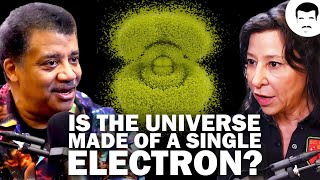 Neil deGrasse Tyson on Quantum Gravity: Space-Time May Be Emergent2021 · 55 min · full transcript
 Neil deGrasse Tyson on Black Holes and Dark Energy: Cosmic Queries2021 · 54 min · full transcript
 Neil deGrasse Tyson on Cosmos and Dark Universe: Why Science Matters2014 · 72 min · full transcript
 Neil deGrasse Tyson on Cosmic Queries: Black Holes, Quarks, and Light2021 · 47 min · full transcript
 Neil deGrasse Tyson on Stephen Hawking Interview: Never Give Up2015 · 47 min · full transcript