Search for Other Worlds
Water, chemistry, and time turn the search for life into a cosmic question.
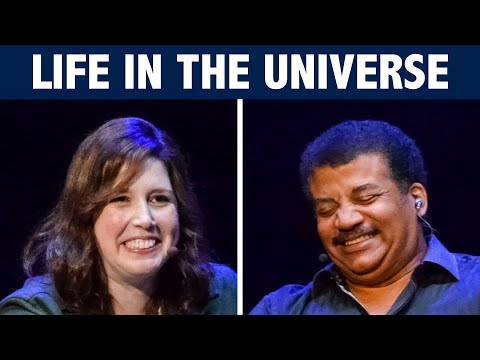
“There really is no Goldilocks zone as it pertains to distance from the Sun…”StarTalk Live at Beacon Theatre, 2018 · 28:56
The lesson
Tyson treats the search for life as a scientific question shaped by water, chemistry, and time. In the recordings, he argues that life elsewhere is plausible because the universe is vast, old, and chemically rich, and because life on Earth appears to have arisen relatively quickly once conditions allowed it12. That does not mean we assume life is everywhere; it means the question is worth pursuing with evidence rather than intuition.
Within our own solar system, that logic broadens the search beyond the old Mars-only picture. Mars remains an important place to look for microbial life, but Tyson also highlights Europa and especially Enceladus as compelling worlds because the search is really for environments that could support life, not just Earth-like surfaces. He explicitly pushes against a simplistic habitable-zone idea based only on distance from the Sun, which opens the door to ocean worlds under ice as serious candidates3.
Tyson also warns that the search can be distorted by human expectations. Mars, in his telling, is a case where familiar patterns can tempt us to see more than the data supports, so the right attitude is to stay disciplined about what the evidence actually shows. That is why he emphasizes exploration itself: we send spacecraft because we do not yet know what we will find, and learning from other worlds also deepens our understanding of Earth4.
Beyond microbial life, Tyson treats intelligent life and SETI as a separate but related frontier. He thinks intelligent life elsewhere is probable on cosmic grounds, yet he is cautious about projecting human motives onto aliens; fears of hostile contact, in his view, often reveal more about human history than alien behavior56. SETI matters because even a single confirmed signal would alter humanity's self-understanding, whether or not contact led anywhere further7.
For Tyson, the biggest idea is not just that life may exist elsewhere, but that discovering it would change the human condition. He says we cannot fully foresee the consequences, which is exactly why the search carries scientific, cultural, and philosophical weight. His stance combines openness to astonishing possibilities with patience, long timelines, and a commitment to evidence over fantasy89.
4 principles from Neil deGrasse Tyson
Follow environments, not familiar worlds
Do not limit the search for life to planets that look most like Earth from the outside. Apply the deeper criteria Tyson returns to: water, chemistry, and conditions that might sustain life, even on icy moons or worlds far from the Sun.
“There really is no Goldilocks zone as it pertains to distance from the Sun…”
Use Earth's story as a clue, not a template
Earth shows that life can arise from ordinary cosmic ingredients on a long but not impossibly long timescale. Use that as reason to investigate other worlds seriously, while remembering that life elsewhere may not copy Earth's exact path.
“The size of the universe and the age in the universe and the ingredients of the universe. I mean, think about it. In the early Earth, life got underway within a hundred million years of as early as it possibly could have. That sounds like a long time and it is, but that's small compared with the timeline of Earth itself, of life on Earth. It's like 5% of the timeline of the Earth. Almost as fast as it could possibly happen, the basic ingredients on Earth, which matched the basic ingredients of the universe, went from organic molecules to self replicating life. Whatever our challenges in the lab, Earth didn't seem to have a problem accomplishing it. And so look how quickly that happened. Yes, it would take a long time, much longer to generate what we're calling intelligent life.”
Do not project humanity onto aliens
When thinking about alien contact, Tyson warns that many fears come from our own record of conquest. Apply this by distinguishing evidence about extraterrestrials from analogies drawn from human behavior.
“His fear of aliens derives not from actual knowledge of aliens, but from an actual knowledge of ourselves.”
Treat discovery as worldview-changing
The search matters not only because it may answer a scientific question, but because the answer would reshape how humanity sees itself. That perspective justifies patience with difficult missions and attention to even small, credible signs.
“…if we found such a signal, it would, dare I say it, change the world.”
In his own words
The quotes behind the lesson, word for word from the transcripts. Numbers match the lesson above.
“The size of the universe and the age in the universe and the ingredients of the universe. I mean, think about it. In the early Earth, life got underway within a hundred million years of as early as it possibly could have. That sounds like a long time and it is, but that's small compared with the timeline of Earth itself, of life on Earth. It's like 5% of the timeline of the Earth. Almost as fast as it could possibly happen, the basic ingredients on Earth, which matched the basic ingredients of the universe, went from organic molecules to self replicating life. Whatever our challenges in the lab, Earth didn't seem to have a problem accomplishing it. And so look how quickly that happened. Yes, it would take a long time, much longer to generate what we're calling intelligent life.”
“So if we ask ourselves, are we alone in the universe? It would be, in spite of my diatribe about UFOs, I tell you in the same breath that it would be inexcusably egocentric to suggest that we are alone in the cosmos. The chemistry is too rich to declare that. The universe? Too…”
“There really is no Goldilocks zone as it pertains to distance from the Sun…”
“We don't know what we're going to find. That's why we're sending the spacecraft.”
“His fear of aliens derives not from actual knowledge of aliens, but from an actual knowledge of ourselves.”
“I don't think all life forms in the universe have the basal, um, primal violent attitudes that we do as a species.”
“…if we found such a signal, it would, dare I say it, change the world.”
“…you have to learn to love the questions just as much as the answer…”
“You want to go—you send a mission to Jupiter. Big, enormous rocket, Falcon Heavy—three Falcon 9 strapped together, 27 engines blasting at once, going as fast as you can, getting a slingshot from Earth. Takes almost six years, and so you’re in this game for the long haul. Do, and with Europa Clipper we’re six years out. That’s what I’m saying. Yeah. Yeah. Years, that’s what you describe. Yeah, yeah. And just, uh, it will change the world.”
Reflect
- Where in your own thinking do you equate 'familiar' with 'likely,' the way people might over-focus on Earth-like planets and overlook ocean worlds?
- What is one question in your work or life where the right move is to gather better evidence rather than fill gaps with expectation or fear?
- If a confirmed biosignature or signal were announced tomorrow, which of your assumptions about humanity's place in the universe would change first?
Check your understanding
Go deeper
 Neil deGrasse Tyson on Aliens and Cosmic Perspective: Are We Alone?2023 · 109 min · full transcript
 Neil deGrasse Tyson on Cosmic Discovery: From Mars to Pluto2011 · 143 min · full transcript
 Neil deGrasse Tyson on Life Beyond Earth: Why It Could Change the World2021 · 47 min · full transcript
 Neil deGrasse Tyson on Search for Life: Saturn, Titan, and Enceladus2018 · 102 min · full transcript
 Neil deGrasse Tyson on Alien Contact: Why It Could Be Dangerous2017 · 43 min · full transcript
- What did Neil deGrasse Tyson say about whether intelligent life exists elsewhere in the universe?
- What did Neil deGrasse Tyson say about whether we are alone in the universe?
- What did Neil deGrasse Tyson say about why Stephen Hawking feared aliens?
- What did Neil deGrasse Tyson say about missions to Europa and the long haul of space exploration?