Neil deGrasse Tyson on Space
Neil deGrasse Tyson treats space as both a source of cosmic perspective and a practical engine of discovery that helps humanity understand itself, protect Earth, and imagine life beyond it.
- Space makes human life feel connected to a much larger cosmos, not less meaningful
- Studying the universe is not a luxury; it produces knowledge and creativity that help life on Earth
- Exploration matters because we do not already know the answers, especially about life beyond Earth
- Tyson favors space ambition, but not fantasy: interstellar travel is brutally hard, and Mars is no substitute for fixing Earth
- Modern space tools open genuinely new windows on the universe, from cosmology to infrared astronomy

Space gives you a humbling but empowering perspective
Tyson returns again and again to the idea that space changes how we see ourselves. In his view, the universe is vast, ancient, and indifferent to our ego, so the right lesson is humility: humans are not the center, not uniquely privileged, and probably not special in the cosmic sense1.
But he does not treat that humility as depressing. He frames our relationship to the cosmos as intimate rather than alien, emphasizing that we are physically continuous with the universe and animated by its processes2. That combination—small in scale, yet deeply connected—helps explain why space can make life feel larger rather than smaller2.
Space science matters because it helps us understand Earth and ourselves
Tyson rejects the idea that studying space is a luxury disconnected from ordinary life. He argues that looking outward often teaches us something vital about conditions here at home, including planetary climate, impact hazards, and the long-term behavior of worlds34. In that sense, spending effort on space is also a way of becoming less ignorant about Earth4.
He also sees space research as a driver of broader human creativity. For Tyson, people who think about the universe often generate ideas whose practical payoff cannot be predicted in advance, and that unpredictability is part of why basic curiosity matters56. Cosmology and astronomy are valuable not only for direct answers, but because they cultivate habits of thought that spill into other domains56.
“How much is the universe worth to you?”SciCafe at the Museum of Natural History, 2008 · full transcript →
Exploration is worthwhile precisely because we do not know what we will find
A central Tyson theme is that space exploration is justified by discovery, not certainty. He stresses that spacecraft are sent because the unknown is real, and because nature may surprise us in ways we cannot script beforehand7. That makes exploration less like checking boxes and more like opening entirely new chapters of knowledge78.
This is especially clear in his view of life beyond Earth. Tyson thinks the universe is so large, old, and chemically rich that it is hard to justify the assumption that life exists nowhere else910. And if even a single credible signal or biosignature were found, he thinks the consequences for human self-understanding would be profound and global11.
That is why he treats places like Mars, Titan, and Enceladus as more than remote objects. They are real testing grounds for one of humanity's deepest questions: whether life is a local accident or a cosmic pattern71112.

“…if we found such a signal, it would, dare I say it, change the world.”StarTalk conversation with Bill Nye, 2021 · full transcript →
Tyson pairs big imagination with hard realism about travel and settlement
Tyson is enthusiastic about becoming a multi-planet species, but he does not accept weak arguments for it. He pushes back on the claim that Mars colonization is mainly a backup plan for extinction, arguing that many threats to humanity are more practically handled by protecting Earth directly13. His instinct is to support expansion because it is inspiring and worthwhile, not because it lets us ignore our present responsibilities13.
That realism becomes sharper when he discusses terraforming. His point is simple: if humanity ever develops the power to remake Mars into an Earth-like world, then it would already have the power to repair Earth itself1415. So Mars is not an excuse to neglect climate, ecology, or planetary stewardship here1415.
He applies the same sobriety to alien contact and deep-space travel. Fear of extraterrestrials, in his view, usually reflects what human civilizations have done to one another rather than any knowledge of alien motives1617. And while intelligent life elsewhere may be probable, the distances between stars make actual travel extraordinarily difficult at current capabilities9.
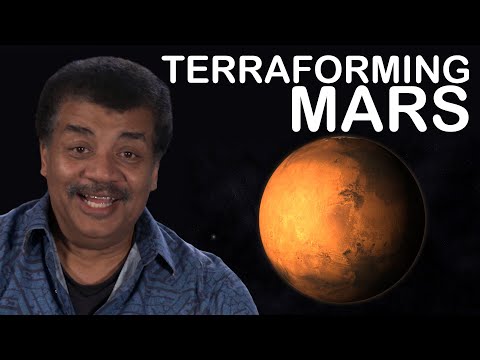
“The day we have the power to terraform Mars, turn Mars into Earth, we'll have the power to turn Earth into Earth.”StarTalk panel, 2018 · full transcript →
Understanding space means understanding how the universe really works
Tyson is not interested in awe without explanation. He wants people to see that the universe is intelligible: gravity links falling objects and orbit, free fall explains weightlessness, and cosmic expansion gives us a way to reconstruct the history of the universe181920. The wonder comes not from mystery alone, but from discovering lawful patterns behind what first looks magical1820.
He also emphasizes that new instruments reveal different aspects of reality rather than simply improving old pictures. His description of the James Webb Space Telescope makes this vivid: infrared astronomy opens a different observational window, allowing us to see through dust and study earlier stages of stars and galaxies8. In the same spirit, dark energy and black holes show that the cosmos still contains deep unanswered questions even where the evidence is strong2122.

“…it’s a complete other window opened up to the universe for you.”The Joe Rogan Experience, 2017 · full transcript →
Tyson on space, in his own words
“You are solar powered, and the universe is alive within you.”
“We live in an expanding universe.”
“…if we found such a signal, it would, dare I say it, change the world.”
“…it’s a complete other window opened up to the universe for you.”
“The day we have the power to terraform Mars, turn Mars into Earth, we'll have the power to turn Earth into Earth.”
“It's called the Copernican principle. You're probably not special.”
Where to watch
 Neil deGrasse Tyson on Universe and Cosmology: From Newton to the Big Bang2008 · 88 min · full transcriptBest single overview of how Tyson connects core space concepts to everyday meaning, from gravity and orbits to cosmic expansion.
 Neil deGrasse Tyson on Aliens and Cosmic Perspective: Are We Alone?2023 · 109 min · full transcriptBest for Tyson’s cosmic perspective: why the night sky stirs curiosity, humility, and questions about life beyond Earth.
 Neil deGrasse Tyson on Life Beyond Earth: Why It Could Change the World2021 · 47 min · full transcriptBest on why the search for life matters and how even one confirmed signal could alter humanity’s worldview.
 Neil deGrasse Tyson on the James Webb Telescope: Why It Changes Everything2017 · 173 min · full transcriptBest for understanding how new space instruments open new windows on the universe rather than just sharper pictures.
 Neil deGrasse Tyson on Alien Contact: Why It Could Be Dangerous2017 · 43 min · full transcriptBest for Tyson’s realist take on alien contact, Mars settlement, and why fixing Earth often beats escape fantasies.
 Neil deGrasse Tyson on Search for Life: Saturn, Titan, and Enceladus2018 · 102 min · full transcriptBest for Tyson’s broader vision of planetary exploration as a search for life and meaning across the solar system.
Questions people ask
- What did Neil deGrasse Tyson say about becoming a multi-planet species?
- What did Neil deGrasse Tyson say about whether intelligent life exists elsewhere in the universe?
- What did Neil deGrasse Tyson say about whether we are alone in the universe?
- What did Neil deGrasse Tyson say about why Stephen Hawking feared aliens?
- What did Neil deGrasse Tyson say about scientists inventing actuarial tables and risk analysis?
- Why did Neil deGrasse Tyson say we should study Venus and Mars?
Sources
Every quote above, word for word from the transcripts. Numbers match the text.
“It's called the Copernican principle. You're probably not special.”
“You are solar powered, and the universe is alive within you.”
“How much is the universe worth to you?”
“People say, why spend money up there when we spend... Because up there, we might learn about down here. Okay? I don't want a runaway greenhouse effect here. Venus is the best example in the solar system of a planet gone bad. Let's learn about that first. So it turns out the more we learn that asteroid impacts, when they hit, can cast rocks in their surrounding areas into space with escape velocity so they never come back to the planet from which it was launched. If Mars was wet and fertile before Earth was, as all evidence suggests, and if Mars had life before Earth had life, it is possible there were…”
“Oh, Sir Edmund Halley invented the act—the notion that you can calculate a risk using actuarial tables. An astronomer did this? Okay, so it's good to have people who think about the universe, who here only want to look at Earth. Where did she go? Where's my Earthwoman? Did she leave? Yeah, oh, she still here. Oh yeah, you're sneaking out over here on me. You're the one that only wanted to look at Earth. People who look up also invent stuff. Just want you—…”
“The people who still think about the universe and study the universe are hugely creative. And the creative energies cannot be prescribed. You can't go to a creative— you might, but I don't know that you'll get their maximum creativity. Say, "I need you to invent a cure for cancer right now. Use that brilliance." I'll try, but the greatest discoveries, the greatest cures, the greatest of these comes from a cross-pollination of interest that people have, that where they were engaged because they were interested just for the sake of being interested. So watch out.”
“We don't know what we're going to find. That's why we're sending the spacecraft.”
“…it’s a complete other window opened up to the universe for you.”
“The size of the universe and the age in the universe and the ingredients of the universe. I mean, think about it. In the early Earth, life got underway within a hundred million years of as early as it possibly could have. That sounds like a long time and it is, but that's small compared with the timeline of Earth itself, of life on Earth. It's like 5% of the timeline of the Earth. Almost as fast as it could possibly happen, the basic ingredients on Earth, which matched the basic ingredients of the universe, went from organic molecules to self replicating life. Whatever our challenges in the lab, Earth didn't seem to have a problem accomplishing it. And so look how quickly that happened. Yes, it would take a long time, much longer to generate what we're calling intelligent life.”
“So if we ask ourselves, are we alone in the universe? It would be, in spite of my diatribe about UFOs, I tell you in the same breath that it would be inexcusably egocentric to suggest that we are alone in the cosmos. The chemistry is too rich to declare that. The universe? Too…”
“…if we found such a signal, it would, dare I say it, change the world.”
“So tonight, we're going to talk about the exploration of the universe and the search for life…”
“Course, let's be a multi-planet species. Fine. >> Right. But—but I—I would do it for different reasons. I'd do it 'cause it's cool, not because we want to protect human, human species from extinction. No, that wouldn't be the reason to do it. Can I tell you why? Please. List every reason why you think we go extinct. One, we trash Earth. Another, and we can't live off of it anymore. An asteroid is coming. There's some nanobot gone astray, okay? Pandemic. Pan-virus pandemic, okay. So, it seems to me that if we want to be a multi-planet species, Mars would be the one 'cause it's a 24-hour day. It's got seasons. We—we would have to terraform first, but then we all move there. You just ship a billion people there. Here's…”
“Whatever it takes to terraform Mars to turn it into Earth, if you had the power of geoengineering to do that, then you have the power of geoengineering to turn Earth back into Earth.”
“The day we have the power to terraform Mars, turn Mars into Earth, we'll have the power to turn Earth into Earth.”
“His fear of aliens derives not from actual knowledge of aliens, but from an actual knowledge of ourselves.”
“His fear of aliens derives not from actual knowledge of aliens, but from an actual knowledge of ourselves. Anytime a more advanced civilization has come upon a less technologically advanced civil, it did not bode well for the less advanced civilization. And that happened in North America, South America, North America with Europeans, South America, the Spanish, uh, Australia with the Brits. Uh, never boded well for the less technologically advanced civilization. His factual knowledge of that leads him to suspect that aliens would be exactly the same. And I, I'm not that…”
“When you are in free fall, you are weightless.”
“There is no doubt about it: the man discovered the laws of gravity by sitting there.”
“We live in an expanding universe.”
“Dark energy is this, is this mysterious pressure in the vacuum of space that's forcing the universe to accelerate in its expansion…”
“If Earth happened upon a black hole that was traveling through space, an encounter between Earth and a black hole, Earth loses gods.”
How this guide was made: drafted with AI from the full transcripts of the recordings cited, then checked: every quotation must match a transcript word for word and be the speaker's own words, and an independent review gates accuracy. Methodology and corrections.