Neil deGrasse Tyson on Learning & Education
Neil deGrasse Tyson sees real education as the protection of curiosity, the defeat of boredom, and the formation of people who keep learning for life.
- Learning fails when school makes curiosity feel boring.
- Science literacy is not memorizing facts; it is continuing to wonder and question.
- Great teachers matter because their enthusiasm can make students want to learn more on their own.
- Education should create adults who embrace new problems as chances to learn.
- A scientific mindset helps people go beyond intuition and understand a reality larger than their senses.
The real enemy of learning is boredom, not difficulty
Tyson’s starting point is simple: people are not naturally opposed to learning. They resist situations that drain interest and make discovery feel dead. In his view, when students want to escape school, that is not mainly a failure of the students but a failure of the educational system to keep curiosity alive.12
He thinks school should leave people wanting more, not feeling finished. Good education should produce a person who continues learning after graduation because learning itself has become satisfying. That is his test of whether education worked.32
Science literacy means curiosity and questioning, not fact memorization
Tyson defines science literacy less as a list of facts and more as a habit of mind. The important question is how much wonder a person still has about the world. That shifts education away from storing answers and toward sustaining the impulse to ask better questions.45
This is why he favors questioning over passive belief. He wants learners to examine claims, test ideas when possible, and become comfortable with skepticism. For him, education should change how you think, not just what you can recite.6
He also emphasizes that reality often exceeds common sense. Human senses were not built to grasp all of nature, so disciplined inquiry matters. Learning, then, is partly about training yourself not to confuse intuition with truth.8
A great teacher awakens desire, not just compliance
Tyson places unusual weight on the teacher’s role as an igniter of interest. The goal is not merely to deliver content but to make students feel the pull of discovery strongly enough that they want to keep going on their own. In his view, the best outcome of a lesson is a student thinking that they want to learn more.39
That helps explain why he values engaging communication so highly. If learning can be made vivid and enjoyable, students stop associating knowledge with dullness and start associating it with possibility. He treats that emotional shift as central, not ornamental.101
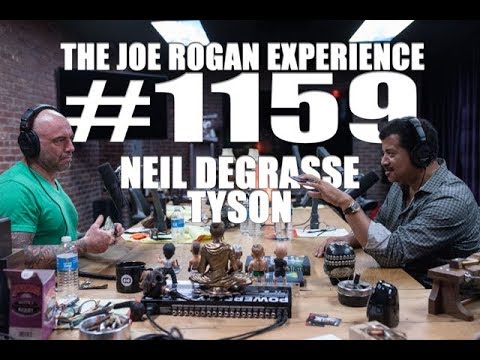
“Be that teacher to your students.”The Joe Rogan Experience #1159, 2017 · full transcript →
Hands-on exploration builds learners who can face new problems
Tyson’s view of education is practical as well as philosophical. He prefers learning that lets people explore, experiment, and figure things out rather than simply absorb instructions. That kind of education creates the kind of person who meets an unfamiliar task with eagerness instead of fear.114
He thinks the world needs more people who can say yes to a new challenge and learn what they need along the way. This is a deeper educational success than mastering a fixed syllabus, because it prepares people for situations they have never seen before. Curiosity becomes a lifelong tool, not just a childhood trait.115
“That's one kind of person in a workplace. Another kind of person is, "But here's a new task. I need you to do it." "Wow, I've never seen that before. Great! Let me figure it out." They’re two completely different species of human being. And what the world needs more of is the second case, where you take a new task and you say, "Wow, I get to learn. I'm going to learn on my own. I'll ask people who know more." You just—you just embrace the act of learning to satisfy your curiosity.”The Joe Rogan Experience #1159, 2017 · full transcript →
Learning should widen your perspective and deepen your humanity
For Tyson, education is not only about competence. It should also expand a person’s sense of place in the universe. A wider cosmic perspective can reorder priorities, making people less trapped by narrow concerns and more open to larger truths.1213
That broader view connects to how he understands the purpose of a life of learning. He ties learning to service, growth, and contribution, not self-display. Education matters because it helps you understand more today than yesterday and use that understanding in ways that reduce suffering and benefit others.141516
This also helps explain why curiosity matters so much to him. Creative breakthroughs often come from people following genuine interest rather than executing a command on demand. Education should therefore protect open-ended inquiry, because that is often where the most valuable discoveries begin.17

“I want to lessen the sufferings of others and make sure I learn something more about the world today than I did yesterday.”StarTalk Podcast, 2021 · full transcript →
Tyson on learning & education, in his own words
“Be that teacher to your students.”
“The universe is under no obligation to make sense to you.”
Where to watch
 Neil deGrasse Tyson on Science Literacy: Learning Without Boredom2017 · 201 min · full transcriptBest single overview of Tyson’s view that education should defeat boredom and create lifelong learners.
 Neil deGrasse Tyson on Cosmic Perspective: Curiosity, Science, and Space2014 · 69 min · full transcriptShows how he defines science literacy as curiosity, questioning, and firsthand engagement.
 Neil deGrasse Tyson on Cosmic Queries: Deep Questions and Big Ideas2021 · 48 min · full transcriptExplains why learning needs science: human intuition is limited, and reality is often not obvious.
 Neil deGrasse Tyson on Aliens and Cosmic Perspective: Are We Alone?2023 · 109 min · full transcriptConnects curiosity and cosmic perspective to meaning, motivation, and a bigger reason to learn.
 Neil deGrasse Tyson on Brain and Consciousness: From Sleep to Selfhood2018 · 127 min · full transcriptAdds Tyson’s interest in how biology and experience shape learning, behavior, and mental function.
Questions people ask
- How does Neil deGrasse Tyson think people should handle new tasks at work?
- Why does Neil deGrasse Tyson say he doesn't want memorials or statues?
- What does Neil deGrasse Tyson think schools should do?
- Why does Neil deGrasse Tyson think space exploration is worth funding?
- What did Neil deGrasse Tyson say about how science discovers new things?
Sources
Every quote above, word for word from the transcripts. Numbers match the text.
“They just don't want to be bored.”
“I don't blame the students. Yeah. I'm blaming the system where you can't wait to get out of school, which means they're not teaching curiosity. Because if they did, staying in school would be fulfilling that. And if they did, leaving school would birth you the rest of your life as a curious person where you continue to learn. That's what school should be about, and it's not. And that's what you're…”
“You should say to yourself, "Damn, I want to learn more.”
“…my personal definition of science literacy is: how much do you still wonder about the world around you?”
“To remain curious is to remain young.”
“Would it be cool if one year, instead of the word "Believe," they put the word "Question?”
“The universe is under no obligation to make sense to you.”
“Be that teacher to your students.”
“You make learning stuff about astrophysics fun.”
“That's one kind of person in a workplace. Another kind of person is, "But here's a new task. I need you to do it." "Wow, I've never seen that before. Great! Let me figure it out." They’re two completely different species of human being. And what the world needs more of is the second case, where you take a new task and you say, "Wow, I get to learn. I'm going to learn on my own. I'll ask people who know more." You just—you just embrace the act of learning to satisfy your curiosity.”
“…the cosmic perspective reorders what is important in this world…”
“You are solar powered, and the universe is alive within you.”
“I want to lessen the sufferings of others and make sure I learn something more about the world today than I did yesterday.”
“Let me back into that by saying, I don't want... I don't need anything that memorializes my life. Because it's not... As an educator, it's not about my life. It's about the life of those who I've touched. It's about their lives. It's not about my life. No statue, no plaques, nothing. I don't need that. I don't seek it. I've had photographers come up to me say, oh, I... I've... I'm a fashion photographer, and I photograph all these famous people. Do you wanna be a part of that? No. It's not about me. I don't need you to look at a picture of me in a book. What I want you to do, open up a book that I wrote and read what I wrote in the book. And you read that and you will learn from it.”
“Be ashamed to die until you have won some victory for humanity.”
“The people who still think about the universe and study the universe are hugely creative. And the creative energies cannot be prescribed. You can't go to a creative— you might, but I don't know that you'll get their maximum creativity. Say, "I need you to invent a cure for cancer right now. Use that brilliance." I'll try, but the greatest discoveries, the greatest cures, the greatest of these comes from a cross-pollination of interest that people have, that where they were engaged because they were interested just for the sake of being interested. So watch out.”
How this guide was made: drafted with AI from the full transcripts of the recordings cited, then checked: every quotation must match a transcript word for word and be the speaker's own words, and an independent review gates accuracy. Methodology and corrections.
