Neil deGrasse Tyson on Religion & Meaning
Neil deGrasse Tyson treats meaning as something forged through truth, curiosity, cosmic connection, mortality, and contribution rather than secured by religious certainty.
- He sees science as a better way to answer factual questions about the universe than religion.
- He thinks meaning grows from cosmic perspective: humans are made of the same ingredients as the universe.
- He treats mortality as a source of urgency and focus, not a reason for despair.
- He believes many people want certainty, but reality often requires humility before unanswered questions.
- He respects religion’s civilizational power and comfort, while insisting that testable claims must face science.
Religion, for Tyson, should not compete with science on factual claims
Tyson draws a sharp line between belief and knowledge. When religion makes claims about the physical world, he says those claims enter the territory where science can test them and potentially show them to be false. That is why he does not treat religion and science as equally reliable ways of explaining nature.12
At the same time, he does not reduce religion to stupidity or pretend it has been irrelevant. He sees it as one of the great historical forces in civilization and thinks serious conversation about it requires being informed rather than reactive.3
His broader complaint is not simply about religion, but about the human tendency to prefer comforting ideas over reality. In his view, people often cling to what feels true rather than what is true, and that impulse can distort both spiritual and everyday judgment.45

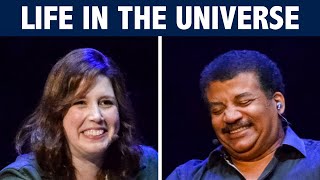
“If your religion is making testable claims about the physical world, be ready for the methods and tools of science to show that it's false…”Conversation with Richard Dawkins, Hayden Planetarium, 2014 · full transcript →
Meaning begins with a cosmic perspective, not with human centrality
Tyson’s alternative to religious centrality is not emptiness but connection. He repeatedly frames human beings as physically continuous with the universe: the same cosmic processes that made stars also made the elements in our bodies. That makes our existence feel less isolated and more deeply embedded in a larger story.678
This perspective is meant to shrink ego without shrinking significance. Tyson says modern astrophysics can make you feel smaller in one sense, yet more connected in another, and that connection itself becomes a source of meaning.910
He presents this not as cold reductionism, but as a profound way of seeing ourselves. In that frame, human consciousness is part of the universe becoming aware of itself, which turns scientific understanding into an existential idea as much as an intellectual one.1112
Mortality gives life urgency and purpose
Tyson does not treat death as something that drains life of meaning. He argues almost the reverse: finitude can focus attention on what matters and sharpen the value of the time we have left.13
That helps explain why his language about purpose is practical rather than metaphysical. He talks about wanting the world to be better because he lived in it, and he returns often to the idea of contributing to humanity rather than seeking personal immortality or memorialization.141516
In this view, meaning is not guaranteed by an afterlife. It is created by what you do, whom you help, what you improve, and what you pass forward while you are here.1714
Wonder does not disappear when science explains things
A common fear is that science strips the world of enchantment. Tyson argues the opposite: explanation can deepen beauty rather than destroy it, because understanding reveals more layers of reality instead of fewer.12
That is one reason he connects questions about God, aliens, and the night sky. For him, the sky naturally awakens awe, but awe should lead to curiosity rather than premature certainty.18
He is especially resistant to the habit of plugging mysteries with final answers. He thinks many people cannot tolerate open questions, so they rush to closure, while science asks us to stay with the mystery and follow it honestly.1920
His deepest moral stance is humility, curiosity, and service
Tyson’s view of meaning is ethical as much as cosmic. Because the human mind is not naturally wired for logic, he thinks humility is essential: we should distrust our first intuitions, avoid overvaluing our own thoughts, and keep revising beliefs when reality demands it.215
That humility feeds curiosity. He criticizes systems that train people to stop asking questions, because a meaningful life, in his view, is one that remains open to learning for a lifetime.22
It also feeds service. He places more value on improving other people’s lives than on self-glorification, and he recommends social habits that spread benefit outward through communities rather than closing it off.1617
Tyson on religion & meaning, in his own words
“If your religion is making testable claims about the physical world, be ready for the methods and tools of science to show that it's false…”
“I want the world to have been better off because I lived in it…”
“However, the world still has mysteries. They're just different mysteries from whatever there used to be. And so follow the mysteries where they take you. And there's another branch of all of us who must have answers to every question. Because they're not learning to love the questions, they only want to love the answer. So they say, what was around before the Big Bang? I said, don't know. We got top people... Something had to be around. I said, I don't know. Must have been God. So there's their answer. Then they're happy. What happens after death? Well, it looks like you rot in the ground, but otherwise, and that's what... It's gotta be something. Your soul... I said, there's gotta be... They got heaven. Okay. That's their answer.”
Where to watch
 Neil deGrasse Tyson on Cosmic Perspective: Stardust, Mortality, and Meaning2023 · 126 min · full transcriptBest single source for Tyson on mortality, stardust, truth, and how cosmic perspective becomes personal meaning.
 Neil deGrasse Tyson on Logic And Religion: Science, Belief, and Labels2014 · 82 min · full transcriptBest for his clearest distinctions between religion, logic, labels, and science’s role in testing claims.
 Neil deGrasse Tyson on Cosmos and Dark Universe: Why Science Matters2014 · 72 min · full transcriptShows how Tyson links science, humility, wonder, and a larger sense of human connection.
 Neil deGrasse Tyson on Aliens and Cosmic Perspective: Are We Alone?2023 · 109 min · full transcriptUseful for his language about the night sky, human significance, and living as part of a cosmic story.
 Neil deGrasse Tyson on Natural Selection: The Blind Watchmaker2021 · 53 min · full transcriptHelpful for understanding why Tyson sees apparent design in nature as explainable without a designer.
Questions people ask
- What did Neil deGrasse Tyson say about intelligent design and science?
- What did Neil deGrasse Tyson say about mortality and meaning?
- What did Neil deGrasse Tyson say about paying kindness forward?
- What did Neil deGrasse Tyson say Stephen Hawking thought about the future of religion?
- What did Neil deGrasse Tyson say about religion and belief systems?
- What did Neil deGrasse Tyson say about religion and understanding other people?
Sources
Every quote above, word for word from the transcripts. Numbers match the text.
“If your religion is making testable claims about the physical world, be ready for the methods and tools of science to show that it's false…”
“It was nothing. Was making sense that people were telling me about religion. What I didn't know is that belief systems don't have to make sense. That's why the belief systems... If they were... Made complete sense, it would just be objectively true. If it's a belief system, then it... It's beyond critical analysis. It's just a belief system. Okay? So when I say beyond critical analysis, what I mean is if something in your belief system lends itself to be tested, we can test it. And if what we test shows that what you believe is false, are you gonna stop believing? Generally not, because it's a belief system. Okay? Most people want to engage you ultimately with some kind of spiritual religious conversation, I have found, especially given my access to the universe.”
“So I acquired all these books and I mostly read them. I've skimmed all of them and read some of them with a little more intensity than others. Alright. On doing so, that enabled me, empowered me to have more meaningful conversations with people who were religious. Much more meaningful and more informed. That's the key. I don't want to speak about a religion unless I know as much as I can about it. As an academic, that should be what would be true of any subject. You're an academic, you care what's true, not what you think is true, what is true, or what people think. Alright? And there's no doubt that religion has been one of the greatest forces operating on civilization, ever since civilization.”
“…people value what they think is true more than what is true…”
“At no time should you overvalue your own thoughts…”
“…we are literally composed of stardust…”
“Okay? So that's the sequence of elements. And now you say, what are the sequence of elements in the universe? The number one is hydrogen. The number two is helium, but that's chemically inert. You might remember from high school chemistry. You can't do anything with it anyway. Helium. Next in the universe, oxygen. Next, carbon. Next, nitrogen. Next, other. Okay. So we are one for one, matched to the ingredients of the universe. And one of the gifts of twentieth century astrophysics is gifts to civilization, is where those ingredients came from. We trace those ingredients, the hydrogen, to the Big Bang itself. And all these heavier elements to stars that manufactured those elements in their core, in the crucible that is their core.”
“You are solar powered, and the universe is alive within you.”
“I feel large. I feel connected to the universe.”
“The humblest person in this world is the astrophysicist…”
“We are a way of the cosmos to know itself.”
“Science is an enterprise that should be cherished as an activity of the free human mind…”
“I think we all do at some point. And especially the more you've lived, the more it all sort of... You ask, what does it all mean? After we all come together, what will it mean to me in five years, ten years? I don't know if you're old enough to think about your mortality. But that's a thing, when you have fewer years left than the years you've lived. And you can... I think the way they say it is there's... You can have a good expectation to live as long as your parents did. I lost both of them in the last five years. So so that's my horizon. And the fact that we die has a capacity to bring focus into the remaining time you're alive.”
“I want the world to have been better off because I lived in it…”
“Be ashamed to die until you have won some victory for humanity.”
“Let me back into that by saying, I don't want... I don't need anything that memorializes my life. Because it's not... As an educator, it's not about my life. It's about the life of those who I've touched. It's about their lives. It's not about my life. No statue, no plaques, nothing. I don't need that. I don't seek it. I've had photographers come up to me say, oh, I... I've... I'm a fashion photographer, and I photograph all these famous people. Do you wanna be a part of that? No. It's not about me. I don't need you to look at a picture of me in a book. What I want you to do, open up a book that I wrote and read what I wrote in the book. And you read that and you will learn from it.”
“And you know what'll happen? That favor... And you tell them to pass it forward? That favor will work its way through society, through cultures, through civilization, never being closed back. The moment you say, hey, I'll repay you the favor, that closes it off and make... And it's no longer available to anybody in civilization. If you don't close it, send it forward, then there are these tributaries of favors working their way through civilization, and everyone is better off for it.”
“So tonight, we're going to talk about the exploration of the universe and the search for life…”
“However, the world still has mysteries. They're just different mysteries from whatever there used to be. And so follow the mysteries where they take you. And there's another branch of all of us who must have answers to every question. Because they're not learning to love the questions, they only want to love the answer. So they say, what was around before the Big Bang? I said, don't know. We got top people... Something had to be around. I said, I don't know. Must have been God. So there's their answer. Then they're happy. What happens after death? Well, it looks like you rot in the ground, but otherwise, and that's what... It's gotta be something. Your soul... I said, there's gotta be... They got heaven. Okay. That's their answer.”
“As an accounting for things that we don't yet understand on the premise that we will never understand it. And I asserted that those people are not useful in the laboratory. Whatever it is they do in life, the lab is not a place I need them to be. I need the people in the lab to say, "There's something I don't understand. I'm going to solve it." That's a different kind of mentality towards the unknown, and those are the people who make discoveries. Okay.”
“…our brain is not wired for logic…”
“I don't blame the students. Yeah. I'm blaming the system where you can't wait to get out of school, which means they're not teaching curiosity. Because if they did, staying in school would be fulfilling that. And if they did, leaving school would birth you the rest of your life as a curious person where you continue to learn. That's what school should be about, and it's not. And that's what you're…”
How this guide was made: drafted with AI from the full transcripts of the recordings cited, then checked: every quotation must match a transcript word for word and be the speaker's own words, and an independent review gates accuracy. Methodology and corrections.