Malcolm Gladwell on Trust And Deception
Malcolm Gladwell argues that people must default to trust to make society work, but that same habit leaves us vulnerable to deception and dangerous misreadings of strangers.
- People are bad at spotting lies and misreading strangers is common.
- We default to believing others, and that habit is necessary for normal social life.
- The cost of trust is that fraud, abuse, and scandal can continue for years.
- Faces, demeanor, and confidence are unreliable guides to truth.
- The practical response is more caution, humility, and slower judgment in high-stakes encounters.
Trust is not a flaw; it is the default setting of social life
Gladwell’s starting point is that human beings are built to believe one another. He says we are inclined to assume honesty rather than suspicion, and he treats that tendency as a basic feature of how people manage everyday life together1.
He does not present trust as naive in itself. He argues that defaulting to trust is often adaptive: people and institutions can function, cooperate, and take productive risks because they are not treating every interaction as a possible con2.
The same trust that makes society work also makes deception durable
Gladwell’s key twist is that successful deception usually does not depend on extraordinary trickery. It depends on ordinary trust. That is why frauds and abuses can persist for so long: the people around the deceiver are doing what normally works, which is believing what they are told and not assuming the worst2.
He also stresses that deception is often not hidden in a dramatic, movie-like way. Modern dishonesty can sit out in the open, buried in routine behavior, dense systems, or things people prefer not to interpret clearly. His point is that secrets are often visible, but people do not process them for what they are3.
That helps explain why cases of abuse or fraud can continue despite warning signs. In his discussion of Larry Nassar, Gladwell emphasizes how long it can take people to move from vague unease to actual belief, even when many people are close to the situation4.

“…the way you hide secrets is in plain sight…”92nd Street Y conversation, 2019 · full transcript →
We are much worse at detecting lies than we think
Gladwell argues that people assume lie detection should be one of our core interpersonal skills, but in practice it is not. He says plainly that we are poor at discerning deception, which means confidence in our judgments often exceeds our actual ability56.
This weakness matters because people often think they can read truth from a face, a tone, or a style of speaking. Gladwell pushes back on that belief. He argues that our judgments of strangers are frequently wrong, especially when we rely on quick impressions and visible cues78.
Misreading strangers turns trust problems into tragedy
For Gladwell, trust and deception are not just about scams. They are also about failed encounters where one person wrongly thinks they understand another. He uses Sandra Bland’s traffic stop to show how a routine interaction can unravel through repeated failures of interpretation9.
A big reason is what he calls mismatch and the assumption that inner feelings are obvious on the surface. He argues that behavior, facial expression, and demeanor do not reliably reveal what a stranger means or intends, so high-stakes judgments made too quickly are especially dangerous108.
That is why he keeps returning to the need to slow encounters down. In situations involving strangers, especially policing, he says adding time can reduce catastrophic error because snap conclusions are often built on misunderstanding11.
The right response is humility, not paranoia
Gladwell does not argue that people should stop trusting. He argues for a more humble view of what we can know about strangers. Since trust is necessary and suspicion cannot run every part of life, the real correction is to become less certain that we can instantly detect honesty, guilt, danger, or intent1314.
In practice, that means building systems and habits that respect how error-prone judgment can be. Slow down important encounters, avoid overreading demeanor, and resist confidence in first impressions. His goal is not cynicism but caution: keep trust, while recognizing the real price it can carry1114.
Gladwell on trust and deception, in his own words
“…the way you hide secrets is in plain sight…”
Where to watch
 Malcolm Gladwell on Truth and Deception: Why We Miss the Signs2019 · 71 min · full transcriptBest single discussion of why people miss deception and how trust lets fraud and abuse survive.
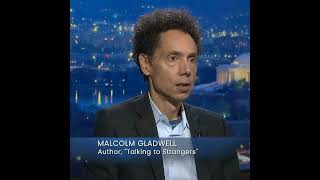 Malcolm Gladwell on Talking to Strangers: Trust, Error, and Tragedy2019 · 57 min · full transcriptStrong overview of default-to-truth, institutional trust, and the consequences of misreading strangers.
 Malcolm Gladwell on Talking to Strangers: Why Trust Goes Wrong2019 · 42 min · full transcriptClear explanation of why we assume honesty and why faces and behavior mislead us.
 Malcolm Gladwell on Talking to Strangers: Why Encounters Go Wrong2019 · 159 min · full transcriptBest for seeing how these ideas apply in real time to tense encounters like Sandra Bland’s stop.
 Malcolm Gladwell on Trust and Strangers: Why We Misread People2019 · 88 min · full transcriptUseful for understanding why Gladwell distrusts snap judgments and visible cues.
Questions people ask
- What did Malcolm Gladwell say about Talking to Strangers being a sequel to Blink?
- What did Malcolm Gladwell say was the deepest hope of Talking to Strangers?
- What is Malcolm Gladwell's main idea in Talking to Strangers?
- Why does Malcolm Gladwell say people need to slow down when dealing with strangers?
- What did Malcolm Gladwell say about why people miss signs of abuse or deception?
- Why does Malcolm Gladwell think trust can be a good thing, even when it leads to fraud?
Sources
Every quote above, word for word from the transcripts. Numbers match the text.
“WE ARE CONDITIONED BY EVOLUTION TO BASICALLY ASSUME THAT EVERYONE IS TELLING THE TRUTH…”
“They just assume everyone's honest. Turns out that's a really good way to make a lot of money, right? The people who are sitting in their home like so paranoid that their money is under a mattress, those people don't make any money, right? So, it's like it's weirdly adaptive to be taken in by Madoff. It's, you know, it’s a sign that you are someone who's generally trusting. Mm-hmm. It's probably a positive thing.”
“…the way you hide secrets is in plain sight…”
“Anyone who's in the gymnastics world of, of around Penn State knew Larry Nassar, but they didn't really know him. And Michigan State—yeah, Michigan State, man—they didn't really know him, and that, you know, partly because we have powerful mechanisms of denial, probably because, you know, if you are a pedophile, you spend a lot of time trying to obscure your behavior from people, but partly because what we're talking about, like people have many, many different dimensions and it takes—it took a very long time for some of those parents to come around to the idea that this man was—took actually finding 37,000 images on his hard drive for many of them to come around to the notion that he might.”
“…we should be good at that and we're not…”
“…we are pretty bad at discerning when someone's trying to deceive us…”
“…we're not very good at talking to strangers…”
“YEAH. SO WHAT I WANTED TO DO WITH THE BOOK IS TO SYSTEMATICALLY BREAK DOWN THE FAULTY ASSUMPTIONS THAT LEAD ENCOUNTERS BETWEEN STRANGERS TO GO AWRY. SO I MEET YOU FOR THE FIRST TIME. ALL WE KNOW ABOUT EACH OTHER IS WHAT WE CAN SEE ABOUT EACH OTHER. WE START TO HAVE A CONVERSATION. SOMETIMES THAT GOES WELL. SOMETIMES IT GOES HORRIBLY WRONG. BUT WE'RE MAKING JUDGMENTS ALL THE TIME... THE WHOLE TIME. ...BASED ON OUR OWN UNCONSCIOUS BIASES AND CONSCIOUS, CORRECT? EXACTLY. I'LL GIVE YOU ONE OF THE ONES THAT I SPENT A LOT OF TIME ON, IS WHAT I CALL THE ASSUMPTION OF TRANSPARENCY, WHICH IS, WHEN I SEE YOU, I OBSERVE YOUR DEMEANOR, YOUR FACE, YOUR EXPRESSIONS, YOUR EMOTIONS, YOUR BODY LANGUAGE, AND I DRAW CONCLUSIONS ABOUT THAT.”
“I wanted to write about because if you break that exchange down moment by moment, you see multiple failures of understanding…”
“THE TECHNICAL WORD FOR WHAT SHE IS, IS MISMATCHED.”
“…what your job is is to add seconds into the encounter…”
“…the cost of that insight is too high…”
“I want people to have, when I end, a call for caution and humility…”
How this guide was made: drafted with AI from the full transcripts of the recordings cited, then checked: every quotation must match a transcript word for word and be the speaker's own words, and an independent review gates accuracy. Methodology and corrections.
