Malcolm Gladwell on Talking to Strangers
Malcolm Gladwell argues that our biggest mistake with strangers is overconfidence: we think we can read honesty, intent, and emotion quickly, but those judgments often fail and can end in deception or tragedy.
- We are worse at understanding strangers than we think.
- We wrongly assume faces and behavior clearly reveal inner truth.
- Human beings default to believing others, which helps society but also enables fraud and abuse.
- Fast, high-pressure encounters magnify misunderstanding, especially in policing.
- Gladwell’s practical lesson is caution, humility, and slowing down before judging.
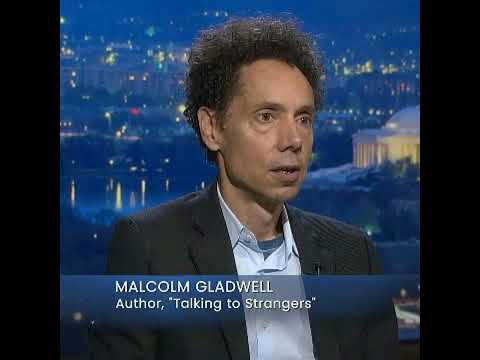
Gladwell’s central claim: we are not naturally good at reading strangers
Gladwell’s view starts with a blunt premise: people are much less skilled at dealing with strangers than they assume. He treats this not as a small social flaw but as a major source of bad decisions in everyday life, public scandal, and violent breakdowns.2
He presents the subject as a study of the faulty assumptions people make the moment they meet someone unfamiliar. In his account, stranger encounters go wrong because we keep making judgments from limited surface information and trust those judgments too much.34
“…we're not very good at talking to strangers…”C-SPAN Q&A, September 2019 · full transcript →
Why first impressions fail: strangers are often not transparent
One of Gladwell’s main ideas is that people wrongly believe inner feelings are visible on the outside. He argues that we look at a face, demeanor, or body language and think we can tell what a person means, feels, or intends, even though that confidence is often misplaced.35
This is why he is so interested in mismatch: cases where someone’s outward presentation does not line up with what observers expect. Once a person seems off-script, other people may read that as suspicious, hostile, dishonest, or evasive when it may mean something else entirely.5
For Gladwell, this is not a rare exception. It is a normal feature of human interaction, which means many of our strongest impressions of strangers deserve less confidence than we give them.34

“THE TECHNICAL WORD FOR WHAT SHE IS, IS MISMATCHED.”Super Soul Sunday, 2019 · full transcript →
Trust is necessary—and that is why deception works
Gladwell does not say people should stop trusting each other. His point is more unsettling: society works because human beings are inclined to believe one another by default, and that same strength creates openings for frauds, abusers, and manipulators.78
He argues that people are poor lie detectors and that deception often succeeds in plain sight. That helps explain why figures like Bernie Madoff or sexual predators can evade recognition for so long: the problem is not simply missing one clue, but a deeper human tendency to keep accepting the person in front of us as truthful and normal.9101112
In Gladwell’s framework, being fooled is not always evidence of stupidity. Often it reflects an adaptive social habit—trust—that is usually beneficial but occasionally exploited at enormous cost.7813
“WE ARE CONDITIONED BY EVOLUTION TO BASICALLY ASSUME THAT EVERYONE IS TELLING THE TRUTH…”Super Soul Sunday, 2019 · full transcript →
Sandra Bland shows how fast judgment can turn fatal
Gladwell returns again and again to the Sandra Bland traffic stop because it concentrates his whole argument into one encounter. He sees it as a moment-by-moment chain of misread signals, bad assumptions, and escalating interpretation, not just a single bad act detached from a larger pattern.14
His emphasis is that the officer and the institutional system around him demanded quick judgments in a setting where quick judgments are least reliable. Details that might look obvious afterward were not obvious in the moment, and some of the behavior interpreted as threatening or defiant had a different meaning entirely.1617
That is why Gladwell pushes the practical rule of adding time rather than force. In tense encounters with strangers, especially police encounters, slowing things down reduces the chance that uncertainty hardens into irreversible error.1716

“…what your job is is to add seconds into the encounter…”The Joe Rogan Experience #1383, 2019 · full transcript →
His broader lesson is humility, not cynicism
Gladwell’s conclusion is not that strangers are unknowable or that trust is foolish. His lesson is that people should be humbler about what they can infer from a brief interaction, a facial expression, or a confident gut reaction.43
That humility has institutional consequences. If humans are bad at reading strangers, then systems built around rapid judgment—whether in policing, interviewing, or high-stakes evaluation—need safeguards, more time, and less faith in first impressions.17
So the enduring takeaway from Talking to Strangers is caution. We should approach unfamiliar people with less certainty, slower judgment, and a clearer awareness of how often misunderstanding is built into the encounter itself.42
“I want people to have, when I end, a call for caution and humility…”C-SPAN Q&A, September 2019 · full transcript →
Gladwell on talking to strangers, in his own words
“…we're not very good at talking to strangers…”
“…what your job is is to add seconds into the encounter…”
“THE TECHNICAL WORD FOR WHAT SHE IS, IS MISMATCHED.”
“WE ARE CONDITIONED BY EVOLUTION TO BASICALLY ASSUME THAT EVERYONE IS TELLING THE TRUTH…”
“…we are pretty bad at discerning when someone's trying to deceive us…”
“I want people to have, when I end, a call for caution and humility…”
Where to watch
 Malcolm Gladwell on Talking to Strangers: Trust, Error, and Tragedy2019 · 57 min · full transcriptBest concise overview of the book’s thesis: why stranger judgments fail, how trust works, and why Sandra Bland matters.
 Malcolm Gladwell on Talking to Strangers: Why Trust Goes Wrong2019 · 42 min · full transcriptStrongest explanation of mismatch, transparency, and the deeper assumptions that make us misread strangers.
 Malcolm Gladwell on Talking to Strangers: Why Encounters Go Wrong2019 · 159 min · full transcriptMost vivid discussion of Sandra Bland and the practical idea that difficult encounters need more time and de-escalation.
 Malcolm Gladwell on Truth and Deception: Why We Miss the Signs2019 · 71 min · full transcriptBest for Gladwell’s thinking on deception, default-to-truth, and why obvious warning signs are often missed.
 Malcolm Gladwell on Trust and Strangers: Why We Misread People2019 · 88 min · full transcriptUseful if you want to see how Gladwell links this book to Blink and to the limits of snap judgment.
Questions people ask
- What did Malcolm Gladwell say about Talking to Strangers being a sequel to Blink?
- What did Malcolm Gladwell say was the deepest hope of Talking to Strangers?
- What is Malcolm Gladwell's main idea in Talking to Strangers?
- Why did Malcolm Gladwell write Talking to Strangers?
- Why does Malcolm Gladwell say people need to slow down when dealing with strangers?
- Why does Malcolm Gladwell think trust can be a good thing, even when it leads to fraud?
Sources
Every quote above, word for word from the transcripts. Numbers match the text.
“…we're not very good at talking to strangers…”
“YEAH. SO WHAT I WANTED TO DO WITH THE BOOK IS TO SYSTEMATICALLY BREAK DOWN THE FAULTY ASSUMPTIONS THAT LEAD ENCOUNTERS BETWEEN STRANGERS TO GO AWRY. SO I MEET YOU FOR THE FIRST TIME. ALL WE KNOW ABOUT EACH OTHER IS WHAT WE CAN SEE ABOUT EACH OTHER. WE START TO HAVE A CONVERSATION. SOMETIMES THAT GOES WELL. SOMETIMES IT GOES HORRIBLY WRONG. BUT WE'RE MAKING JUDGMENTS ALL THE TIME... THE WHOLE TIME. ...BASED ON OUR OWN UNCONSCIOUS BIASES AND CONSCIOUS, CORRECT? EXACTLY. I'LL GIVE YOU ONE OF THE ONES THAT I SPENT A LOT OF TIME ON, IS WHAT I CALL THE ASSUMPTION OF TRANSPARENCY, WHICH IS, WHEN I SEE YOU, I OBSERVE YOUR DEMEANOR, YOUR FACE, YOUR EXPRESSIONS, YOUR EMOTIONS, YOUR BODY LANGUAGE, AND I DRAW CONCLUSIONS ABOUT THAT.”
“I want people to have, when I end, a call for caution and humility…”
“THE TECHNICAL WORD FOR WHAT SHE IS, IS MISMATCHED.”
“WE ARE CONDITIONED BY EVOLUTION TO BASICALLY ASSUME THAT EVERYONE IS TELLING THE TRUTH…”
“They just assume everyone's honest. Turns out that's a really good way to make a lot of money, right? The people who are sitting in their home like so paranoid that their money is under a mattress, those people don't make any money, right? So, it's like it's weirdly adaptive to be taken in by Madoff. It's, you know, it’s a sign that you are someone who's generally trusting. Mm-hmm. It's probably a positive thing.”
“…we should be good at that and we're not…”
“…the way you hide secrets is in plain sight…”
“…we are pretty bad at discerning when someone's trying to deceive us…”
“Anyone who's in the gymnastics world of, of around Penn State knew Larry Nassar, but they didn't really know him. And Michigan State—yeah, Michigan State, man—they didn't really know him, and that, you know, partly because we have powerful mechanisms of denial, probably because, you know, if you are a pedophile, you spend a lot of time trying to obscure your behavior from people, but partly because what we're talking about, like people have many, many different dimensions and it takes—it took a very long time for some of those parents to come around to the idea that this man was—took actually finding 37,000 images on his hard drive for many of them to come around to the notion that he might.”
“…the cost of that insight is too high…”
“I wanted to write about because if you break that exchange down moment by moment, you see multiple failures of understanding…”
“He—so even on the level I try and identify in the book all of the different ways—and this is when I come back to the case at the end of the book—I go through this in more detail, all the different ways in which he completely misunderstands her. And one of them is, he doesn't understand the meaning of lighting a cigarette in a moment of tension, and that's, you know, still more evidence why you need, if you're a cop or anyone dealing with a stranger, you need to slow down and not jump to any conclusions because there's so much you can miss. What it seemed to me when I listened to it initially, and then I listened to it again in your audiobook, there's a thing that happens with police officers, and I've never been a police officer, but I was a security guard for a brief period of…”
“…what your job is is to add seconds into the encounter…”
How this guide was made: drafted with AI from the full transcripts of the recordings cited, then checked: every quotation must match a transcript word for word and be the speaker's own words, and an independent review gates accuracy. Methodology and corrections.

