Malcolm Gladwell on Politics & Government
Gladwell sees government at its best not as a machine for applying blunt rules, but as a human institution that slows down, reads context, and builds the capacity to handle complex problems well.
- Modern institutions often use old rule-based methods on problems that require judgment and interpretation.
- Police and other authorities fail when they rush stranger encounters instead of slowing them down and adding time.
- He has moved away from broad, indiscriminate policing toward selective, thoughtful use of authority.
- Good institutions focus on context, place, and capacity—not just individual blame or abstract ideology.
- His ideal government is more human: individualized, reassuring, and better at motivating change.

“…a mystery is a problem caused by too much information.”World Governments Summit speech, 2018 · 6:35
Government now faces mysteries, not just puzzles
Gladwell’s basic view is that many institutions were designed for an older world where the main problem was missing information. In that world, success meant gathering facts, applying rules, and producing a standard answer. But he argues that today’s hardest public problems are different: they involve overload, ambiguity, competing signals, and hard judgment calls rather than simple fact-finding.12
That shift matters because institutions built for routine administration can struggle when citizens need interpretation, reassurance, and tailored responses. Gladwell’s answer is not less government, but a different kind of government—one that can make sense of complexity and respond at a more human scale.345
Institutions fail when they mistake speed for competence
A recurring Gladwell theme is that encounters with strangers are fragile, especially when one side has power. He argues that many public failures begin with overconfidence: officials think they understand what they are seeing, when in fact they are badly misreading behavior, intention, fear, or stress.678
That is why he puts so much weight on slowing down. In policing especially, he argues that the job is often to create more time inside the encounter, because extra seconds can prevent tragic escalation and reduce the odds of acting on a false read of the situation.9
This leads to a broader institutional lesson: systems should reward caution and humility, not snap judgments dressed up as decisiveness. For Gladwell, public authority becomes dangerous when it is too certain, too fast, and too unwilling to admit uncertainty.1112
He changed his mind on policing: selective authority beats dragnet tactics
Gladwell’s thinking about institutions includes a public revision. He once helped tell a confident story about crime decline in New York, but later concluded that story was too neat and too final. He now treats that earlier certainty as a mistake and uses it as an example of how institutions and commentators can become trapped by elegant explanations.1312
His current position is that the important thing was not aggressive, indiscriminate enforcement. What mattered more was the careful, discriminating use of police power—authority applied with intelligence and selectivity rather than as a mass tactic like stop-and-frisk.1415
This is an important clue to his politics of institutions. He is not arguing that authority is unnecessary; he is arguing that blunt authority is often both unjust and ineffective. The better institution is precise, self-correcting, and willing to rethink its own story when reality changes.141512
To fix social problems, look at context and place, not just bad actors
Gladwell repeatedly shifts attention away from the idea that problems are mostly caused by a few flawed individuals. In crime especially, he argues that place matters enormously: harm is clustered, contagious in a broad sense, and shaped by environments and local conditions. Institutions miss this when they focus only on personal guilt and ignore geography and context.17
That way of thinking pushes government toward targeted intervention. If risks are concentrated, then the smart response is not blanket action everywhere but better detection, better mapping, and better use of scarce attention where it matters most. His examples about state capacity and outbreak handling point in the same direction: what counts is not merely having information, but being able to act on it effectively.181920
The institutions he wants are more human
Across policing, public health, education, and administration, Gladwell’s preferred model is an institution that treats people less like average cases and more like individuals. He argues that modern public systems increasingly need personalized responses rather than one-size-fits-all group solutions.34
That does not mean endless softness or the abandonment of standards. It means developing the social capacity to calm fear, motivate better choices, and match responses to the person and the situation. For Gladwell, the future challenge for government is to become more capable precisely by becoming more human.5
Gladwell on politics & government, in his own words
“…a mystery is a problem caused by too much information.”
“…governments are going to have to learn how to treat people as individuals.”
Where to watch
 Malcolm Gladwell on Government as Mystery-Solving: A More Human State2018 · 38 min · full transcriptBest single statement of his theory that modern government must shift from rule-based puzzle solving to human judgment and individualized solutions.
 Malcolm Gladwell on Broken Windows: Why He Was Wrong2024 · 17 min · full transcriptShows how he rethought policing and why he now favors selective authority over broad stop-and-frisk style enforcement.
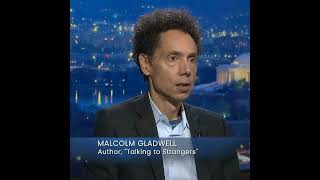 Malcolm Gladwell on Talking to Strangers: Trust, Error, and Tragedy2019 · 57 min · full transcriptExplains how institutional trust and misunderstanding shape failures between citizens and authorities.
 Malcolm Gladwell on Talking to Strangers: Why Encounters Go Wrong2019 · 159 min · full transcriptA detailed discussion of why police encounters go wrong and why slowing them down matters.
 Malcolm Gladwell on Crime Hotspots: Why Place Beats the Individual2025 · 53 min · full transcriptUseful for understanding his emphasis on place, concentration, and state capacity in solving public problems.
Questions people ask
- What did Malcolm Gladwell say about state capacity and preparing for pandemics?
- Why does Malcolm Gladwell say people need to slow down when dealing with strangers?
- Why does Malcolm Gladwell think writers should admit uncertainty?
- What did Malcolm Gladwell say about the future of pandemic defense?
- What did Malcolm Gladwell say governments need to do to become more human?
- Why did Malcolm Gladwell say poop testing was important in COVID?
Sources
Every quote above, word for word from the transcripts. Numbers match the text.
“…the Cuban Missile Crisis was a puzzle, and a puzzle is a problem caused by a lack of information.”
“…a mystery is a problem caused by too much information.”
“They are now in the business of providing individualized, personalized solutions and not group solutions.”
“…governments are going to have to learn how to treat people as individuals.”
“Surround us, we're going to have to simultaneously raise the sophistication of our social gifts in government. Governments are going to have to learn how to treat people as individuals. They're gonna have to learn how to reassure people who are frightened, and they're going to have to learn how to motivate people to change their lives in meaningful ways. That is the challenge that I think all governments around the world are going to face over the next generation. They're going to have to find a way to be more human. Thank you so much.”
“…we have got this thing about talking to strangers down?”
“…we're not very good at talking to strangers…”
“I wanted to write about because if you break that exchange down moment by moment, you see multiple failures of understanding…”
“…what your job is is to add seconds into the encounter…”
“I want people to have, when I end, a call for caution and humility…”
“I've tried to be, I mean, I realize when I look back at my younger self, I was way too certain about the ideas that I was putting forth. And I thought that if you wanted to win over an audience, you had to communicate certainty. And now I realize that's actually backwards, that you're more willing, you're more capable of winning over an audience when you admit to the uncertainty and the fragility of your position. People want that. They like that, they appreciate that spirit far more. And people are much more likely, I think, to be suspicious of someone who seems falsely certain.”
“I told a story about how crime fell in New York, and I told the story like the story was over.”
“This is what I believe happened now…”
“…the intelligent and thoughtful and selective application of police authority…”
“Criminology is rooted in place more than the individual.”
“Talk endlessly about state capacity, which is something distinct from knowledge or resources, which is your ability to act on information. Information and what you—I think if we focused heavily on state capacity, my favorite state capacity example would be the in-co. The best detectors of COVID were dogs, by far, by far. H, by far. Smelling. Yeah, yeah, yeah, sense of smell. You could—I went—I did this episode of my podcast. We went out to Alabama where they train COVID-sniffing dogs. The dogs outperform every other test of COVID.”
“So it might be that the future is not the absence of a devastating virus; it's our capacity to handle it when it comes up. That would solve the problem just as much as having a perfect antiviral serum that would be anti-every viral virus, right? That's the dream. Yeah, the dream. But if we have a system in place where no matter the virus, it never gets a foothold. Yeah. No, this is this idea of building the, like, The Economist, you know.”
“The poop stuff is actually really fascinating because the poop stuff is, uh, it was one of the first places we began to see these radical asymmetries. You could, you could see enormous numbers of amounts of virus coming from very, very, very specific locations. It wasn't uniformly spread. It was like, um, I forgotten, there's some incredible story one of these aerosols told me about that kind of analysis. But no, I think, you know, people need to get over it.”
How this guide was made: drafted with AI from the full transcripts of the recordings cited, then checked: every quotation must match a transcript word for word and be the speaker's own words, and an independent review gates accuracy. Methodology and corrections.
