Geometry Meets Physics
Basic science pays off in ways nobody can schedule.
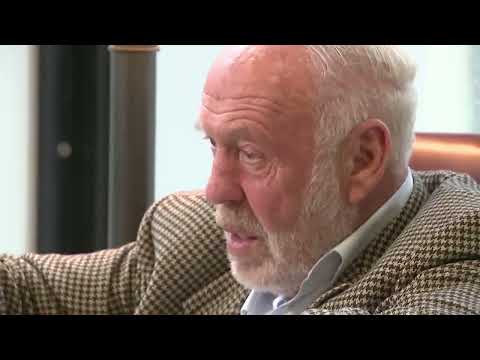
“It was just a beauty. It was just a beauty of it.”Public forum at CUNY Graduate Center, 2007 · 10:10
The lesson
Simons presents geometry not as a narrow specialty, but as one of the deep languages of science. He was drawn to differential geometry because of its internal beauty, especially the way broad ideas like Stokes’ theorem unify many cases at once, and that attraction shaped the direction of his work rather than any planned application12. In this chapter, the key point is that for Simons, beauty in mathematics was not separate from usefulness; it was often the start of work that later mattered far beyond mathematics.
That later reach is central to his view of the relationship between geometry and physics. In the recordings, he stresses that ideas developed in pure geometry eventually became useful in modern physics, including work that grew into Chern-Simons theory and related structures34. The important lesson is not just that one theorem found one application, but that abstract mathematical structures can become part of the conceptual toolkit of physics long after they are created.
His more technical talks reinforce why this happens. By tracing a line from Euler characteristic and Gauss-Bonnet to Chern’s intrinsic proof, characteristic classes, and then Chern-Simons forms and differential cohomology, Simons shows how geometry builds durable frameworks rather than isolated tricks567. Frameworks like these survive because they organize many problems at once, which is exactly why they can later migrate into physics.
From that perspective, Simons’s case for basic research becomes practical, not sentimental. He argues that in mathematics and basic science, you often cannot know in advance where good work will lead, yet strong foundational work can open surprising paths later84. That is why he supports institutions devoted to serious long-term research in areas like geometry and physics, rather than trying to schedule discovery around immediate payoffs910.
This view also implies a way to judge what to fund or study. Simons favors backing strong people, collaborations, and institutions that let important ideas develop over time1011. If applications cannot be predicted well, then one sensible strategy is to support talented researchers working on deep problems and give them the setting to keep inching toward new ideas.
4 principles from Jim Simons
Follow deep structure, not just immediate use
Simons’s path into geometry began with mathematical beauty and conceptual power, not a forecast of application. In your own work, pay attention to ideas that unify many cases or reveal hidden structure, because those are often the ones that travel farthest.
“It was just a beauty. It was just a beauty of it.”
Expect basic research to pay off unpredictably
A core theme here is that important applications often arrive long after the original work, and not in the field where the work began. That means basic science should be judged partly by its depth and fertility, not only by whether it solves a near-term problem.
“But mathematics is that way and basic science is that way. You do a piece of basic science, you know, and you don't know where it's going to go. But if it's pretty good science, it can lead to a surprising place. I mean when Maxwell developed the Maxwell equations, the television occurred to him as a consequence.”
Build frameworks, not isolated results
Simons’s mathematical story moves from classical geometric ideas into broader theories like characteristic classes, Chern-Simons forms, and differential cohomology. In practice, this means valuing work that connects many concepts and creates reusable language for future problems.
“…the roots of the subject that's come to be known as differential cohomology…”
Support excellent people in shared research environments
Because no one can reliably predict where fundamental ideas will lead, Simons emphasizes working with very smart people and letting collaborations develop over time. Applied to philanthropy or leadership, this means funding talent, conversation, and institutions rather than trying to micromanage outcomes.
“Work with the smartest people you can, hopefully smarter than you…”
In his own words
The quotes behind the lesson, word for word from the transcripts. Numbers match the lesson above.
“It was just a beauty. It was just a beauty of it.”
“But I really had an epiphany when I learned Stokes' theorem. Now, I guess you're all mathematicians so you probably know Stokes' theorem. You integrate one thing over a boundary and you take its differential and you--that's the same as integrating that over the interior or something. And that, you know, is a great generalization of the fundamental theorem of calculus and it works at all dimensions. And I thought it was the most beautiful thing, that theorem. And it really made me appreciate mathematics, it made me want to become--go into this field of differential geometry which I had sort of gradually learned existed.”
“What was interesting—or what else was interesting—ten years later or so, Ed Witten and some other physicists found that this stuff was useful in physics, not only in string theory and quantum field theory. Other people applied it to condensed matter physics, and now these Chern-Simons invariants are really kind of ubiquitous in many aspects of physics: the quantum Hall effect, whatever that is, even—I think—you have to get something cold, but I'm not sure. And even in quantum computing. I was just out in the steps with someone who…”
“You never know where something will go.”
“A Simple Intrinsic Proof of the Gauss-Bonnet Theorem…”
“…the roots of the subject that's come to be known as differential cohomology…”
“…it ended up being something that seemed worthy of study on its own…”
“But mathematics is that way and basic science is that way. You do a piece of basic science, you know, and you don't know where it's going to go. But if it's pretty good science, it can lead to a surprising place. I mean when Maxwell developed the Maxwell equations, the television occurred to him as a consequence.”
“The modern thrust of mathematics into geometry...”
“Work with the smartest people you can, hopefully smarter than you…”
“…you have a lot of smart guys and they keep inching away and getting a new idea here and a new idea there…”
Reflect
- What is one idea in your field that seems elegant or foundational but not immediately useful? How might you treat it differently if you assumed its value could emerge later?
- When you choose projects, do you overweight short-term payoff and underweight conceptual depth? Where might that be limiting your growth?
- If you were funding a lab, team, or personal research agenda, how would Simons’s emphasis on strong people and long time horizons change your decisions?
Check your understanding
Go deeper
 Jim Simons on Mathematics to Quant Investing: From Geometry to Markets2007 · 61 min · full transcript
 Jim Simons on Mathematics and Luck: A Life in Ideas81 min · full transcript
 Jim Simons on Geometry and Physics: Math, Science, and Purpose60 min · full transcript
 Jim Simons on Chern-Simons Forms: From Gauss-Bonnet to Physics68 min · full transcript
 Jim Simons on Differential Cohomology: the mathematical roots2013 · 96 min · full transcript
 Jim Simons on Math and Philanthropy: A Short Story of My Life2022 · 16 min · full transcript
 Jim Simons on Philanthropy and Science: Making a Difference2019 · 82 min · full transcript