The Mathematical Temperament
Start where Simons starts: with beauty, clarity, and play.
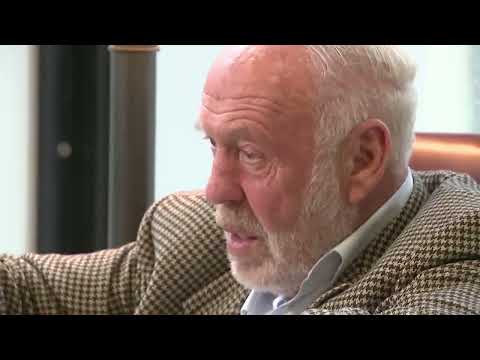
“It was very natural and I I always liked it.”Public forum at CUNY Graduate Center, 2007 · 0:00
The lesson
For Simons, mathematics began as a natural attraction, not a strategic career choice. He describes liking it from childhood, enjoying counting, doubling, and simply thinking for its own sake12345. That matters because it frames mathematics as a temperament: a way of noticing patterns and taking pleasure in clear structures before any thought of status or application.
What held his attention was not only numbers but the special clarity of proof. He says theorems and proofs appealed to him, and in these recordings mathematics comes across as a domain where definitions, logic, and structure feel unusually solid6. This helps explain why mathematics felt more real to him than many ordinary practical concerns: it offered permanence and exactness, not vagueness.
A central turning point was his encounter with Stokes' theorem. Across several recordings, he returns to it as a moment when beauty and generality came together and revealed a field he wanted to enter, differential geometry8910. The lesson is not just that one theorem impressed him, but that a single elegant idea can reorganize a person's intellectual life by showing how many things fit together at once.
Simons also treats mathematical development as guided by taste. He explicitly says taste matters in mathematics, which fits his attraction to beautiful, unifying ideas rather than to busy work or external rewards11. In practice, that means learning to prefer problems, tools, and explanations that are deep, clean, and revealing—not merely complicated.
Finally, this chapter sets up a lifelong pattern in Simons's thinking: follow beauty and clarity first, and trust that useful consequences may come later. He notes that basic science often leads to surprising applications long after the original work, and he describes enjoying algorithmic model-building in a similar spirit of exploration12. So the mathematical temperament here is both playful and serious: pursue what is elegant and intelligible, then keep working until it becomes a method.
5 principles from Jim Simons
Start from genuine fascination
Simons's early relationship to mathematics was rooted in enjoyment, curiosity, and the pleasure of thinking. When choosing what to study deeply, pay attention to what feels natural enough that you return to it without external pressure.
“It was very natural and I I always liked it.”
Prefer clarity over vagueness
The appeal of mathematics for Simons was tied to proofs, definitions, and exact structure. In your own work, look for formulations where you can say precisely what is true, why it is true, and what follows from it.
“The idea of theorems and proofs really appealed to me…”
Let beauty guide your field choice
Simons's attraction to Stokes' theorem helped draw him into differential geometry because one beautiful idea revealed a wider landscape. When a concept feels unusually elegant and generative, treat that as a clue about where your strongest work may lie.
“It was the most beautiful thing, that theorem.”
Develop mathematical taste
Taste means learning to recognize which ideas are deep, illuminating, and worth extended effort. You build it by comparing solutions, noticing which ones unify many cases, and asking which approaches make a subject feel simpler rather than messier.
“It was just a beauty. It was just a beauty of it.”
Trust basic inquiry to pay off indirectly
Simons emphasizes that strong basic science can lead to uses no one foresaw at the start. Don't demand immediate application from every worthwhile idea; instead, build understanding carefully and let later opportunities connect to it.
“But mathematics is that way and basic science is that way. You do a piece of basic science, you know, and you don't know where it's going to go. But if it's pretty good science, it can lead to a surprising place. I mean when Maxwell developed the Maxwell equations, the television occurred to him as a consequence.”
In his own words
The quotes behind the lesson, word for word from the transcripts. Numbers match the lesson above.
“It was very natural and I I always liked it.”
“I liked counting. I liked doubling: 2, 4, 8, 16—all the way up to 128…”
“I was just a kid who just liked thinking.”
“As a child, I was always interested in mathematics…”
“I just liked it, you know. I just liked it.”
“The idea of theorems and proofs really appealed to me…”
“It was the most beautiful thing, that theorem.”
“And it made me appreciate the beauty of mathematics.”
“But I really had an epiphany when I learned Stokes' theorem. Now, I guess you're all mathematicians so you probably know Stokes' theorem. You integrate one thing over a boundary and you take its differential and you--that's the same as integrating that over the interior or something. And that, you know, is a great generalization of the fundamental theorem of calculus and it works at all dimensions. And I thought it was the most beautiful thing, that theorem. And it really made me appreciate mathematics, it made me want to become--go into this field of differential geometry which I had sort of gradually learned existed.”
“It was just a beauty. It was just a beauty of it.”
“But mathematics is that way and basic science is that way. You do a piece of basic science, you know, and you don't know where it's going to go. But if it's pretty good science, it can lead to a surprising place. I mean when Maxwell developed the Maxwell equations, the television occurred to him as a consequence.”
Reflect
- What kinds of problems or subjects do you return to naturally, even when no reward is attached? What does that suggest about your own intellectual temperament?
- Think of a concept, theorem, or tool that changed how you see a field. What made it feel beautiful or clarifying rather than merely useful?
- Where in your current work are you tolerating vagueness? How could you restate the problem in a way that is more precise, structured, or provable?
Check your understanding
Go deeper
 Jim Simons on Mathematics to Quant Investing: From Geometry to Markets2007 · 61 min · full transcript
 Jim Simons on Mathematics and Luck: A Life in Ideas81 min · full transcript
 Jim Simons on Math, Codes, and Investing: A Life in Five Parts103 min · full transcript
 Jim Simons on My Life in Mathematics: From Geometry to Quant Investing2014 · 52 min · full transcript
 Jim Simons on Mathematics And Quant Investing: From Proofs to Markets160 min · full transcript
 Jim Simons on Mathematics and Science: From Holonomy to Physics2016 · 84 min · full transcript
 Jim Simons on Mathematics and Investing: A Life Between Worlds7 min · full transcript