Jim Simons on Philanthropy and Science: Making a Difference

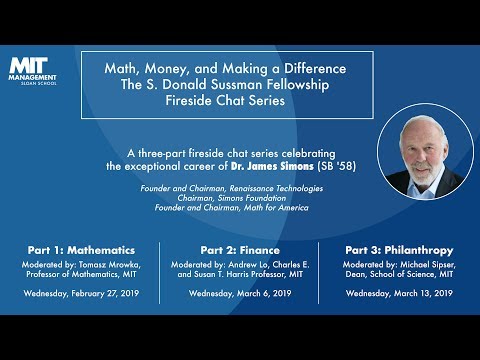
What Simons talks about
Jim Simons spoke at the S. Donald Sussman Fellowship Award Fireside Chat Series in September 2019 about philanthropy, science funding, research institutions, and math and science education.
Also known as: S. Donald Sussman Fellowship Award Fireside Chat Series; Finance at MIT fireside chat; Chat 3.
Jim Simons describes how his philanthropy evolved from small gifts into a large foundation focused on science, education, and research infrastructure. He explains why he prefers backing strong researchers and building durable institutions rather than chasing every cause.
A major theme is how the Simons Foundation supports science: autism research, computational biology, physics, astrophysics, quantum physics, and collaborations that bring scientists together around big questions. He also explains the Flatiron Institute and why in-house scientific teams and programmers can accelerate research.
He spends substantial time on Math for America, arguing that strong math and science teaching is essential, underpaid, and under-respected. Simons also shares his guiding principles: beauty, smart collaborators, persistence, and luck.
The event is introduced and moderated by MIT hosts, with audience Q&A at the end; Simons speaks for most of the conversation.
In his words
“Be guided by beauty.”
“Work with the smartest people you can, hopefully smarter than you”
“Don't give up easily.”
“People work for a combination of money and respect.”
“Math for America sounds terrific”
Key points
- Philanthropy began with occasional gifts, then became more intentional through a foundation started with Marilyn in 1994.
- The foundation first invested heavily in autism research, then expanded into math, physics, biology, and computation.
- Simons emphasizes funding smart people, workshops, collaborations, and institutions that can last.
- He explains the Flatiron Institute as a place for computational research with dedicated staff and programmers.
- Math for America is meant to reward excellent math and science teachers and improve STEM education.
- He argues the U.S. needs better math and science teaching and even proposes a National Science Corps.
- His philanthropic philosophy is to support strong work directly rather than optimize for social impact inside every investment.
Full transcript: Jim Simons, Sussman Fellowship fireside chat (2019)
I want to particularly acknowledge donors to the Sussman Fellowship: friends and families of friends and family of our award recipient Dr. Simons, alumni, faculty, and students from around MIT. They're joining us today. Let me also thank the MIT Sloan Finance Group for organizing the event series, and let me just state at the start that it's a real pleasure to be here for this third and final installment of the Fellowship Award Series. I certainly wish that I could have attended the first two, but I know from talking to many of you that they were really quite fantastic talks, and I'm sure we'll have a wonderful fireside chat this afternoon. Let me start with a little bit of background about the Donald Sussman Fellowship for those of
you might not have been able to join for the previous events in this series. The fellowship was established in honor of Donald Sussman's 30-year career in alternative investments and fund management. The focus is on both quantitative and fundamental strategies. Donald Sussman is the founder of Paloma Asset Management, Coloma Funds, and New China Capital Management LLC. The Sussman Fellowship is awarded to an individual or group who best exemplifies Donald Sussman's impressive career as a successful investor in quantitative investment strategies and models. This academic year, the selection committee awarded MIT alumnus Dr. James Simons as
the recipient of this fellowship: impressive career as a successful investor in quantitative investment strategies and models. I think that works, Jim. Let me say a few words of background about Jim Simons. Jim has had an extraordinary career as a mathematician, investor, and philanthropist. He's a founder and chairman of Renaissance Technologies, a highly quantitative investment firm; chairman of the Simons Foundation, an organization dedicated to advancing the frontiers of research in mathematics and the basic sciences; and also the creator of the Flatiron Institute. He's founder and chairman of Math for America, a nonprofit organization with a mission to
significantly improve math education in our nation's public schools. And perhaps most importantly for us, he's a class of 1958 alumnus, having earned his degree out of course 18. Jim's been a leader in the MIT community for many decades, also serving as a lifetime emeritus member of the Corporation. Jim and his wife Marilyn, who's joined us this afternoon as well, have really been an incredibly important partner with us in our pursuit of mathematics at MIT and in the world. I would point out that their generosity enabled the Institute to restore for the first time in, I think, a hundred years
Building 2 on the MIT campus — the renovation of Building 2, which is now named the Simons Building, and is the home for the Department of Mathematics. If you haven't been there since the renovation, I encourage you to do it because it's really quite beautiful. Since 1999, the Department of Mathematics has presented the Simons Lecture Series each spring to celebrate the most exciting mathematical work by the best mathematicians of our time. The Simons Foundation established the Simons Center for the Social Brain to create and translate knowledge into better diagnosis and treatment of autism spectrum disorders. Jim and Marilyn are also very passionate about supporting math and science teaching at the middle school and high school levels, and the Simons Foundation established Math for
America, an organization that identifies and supports outstanding math and science teachers in the New York City Public Schools through renewable four-year fellowships. I could continue on for many pages with all the wonderful things they've done both here at MIT and in the world of U.S. philanthropy. We've been honored to have Jim on campus with us over the past few weeks to discuss his expansive career in math and finance. Tonight we conclude the Math, Money, and Making a Difference series with a conversation focused on Jim's experience and dedication as a philanthropist. Mike Sipser, the Donner Professor of Mathematics and the Dean of the School of Science, will moderate this fireside chat. I would be
remiss if I didn't point out that tomorrow is an important day in philanthropy. Hi, Dad. It's also when we announce admissions. But Pi Day is a day that will mark MIT's third annual 24-hour challenge. It's a day when our community comes together to provide critical funding for the Institute. So we're incredibly fortunate to have Jim with us today, who's going to talk to us about his career as a philanthropist and what inspires his dedication of support with so many initiatives that are initiatives to make a better world. So without further ado, let me invite Jim and Mike to the stage, and let's please welcome him. (applause) Oh, thank you, Marty. So I also want to
welcome you all to this third Donald Sussman Fellowship fireside chat with Jim Simons. It's entitled Making a Difference and will be about Jim as philanthropist. The first talk was about math, and the second talk was about money. Those talks were moderated by Tom Rothvgar, a mathematician, and Andrew Lo, an expert in finance. I am NOT a philanthropist, Honora, and my an expert in philanthropy, but it is fitting, I think, that I conduct this interview because I was head of mathematics, as Marty said, for 10 years, and the department — the math department — was transformed through Jim's generosity, especially through the
marvelous renovation of the Simons Building, as we now call it, endowed chairs, fellowships, and in many other ways. You know, some of them ongoing through the Simons Foundation support. It's also especially meaningful for me to be personally here with you, Jim. I've known you since I was a graduate student in the 1970s and, maybe actually, that's longer than anybody else in the room — anybody else in the room has known you, or as I've known anyone else in the room, I think. For example, who my grandson is—I have known him for a long time. I think I've known you longer than that. Oh, you could have been, it could
Have, well, I'll explain. Mike was the boyfriend of my ex-wife. He was the boyfriend of my ex-wife, and that's how I met him. And this is true. Well, life is strange. Yeah. All right, you can stop laughing now. It's not— I mean, should I say anything more about that? Or, you know, about— that's definitely enough. Well, I mean, that is true. I—I had nothing to do with—
a problem with between Jim and Barbara Simons. Just, just, just for— just for to be clear on that. But Jim was always very gracious to me. You know, I got to know Jim and his—and his children through that, at that, at that time. And so anyway, I remember asking you about—because you were already in the process of amassing your wealth at the very beginning. You were—well, you know, you’re a lot wealthier than I had any vision to be, a lot less wealthy than you are now, of course. And I remember I asked you, you know, what are you gonna do with all your—
money? I don't know if you remember the conversation. I don't, but I do. And you said you didn't know, but you said you'd figure it out. And I do. And you did. That's what brings us here today. So, I thought I would start at the beginning and ask you to tell us about how your philanthropy got started. We were philanthropic children. Okay. Well, when I did start to make money—the first time I made a reasonable amount of money—I thought I would give a little bit of it away, which I did. In fact, it was to CARE.
This is an outfit called CARE. I gave some money to CARE, and then periodically I would give a little money here, a little money there. I'm married to Marilyn, who was sitting here in the front row, and we were both giving money away in kind of random ways to good causes. But then she had the idea to make a foundation. That was in 1994. And in 1994, I thought that was a pretty good idea, in particular because I could give money to the foundation, get a tax—
deduction and not have to worry about exactly where the money was gonna go. So you could, you could pile it up and give it out later. So we started this foundation. Marilyn ran it out of her dressing room in one of those boxes or something for a number of years. And finally, she hired her first employee. Now, we have 350 employees, is that right? 350? 350 employees. So the foundation grew, and the first meaningful science—
we did was in the field of autism. We have a relative on the autistic spectrum, and we were very interested in this condition. And while Columbia University said, "I'll give us ten million dollars, and we'll start an institute," I said, "Well, maybe." But someone else at Columbia said, "Don't be so fast. You should learn more about the field." So we had a roundtable. This was in June of '03, where the head of the NIH was there, a number of very distinguished—
neuroscientists were there, and we had this roundtable for all day, and we came out of it realizing our learning two important things. One: the condition is highly genetic. If two identical twins—if one of them has autism, it's at least ninety percent that the other will—not a hundred—but so, it's clearly highly genetic. And the second thing that we learned was, with a few exceptions, people working in the field were not such Cracker Jacks. It hadn't attracted, with—
with a few exceptions, really first-class scientists. So that became our mission. Okay, we'll focus on genetics and give grants. Well, we might to very smart people who want to get into this field. And we gave a few grants and they went okay. But it wasn't long before I realized that—and I guess Marilyn realized too—that we really didn't know what we were doing in this grant process. It turned out we gave a couple of good grants, one in particular which was terrific. I had a terrific—
result. But how do you really give grants and judge whether they're gonna be good or bad? So we decided we needed someone to run this program. And I did a search, and it was a nice search. I performed the search committee. I got the president of Rockefeller University to be a member. I got Harold Varmus to be a number member. And I had known this fellow Jerry Fishbach when he was head of the Columbia Medical School, and I thought it was a nice guy. I said how he could be on the search committee, and they said yes, yes he could be a great number. So I had—
to interview him to see if he wanted to do it, and we met over a pastrami sandwich, and we started talking about the job and so on. And he got more and more excited about it. And at a certain point, I said, "Do you want this job?" And he said, "I, yes, maybe I do." And after a week, he said, "Yeah, I want the job." So that was the end of the search committee. But that was very gratifying. So Jerry, he was a very distinguished neuroscientist, member of the National Academy, head of Neuroscience at Harvard, and so on. He came to us, and that's when we began to build something professional in the way of—
giving money to science. He hired some people who knew how to do a call for grants, knew how to get people to review the grant applications and so on. And so he was the first scientist of note that joined us in the foundation, and he hired a few in-house scientists but no one at the level of Jerry. And that went extremely well. We did a very big collection that had never been done before. We found a lot of genes that—
Indeed, because mutations in which cause autism, so that was a successful program. Now we were giving up money in other areas, but not so in such a formal manner. And we decided to make it more formal. Actually, Marilyn suggested we hire a guy named David Eisenbud, who had been head of the Math Science Research Institute in California, and he was now finished doing that. And I invited him to head Math and Physical Science. He did. We had
some great programs. In fact, he called a meeting first of theoretical physicists, that of mathematicians, and none of computer scientists—three separate meetings, asking each group, "What's the most important to you? What do you want?" Well, both the physicists and the mathematicians, there were the article physics. We wouldn't think of giving money to experimental physics at all in the future; subsequently, have done some of that. They were basically interested in individual grants and to very smart people and a variety of different types of grants.
And that was fine, but the computer scientists didn't—weren't so interested in grants. Their highest priority was an institute for theoretical computer science. Now, there were a number of institutes for mathematics, there were a number of institutes for snipped physics, but there was no Institute for Computer Science. So, well, okay, we'll do that. We had a big competition. We announced this. 18, you know, 17 universities and a Veterans Hospital applied for this institute. Now, we quickly eliminated the Veterans Hospital. They took—that was not quite
the right place to locate, and then these 17 universities got whittled down to 9, and we came back to them. And so they had to make a proposal, and the proposal had to include some money; what were they going to put in? So the nine came back again with improved proposals, and it was finally down to three, of which MIT was one, University of Chicago was the second, and Berkeley was the third. Now, I was an alumnus of MIT and I was an alumnus of Berkeley because that's where I got my PhD, so I didn't
anyway, I didn't want to interfere with this selection process, but it ended up Berkeley offered us a whole building, and that was more than either MIT or University of Chicago had offered. And so we built that in, and I don't know if you've ever been there. Oh, I have. It's a great place, right? Oh, it's wonderful. It's a wonderful place. It was a real success, a real success. In fact, yeah, it was a real success. Now, the woman who now runs it—she has just come to run it—was at MIT, and she would have run it if it had been at MIT, a woman named Shop Hee-Go and Wash it. So now she has taken over
from a fellow named Dakar, who I worried about at the beginning because he was kind of old, but he was apparently not that old because he did a wonderful job. And, you know, to copy—I took a classroom to Kop when I was a graduate student at Berkeley. He's a great guy, he's a great guy, and he's respected by everybody. So many, he was able to really gather great people around him. So that was. And then finally, in life science, we brought on a woman while she was first working in the autism group, but she was a little restless and more interested in other
things besides autism per se. So she now heads a unit on life science, and we do, we give a lot of grants and certain kinds of collaborations, which I'll get to. But now, am I going on too long, or do you have some other question you're burning to tell? Because I've—I'm delighted to continue with the progression of the foundation, if that's okay with you. II, it's your show. Okay, well, I have other questions too if you want, but so, well, I can finish this in another eighty
minutes, I think. So that came a time when I got—I don't remember what the root of this was, but I got interested in the possibility of doing collaborations. Now up till now, we had been giving individual grants, grants on grants to individuals; sometimes they work together or whatever, but it was typically grants to individuals. And I thought it might be a good idea to find a goal that one wants to work towards and do a collaboration
among maybe 20 or 30 scientists, postdocs, or whatever, and move science forward that way. So we had a meeting of a bunch of scientists. They were all hotshots, bigshots. In fact, Eric Lander was supposed to chair that meeting, but he had the poor taste to win a prize just before that and he had to go collect the prize, so he couldn't share the meeting. But David Baltimore chaired the meeting. But we had physicists and mathematicians and so on, and we met for two days in a sleepy little town on the up the Hudson River,
and the conclusion was, yes, this is a good idea, if it's organized appropriately; this would be a good idea. And in fact, a few people came with ideas already for collaborations. That was in 2012, and we started doing these collaborations. And one of the most origins of life, for example, now that's a—we all want to know where we came from, but the NIH, I don't think, cares where we came from, so it's not so easy for a life
scientist to get money for that quest, but it sure is interesting. And we—that—that collaboration is now in its sixth year, and we are getting closer to figuring it out. We're certainly not there yet. It's supposed to go on for ten years. Would it be there in four more years? Probably not. And maybe we'll extend it longer, but we've made a lot of progress in origins of life. And now we have 16 collaborations—that's a big one. That's it. Anything in life science is very expensive. I want you to know that right off the bat. Mathematics and
Theoretical physics is cheap, you know. You only need pencils and paper. But biology requires equipment, and that could be expensive. But we've started a lot of collaborations. One of them is co-headed by someone I believe is in the audience here named Penny Chisholm. Where's Penny? Where? Oh, that's—oh, she's very close here. There's Penny Chisholm, and I think she's the co-head of a collaboration called SCOPE. And SCOPE is trying to understand the microbial dynamics of our oceans and the ecology, the microbial ecology of
our oceans, and that's a really interesting and very complex subject. So, well, that's a collaboration that we have, and we have—I won't go through the litany of all—one is called the Global Brain, which is a very large neuroscience collaboration, and they're all there. They're going very well. So it was kind of a turning point. But one person there named Ingrid Daubechies, who is an applied mathematician of great distinction. She invented something called wavelets. Who's heard of a wavelet?
Looking—no? So she has a big following. She invented wavelets, and she suggested that we do something with data analysis—not necessarily a collaboration, but do something in the area of data analysis. She may have hoped that we would set up an institute at Duke, which is where she was, but I thought—and Marilyn agreed—it was a great idea. After all, I made a lot of money doing data analysis, and in finance, we analyzed a
lot of data, so that appeals to me. But it also seemed reasonable just to do that in-house. Why set up an institute? We could just hire people, and they'd work in the foundation. So we started in the biology area. We hired a great applied mathematician who happens to be an MD, Leslie Greengard. You know Leslie Greengard, say? So he agreed to head this group, and it was quantitative or computational biology, and he built a very nice group
of about 40 people, maybe 50 by then, and it was going wonderfully, wonderfully, and they were doing very good work. As opposed to a university department, we could hire programmers. In departments, programming is typically done by graduate students or postdocs, and then they leave, and there's no one to, you know, maintain the code, and not only that, they might not have been such wonderful coders. But departments can't give tenure to computer
programmers, researchers, after all, so anyway, you can't do that. But we can, and our program is—we hire stupendous programmers, very, very good programmers. So anyway, that worked out so well we decided to generalize the notion, and we knew we'd have to have a facility to do that because Leslie's group fit in our offices, but the rest of the foundation was growing as well, and we certainly couldn't have more such groups. So we took a building across the street that happened to be available. The guys
wouldn't sell it to me, but they gave me a 35-year lease with the 15-year extension. Now, I don't expect to be around to sign that extension, although I might be around some of those first 35 years. But so that was great, and we renovated that building at quite a cost. Don't ever renovate a very old building if you could just tear it down and build it from scratch. It costs—renovations cost more than, you know, construction. But anyway, yeah, I think we know that at MIT. Yes? Yes? That renovating
is expensive. It's expensive. Yeah. You have to... well, anyway, we renovated the building. It's a beautiful building. And our next thing was astrophysics, computational astrophysics. Now, for each of these units, just like we do for collaborations, we have a workshop first to decide: Is this a good idea or a bad idea, and so on? So astrophysics sounded interesting. I mean, we're all interested in what goes on out there. And so we did a workshop which was organized by a fellow named David Spergel, who was at Princeton, and he got a group
together, and the workshop was very good, and Spergel was terrific. So it seemed clear, yes, we should do this unit, and Spergel should lead it. And after a certain amount of courting, he agreed to do it, and he's come, and that unit is complete now. It has 55 people in it, and he's done a stupendous job. Well, the next one—this building could hold four units. Then the next one is something called quantum physics, and quantum physics is kind of material science. It's condensed matter physics. It's very,
very different from astronomy, and it's different from, you know, particle physics. But it's a very interesting field—materials. So again, we had a workshop to see if this is a good idea. It was a good idea. And there was a fellow named Antoine Georges. Now, four years earlier, we had started a collaboration called Many Electrons, which was kind of in the same field: the dynamics of electrons and materials, and so on. So when the workshop—
we did the workshop, there were 20 people sitting around a table, and everyone said this or that, and someone—they were all scientists—but when this fellow Antoine Georges opened his mouth, everyone got quiet right away to hear what Antoine had to say. I thought, well, Antoine would be a great guy to run this thing since, first of all, he was a very distinguished scientist, and second of all, everyone likes to listen to him. So, and that was the hardest, hardest recruit because he he was in Europe and had three jobs. So, well, he was at the Collège de France, he was at the Polytechnique, and he was also at the University of
Geneva. So, well, I had managed to pry them away from two of those jobs, and he finally agreed to come. So he's with us three-quarters time, and one-quarter time he's back at the college, difference. So now that unit now has 25 or 30 people. It's only been going for under two years, and it's terrific. They have all kinds of meetings and people come for workshops from around the world and so on. Now, we had room for one more, and there was a lot of debate that went on. What will the fourth unit be? We thought.
Might maybe it would be something in Earth science of some sort, but we couldn't — we couldn't really converge on anything. And then the idea was floated by someone, "Why don't we do a unit on computational mathematics?" Now, in the face of it, that sounds kind of redundant. I mean, mathematics is computational, but of course, it's also a lot of theorem proving. I mean, you know, pure mathematics—much of it is not computational at all. But by computational mathematics, we meant, or the guys who were proposing,
This meant statistics, machine learning, algorithm development, numerical analysis, and something else which I always forget. It is five things that I always could only remember for the time, but it was something else. Anyway, that's what that would be, and everyone, the three directors, really liked this idea because that unit, they saw, has been able to glue the other three units together. The other thing is, we're using mathematics, certainly because it's computational stuff, and there were interactions between, let's say, quantum physics and astrophysics, but they weren't big.
Interactions, and I wanted more collaboration even between units. And so, we decided to do computational mathematics, and that's just started and that will get built up to fifty, fifty-five people. And so, along the way, we decided to call this the Flatiron Institute. Now why that? Because it's in the Flatiron District of New York, a couple of blocks away from the famous Flatiron Building. So we call the Flatiron Institute. Everyone liked the name, and it's, it's, it's just going. It's
Just going great guns. So, that's pretty much where we are. We may add a fifth unit, but that would be the last one, and that's not definite yet. So, I think two things that distinguish our foundation—oh, also, we do outreach and education in the foundation, and we publish a—has anyone ever heard of Quanta Magazine? You know Quanta? Yeah, pretty good. Marilyn oversees that, and our other outreach we've made.
Made some movies and stuff like that, and how many? We have six million viewers of Quanta or something like that, six million, and six of them are right in this room. And I don't know where the other—the other six million minus six is. But so, about 10% of our effort goes to outreach and education, and you're probably going to ask me about Math for America, because I'm finished describing the foundation. You can ask. Yeah, this is one of the more easy interviewing.
Experiences that I've—well, I was going to ask about Math for America, but maybe even before that, I don't know if you can answer this question: what motivates your philanthropy? Is it curiosity, or the people that you work with, a sense of giving back? Is this a mix of those, or, you know, can you speak to that? Yeah, I think all the things that you said. I enjoy it; I enjoy being around scientists at Maryland, like scientists—so she likes science, we both like.
Science, and yeah, I'm curious about a lot of things. I really would like to know the origins of life, how life originated, and maybe the answers to some easier questions. So I like it. I'm not— and by establishing this, it's established in perpetuity. It has a very, very, very good endowment. And what else? And I got to do with my money. I mean, I'm giving some to my kids, so on. But what else am I gonna do with the money? And it's enjoyable, it's...
Really enjoyable. So, I can partner with my wife. See, we'd never been, which is not trivial by the way. It can have its rough spots, but on the whole, it's been great. So, does that answer your question? Yeah, I think so. Let's see. Well, when we talk about Merriment America, since you mentioned it... Yeah, Merriment America. It's a fact in the United States that STEM education is very poor in middle schools.
And in secondary schools, and you know, even in high school, it's probably not—it's not so good in the long grades either. We don't stack up in standardized math tests to any of the developed countries. We're at the bottom of the heap in how our kids do in these standardized tests. Now, you might say, "Well, you know, we're a very heterogeneous population," and so on. That's not the reason. Our best 10% don't do as well as their best 10%. So, why is that? Well, it's...
Pretty clear to me that our teachers of mathematics—I'm starting with math because we'll get into science in a minute—but our teachers of mathematics in many cases don't know very much mathematics. They just don't. I mean, you know, if you want a teacher, you want your teacher to know the subject that he or she is teaching and to love the subject, but they're few and far between. They're existent; there are some good teachers, knowledgeable teachers, but we don't have it enough. Now, why is that? Well, high school, let's say, high school teaching.
Middle school teaching doesn't have all the respect in the world as a job it should, but it doesn't. Moreover, if you know enough math to teach high school math, you probably know enough math to work for Google or Goldman Sachs or someplace that begins with a G. There are a lot of places beginning with G, so that's a problem. When I was a kid, there were no computers whatsoever. If you liked math, you know, being a math teacher was...
Was a pretty good job if you like math. I know you could be a bookkeeper or an accountant or something like that. Now would be fine. But, and women who couldn't even become engineers in those days because if you're a woman you couldn't do engineering. A woman who liked math, that was a very good job for her. But today the pull out of the classroom is very strong because, like I say, if you know enough math to teach properly, teach high school math, you could get a job at Google that may be twice the salary or anyway a good deal more, and you get more respect. "I work for Google." "Oh really?"
Telling you about it, "I'm a ninth grade teacher and such-and-such a junior high school." "Uh-huh, nice." But it's not the same. So how? So, it's my view that people work for a combination of money and respect. So a lawyer might aspire to someday, "I could be a Supreme Court justice." Well, he's not going to make a fortune as a Supreme Court justice, but you get a lot of respect if you, you know, it's a job that anyone would be very, very proud of. So what we do is, so this is how it works: people, teachers themselves, if they've
had three years' experience or more, can apply to become members of a core. It's a core of teachers. They first have to take a test of knowledge. If they passed the test at an adequately high level, then they come in. They're interviewed. They have to do a little sample class to show, but not only do they know math, but they know how to teach it. And then they come into the core. Now they get twenty thousand dollars a year on top of their, no, fifteen thousand dollars a year on top of their salary. Now their salaries are maybe seventy-five thousand dollars, so
fifteen thousand, well, it's not mine, you know, game-changing but it's nice, another fifteen thousand dollars, and they meet to do professional development. We have courses that they take and give to each other. Most of the courses are taught by the teachers themselves, and their esprit de corps is terrific. They're very proud of this organization. Now four or five years ago we started to include science and now there are, in New
York City, 1,000 members of the Math for America core: half of them teaching math and half of them teaching biology and chemistry and physics and the other thing. And that's about right for the classrooms. There's a lot more math taught than any of those others but, and there they are, so enthused and so terrific, and their students in every course, their students do better than the average student. We went
through all the courses, and their leaders in their schools, and so it's, it's, it's a, it's a great program. And you're appointed for four years; you can reapply and many people do reapply, and a meaningful fraction of them get accepted again, and we have some, a few who are now in their fourth term. So, and, and as a stylist, now a thousand is ten percent of all the math and science teachers in New York public schools in the middle and upper and high school, whether there
aren't any in lower school. So we have 10% of all the teachers, and the state of New York likes the program so that I have almost the identical program outside of New York City, and they too have about a thousand teachers, and that is about 10%. New York City is about half of the population of New York State, so it's about the same size, and that's the only... wonderfully. So that's, that's Math for America, and we didn't change it to Math and Science for America; it just sounded kind of dorky. So, well, we had one name. So go ahead. No way. It's, I think it's a tremendously important program. I
my father was a high school math teacher. Uh-huh. And, you know, you're right. Back in those days, there were fewer opportunities available, but he also loved doing it. You know, yeah, great job. You know, and I think I, I can, oh my own both my love of mathematics and also my love of teaching. So, but how did you get started with Math for America? Seems a little bit of an outlier relative to the other kinds of things you do which are mainly supporting science itself. Yeah, how did the deck—was that Maryland's idea? Was it—no, no, it wasn't my idea.
Well, I had this idea years ago, and because it was, it was clear the problem was clear to me, you know? And well before I—I neglected to say that for, after I retired from Renaissance, I've been more or less full-time with the foundation, but this is way before that. I saw this as a problem, and it looked to me like it could be relatively easily solved with a federal program. Now because I could see
we're competing, our country is competing with all these other countries, and, well, more and more of the economy is quantitatively driven, and we need, you know, we're not we're not doing our job in training our kids. So I was the beneficiary of a program years ago called the National Defense Education Act that was formed in the wake of Sputnik, which I think went up in, in '58, and that really shook up America. The Russians are ahead of us. Soon they'd be on the moon,
throwing butter at us or something. There was a real panic, and the conclusion was we don't have enough scientists, we don't have enough mathematicians and physicists. They weren't focusing on biological science; they were focusing on math and physics, electrical engineering, that kind of stuff. We don't have enough. So they made this big program, and part of the program was fellowships, graduate fellowships, and I got one, and I was the first person in the United States to get his Ph.D. under the auspices of the National Defense Education Act. Now that was
Someone had to be first, and anyway, I know the number of PhDs in math granted in my year, 1961, was about a hundred. Ten years later, it was fourteen hundred. So all kinds of people got drawn into math and science, and at least the non-life science salaries went up very fast. Academic salaries went up quite quickly in those fields, and so I saw, hey, there's a national program.
That could work. I said, okay, now we have this need; it's not Russia we're trying to best, as we're competing with everybody. So I had supported a guy named Schumer to run for Senate. I was, I guess, twenty years ago probably, and it was the first politician I'd ever supported. I never mind why, but I did. I supported him, and as soon as he—anyone—and as soon as he was in office, I went down to talk to him about this program. I wanted to do a national program, a national program, and
he said, "It's a great idea, it's a great idea. I'll get right on it." And as I left, I was standing outside his office for a little while for some reason, and I heard him say to the next group, "It's a great idea, it's a great idea. I'm gonna get right on it." Well, I love Schumer, but he didn't get right on it, and it sounded a little—I think it sounded a little oddball, I don't know. And he worried about—or people worried about how would the unions deal with that? PSD unions are totally fine with it because the money doesn't come out of the school system; it comes from—it's like manna from heaven, it comes from us. But if it came from the federal
government, it would be the same. So my real goal, and I'm marching down to Washington after the next presidential election—and I think I'll have a little more clout—is to have something called the National Science Corps, which is a corps of teachers. There are five hundred thousand math and science teachers in the United States, five hundred thousand. If 10% of them were in this corps, there'll be 50,000 people. And if it costs $20,000 a head, say 15,000 for the top-up in salary and 5,000 for administrative expenses, it would cost a
billion dollars a year. Now, a billion dollars a year is a rounding error in our budget. It's a rounding error in the Department of Education budget. We went to Obama with this idea, and he liked it and tried to sell it to his Secretary of Education, Arne Duncan, who didn't like it at all. And so it never floated. He wanted to get rid of bad teachers, fix bad teachers, get rid of them. What I want to do is recognize and reward the good ones because that's what produces morale in any company. If you're running a company, okay, if someone's not good, you have to throw
them out, but if someone is good, he wants to be recognized and rewarded appropriately, and that's how you keep up morale. You do a good job; you're recognized for it. So that's what this corps is doing, and we really hope that we'll make it a national corps. Like you all to write your Congressman and Senator, too. Well, you don't have to do that, but if you want to do that, ask them about something like that. So yeah, this is a little different from other things we do in the foundation, but yeah, it's a good—I think it's great. I really do.
Then let me—let's go back a little bit to the science side of things. You know, you have these several different areas within the Flatiron, not your—you're supporting them, and I think one of the things that is a hallmark of yours is that you have great taste in areas and big questions. So like, you know, the origin of life, other—what are the other questions that interest you that you kind of try to make it advance within there? Well, I like origins questions. We do have a small collaboration on the origin of the
universe, but I have a big telescope project that's in that area. So right, so—so would putting up a telescope array at the Atacama Desert in Chile, 17,000 mile—17,000 feet high. And it's in the microwave frequency; it's not in the—not optical telescopes, their microwave telescopes. And how many people have heard of the Cosmic Microwave Background? Okay, that's a majority of
where? At MIT? Okay, it's a majority of the people know about the Cosmic Microwave Background, but it's something that occurred right in the Big Bang or whatever it was, at the very, very beginning, and it was discovered about 50 years ago to exist. And examining it can be pretty—get pretty good evidence as to what happened at the beginning. Now there's a theory, and one of the professors here at MIT, Guth, was one of the fathers of this theory called
inflation. Now, inflation was supposed to have occurred in the first many, many, many, many microseconds of the universe when it started with a point, let's say, and it inflated with incredible rapidity, much, much faster than the speed of light. It just zoom. Now, that inflation should have caused gravitational waves—primordial—that called primordial gravitational waves because, well, you know, now most of you have heard of gravitational waves, you know, two black holes
crashing and stuff like that make these waves. It's a—it's a fantastic LIGO is a fantastic thing. But inflation hypothesizes that there will be these primordial gravitational waves. Now the only way to see them is through the Cosmic Microwave Background and getting enough accuracy in measuring it so you could see such a pattern. Now, three years ago, or maybe now it's four years ago, a group at Harvard said we found them we
Found primordial gravitational waves, and in fact, that twice as strong as was theorized to be. Oh, okay, good, I found them. But within weeks, people in the know and the real know realized they didn't find them, and after a couple of months, they admitted that it was dust. We hadn't adjusted for dust, and that's really what we were seeing. And so, okay, the instruments that we're building, so this is a combination of Princeton, UCSD, and University of Pennsylvania, and we're
putting up the money. They're putting up a little, we're putting up a lot, and I'm very excited about this. So personally, I don't think we're going to find them, but we can drive the size down to within one-tenth of what that theorized to be. We can really see this very, very accurately. And if there's no primordial gravitational waves, even at 10% of the strength that they were hypothesized to be, well, it's back to the drawing board and new theories of the origin of
the universe will emerge, and some of them already have emerged. It's always been aesthetically unpleasant to me to think that time had a beginning, when we all think time will go forever. Why shouldn't that have gone forever? Why shouldn't it? I mean, the number line—you could go to the left, you can go to the right, it goes forever in both directions. So why not that? That the hypothesis that our universe started from a point 14 billion years ago—I think that's ages, doesn't seem, you know, so sensible.
On the other hand, I mean, it's a no-lose proposition. If we find the primordial gravitational waves, everyone will get a Nobel Prize, and, you know, people will be dancing in the streets and we can say, "Oh, our foundation did that," so funded that, but so either way we win. But anyway, that would be great. That's something. Okay, you know, here's something I wanted to ask you. It gets a little deviating here, but more of a kind of sciency question, just your speculation—you, so you're making progress on trying to figure out the
origins of life. And so, do you have any opinion, I guess, as to whether there is life elsewhere? Intelligent life, let's say, maybe even elsewhere in the universe. I mean, we have intelligent life here, but—well, I do have opinions, they're not very strong, I would say. Well, look, here's the thing: there's, I think, 10 to the 23 stars in the universe. 10 to the 23, that's a very, very big
number. And from what we know, what we're seeing now, the expected number of planets around each star is bigger than one. So let's say, okay, 10 to the 23, I'll have on the average one or more. Now, well, that's a huge number. So people think, "My God! With all those opportunities for life, the universe must be teeming with life." Oh yeah, maybe, but maybe not. So one of the guys in this outfit, a guy named John Sutherland from Cambridge, he's in the origins collaboration, in fact he's the co-head of it—a brilliant guy.
He started with, now we know that the atmospheres of exoplanets have a seed of organic molecules. These are not rare, they're common in the dust of stars in formation. You can see these, you know, organic molecules. It's not that they're full of them, but there are organic molecules. So a rather common one is hydrogen cyanide. I always thought cyanide was something that kills you, but anyway, it's an organic compound, hydrogen cyanide, and
John Sutherland traced a trip—made a trail from hydrogen cyanide pretty much up to RNA. I said, "Okay, the hydrogen cyanide combines with blah, blah, and then blah-blah combines with boo-boo," and so on. And maybe there were 10 or 15 steps, and finally you got to—I said, "Okay, John, just give me the probability of every step occurring. I'll multiply all the probabilities together, and then I'll see what the likelihood was their life to have started on Earth." But he couldn't do that because he had no idea. They were plausible, each of these combinations was plausible; it could have happened, but, you know, these things had to bump into each
other somewhere. And so I think it's entirely possible that we're alone. It's entirely possible or alone. It's also possible that there's a great deal of life, microbial life, all over the place, as that seems possible. And now was it down, but those two possibilities pretty much covered, yes. But if you had to bet one way or the other, you would bet on—I would—I would bet that the first question I'd bet
there isn't intelligent life. Mm-hmm, on the microbial level I would bet there is. No, I think I would bet there is. Now, even though you can get up to DNA or RNA, you know, getting up to us humans, for better or worse, was quite a trail as well. And who knows, you know, we had a good climate, we had this, we had that. So we had a lot of favorable things and probably a lot of luck. So that's why I'm not—well, anyway, there's my answer. You want to make a bet? I would—you bet—
Well, I would bet that there isn't life elsewhere. I think we're alone. I think intelligent life—any life—or you think it would go—that's, I mean, it's just too hard. I mean, until you have evolution, I mean, you can make RNA and stuff like that, but until you actually have evolution, you can't make progress. It's just a random thing. And then how? Yeah, and then, you know, evolution itself—you need so much, so many structures in place that had to come to be there without evolution. Yes, and just seems so unlikely even with so many points, isn't it? With 10 to the 23? Yeah. Well, I can't disagree with you, you know.
So we don't have a bed after all. We're on the shake shop. Okay, that sounds— that sounds good. So, I don't know. I thought maybe we would open it up to questions. So, we have folks here with microphones. And you want— who is supposed to be actually picking these? Well, that was the first hand that went up right there. You know, they'll give you a mic. Thank you so much. Thank you so much, Mr. Simons. Such a wonderful series of lectures today. You were describing one person, Antoine Georges, as somebody that everybody would
listen to when he was talking. Could you describe or could you name one person or maybe one company in each field that you talked about in mathematics, in finance, hedge funds probably, and in foundations, one organization that when it talks, people listen? Well, if I understood the question, he is suggesting for you to pick a, you know, a leading person in each of the three areas: math, finance, and philanthropy, they're people listened to.
You know, you mentioned this Antoine for—yeah, right, yeah. Well, in mathematics, there are quite a number of people that people listen to. It's a very big field, and there’s more than a handful of great leaders in this field. So, you know, while Michael Atiyah just died, he's someone that everyone would listen to. We should include Grothendieck; everyone would listen to if they can understand his Russian or his accent, his accent. So there's certainly very, very important
mathematicians that if they speak, you listen. Now, in finance, I mentioned—was that a field? Well, I don't know. I live in an apartment building where George Soros also lives, so I suppose he's worth listening to. Oh, he talks an awful lot. I was— but he was certainly very
successful. I think, you know, there are some great investors. I guess Warren Buffett was a great investor, although someone told me his funds underperform the S&P for the last number of years, so that's entirely possible. But there have certainly been some excellent investors, so I guess those two. And as far as philanthropy—hoo-hoos, well let's see, Marianne helped me. Who was
some great philanthropist? Okay, those are two very good examples: Bloomberg and Gates. Gates are certainly, I think he's wasted, but you’re always going to waste some money, and not everything's going to work. So you even don't waste money sometimes. But those—that's our two people. You know, everyone likes to think of Andrew Carnegie, who was a great philanthropist. He’s not around anymore, so we— we can't chat with him, but we can chat with those other two if they'll talk to you. But
does that answer your question? Okay, okay. Yeah, your philanthropy of lights has been in setting up things that more or less you have complete control of, as opposed to giving money to universities. And I was wondering, anybody who gives an endowed chair to a university ends up knowing that the endowment is mostly used by the
university, not the fund, the chair but for other things. And whether you think that perhaps universities are making a mistake to not give potential philanthropists more say about how their money is actually spent? Well, so the question is, should a philanthropist who gives money to a university really care or get involved with how it's spent? Well, yes and no. If you don't have any
particular field of interest, but you love the university that you went to, for example, and you think that they have a very good president who knows what he's doing, it's not unreasonable to say, "Look, I'm giving you a million dollars, spend it to where you think best for the institution." On the other hand, and we do that to a limited extent. We give money to MIT every year, not a huge amount, but a meaningful. Look, by the way, I'll just say something about MIT. We
have 50 current grants, active grants to people at MIT. They're all different people, and that's more than to any other university, and it's not because of a big MIT fee, and it's just because the applications for grants are so good from MIT. They get more than other people. We, of course, primarily, except for these places like MIT and places that we're on the board. Marianne we're on the board of Cold Spring Harbor and MIT and Rockefeller University, so we'll give money to that organization just to do as you wish, but
almost all the money that we give and it almost all goes to people at universities. We're very interested in what they're gonna do with it, and it's very designated. So I think it depends on the giver more than the policy. And so that's as well as I can answer that question. Now speak right into the mic. Okay, I lost my voice. How as a philanthropist do you decide to determine whether you invest in unanswered questions versus unsolved problems? So, things like sustainability or climate change versus
the origin of life are questions that you have. How do you make that distinction? Well, trying to distinguish between sort of fundamental unanswered questions in science and problems of society like climate change and things of that kind, how do you, you know, break that down? Yes, the world is full of good causes. Now, when you take climate change, my son happens to be a fanatic working very, very hard. He's wealthy, and that's his main interest in life, is climate change and how to deal with it. And, but, and I think that's a
very important thing. But the world is full of very important things, and we get asked, "Oh, we want to do this," and that's a great cause, but we can't give to everything. So, and we want to be intelligent about what we do give. So narrowing it down to science, which is still a very broad area, makes it easier for us to do intelligent things. So there, you know, criminal justice needs attention. I mean, there's all kinds of things that really need attention, and we can't do them all. Hi, I'm, um, thank you so
Much for coming to speak with us, not only today but also the past two weeks. My question for you is about endowments for nonprofit organizations. When you are thinking about your philanthropy, do you like to give to organizations that are going to use that money, or organizations that are going to take that money and use it in an endowment that's going to make their work sustainable in the long term? Right, almost all of the money we give is not for endowments. That's the answer to your question. We like to see it go into operations of the university and, of course, all these research for
answers is definitely not endowment. So we're not so interested typically in adding to the endowment, right? I want to add to our own endowment. It's going to make sure that lasts for a long time. I was wondering, with the rise of a lot of funds creating things called social impact funds that are trying to balance financial returns with also, like, philanthropic causes or we're chasing things like sustainability, do you have an opinion on whether that's something, you know, that's viable, or should people really be pursuing strategies where, you know, they make money elsewhere and try to donate or support causes without expectation of
any return? Okay, that's fine. So there's certain kinds of funds which take into account, you know, the social impact. So social impact funds, you know, which mix investment funds where we have the, you know, impact in society. And the question is whether it's a good idea to invest in those or to try to maximize return by investing in a pure, you know, pure fund that doesn't have other objectives and then using the money to, you know, for social balance. That second is pretty much my philosophy when I invest in a company unless it's, you
know, a company that's doing terrible things: invest in the company I really care about. Is this company going to succeed? Not is it doing good in some way or other. I don't want a company that's doing bad, but, so that's been my philosophy in giving. Next question? Yeah, so I'm, I'm first of all on YouTube and I get notifications from the Simons Institute about lectures posted every day, and now I finally know why it's called the Simons Institute. So thank you so much for that. About my question,
do you support nonprofit or educational institutions abroad that are focusing on math and science education? Do we support, you support institutions abroad that focus on education? No. Well, we support some universities abroad, which of course do education, but not, but we support them for the science that they do. We have grants to Cambridge, we have grants to many places abroad, but not for the pure education aspect of it. Was that your question? Yeah, that's what
week. Yeah, Math for America sounds terrific from everything you've said about it, and I'm interested: do you have metrics that gauge how results you're actually having on the students in New York City or other areas where the program's active? You want to know what our metrics are for the students? Yes. Do they leave? Well, yeah. Do you track? I mean, you have the teachers coming, but are you tracking the effect that's on the students who've been taught by these teachers? Yes. I understand the question, and the answer
is no. We don't. We track their success in the classroom where they are, but we don't follow them. That would be an awful lot of work actually to do that because, you know, they—our teachers are teaching a hundred thousand kids a year, so it would be tracking a hundred thousand people in college every year. There's a new hundred thousand. I mean, it's an idea, but okay, we don't do it. Dr. Simons, thank you for coming today.
You've been very successful. I was wondering if you could share with us some of your life principles or life lessons principles. My wife once asked me in a talk I gave at MIT years ago—we were driving up here—and she said you should finish up with your, uh, I don't know what she said, was it values? She wanted to know my values. I mean, I may have been living life with me all this time. She probably knew my values or their
lack thereof. So I said, okay, I won't call them values, but I'll call them guiding principles. And here are some of the guiding principles: Be guided by beauty. It's an aesthetic, and it could be the way a company runs, or it could be the way an experiment comes out, or it could be the way a theorem comes out on the science side, but there's a sense of beauty when something is really working well, and there's almost an aesthetic to
it. So that's one value. Work with the smartest people you can, hopefully smarter than you, because that amplifies your effect by working with very smart people. Now, the person who just asked the question seems to be leaving the room. Oh no, I saw someone else keep standing. I can see who I'm talking to.
So let's see. Don't give up easily. Stick to it. Not to the point where it's clearly insane to go further, but be persistent. Be persistent. Don't give up easily is one of my principles. The title of that talk was Mathematics, Common Sense, and Good Luck, and I always say that that's an inverse order of importance. People underestimate the value in their
lives of having some good luck, or maybe maybe not, so hope for good luck of course. You can't really do anything about it, but anyway, you can hope for it. So that's always been a principle or value. And I probably have a few more, but I'm trying to remember. Marilyn, can you remember my values? Marry a pretty woman; that's there if you happen to be a man. Anyway, I think we're going to end on that note, so thank you, Jim. So just a few words. I first of all, I
I want to thank our Provost Marty Schmidt for being here with us today, the organizers, and all of you for coming. I hope that many of you have been inspired by Jim's example and will give generously to support science and MIT. Just in reflecting about these three talks—math, money, and making a difference—each of which would have been an extraordinary career on its own, and you know, even separately from one another, Jim has managed to weave them all together into one extraordinary life. So, everybody, Jim Simons.
(applause)
From YouTube captions, lightly punctuated for readability. Timestamps link to the video above. Errors are possible.
Cite this recording
Jim Simons, “Sussman Fellowship fireside chat (2019)”, Simons Foundation, September 2019. Transcript and video: Thinkers Archive, https://thinkersarchive.com/jim-simons/philanthropy-science-mit-2019/
Quoting a passage? Link to its exact moment: every timestamp above has its own anchor (for example https://thinkersarchive.com/jim-simons/philanthropy-science-mit-2019/#t-131).