Jane Goodall on Wartime Childhood: Books, Africa, and Gombe

What Goodall talks about
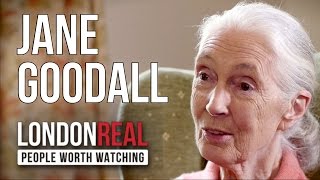
Jane Goodall gave this interview with London Real in 2016 about her wartime childhood, love of animals and books, journey to Kenya, meeting Louis Leakey, and road to Gombe.
Also known as: Wartime Childhood, Louis Leakey & the Road to Gombe; Part 1 (London Real).
Jane Goodall traces the childhood roots of her life’s work, from loving animals and books to dreaming of Africa despite wartime scarcity and doubt from others. She says her mother’s encouragement—work hard, seize opportunity, never give up—made the dream possible.
She also recalls the practical path to Kenya: secretarial work, waitressing, and the long boat journey to East Africa, where she first met Louis Leakey and eventually went to Gombe. Those early experiences shaped the observations that changed science’s view of chimpanzees.
Beyond the origin story, Goodall argues for empathy in science and urgency in conservation. She says hope matters, young people matter, and small daily choices can help change the world.
Brian Rose interviews Goodall, with brief intro and outro narration; Goodall speaks at length.
In her words
“If you really want to do this thing you're going to have to work really hard take advantage of opportunity and never give up”
“I was very shy very retiring and All I wanted to do was go and live with animals and write books about them”
“Science is wonderful when it's done right it's about knowledge finding out facts but to get your facts through Inhumane Behavior, I think it's awful”
“We need money to live but it goes wrong when we live for money, and that's what leads to corruption”
Key points
- Her childhood dream was to go to Africa and live with animals, inspired by Dr. Dolittle and Tarzan.
- Wartime Britain meant scarcity, shelter drills, and a backdrop of fear, but she says it did not define her path.
- Her mother strongly supported her ambition and taught her to work hard, take opportunities, and never give up.
- She saved money through secretarial training and waitressing before traveling to Kenya.
- Louis Leakey recognized her knowledge and brought her into the work that led to Gombe.
- She insists empathy is essential to good science, not a weakness.
- Her broader message is conservation, youth action, and hope in the face of environmental damage.
Full transcript: Jane Goodall, London Real interview, part 1 (2016)
Everybody laughed at me. How would I get to Africa you know the war was raging? We didn't have any money and I was just to go But my mother would say if you really want to do this thing you're going to have to work really hard Take advantage of opportunity and never give up The [professor's] who told me. I done the study wrong the chunk should have had numbers not names And they didn't have personalities Minds capable of thought or emotions because those were unique to us that's what I was told, and that's when I knew they were wrong Science is wonderful when it's done right it's about knowledge finding out facts but to get your facts through Inhumane Behavior, I think it's awful What happens when you're hugging the chimpanzee like that and seems like something deep is being communicated between you two are you thinking?
Not really thinking much Just love I suppose We need money to live but it goes wrong when we live for money, and that's what leads to corruption That's what's destroying the planet very very fast Well a lot of people think having hope is crazy, so let's face it. We don't have a big window of time every single day You live, and you have a choice as to what kind of difference. You're going to make of your little choices What you buy to eat, but you [where] if you just think those little things that? Millions and billions people think the same the world will change I am here at beautiful Windsor castle the home of the queen, and I've just spent the last hour speaking with the Anthropologist Jane Goodall she is the og [of] scientists in the Community in 1960 she [learned] that Chimpanzees used tools and had lots of other Emotions and behaviors that really say a lot about us human [beings] and in her 80s She still sharp as a tack and she's talking about bigger issues these days
She's talking about the fact that we're probably consuming too many things as a species were overpopulated [we're] not thinking about Animals and the fact that we're eating them our carbon footprints and she travels the world Working 300 days a year with her roots and shoots organization to teach young [people] to start thinking about the bigger picture And I really was honored to sit down with jane. She's such a special human she gave me a big [hug] at the end and Grunted in my ear like a female chimpanzee would do when when greeting a male one She spent time talking to us afterwards and she's really a special special Spirit and a special human being and has a lot of really important things to say she just works tirelessly And she really is a london real or she's got the spirit And she's really thinking about the bigger picture things past her own life And so I think you're really going to enjoy this time with Jane very much So and that we were just so excited to finally sit down and talk [to] her So that's happening here while I'm out here at this beautiful castle I'm also excited about all the things going on in the academy right now We've got crazy things happening with the body-mind Challenges and our new four-week create and connect cycle has started [so] jump in and join us. It's a lot of fun We'll see you in there This is London real
I am brian [rose] my guest today is Jane Goodall the primatologist [Pathologist] and anthropologist who revolutionized the way we understand the animal Kingdom by Observing wild Chimpanzees our closest living relatives in 1957 at the age of 23 you [sailed] to Kenya and later traveled to Tanzania to live in the wild [with] a colony [of] Chimpanzees There you make groundbreaking discoveries regarding the use of tools hunting behavior Leadership emotions and language you are a united nations messenger of peace one of the most respected members [of] the world Scientific Community Your [roots] [&] [Shoots] program inspires young people in over 130 countries And your institute now protects over 1 and a half million acres of natural Habitat Jane welcome to London real. Thank you It's a pleasure having you here. We're actually in St. George's house today inside Windsor castle the queen's main residence where leaders of government Industry Commerce and charity get access [to] discuss matters of National interest. I'm always curious Do you always know when you grow up in bournemouth that you were kind of destined to do big things?
and be in places like this of course not [I] was very shy very retiring and All I wanted to do [was] go and live with animals and write books about them That was what I wanted to do, but it didn't go beyond that Talk to me about doctor dolittle. [I] was a big fan growing up What was it about dolittle kind of got your imagination? Well right from the beginning? I loved animals when I was Tiny I mean I took worms to bed when I was one and a half I had an amazing mother who just said well they need the earth or they'll die rather and get mad at me because my bed was full of Earth and So when I read Dr.. Doolittle. I mean it was everything I'd wanted Talking to animals. I wanted a parrot to teach me. I was eight years old when I read the story of Dr.
Dolittle [and] it came from a [library] because we couldn't afford books when I was growing up we you know had virtually no money in the war and So I read it Twice under the bedclothes [when] I wasn't allowed to read at [night] with [my] flashlight Because I had to read [it] again, so it went back to the library it was the first book I ever owned my grandmother got me [a] copy for the next Christmas Still have that book Is it true you used to tell the children you could talk to the squirrels? [oh], I told them I could understand the squirrels the birds the dog's the cats I told them what they said and they won't believe me Be cruel. [no] why not. I was pretty sure I understood myself yeah, and you said once it was your dog that kind of really thought you'd understand that animals had apathy had emotion had empathy but of course rusty and What was Britain like in in the 40s? [I] think a lot [of] us just don't even understand The [Warriors] and then the kind of Poverty after is there any way you can kind of describe that to me?
Well, you know I was very young so all I remember most vividly is you know stories from people we knew who were killed and We didn't of course until right at the end of the war. We didn't know [about] their concentration camps and It was a time. We couldn't go down Although we lived by the sea. We couldn't actually get into the sea because it was barbed wire along the coast and We knew about the bombs falling in London some bombs fell? By us they were mostly German Pilots who hadn't managed to drop bombs on their target so they wanted to drop them somewhere So that they'd be less likely to be blown up going back To Germany over the sea Did that affect you as a young girl, or did you just kind of get on with it?
Not really didn't really affect me. What did affect me was at the end of the war and I read [about] the holocaust that affected me very much [I] Guess and that was a shock to everybody in britain. Yeah, I guess the world when they about that. Yes, and did that change Actions did that make you think I had to maybe do bigger things in the world. No, I didn't think so it just Helped me to understand human nature a little better okay, and then after the war [Britain] was really rebuilding so I hear stories [that] there just wasn't really much of anything [you] know food wise commodities that kind of thing do you remember yeah? We had russian. We had russian cards. We had clothing coupons was like All through the war and immediately afterwards it was like something like one egg a week or something like that but we used to get packages of Food which was sent over from Australia To you know from the colonies to families with children, and it was things like dried milk Powder dried eggs In other words there were the delicacies [like] the odd tin of peach So if there was an air-raid warning which happened quite often all of us in the family [we'd] been given because there were children. We'd be given one of these Anderson Shelters Which was like the but not much. I haven't that steel top so if a bomb fell you'd be safe inside it under the rubble of the house and my sister was younger than me and she Soon as the the siren went she was out of bed like this and rushing to get down into the shelter
I Meanwhile clung on to all my because I did not want to leave my bed left to be carried down with all the bedclothes and we if we were there more than an hour as a treat we could open a tin of peaches of what I remember and also growing up on dried Egg Powder I Thought of a runny egg still makes me feel sick So absolutely safe to see the slimy are they young [colder] [no] the slow? So you don't crave it because you didn't grow up on it. That's right. I mean [boring] hard eggs is fine although eggs today with intensive farms I wouldn't I try not to eat them we have rescued hens at home in Bournemouth Sister looks after these hens rescued from the battery farms they legs for us Can you tell me about your mother?
My mother was one of the most amazing people I attribute everything to her Because when everybody laughed at this idea go to Africa, right? you know live with animals write books about them which began when I was [ten] and I find this little book in a secondhand bookshop With no money to buy new books. I was save up any little penny I had four second-hand books and I found this at a book which again. I still have called Tarzan of the apes So of course I fell in love passionately with this glorious. Lord of the jungle, and he went and married the wrong Jay, so So this is where my dream began and everybody laughed at me. How would I get to Africa you know the war was raging?
Africa was the dark continent very far away. Nobody knew much about it We didn't have any money and I was just a girl I Couldn't why was I dreaming such a nonsense? But my mother would say if you really want to do this thing you're going to have to work really hard take advantage of opportunity and never give up [I] Don't [know] [if] she said it quite like that in that way, but that was the message the whole way through that That I was not laughed at for having a dream like that what did she get her strength was your grandmother very strong very strong my grandmother was in mentally strong and My mother's sister older sister. She was one of the very first to qualify as a woman as a physiotherapist [I] Was thinking about you you know being you at ten years old and female role models, and I realized that It wasn't even a queen at that point. Oh, so did you have anyone to look up to well of a [Sauron's] nightingale?
I remember stories about her and Madame Curie Losses were two women that that we had stories read to us about them So that's something too okay, and books books really spurred you it seems books were kind of the internet of your time It was though there was no yeah, there was no you know there was radio and books that was it I was it to get no TV right hmm And so you fell in love with books and you thought I'm gonna go to Africa and write books That was kind of the plan since 10 go to Africa and live with animals Live with wild animals wasn't Africa was the animals okay? and you know I had brief times thinking about going to Canada with the wolves and the bears and then the jungles of South America You know I read a book called the [green] [hell] And I was [fascinated] by the anacondas and thing so it was the wilderness that attracted me I've got Africa especially and I think that was Tarzan So during the war you're dreaming of this one you can't even leave the country We don't even know if we're going to survive. [we] don't know if the germans are going to land on your doorstep [very] trying times after that and we had Churchill and you had sure we had Churchill I think we'd have been Invaded but for him. Do you ever remember him on the radio?
Oh, I remember him vividly. I remember that voice you know It was he was his voice was amazing it really really got us through. I'm sure it did got everyone through that Yes, I think it did I've listened to many of his speeches. There was just incredible For people that don't understand. I mean when you think of Churchill in those years You know was he did he make or break the survival of the country I think so And [it's] interesting people say you know that hitler also had power of oratory and they said if they'd been television Hitler would never have risen to power the way. He did because [he] wasn't very attractive, but his voice I'm told is really powerful, right?
That didn't think about that and so after the war not a lot of money very hard times and yet You still have this dream. I'm going to go to Africa [yes], and you're a young woman What are people telling you now you're in your same thing selling telling me the same And you know I had to I had to get some money So I did a secretarial [cause] there was no money for university you couldn't have done university But then came a letter from a school friend inviting me to Kenya that was it that was the opportunity so I worked as a waitress for about five months [early] hard work in an Old-fashioned Hotel and it was you know [just] after the war so they were coming down from up north for a holiday by the sea and They didn't have much money not much brass You know so you had to work really hard for a week to get even a little tip Because I made sure they all knew I was saving up to go to Africa crowd-funding Well, it didn't work Terribly well, because they didn't have much money, and I would I was the only Non-professional in that hotel and [the] others were all professional waiters and waitresses And they resented me hugely to start with I mean who does she think she's coming in?
[oh], she'll be invited out, and she'd [just] leave [us] in the lurch When they found that I was every [bitter] or more conscientious than them. I was welcomed into this whole new They were mostly Irish Catholic, so it was a whole new learning experience And if you hadn't received that letter from Africa inviting you Would that have slowed your your progress getting down there? How would you find out the way? I I don't know okay How can I how can I tell I don't know so you saved the money you get the ticket on the boat? three weeks What's that like it's because we should have gone through the suez canal, but there was that little war With egypt [yes], and the suez canal was closed so [the] boat had to go all the way around the cape And they they said they were really sorry they have to charge a bit extra money. They'd make it as little as possible So I think I had to do two extra weeks Waitressing to make up the money to go around, but it was lovely to have that long journey You know with the sea changing from Gray Dark, and then gradually getting bluer and the first flying fish that was amazing and then a dolphin jumping but then Coming to cape town and Durban. I'm meeting apartheid was awful It was horrible We landed briefly on sure and you can tell [right] away there was something everywhere You looked it was you know whites only [whites]. [oh] nice legs blonde on every seat on Every door, and it was awful
Wow, just horrible wow and that was only in South Africa and as far as you continued that was gone well, it was still no there was there was the remains of it and what they called the white Islands in Kenya, and The servants were still referred to as boys and [you] still heard walk occasioning These are the old colonial types in Kenya okay, so Of course it became independent, but it took a while for some of the old habits to die [and] Tanzania was still a colony when I arrived, Tanganyika Were you were you're pretty tough tough woman at that point did you feel [like] I can kind of handle things did people kind of size you [up] when you're Abroad and try to intimidate you at all no, I think I was always quite feminine and Which was to my advantage, I think definitely You know I?
Think if I'd been sort of you [know] really ugly person I'm not sure that Louis Leakey would have welcomed me as his secretary. Which is how it all began You said on 60 minutes that you were a terrible flirt. I was a flirt Hey, I enjoyed being young flirtatious [and] invited out and dinners and things How long were you in? Tanzania before you met Louis Leakey, and how that come well? I went to Kenya Kenya for it is where he was [okay], and I think I'd been out there about Maybe three week, maybe a month something like that staying with my friend and then I got a job in nairobi because you don't sponge on your friends you know and That's when I heard about [Leakey] and [I] went to see him I Just went to talk about animals somebody said I should and I came away with a job He said could you just left it must have been meant And what did you what do you remember about Lewis the first time you met him? Oh I was completely You know in awe because he he knew everything about animals. I [mean] it was just a sort of person just an amazing knowledge of Africa and animals and Yes, he was brought up as a kikuyu So he knew the local people, okay? Is that a local local tribe [equius] It's the sort of dominant tribe in the Kikuyu and [the] [maaSAi] okay, and he was impressed with your [knowledge] of Animals yes, he took me around asked me hundreds of questions at the Museum [the] natural history Museum
He was very impressed, so it was like an interview or a quiz yeah but I didn't know it was looks like I've been going [to] get a job, so And you had had got all that knowledge from reading books about animals. Yes, and spending hours in the natural [history] Museum in London As well [in] London, okay? Wow yes okay? So you meet him he agrees to hire you [on] you. Go out? Then he takes me to olduvai digging for fossils [and] in those days [old] [of] [I] was Totally remote there wasn't a road there wasn't a track it was in the middle of nowhere So I think the three weeks that I was there with one other young girl. We saw maybe four maasai warriors, and that was it There was just us It was magic. Yeah, [you] said you really feel at peace when you're alone in Nature Was that probably one of the first times you were really that far out and really the first time I was that far out and It was mostly you know when I didn't wonder about on my own on the planes but I went with [Julie] [and] the other girl and We met a rhino once. I mean all the animals were there then so we met a rhino like Twice the length of this room away Luckily the wind was blowing [from] him to us He knew there was something [that] they don't see very well, so he trusted back and forth a few [times] And then likely trotted in the other direction With his tail up, and then there was the lion the [young] male lion who followed us quite away, she was a bit scary, but very exciting were you scared, but
funnily enough not really Afterwards it was a bit more scary than at the time because you didn't know [no], this there was one scary moment We julien and I had to take out these two dogs with us [Leakey's] wife's dogs one of whom was the champion of all breeds of Kenya there were two dalmatians and The Mary said take the dogs with you when you go walking, so we took the dogs and on this occasion Ahead of us along the trail. We're down in the gorge order.i gorge. It's just thorn bushes and things and this mouse Ran across the trail under a low low branches of a tree so the two dogs took off after the mouse that's when the lion appeared behind and Of course, we're dogs. It's could be dangerous because dogs are more likely to be attacked by [a] lion Humans weren't in those days. I think but anyway, we you know there was the lion and we couldn't leave the dogs and the dogs wanted to chase the mouse and So how do you get the dogs that we can't yell to it?
To despot about [it]. We finally get the dogs, and I think I put my belt around One of them the male julian gets the champion of all breeds of Kenya and and annoyed she puts anyway We get the dogs me climb up the side of the gorge to where it's open because I thought that would be safest and [gillian] let go of the champion of all breeds of Kenya who immediately went back down to the mouse That was the scary moment Because I thought I'd have to go and get I couldn't just leave Mary leaked his beloved dog We were scared of Mary you might get sacked Hmm, and this whole time are you thinking? I'm gonna stay in Africa the rest of my life [are] you thinking? I'll go back to england at some point. Where were you where was your head at that point?
didn't really think when I was at the museum, then leaked he asked me if I'd like to go and do the chimps and That's when of course I said yes, but then it took a [year] to get the money, okay And he was impressed with your coolness in the lion incident. Yes. He was and thought I'm gonna I'm gonna bring jane with me. Well. I think that that was the turning point okay, not with him He never came to gumby okay, so he sent you he sent me okay? And [I] was not allowed [to] be on my own the authorities wouldn't have it So that's when mom volunteered, [and] that's the local authorities wouldn't have it the other british [I] [was] British okay, and so mom took the boat right out to join you yes, okay? Well she actually flew okay, and The Chimpanzees, [I] mean do you remember when when you first saw them and if you ran away they ran away?
Day off today they take one look and run away You said at first they were scared then they were belligerent than they were tolerant of you hMM How long did the fear last with the Chief NZ's? [oh] he allow stood for for many of them. It lasted for about I know five months. I mean it went on and on So I was still watching them with my binoculars [from] this peak so I was learning stuff but from distance until David greybeard showed me termite in I wasn't that close, but through my binoculars I could see him fishing for termites and That was the breakthrough that's what brought money has brought the geographic in right? And that was after five months of observing something like that though. I think I saw that a bit before because It's between four and five months The termite season begins and did you know right away that this was something pretty incredible?
I mean when you're looking through that and you're like wait a second [I] know this is something people won't believe I did think that in fact I didn't send a telegram to [leekie] until I'd seen it again twice Because that maybe perhaps I imagined it Patients would you would you argue that's probably one of your greatest virtues hMM? Well when I was four and a half I hid for four hours in the hen house To see a hen. Lay an egg, so I was born with [patience] I think And not many people would have probably waited and watched for so long. No, I don't think they would And so you see the use of tools you are back to [Leakey] and then Then it all comes, then the geographic said that they would send money and they send a photographer filmmaker who became my first husband and the pictures went around America and around the world and that's when it all began and [when] you look back at that and try to figure out How [that] became so big because it really was a global sensation if it was today. You would have broke the internet I think I mean yes totally It would have gone more than viral I mean What was it about you the the chimpanzees?
Africa that just made everyone so fascinated well first of all nobody was doing it secondly You know they said it was beauty and the beast the [black] chimps and the fair-haired young English girl That was attractive to people and it was all new people had no idea how gyms behaved in the wild so what with me being out in the forest and the chimps and and Africa kind of Romantic you know How did you like being a celebrity all I hid I hid from the press I? Was really shy? In Africa the press there and here no not that for there was no pressing I fucker but when he came back here when I [came] back here and then going over to geographic you see And people called you the geographic a girl [covergirl] And how did that feel?
I am I came to resent it deeply and bitterly but at the beginning. I didn't really care and later you because I mean I was at Cambridge by that time by that time you were right and Just to finish out with that cambridge you go there in 62 to get your phd What was that reception I could just imagine that first couple months of Cambridge must have been very difficult. It was horrible, okay? They're looking at you is it. I don't know a pSeudo scientist, and then also you're the cover girl And then you're probably one of the few women there Yeah, well the you know one I felt the students resented me who does she think she is just because she's washed off to Africa [you] know and I'm sure some of them did think that but secondly it was the Professors who told me I done the study wrong the chimp should have had numbers not names And they didn't have personalities Minds capable of thought or emotions because those were unique to us, that's what I was told And that's when I knew they were wrong because of my dog Rusty taught me and the other animals. I had to so I knew they were wrong and You know the only reason I wanted the Phd was for Louis Leakey. I didn't want to let him down I didn't want to be a scientist So I didn't think I minded these [covergirl] things, but later on you know when I did get the phd That was when I began to resent all these remarks that just because I didn't write in the Accepted scientific way, and it's because my ideas weren't accepted in science that that would make me
non-scientific and You know it still is [sylla] bone of contention Can you can you feel empathy with the animals you're observing and be objective of course you can But it's still maintained by many scientists. That's not possible It's not true. It's not true, no Because the scientific method is always extremely objective in the double [bryant]. I got hold I'm cold so My feeling is that science? Which is head and no heart is what's led to some really terrible inventions by science And I think empathy [in] science is tremendously important [I] Mean you know they did that experiment where they got students in and they were they were told that they were electing a little mild electric shocks to this man inside through the glass and Of course they weren't really shocking him, but they didn't know they thought they were and they were told to continue and give bigger and bigger shocks, and they some of them actually went on until The Shock would have killed the person and they knew it But they were told to do it as part of the experiment and they did it Which was a wicked thing to do because how would the student feel afterwards?
It's terrible to do that What does that say about human Nature exactly? And science you know [because] science science is wonderful when it's done right it's about knowledge finding out facts but to get your facts through Inhumane Behavior, I think is awful And your empathy was critical in the discoveries you made the relationships you build the things you learned about the chimpanzee Yes, I would argue your feminine energy was maybe necessary in the situation, it's not necessarily a feminine is sort of I mean the good men out [there] in the field they have the same sort of Empathy and and Wanting to know and everything Because what if you so okay?
You watch behavior and don't really know what it means, but you have empathy and so you think you know what it means [and] that's that's really important this once you think you know what it means, then you can start Finding out if that's true. You can ask the right questions But if you never get to that point through empathy you can never ask the right questions So it's actually a critical part of the scientific method to me because the mobility vehicle there must be passion there must be interest, okay other important Observations you made about the chimpanzees you started with the tools what were some of the other big ones now the yoke back. [oh] Maternal Behavior is one of the really important ones good mothers and bad mothers infant development You know how they develop differently?
and then as time went on Realizing that that the females actually learn by having their own kids But the sisters learn if they have baby brothers and sisters and a female who's the last born in her family? Doesn't she doesn't know how to be a good mother because she hasn't been able to practice with baby brother and baby sister So all of those were fascinating the fact they all have such different [personalities] the fact that some males really are motivated to get to the top And even if they get big setbacks, and they're attacked as they're making this effort. They still come back When their wounds heal and try again others, just give up and have seen content to remain [low-ranking] and the different techniques males use to get to the top some is just brute strength Others use their heads You notice some alpha males that had long [tenures] at the top and now there were more of coalition Builders or coalition or Brains I mean Mike didn't have a partner really but um No, he didn't but he had the even used these empty tin cans And he would charge with up to three of them four gallon cans making it a hell of a tin charge towards other Males who all were ranked higher than him and of course they rushed out [of] the way?
And then they would Gather and groom Mike so he got to the [top] in four months and that he had to defeat 11 who ranked higher than him and as far as we know there was no serious fight there were no wounds no handfuls of hair torn out and When we took the cans away because it was dangerous for us to then he seemed to think well This was desperate so whereas a male would only drag one branch in one of his dominance displays Mike would get three When a male will throw [One] Rock or maybe two Mike would throw 20 Because I he didn't have his cans anymore, so then he relaxed realize he'd made it So the cans is another use of tools yes, definitely Wow, and what did some of this behavior start teaching you about about humans?
well For a long time, I thought chimps were like us, but nice so and I realized they [too] have a dog Brutal aggressive side So it's sort of I think Louis wanted me to study the chimps because he felt it would help him better understand how early humans might have behaved and so when you when you start seeing so many human characteristics in the Chimps like the gentle Maternal behavior the the the family bonds the relations between older Brothers and sisters that the long-term bond with the mother That you know the this desire for dominance and some of the males All [he's] very human characteristics the Empathy the Grief Shown by a mother when she loses a child or a child when he loses his mother?
the fact that they have altruism that a young male will adopt an orphan even if it's not related to him and Then finding they have this Warlike Brutal Aggressive Behavior and You know helping to understand more about some of the behaviors that we brought with us from our ancient primate past When they were ape-like human-like creatures, we went one way and they went the other Before [you] found out about the dark side. Do you think you would kind of romanticize their behavior that they were much nicer than us? Which is a natural [tendency]. Yes? I've seen you know footage of you out there with them. These are these are big animals [potentially] scary animals Did you get over fear did you just not have fear I had fears sometimes luckily the Fear has never come at the point of the [interactional] whatever it is it comes off towards me like when they first began to lose their [fear]. They would do these displays, they'd be charging all around me and swaying branches hitting my head with them and it was very [scary], but at the time I Thought well [best] thing I can do I pretended to dig holes in the ground. I wouldn't look at them I pretended to eat leaves [and] [they] eventually went away and after they'd gone. That was when I was afraid My legs were trembling. You know it was very scary really but at the time something comes in and It wasn't fear was more. I was fed [up] with them while be behaving like this Horrible creatures, but you can't react that's the last thing you [can] do yeah, I
saw some video of you, or I think you were in a place where there was a Plexiglass separating you and some chimpanzees and almost jumping into the palace and you said he's just trying to get a reaction He's trying to control his environment Which is what I guess all any of us are trying to do But you he slammed into the glass and [you] just need not even batting an eyelid poor chimp I guess as an observer and a liver with the chimps you have to be one of the best actresses in [the] [world] as well right probably There's also some footage of you hugging a lot of chimps And there was one that I think had been repatriated out to the wild and he gave you a [hoggin]. Oh, that was a She a female [okay]. That was the most amazing thing that's ever happened. I only met her that day She was fully adult she'd be nursed back from near Death by the veterinarian Runs the sanctuary and She was going to go on to this island. It's not completely the wild, but it's a beautiful forest They just have to have food supplement. That's all so it was window now was going to go and join the others and I you know. I was with her on the boat, and I thought she's with people she knows But [she] must wonder on Earth's happening You know going into a cage being sedated going on the boat?
And I was trying to reassure her that it was going to be wonderful, and [when] she got out of that cage, and she suddenly deliberately Stops when she gets to me and comes and gives me. I think that went viral It was amazing we were all in tears because [it] wasn't just a little hug She kept her arms around me [I] felt like you were talking to her with your heart something there I felt like It was really absolutely extraordinary [what] happens when you're hugging the chimpanzee like that and seems like something deep is being communicated [between] you two are you thinking? Not really thinking much just sort of Love I suppose yeah, yeah Did you miss being with the chimpanzees all the time? Do you is it strange coming back to humans sometimes?
well since 1986 it's been my life 300 days a year on the Road and You know I have a task which somehow. I was given the [gifts] to do which is to go and talk Talk about the chimps, but you know try and find ways to save the forest to save the wild places You travel 300 days a year you just flew in from a country you're about to go out to another one, and you've been said To say there's so much left to do so there is this feeling of desperation [mmM]. Can you explain well? As I say I was given a gift and one of the gifts is Communication so that when I talk people listen, and it affects them and that's a gift [on] you know so because I know that and because I feel it's desperately important to work with youth young people and So we have [our] youth program now in about a hundred countries. It's We thought it was more, but it's actually about a hundred countries Which is a lot, and we have we have young people now from Kindergarten through University and it's about a hundred thousand active groups, and then all the way all the young when people who grow growing through it and Whose attitude to environment and animals has changed they all say so because of having this program which is about making things better for people for animals for the environment and so you because because my going around triggers more and more and more people to join this and it affects their parents and then they become parents and
You know fighting for a critical mass of youth that understands we need money to live But it goes wrong when we live for money, and that's what leads to corruption That's what's destroying the planet very very fast We don't have a big window of time You know some people think it's too late already Continue watching this fascinating conversation for free by clicking on the link below to visit our website and I'll see you on the inside [I] need people everywhere who are kind of feeling hopeless and Some of them are depressed some of them are angry mostly. It's just apathy
From the video's published captions. Timestamps link to the video above. Errors are possible.
Cite this recording
Jane Goodall, “London Real interview, part 1 (2016)”, 2016. Transcript and video: Thinkers Archive, https://thinkersarchive.com/jane-goodall/wartime-childhood-london-real-2016/
Quoting a passage? Link to its exact moment: every timestamp above has its own anchor (for example https://thinkersarchive.com/jane-goodall/wartime-childhood-london-real-2016/#t-328).