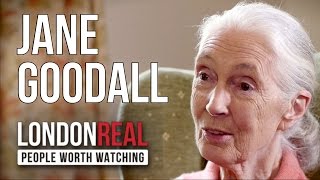
Jane Goodall on Hope
Jane Goodall treats hope as a practical force: without it people give up, but with it they can begin where they are and make choices that help heal the world.
- Hope matters because without it people become apathetic and stop acting.
- For Goodall, hope is inseparable from action, not wishful thinking.
- The right scale for hope is local and practical: do what you can where you live.
- Hope grows when people see that each person affects the planet every day.
- She grounds hope in interconnection, community, and the ability of people and nature to recover.

Hope is necessary because despair leads to inaction
Goodall begins from a hard truth: the world is in trouble, and pretending otherwise is useless. But she thinks hopelessness is even more dangerous, because once people believe nothing can be done, they stop trying. That is why she treats hope as a condition for action rather than a comforting extra.123
Her point is simple and demanding. If people feel the future is closed, they drift into apathy; if they believe change is still possible, they can begin to move. In that sense, hope is not denial of crisis but the refusal to surrender to it.142
“…if we lose hope, we're doomed…”Call Her Daddy interview, 2025 · full transcript →
For Goodall, hope is something you do
Goodall does not define hope as optimism or positive thinking by itself. She ties hope directly to doing something concrete, however modest. Hope becomes real when it changes behavior.56
That is why she repeatedly emphasizes daily responsibility. Each person is already shaping the world through ordinary living, so hope starts with choosing what kind of effect to have. Her view turns hope from a feeling into a practice.789
She also resists the excuse that only large-scale heroes matter. In her account, small decisions are morally serious because they accumulate and because they prove that people are not powerless.1112

“To me, hope is about action.”Jay Shetty Podcast interview, 2020 · full transcript →
Start locally instead of trying to carry the whole world
One of Goodall's most practical ideas is that people should not begin by trying to solve everything. She urges a local starting point: your street, your town, your habits, your community. This keeps hope from collapsing under the size of the world's problems.131415
Her advice lowers the threshold for action without lowering the stakes. You may not be able to fix the whole planet, but you can oppose a destructive project near you, improve a neglected place, change how you consume, or support something better. That is how hope becomes durable: it is attached to specific tasks.1511
She makes the same point another way when she says people do not have to do everything. Choosing one meaningful step is better than being paralyzed by the demand to be perfect.1612

“Don't think globally. First, think locally.”Talks at Google, 2021 · full transcript →
Hope grows from interconnection and visible results
Goodall's hope is not individualistic. She sees people, animals, and the environment as bound together, so helping one part of the web helps the whole. This is why her examples so often connect human well-being, wildlife, and habitat rather than treating them as separate causes.1718
That same logic shapes her work with young people. She highlights projects that serve people, animals, and the environment together, because this teaches that positive change can be comprehensive and shared. Hope becomes stronger when people can see results in the places around them.1920
She also points to recovery itself as a source of hope. Damaged landscapes can regenerate, communities can restore what was lost, and collective effort can heal some of the harm already done. Her confidence is not that damage is unreal, but that repair is possible.212223

“If we get together, then we can start to heal some of the scars that we've inflicted.”TEDxPaloAltoSalon interview with Guy Kawasaki, 2017 · full transcript →
Hope also depends on character: curiosity, persistence, and heart
Goodall's account of hope includes inner habits. She links it to curiosity, patience, and the willingness to keep going when answers are not easy. These traits matter because lasting action requires more than urgency; it requires endurance.242526
She often traces those habits back to encouragement rather than cynicism. Supportive guidance helped her protect curiosity, work hard, and not give up, and she presents those qualities as part of what lets a person remain hopeful in difficult times.272829
Just as important, she thinks human beings get into trouble when intellect outruns wisdom and feeling. Hope becomes more trustworthy when clear thinking and moral concern work together.303132

“…only when head and heart work in harmony can we attain our true human potential.”Aprendemos Juntos talk, 2017 · full transcript →
Goodall on hope, in her own words
“…if we lose hope, we're doomed…”
“So the key important thing is to give people hope that we can get through, because if you don't have hope, why bother?”
“To me, hope is about action.”
“Don't think globally. First, think locally.”
“…each and every one of us makes a difference each and every day…”
“…every individual matters, every individual makes a difference, and every individual has a role to play.”
Where to watch
 Jane Goodall on Hope and Action: Winning the War on Nature2020 · 57 min · full transcriptBest single statement of her core idea that hope is action, tied to local steps and everyday choices.
 Jane Goodall on Hope and Purpose: Keep Going, Keep Giving Back2025 · 50 min · full transcriptA clear, direct explanation of why losing hope creates apathy and why purpose keeps people going.
 Jane Goodall on Reasons for Hope: Why Small Actions Matter2021 · 61 min · full transcriptStrong on small actions, local focus, and the idea that each person affects the planet every day.
 Jane Goodall on Message of Hope: Storytelling for Conservation2020 · 8 min · full transcriptConcise version of her message that people need hope or they will ask why bother.
 Jane Goodall on Conservation and Hope: Young People Can Change the World2017 · 60 min · full transcriptShows how hope becomes practical through youth action, community repair, and healing damaged places.
Questions people ask
- How does Jane Goodall think young people can make a difference?
- What advice did Jane Goodall's mother give her about doing important work?
- What did Jane Goodall learn from her mother about curiosity and learning?
- What did Jane Goodall say about hope and why it matters?
- What did Jane Goodall say about how to persuade people to care about conservation?
- What does Jane Goodall say ordinary people should do when the world feels overwhelming?
Sources
Every quote above, word for word from the transcripts. Numbers match the text.
“…if we lose hope, we're doomed…”
“So the key important thing is to give people hope that we can get through, because if you don't have hope, why bother?”
“Well, the thing is, you know, this mission keeps me going because there's so much to do. Yeah. And if we lose hope, we're doomed. Because if you lose hope, you become apathetic and do nothing. But I'm not alone. You know, the Jane Goodall Institute is now in 25 countries, different chapters. And in addition, there's our program for young people, Roots & Shoots, which is humanitarian and environmental, and that's in 75 countries.”
“…if you're not hopeful, things are going to get less hopeful…”
“To me, hope is about action.”
“Hope is something tied into action…”
“…every day you live, you make an impact on the planet…”
“…every single one of us makes an impact on the planet every day…”
“…each and every one of us makes a difference each and every day…”
“Well, it depends who we are. I think it depends who we are. I mean, we all have to choose to change in a way that we can cope with. And for some people-- some people can make huge changes because they're very wealthy. They can write checks. They can do all these different things. But everybody can do something. Everybody can do something. Everybody can remember to turn out lights, can walk, or cycle, or take public transport. All these little things that we can think of doing. And we just have to choose. You can't dictate to people. They have to want to make change.”
“You're asking people to do a lot. Well, why not? If they care about the future, especially if they've got children, you don't have to do it all. You know, even if you just pick one thing, like eating less meat, just do something. You…”
“Don't think globally. First, think locally.”
“…don't think globally, act locally.”
“Well, you can't solve the problems of the world, but what about where you live, your community? Is there something there you feel you might like? You don't like litter on the pavement, or you don't like they're planning to dig up a little forest to put yet another super mall. Go and do something about it.”
“You don't have to do it all.”
“We're all interconnected: people, animals, our environment.”
“We are, as you say, part of nature…”
“One for people, one for animals, one for the environment.”
“And we decided that the main message would be every single one of us makes an impact on the planet every day, and we have a choice what sort of impact do we make, and that every group would choose three projects to make the world better because I learned in the rainforest how everything is interconnected. And so each group chooses the project to help people, a project to help animals, a project to help the environment. And these young people now-- it's actually 65 countries today. And they're changing the world as we speak. I mean, there's hundreds and thousands of young people. And the great news is that what I call the alumni, because beginning in '91 some of those students are now all grown up and out in the big wide world, and some of them have decision making jobs.”
“If we get together, then we can start to heal some of the scars that we've inflicted.”
“Surrounded by completely bare hills. When I began in 1960, it was part of this equatorial forest belt that stretched from East Africa right through the Congo Basin to the West African coast, and I looked down and there were clearly more people living there than the land could support - too poor to buy food from elsewhere, struggling to survive. That's when we started our program to improve their lives. If you fly over Gombe today, you won't see bare hills. It's trees, and the trees have come back, and we probably all can think of places that we have destroyed in our thoughtless way which, given time and…”
“And the next reason for hope -- nature is amazingly resilient. You can take an area that's absolutely destroyed, with time and perhaps some help it can regenerate. And an example is the TACARE program. I told you, where a seemingly dead tree stump -- if you stop hacking them for firewood, which you don't need to because you have wood lots, then in five years you can have a 30-foot tree. And animals, almost on the brink of extinction, can be given a second chance. That's my next book. It's inspiring. And it brings me to my last category of hope, and we've heard about this so much in the last two days: this indomitable human spirit. This determination of people, the resilience of the human spirit, So that people who you would think would be battered by poverty, or disease, or whatever, can pull themselves up out of it, sometimes with a helping hand, and take their part in society, and take their part in changing the world.”
“…curiosity, asking questions, not getting the right answer, deciding to find out for yourself…”
“Curiosity, asking questions, not getting the right answer, deciding to find out for yourself, making a mistake, not giving up, and learning patience.”
“I just have to carry on and learn all I can.”
“The best advice I've ever received was from my mother when she said, "If you really want to do something, work hard, take advantage of opportunity, and don't give up.”
“Anyway, the point of that is that was the making of a little scientist. Asking questions, not getting the answer, deciding to find out for yourself, making a mistake, not giving up, and learning patience. And a different mother might have crushed that early curiosity and I might not be talking to you now.”
“If you really want something, you're going to have to work really hard and take advantage of opportunity and never give up.”
“…only when head and heart work in harmony can we attain our true human potential.”
“We don't deserve the title of Homo sapiens, the wise ape…”
“…there's been some kind of disconnect between this clever brain and the human heart…”
How this guide was made: drafted with AI from the full transcripts of the recordings cited, then checked: every quotation must match a transcript word for word and be the speaker's own words, and an independent review gates accuracy. Methodology and corrections.