Jane Goodall on Chimpanzees
Jane Goodall sees chimpanzees as thinking, feeling, social beings whose lives blur the boundary people once drew between humans and the rest of the animal world, and whose survival depends on human choices.
- Chimpanzees are far closer to humans than people once believed
- They use and make tools, learn from one another, and even have culture
- They have personalities, minds, emotions, and complex relationships
- Chimpanzees face declining numbers from habitat loss and the wildlife trade
- Saving chimps requires changing human behavior and helping local communities live without destroying forests
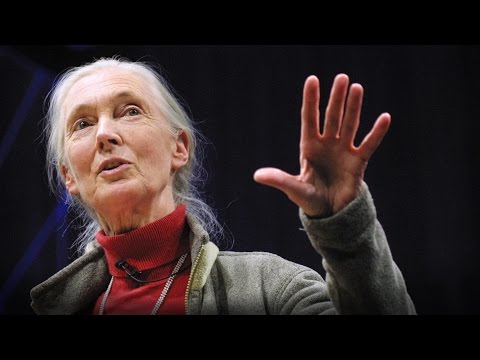
Chimpanzees are not separated from us by a hard line
Goodall’s central claim is that the old picture of humans as sharply apart from other animals does not hold up, especially when you look closely at chimpanzees. She argues that the human-animal divide is not fixed and clean, but much more continuous than many people assumed123.
That matters because chimpanzees are not just useful for comparison; they force a rethink of what makes humans special. In Goodall’s view, once you pay attention to how chimpanzees behave, the idea of human uniqueness becomes narrower and more complicated145.
“It's a very wuzzy line…”TED talk, 2000 · full transcript →
Chimpanzees changed science because they make tools and learn socially
One of Goodall’s most famous discoveries was that chimpanzees do not merely use objects they find; they can also modify them for a purpose. Her observation of termite fishing helped overturn the belief that toolmaking belonged to humans alone6.
She also stresses that chimp behavior is learned socially, not just programmed by instinct. Young chimps watch others, different groups show different tool-using traditions, and that means behavior can be passed across generations in a way Goodall regards as culture7.
This is one reason she thinks studying living chimpanzees matters so much for understanding evolution. Bones can tell part of the story, but behavior reveals capacities and relationships that fossils cannot preserve7.

“It was very exciting. And it was the first chimpanzee who began to lose his fear of me who I saw one day break off grass stems, push them into termite mounds, pull them out, and bite off the termites and then, breaking off a leafy twig. So, to use that as a tool, he had to strip the leaves, that's the beginning of tool making. And it was that observation, because we were, as you say, the only creature to make and use tools. We were "man the toolmaker." And it was that observation that enabled Leakey to go to National Geographic Society. And they agreed A, to fund the research when my six months money ran out, and B, they sent a photographer and filmmaker to document what, by that time, I was learning.”StarTalk episode, National Geographic, 2024 · full transcript →
Chimpanzees have emotional lives, personalities, and social bonds
Goodall rejects the idea that animals are emotionless or interchangeable. She says plainly that humans are not the only creatures with personalities, minds, and emotions, and chimpanzees are one of her strongest examples8.
Her picture of chimp social life is concrete and familiar: affection, closeness, reassurance, and tenderness all appear in their behavior. She points to gestures of intimacy and connection, and she also says chimpanzees can be gentle, loving, and compassionate910.
At the same time, she does not sentimentalize them. Across her talks, chimp societies include both conflict and care, which is part of why she sees them as so revealing: they resemble humans not because they are perfect, but because they are socially and emotionally complex108.

“We know that chimpanzees can be gentle and loving and compassionate.”Berkeley talk, 2014 · full transcript →
What most sets humans apart is intellect, not basic feeling or social life
Goodall does not argue that humans and chimpanzees are identical. She says the main difference is humanity’s extraordinarily sophisticated intellect, especially our expanded capacity for language, abstraction, and technological development47.
But this difference becomes a moral challenge, not a license for superiority. Her recurring question is why a species with such intelligence uses it to destroy forests, damage ecosystems, and endanger other beings, including chimpanzees11.
So her comparison with chimpanzees cuts two ways: it narrows the gap below us, and it raises the standard above us. If our intellect is our distinguishing trait, then wisdom and responsibility should follow from it41112.

“The main difference is the fact that we have developed this extraordinarily sophisticated intellect.”Talks at Google, 2021 · full transcript →
Chimpanzees are in danger, and saving them means changing how people live
Goodall is direct that wild chimpanzees are still under severe pressure. She says their numbers are decreasing, driven above all by habitat destruction, and worsened by bushmeat hunting and the live animal trade that takes infants after mothers are shot1314.
Her conservation view is practical rather than abstract. She argues that chimpanzees cannot be saved by protecting forests on paper while ignoring the poverty of people living around them; if families need land, fuel, and food to survive, environmental destruction will continue1516.
That is why she insists on action at both levels: local livelihoods and personal responsibility. People need ways to live without destroying habitat, and each person must choose what kind of impact to make through daily decisions171819.
Goodall on chimpanzees, in her own words
“It's a very wuzzy line…”
“We are not the only species with personalities, minds, and emotions…”
“We know that chimpanzees can be gentle and loving and compassionate.”
Where to watch
 Jane Goodall on Human-Chimp Differences: We’re Not So Separate2000 · 29 min · full transcriptBest single overview of why Goodall thinks the human-chimp boundary is far less sharp than people assumed.
 Jane Goodall on Chimpanzee Behavior: What We Share2024 · 47 min · full transcriptBest for hearing how chimp tool use, learning, and culture changed science and what we share with them.
 Jane Goodall on Chimpanzee Conservation: Hope, Habitat, and Action2021 · 33 min · full transcriptBest for Goodall’s direct account of the threats chimpanzees face and what protection really requires.
 Jane Goodall on Chimpanzee Behavior: How chimps greet, learn, and feel2014 · 46 min · full transcriptBest for vivid examples of chimp greetings, feelings, family life, and compassion.
 Jane Goodall on Reasons for Hope: Why Small Actions Matter2021 · 61 min · full transcriptBest for how her understanding of chimpanzees leads to a broader ethic of human responsibility and hope.
Questions people ask
- What did Jane Goodall say about chimpanzee culture and learning?
- What did Jane Goodall say about chimpanzees using tools?
- What did Jane Goodall say about humans destroying the planet and what aliens would think of us?
- What did Jane Goodall say about making small changes instead of big ones?
- What did Jane Goodall say about poverty and deforestation in Africa?
- What did Jane Goodall say caused the decline in chimpanzee populations?
Sources
Every quote above, word for word from the transcripts. Numbers match the text.
“…after all, there isn't a sharp line dividing humans from the rest of the animal kingdom…”
“It's a very wuzzy line…”
“There isn't a sharp line between us and the chimpanzees.”
“The main difference is the fact that we have developed this extraordinarily sophisticated intellect.”
“What we find is that over these 40-odd years that I and others have been studying chimpanzees and the other great apes, and, as I say, other mammals with complex brains and social systems, we have found that after all, there isn't a sharp line dividing humans from the rest of the animal kingdom. It's a very wuzzy line. It's getting wuzzier all the time as we find animals doing things that we, in our arrogance, used to think was just human. The chimps -- there's no time to discuss their fascinating lives -- but they have this long childhood, five years of suckling and sleeping with the mother, and then another three, four or five years of emotional dependence on her, even when the next child is born.”
“It was very exciting. And it was the first chimpanzee who began to lose his fear of me who I saw one day break off grass stems, push them into termite mounds, pull them out, and bite off the termites and then, breaking off a leafy twig. So, to use that as a tool, he had to strip the leaves, that's the beginning of tool making. And it was that observation, because we were, as you say, the only creature to make and use tools. We were "man the toolmaker." And it was that observation that enabled Leakey to go to National Geographic Society. And they agreed A, to fund the research when my six months money ran out, and B, they sent a photographer and filmmaker to document what, by that time, I was learning.”
“They can, they can. They can learn sign language. They can learn 400 signs or more of American sign language, they can do amazing things on a computer. Chimps in different parts of Africa show different tool-using behaviors. And the young ones watch and learn. So, if we accept a definition of human culture, as behavior passed from one generation to the next through observation. Chimps have culture. I think that you know, the thing that makes us more different, some point in our evolution, we developed this ability to communicate with, with words, spoken, written. And once you have speech, our kind of speech, you can teach children about things that aren't present.”
“We are not the only species with personalities, minds, and emotions…”
“They kiss; they embrace; they hold hands…”
“We know that chimpanzees can be gentle and loving and compassionate.”
“And quite honestly, if an intelligent alien looks at us now, they would think, "What on Earth has gone on?" This, what separates us most from the chimps and other animals is this intellect that designs technology that enables you to learn about the stars. So how on Earth is this most intellectual creature to ever walk on the planet, why is it destroying its only home? Why are we polluting and cutting down the rainforest, acidifying the ocean? Why on Earth are we doing all this?”
“…only when head and heart work in harmony can we attain our true human potential.”
“One thing we do know, their numbers are still decreasing…”
“And today, what is there? -Today it's, it's maximum, 300,000. -And what accounts for the drop in numbers? -Destruction of the forest. -So, their habitat? -Their habitat. But also, the bush meat trade, which is the commercial hunting of wild animals for food. Uh, different from subsistence hunting. And then finally, the live animal trade. Shoot a mother to steal the baby to sell. And we thought we'd stamp that out. But now there's a whole new inflow of chimpanzees moving from Africa, often through the Middle East to places like China.”
“…if we don't help these people find ways of making a living without destroying the environment, we can't save chimps, forests, or anything else…”
“But it's also difficult for so many of the African people. So many living in abject poverty, um, not enough food, not enough education or health facilities. And it was when I flew over Gombe in 1990, and looked at what had been part of this great equatorial belt, and saw a tiny oasis of forest surrounded by bare hills. More people than the land could support. Too poor to buy food from elsewhere. You have to cut the last trees down. Because you got to survive, you got to try and grow more food. So, poverty alleviation is really important. But at the same time, the unsustainable lifestyle of the rest needs to come down, we need to think differently.”
“Don't think globally. First, think locally.”
“…each one of us makes an impact on the planet every single day…”
“Every single day we live, we make some impact…”
How this guide was made: drafted with AI from the full transcripts of the recordings cited, then checked: every quotation must match a transcript word for word and be the speaker's own words, and an independent review gates accuracy. Methodology and corrections.


