What did Jane Goodall say about the line between humans and chimpanzees?
Jane Goodall said there is not a sharp line dividing humans from the rest of the animal kingdom. She argued that the distinction is becoming “wuzzier all the time” as scientists keep finding animals doing things people once thought were uniquely human. In her view, chimpanzee behavior shows continuity with human culture and learning.
“What we find is that over these 40-odd years that I and others have been studying chimpanzees and the other great apes, and, as I say, other mammals with complex brains and social systems, we have found that after all, there isn't a sharp line dividing humans from the rest of the animal kingdom. It's a very wuzzy line. It's getting wuzzier all the time as we find animals doing things that we, in our arrogance, used to think was just human. The chimps -- there's no time to discuss their fascinating lives -- but they have this long childhood, five years of suckling and sleeping with the mother, and then another three, four or five years of emotional dependence on her, even when the next child is born.”
Key takeaways
- Question sharp human-animal boundaries when new evidence emerges.
- Look for learning, imitation, and social transmission, not just instinct.
- Humility grows when we notice traits we thought were uniquely human in other species.
Context
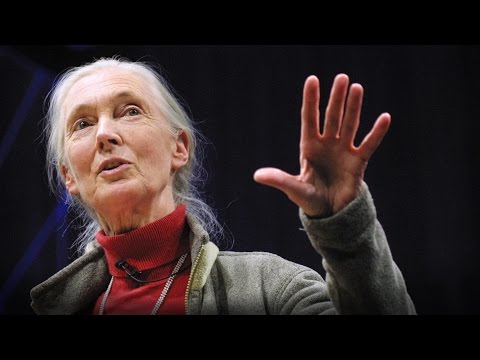
In her 2000 TED talk, Goodall was describing decades of chimpanzee research and how it changed scientific ideas about human uniqueness. The quote above is taken word for word from the recording's transcript.
In the transcript
…man, the toolmaker. So that when Louis Leakey, my mentor, heard this news, he said, "Ah, we must now redefine 'man,' redefine 'tool,' or accept chimpanzees as humans." (Laughter) We now know that at Gombe alone, there are nine different ways in which chimpanzees use different objects for different purposes. Moreover, we know that in different parts of Africa, wherever chimps have been studied, there are completely different tool-using behaviors.
What we find is that over these 40-odd years that I and others have been studying chimpanzees and the other great apes, and, as I say, other mammals with complex brains and social systems, we have found that after all, there isn't a sharp line dividing humans from the rest of the animal kingdom. It's a very wuzzy line. It's getting wuzzier all the time as we find animals doing things that we, in our arrogance, used to think was just human. The chimps -- there's no time to discuss their fascinating lives -- but they have this long childhood, five years of suckling and sleeping with the mother, and then another three, four or five years of emotional dependence on her, even when the next child is born.
The importance of learning in that time, when behavior is flexible -- and there's an awful lot to learn in chimpanzee society. The long-term affectionate supportive bonds that develop throughout this long childhood with the mother, with the brothers and sisters, and which can last through a lifetime, which may be up to 60 years. They can actually live longer than 60 in captivity, so we've only done 40 years…
Topics
More questions about Jane Goodall
- How does Jane Goodall think problems should be solved?
- What did Jane Goodall say about the spiritual nature of chimpanzees and trees?
- What did Jane Goodall say about youth activism and Roots and Shoots?
- What did Jane Goodall say about hope and why it matters?
- What does Jane Goodall say ordinary people should do when the world feels overwhelming?
- What did Jane Goodall learn from her mother about curiosity and learning?
How this answer was made: the quote is checked word for word against the transcript of the recording and confirmed as the speaker's own words; the summary above it was drafted with AI from that transcript and quality-checked. Methodology and corrections.