Jane Goodall on Life Lessons
Jane Goodall’s life lessons center on staying curious, working hard, refusing to give up, and turning hope into daily action that serves a larger purpose.
- Hope is not passive; it should move you to act.
- Curiosity, patience, and learning from mistakes are the roots of growth.
- If you want something deeply, work hard, use opportunities, and do not give up.
- Each person affects the world every day, so daily choices matter.
- A good life joins intellect with compassion.

“Well, you can't solve the problems of the world, but what about where you live, your community? Is there something there you feel you might like? You don't like litter on the pavement, or you don't like they're planning to dig up a little forest to put yet another super mall. Go and do something about it.”Call Her Daddy interview, 2025 · 6:32
Hope matters because without it, people stop trying
Goodall treats hope as a practical necessity, not a soft feeling. Her point is simple: when people lose hope, they become passive, and passivity guarantees decline. That is why she keeps returning to hope even when the world looks dark.123
But her version of hope is demanding. She says hope must lead to action, because belief without effort changes nothing. In her view, the right response to fear or discouragement is to do something concrete.45
This makes hope one of her central life lessons: do not wait to feel certain before you begin. Begin, and let action protect you from despair.41
Start small and local, because that is how people keep going
Goodall does not tell people to solve everything at once. She advises acting where you live, in the part of the world you can actually influence. That turns overwhelming problems into responsibilities you can carry.67
She also insists that daily life is never neutral. Every day, each person leaves some mark on the planet, so ordinary choices are already moral choices. The lesson is that purpose is built through repeated acts, not grand declarations.8910
This is one reason her message is so durable: you do not need power, fame, or perfect conditions to begin. You need to notice what is in front of you and act on it.71112
“Well, you can't solve the problems of the world, but what about where you live, your community? Is there something there you feel you might like? You don't like litter on the pavement, or you don't like they're planning to dig up a little forest to put yet another super mall. Go and do something about it.”Call Her Daddy interview, 2025 · full transcript →
Curiosity and patience are the beginning of a meaningful life
Goodall traces her whole path back to curiosity. She sees growth as a process of asking questions, tolerating not knowing, making mistakes, and then finding out for yourself. That combination of wonder and persistence is, for her, the making of both a scientist and a serious human being.131415
Patience matters just as much as curiosity. She describes learning as a long process rather than a quick result, and she values the willingness to carry on, observe carefully, and keep learning.1614
Her broader lesson is that real understanding does not come from rushing to certainty. It comes from paying attention long enough for reality to reveal itself.1316

“Curiosity, asking questions, not getting the right answer, deciding to find out for yourself, making a mistake, not giving up, and learning patience.”Concordia University lecture, 2014 · full transcript →
If you care deeply about a goal, work hard and never give up
One of Goodall’s clearest lessons is about persistence. She repeats her mother’s advice that if you really want something, you must work hard, seize opportunity, and refuse to give up.17181920
This lesson is more powerful because it came before success, not after it. She began as a shy child with an outsized dream, and her path depended on effort, practical work, and staying loyal to that dream despite obstacles and doubt.2122
For anyone looking for guidance on courage, her model is not fearlessness. It is steadiness. She kept going toward what mattered, and when fear came, she did not let it choose for her.17
Purpose grows when head and heart work together
Goodall does not separate intelligence from compassion. She argues that human beings have developed extraordinary intellect without enough wisdom, and that this split helps explain so much destruction.2425
Her answer is to bring thought and feeling back together. She says human potential depends on the harmony of head and heart, and she extends that lesson to how we understand animals, other people, and the planet.272829
That is why empathy matters so much in her worldview. Care sharpens attention, helps us ask better questions, and prevents knowledge from becoming cold or cruel. In life as in science, she sees moral seriousness and genuine understanding as partners.30
Goodall on life lessons, in her own words
“Curiosity, asking questions, not getting the right answer, deciding to find out for yourself, making a mistake, not giving up, and learning patience.”
Where to watch
 Jane Goodall on Hope and Purpose: Keep Going, Keep Giving Back2025 · 50 min · full transcriptBest concise entry into her view that hope, mission, and daily impact should keep you moving.
 Jane Goodall on Hope and Action: Winning the War on Nature2020 · 57 min · full transcriptBest for understanding her core claim that hope is action and that change starts locally.
 Jane Goodall on Seeds of Hope: Each Person Makes a Difference2014 · 55 min · full transcriptBest full-length statement of her lessons on curiosity, patience, persistence, and making a difference.
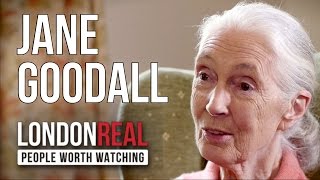 Jane Goodall on Wartime Childhood: Books, Africa, and Gombe2016 · 44 min · full transcriptBest for seeing how childhood encouragement and determination shaped her courage and persistence.
 Jane Goodall on Hope and Animal Intelligence: Life Lessons from a Good Heart2017 · 72 min · full transcriptBest for her deeper moral lesson that learning needs both rigor and compassion.
Questions people ask
- What advice did Jane Goodall's mother give her about doing important work?
- What did Jane Goodall learn from her mother about curiosity and learning?
- What did Jane Goodall say about hope and why it matters?
- What does Jane Goodall say ordinary people should do when the world feels overwhelming?
- What did Jane Goodall say about fear and working with chimpanzees?
- What did Jane Goodall say empathy does for scientific discovery?
Sources
Every quote above, word for word from the transcripts. Numbers match the text.
“…if we lose hope, we're doomed…”
“Well, the thing is, you know, this mission keeps me going because there's so much to do. Yeah. And if we lose hope, we're doomed. Because if you lose hope, you become apathetic and do nothing. But I'm not alone. You know, the Jane Goodall Institute is now in 25 countries, different chapters. And in addition, there's our program for young people, Roots & Shoots, which is humanitarian and environmental, and that's in 75 countries.”
“…if you're not hopeful, things are going to get less hopeful…”
“To me, hope is about action.”
“Hope is something tied into action…”
“…don't think globally, act locally.”
“Well, you can't solve the problems of the world, but what about where you live, your community? Is there something there you feel you might like? You don't like litter on the pavement, or you don't like they're planning to dig up a little forest to put yet another super mall. Go and do something about it.”
“…every day you live, you make an impact on the planet…”
“Every single day we live, we make some impact…”
“…each and every one of us makes a difference each and every day…”
“…every individual matters, every individual makes a difference, and every individual has a role to play.”
“Every single individual matters, has a role to play.”
“…curiosity, asking questions, not getting the right answer, deciding to find out for yourself…”
“Curiosity, asking questions, not getting the right answer, deciding to find out for yourself, making a mistake, not giving up, and learning patience.”
“Anyway, the point of that is that was the making of a little scientist. Asking questions, not getting the answer, deciding to find out for yourself, making a mistake, not giving up, and learning patience. And a different mother might have crushed that early curiosity and I might not be talking to you now.”
“I just have to carry on and learn all I can.”
“…if you really want to do this thing you're going to have to work really hard take advantage of opportunity and never give up…”
“If you really want something, you're going to have to work really hard and take advantage of opportunity and never give up.”
“If there's something you really want, you're going to have to work hard and take advantage of opportunities, and most important of all, don't give up.”
“The best advice I've ever received was from my mother when she said, "If you really want to do something, work hard, take advantage of opportunity, and don't give up.”
“I was very shy very retiring and All I wanted to do was go and live with animals and write books about them…”
“I was literally born loving animals…”
“…the most intellectual creature that's ever walked on planet Earth…”
“…there's been some kind of disconnect between this clever brain and the human heart…”
“…only when head and heart work in harmony can we attain our true human potential.”
“…the head and heart working in harmony is what's going to heal the world.”
“We're all interconnected: people, animals, our environment.”
“You watch behavior and don't really know what it means, but you have empathy and so you think you know what it means [and] that's that's really important this once you think you know what it means, then you can start Finding out if that's true. You can ask the right questions But if you never get to that point through empathy you can never ask the right questions So it's actually a critical part of the scientific method to me because the mobility vehicle there must be passion there must be interest, okay other important Observations you made about the chimpanzees you started with the tools what were some of the other big ones now the yoke back. [oh] Maternal Behavior is one of the really important ones good mothers and bad mothers infant development You know how they develop differently?”
How this guide was made: drafted with AI from the full transcripts of the recordings cited, then checked: every quotation must match a transcript word for word and be the speaker's own words, and an independent review gates accuracy. Methodology and corrections.


