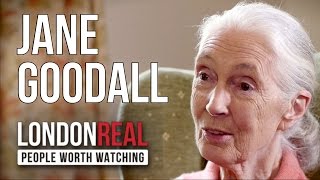
Jane Goodall on Conservation
Jane Goodall sees conservation as an interconnected moral and practical task: protect wildlife and forests by working with local people, changing daily choices, and acting with hope.
- Conservation starts from the fact that humans are part of nature, not separate from it.
- You cannot save chimpanzees or forests if people living nearby are too poor to survive without destroying them.
- Goodall treats conservation as a daily practice of responsibility through what we buy, use, and support.
- She insists hope is practical: local action, community programs, and young people can repair damaged places.
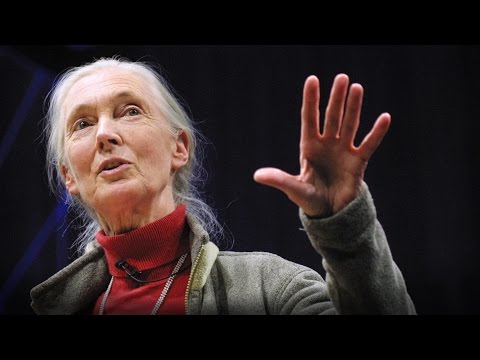
“…after all, there isn't a sharp line dividing humans from the rest of the animal kingdom…”TED talk, 2000 · 8:56
Conservation begins with kinship, not separation
Goodall’s view of conservation starts with a basic shift in how humans see themselves. She argues that humans are not sharply separate from the rest of life, and that the boundary between us and other animals is much less rigid than many people assume. That changes conservation from a niche concern into a question of how we relate to living beings with whom we share continuity.124
Her decades with chimpanzees helped drive this view. When she points to chimpanzees as emotional, social, and intelligent beings, conservation becomes more than preserving scenery or protecting resources; it becomes a response to lives that matter in themselves. She also frames humans as part of nature, which means environmental destruction is not damage done to something outside us.5678
“…after all, there isn't a sharp line dividing humans from the rest of the animal kingdom…”TED talk, 2000 · full transcript →
Why conservation became urgent: habitat loss, exploitation, and human pressure
Goodall’s conservation message is driven by decline she has watched firsthand. She says chimpanzee numbers are still falling, and she links that decline to forest destruction, the bushmeat trade, and the live animal trade. In her account, these are not isolated problems; they are connected pressures that tear apart both habitats and chimpanzee families.910
She also treats environmental damage as a human moral failure with consequences for the future. When forests are destroyed and wildlife is exploited, the cost is borne not only by animals living now but also by children who inherit a poorer world. Her language about the future makes conservation an issue of responsibility across generations, not just species protection.111213

“One thing we do know, their numbers are still decreasing…”PBS Nature interview, 2021 · full transcript →
You cannot save wildlife without helping people live differently
One of Goodall’s strongest and most practical ideas is that conservation fails when it ignores poverty. Around Gombe, she saw that people were cutting trees and overusing land because they needed food, fuel, water, and income. Her conclusion is direct: if people have no viable way to live, they will keep using the environment in destructive ways, not because they are careless but because they are trying to survive.1415
That is why she supports a holistic model rather than fortress conservation. She points to work that improves village life through tree nurseries, farming methods suited to damaged land, erosion control, reclaiming farmland, and access to water. Conservation, on this view, is not just setting aside land; it is building conditions in which people can protect forests and wildlife because doing so also helps their own families.1718
This also explains her repeated phrase about working with people, not against them. She does not present local communities as obstacles to conservation but as essential partners, because long-term protection depends on livelihoods, education, and trust.181415
“…if we don't help these people find ways of making a living without destroying the environment, we can't save chimps, forests, or anything else…”PBS Nature interview, 2021 · full transcript →
Conservation is a daily choice, not only a policy agenda
Goodall does not leave conservation at the level of governments or NGOs. She says each person affects the planet every day, which turns conservation into a matter of ordinary behavior as well as large systems. For her, impact is continuous, and so is responsibility.19202122
That leads to a very concrete ethic of consumption. She urges people to ask what harm may lie behind a product: damage to the environment, cruelty to animals, or exploitation of people. This makes conservation inseparable from shopping, energy use, transport, and other routine decisions.
Her advice is to begin where you are. Rather than being paralyzed by the scale of global problems, she tells people to think locally first and choose the kind of impact they want to make. In her view, conservation spreads through accumulated acts of responsibility.252627

“…every single one of us makes an impact on the planet every day…”Talks at Google, 2021 · full transcript →
Hope is not optimism; it is action with purpose
Goodall’s conservation message is unusually hopeful, but her hope is disciplined and active. She ties leadership and action to purpose, and she repeatedly tells people that individual effort matters. That is why she spends so much energy encouraging audiences rather than only warning them.28293031
She offers two practical grounds for hope. First, nature can recover when pressure is reduced and people help restoration along. Second, human beings, especially young people, can choose projects that help people, animals, and the environment together. Hope, then, is not wishful thinking; it is the belief that damaged systems can regenerate when moral commitment is turned into local action.323334
Goodall also thinks conservation needs both intellect and feeling. Knowledge matters, but people change most deeply when the heart is engaged. Her ideal is not cold management of nature, but wise action guided by compassion for all life and a sense of shared future.3536

“…the head and heart working in harmony is what's going to heal the world.”Root & Shoots Celebration, Columbia University, 2015 · full transcript →
Goodall on conservation, in her own words
“…if we don't help these people find ways of making a living without destroying the environment, we can't save chimps, forests, or anything else…”
“…every day you live, you make an impact on the planet…”
“Every single individual matters, has a role to play.”
“…the head and heart working in harmony is what's going to heal the world.”
“Together, together, we can make this a better world.”
Where to watch
 Jane Goodall on Coexistence and Conservation: Hope for Tomorrow2006 · 25 min · full transcriptBest single talk for seeing how Goodall links chimp conservation to village livelihoods, TACARE, and practical hope.
 Jane Goodall on Ethical Daily Choices: Every Day You Shape the Planet2008 · 25 min · full transcriptBest for her argument that conservation is built from ethical daily choices and human responsibility.
 Jane Goodall on Conservation and Hope: Working With People, Not Against Them2016 · 90 min · full transcriptBest long-form explanation of why conservation must work with local communities facing poverty and environmental pressure.
 Jane Goodall on Chimpanzee Conservation: Hope, Habitat, and Action2021 · 33 min · full transcriptBest concise account of the current threats to chimpanzees and why livelihoods are central to saving them.
 Jane Goodall on Reasons for Hope: Why Small Actions Matter2021 · 61 min · full transcriptBest for her philosophy of local action, hope, and the idea that small choices can scale.
 Jane Goodall on Roots & Shoots: Young People Can Change the World2015 · 42 min · full transcriptBest for how Goodall turns conservation into a youth-led practice of helping people, animals, and the environment together.
Questions people ask
- How does Jane Goodall think problems should be solved?
- How does Jane Goodall think young people can make a difference?
- What did Jane Goodall say about how to make people care about conservation?
- What did Jane Goodall say about how to persuade people to care about conservation?
- What did Jane Goodall say about making small changes instead of big ones?
- What did Jane Goodall say about poverty and deforestation in Africa?
Sources
Every quote above, word for word from the transcripts. Numbers match the text.
“…the world is not composed only of human beings; there are also other animal beings…”
“…after all, there isn't a sharp line dividing humans from the rest of the animal kingdom…”
“…there is no sharp line between humans and the rest of the animal kingdom…”
“They kiss; they embrace; they hold hands…”
“We are, as you say, part of nature…”
“We know that chimpanzees can be gentle and loving and compassionate.”
“There isn't a sharp line between us and the chimpanzees.”
“One thing we do know, their numbers are still decreasing…”
“And today, what is there? -Today it's, it's maximum, 300,000. -And what accounts for the drop in numbers? -Destruction of the forest. -So, their habitat? -Their habitat. But also, the bush meat trade, which is the commercial hunting of wild animals for food. Uh, different from subsistence hunting. And then finally, the live animal trade. Shoot a mother to steal the baby to sell. And we thought we'd stamp that out. But now there's a whole new inflow of chimpanzees moving from Africa, often through the Middle East to places like China.”
“That's us. We did that.”
“We have been stealing the future of our children.”
“We haven't been borrowing your future, we've been stealing it.”
“…if we don't help these people find ways of making a living without destroying the environment, we can't save chimps, forests, or anything else…”
“…if we don't help these people find ways of making a living without destroying the environment, we can't save chimps, forest, or anything else.”
“This led to a program, which we call TACARE. It's a very holistic way of improving the lives of the people living in the villages around the park. It started small with 12 villages. It's now in 24. There isn't time to go into it, but it's including things like tree nurseries, methods of farming most suitable to this now very degraded, almost desert-like land up in these mountains. Ways of controlling, preventing soil erosion. Ways of reclaiming overused farmland, so that within two years they can again be productive. Working to help the villagers obtain fresh water from wells.”
“…the human brain, coupled with the human heart…”
“…every single one of us makes a difference, every single day…”
“…every single one of us makes an impact on the planet every day…”
“…each one of us makes an impact on the planet every single day…”
“…every day you live, you make an impact on the planet…”
“Don't think globally. First, think locally.”
“…every single individual makes a difference…”
“…each and every one of us makes a difference each and every day…”
“…if you didn't have purpose, I don't believe you could lead.”
“Every single individual matters, has a role to play.”
“…every single one of us matters…”
“Together, together, we can make this a better world.”
“And the next reason for hope -- nature is amazingly resilient. You can take an area that's absolutely destroyed, with time and perhaps some help it can regenerate. And an example is the TACARE program. I told you, where a seemingly dead tree stump -- if you stop hacking them for firewood, which you don't need to because you have wood lots, then in five years you can have a 30-foot tree. And animals, almost on the brink of extinction, can be given a second chance. That's my next book. It's inspiring. And it brings me to my last category of hope, and we've heard about this so much in the last two days: this indomitable human spirit. This determination of people, the resilience of the human spirit, So that people who you would think would be battered by poverty, or disease, or whatever, can pull themselves up out of it, sometimes with a helping hand, and take their part in society, and take their part in changing the world.”
“And we decided that the main message would be every single one of us makes an impact on the planet every day, and we have a choice what sort of impact do we make, and that every group would choose three projects to make the world better because I learned in the rainforest how everything is interconnected. And so each group chooses the project to help people, a project to help animals, a project to help the environment. And these young people now-- it's actually 65 countries today. And they're changing the world as we speak. I mean, there's hundreds and thousands of young people. And the great news is that what I call the alumni, because beginning in '91 some of those students are now all grown up and out in the big wide world, and some of them have decision making jobs.”
“You're the hope, you're my hope.”
“The main difference is the fact that we have developed this extraordinarily sophisticated intellect.”
“…the head and heart working in harmony is what's going to heal the world.”
How this guide was made: drafted with AI from the full transcripts of the recordings cited, then checked: every quotation must match a transcript word for word and be the speaker's own words, and an independent review gates accuracy. Methodology and corrections.