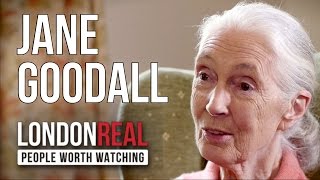
Jane Goodall on Science
For Jane Goodall, science begins in curiosity and patient observation, grows through empathy and evidence, and should be used in service of life.
- Science starts with curiosity, questions, patience, and finding out for yourself.
- Her chimpanzee work changed science by showing tool use, culture, emotion, and continuity between humans and other animals.
- She thinks empathy helps scientists ask better questions, as long as observation stays rigorous.
- Science should not stop at discovery; it should guide conservation and improve life for both people and nature.
- She welcomes technology as a tool for science and conservation, but insists it must be guided by wisdom and humility.

“…it's the making of a little scientist: curiosity, asking questions, not getting the right answer, deciding to find out for yourself, making a mistake, not giving up, and learning patience.”Templeton Prize speech, 2021 · 3:40
Science starts in curiosity, not authority
Goodall treats science first as a habit of mind: asking questions, accepting that you may not get the answer right away, trying to find out for yourself, learning from mistakes, and developing patience. In her telling, that is the real beginning of a scientist, long before credentials or status.12345
This matters because her own path did not begin inside a conventional academic pipeline. She presents discovery as something driven by sustained attention and persistence: if you want to know something, you keep watching, keep learning, and do not give up.678
“…it's the making of a little scientist: curiosity, asking questions, not getting the right answer, deciding to find out for yourself, making a mistake, not giving up, and learning patience.”Templeton Prize speech, 2021 · full transcript →
Patient observation can overturn what science thinks it knows
Goodall's best-known scientific claim is that careful field observation can force a whole discipline to rethink its assumptions. Watching chimpanzees in Gombe, she saw tool use and tool making, which challenged the belief that humans alone made and used tools.9
She also argues that behavior matters because it reveals evolutionary kinship in ways fossils cannot. Chimpanzees learn from one another, show different local tool traditions, and pass behavior across generations, which led her to argue that they have culture.10
The larger lesson is that the line once drawn sharply between humans and other animals is much less clear than scientists thought. Her observations pushed science toward a more continuous picture of minds, emotions, and intelligence across species.1112
Empathy helps science ask the right questions
Goodall does not see empathy as the enemy of science. She thinks that when you watch behavior closely, empathy can help you form better hypotheses about what an animal might be experiencing or intending, which then helps you ask the right questions.13
That view also shaped how she studied chimpanzees as individuals rather than as interchangeable specimens. By paying attention to particular lives, relationships, and stories, she believed science could see more clearly what animal societies are actually like.
Her position is not that feeling replaces evidence. It is that interest, passion, and imaginative understanding can be part of good scientific work when they lead to more precise observation instead of less.13
Science should widen our moral circle
Goodall's science points toward a moral conclusion: other animals are not mindless objects. She says plainly that humans are not the only beings with personalities, minds, and emotions, and her chimpanzee research is one reason she thinks that.12
She extends that thought beyond chimpanzees to a broader view of life as deeply interconnected. Humans, animals, and the environment belong together, so scientific understanding should make us less arrogant and more responsible.141516
This is one reason her scientific work became conservation work. Once you understand continuity between humans and other living beings, and once you see ecosystems as interdependent, destruction stops looking like a technical problem and starts looking like a moral failure.17
Good science must help people and nature together
Goodall rejects the idea that conservation science can succeed by focusing on animals alone. If people living around forests are too poor to survive without cutting trees or degrading habitat, then scientific knowledge by itself will not save chimpanzees or ecosystems.192021
So for her, applied science has to deal with whole systems: forests, animals, livelihoods, education, and local communities. That is why she emphasizes practical action that helps people, animals, and the environment together.2223
She also links science to agency. Since each person affects the planet every day, knowledge should lead to choices and local action rather than passive concern.24252627
Technology is useful, but wisdom matters more
Goodall is open to new scientific tools. She sees technologies, including AI, as potentially powerful for understanding ecological patterns and supporting conservation, but she insists that a tool is only as good as the people directing it.28
That caution fits a larger theme in her thinking: human intellect is impressive, but intellect alone is not enough. She worries about the gap between cleverness and wisdom, especially when advanced knowledge is used in ways that damage the living world.291730
Even as science becomes more powerful, she does not want it to flatten the wonder of life. There should still be humility before what we do not fully understand, including the inner lives of other beings.31

“…it's a tool and it depends on whose hands it's in and whose minds are developing it…”Possible podcast interview, 2025 · full transcript →
Goodall on science, in her own words
“…it's the making of a little scientist: curiosity, asking questions, not getting the right answer, deciding to find out for yourself, making a mistake, not giving up, and learning patience.”
“There isn't a sharp line between us and the chimpanzees.”
“…it's a tool and it depends on whose hands it's in and whose minds are developing it…”
Where to watch
 Jane Goodall on Chimpanzee Behavior: What We Share2024 · 47 min · full transcriptBest for seeing how Goodall thinks patient observation changed science's view of chimpanzees, culture, and human uniqueness.
 Jane Goodall on Conservation and Hope: Young People Can Change the World2017 · 60 min · full transcriptShows how she defended her observations, faced criticism, and used evidence to shift scientific opinion.
 Jane Goodall on Hope and Animal Intelligence: Life Lessons from a Good Heart2017 · 72 min · full transcriptA strong overview of her idea that curiosity, patience, rigor, and empathy belong together in science.
 Jane Goodall on Chimpanzee Conservation: Hope, Habitat, and Action2021 · 33 min · full transcriptConnects her scientific discoveries to method, individual observation, and conservation in practice.
 Jane Goodall on Hope and AI: Technology for Conservation2025 · 59 min · full transcriptUseful for her view of technology, AI, and how modern science should serve conservation without losing humility.
Questions people ask
- What did Jane Goodall learn from her mother about curiosity and learning?
- What did Jane Goodall say about chimpanzee culture and learning?
- What did Jane Goodall say about chimpanzees using tools?
- What did Jane Goodall say about humans destroying the planet and what aliens would think of us?
- What did Jane Goodall say about poverty and deforestation in Africa?
- What did Jane Goodall say empathy does for scientific discovery?
Sources
Every quote above, word for word from the transcripts. Numbers match the text.
“…it's the making of a little scientist: curiosity, asking questions, not getting the right answer, deciding to find out for yourself, making a mistake, not giving up, and learning patience.”
“…curiosity, asking questions, not getting the right answer, deciding to find out for yourself…”
“Curiosity, asking questions, not getting the right answer, deciding to find out for yourself, making a mistake, not giving up, and learning patience.”
“Curiosity, asking questions, not getting the right answer, deciding to find out for yourself…”
“Anyway, the point of that is that was the making of a little scientist. Asking questions, not getting the answer, deciding to find out for yourself, making a mistake, not giving up, and learning patience. And a different mother might have crushed that early curiosity and I might not be talking to you now.”
“I just have to carry on and learn all I can.”
“If you really want something, you're going to have to work really hard and take advantage of opportunity and never give up.”
“This is what I meant to be doing. This is what I'm here for.”
“It was very exciting. And it was the first chimpanzee who began to lose his fear of me who I saw one day break off grass stems, push them into termite mounds, pull them out, and bite off the termites and then, breaking off a leafy twig. So, to use that as a tool, he had to strip the leaves, that's the beginning of tool making. And it was that observation, because we were, as you say, the only creature to make and use tools. We were "man the toolmaker." And it was that observation that enabled Leakey to go to National Geographic Society. And they agreed A, to fund the research when my six months money ran out, and B, they sent a photographer and filmmaker to document what, by that time, I was learning.”
“They can, they can. They can learn sign language. They can learn 400 signs or more of American sign language, they can do amazing things on a computer. Chimps in different parts of Africa show different tool-using behaviors. And the young ones watch and learn. So, if we accept a definition of human culture, as behavior passed from one generation to the next through observation. Chimps have culture. I think that you know, the thing that makes us more different, some point in our evolution, we developed this ability to communicate with, with words, spoken, written. And once you have speech, our kind of speech, you can teach children about things that aren't present.”
“There isn't a sharp line between us and the chimpanzees.”
“Of course, we are not the only beings with personalities, minds, and emotions.”
“You watch behavior and don't really know what it means, but you have empathy and so you think you know what it means [and] that's that's really important this once you think you know what it means, then you can start Finding out if that's true. You can ask the right questions But if you never get to that point through empathy you can never ask the right questions So it's actually a critical part of the scientific method to me because the mobility vehicle there must be passion there must be interest, okay other important Observations you made about the chimpanzees you started with the tools what were some of the other big ones now the yoke back. [oh] Maternal Behavior is one of the really important ones good mothers and bad mothers infant development You know how they develop differently?”
“We're all interconnected: people, animals, our environment.”
“I felt this spiritual power in every living thing.”
“When I was in Gombe, particularly, I felt very, very close to a great spiritual power. [music] If we think of the Bible, it would be "in whom we live and move and have our being," and I felt this spiritual power in every living thing. We call it our soul. Well, if we have a soul, then that spark of energy is in chimpanzees. They have a soul, even though most people wouldn't talk about it that way, and the trees, they have a soul too. They've got a spark…”
“…there's been some kind of disconnect between this clever brain and the human heart…”
“…if we don't help these people find ways of making a living without destroying the environment, we can't save chimps, forests, or anything else…”
“…if we can't help these people find a way of making a living without destroying their environment, we can't save anything…”
“But it's also difficult for so many of the African people. So many living in abject poverty, um, not enough food, not enough education or health facilities. And it was when I flew over Gombe in 1990, and looked at what had been part of this great equatorial belt, and saw a tiny oasis of forest surrounded by bare hills. More people than the land could support. Too poor to buy food from elsewhere. You have to cut the last trees down. Because you got to survive, you got to try and grow more food. So, poverty alleviation is really important. But at the same time, the unsustainable lifestyle of the rest needs to come down, we need to think differently.”
“One for people, one for animals, one for the environment.”
“It's very important that young people learn that you can't just care for the environment. You need to care for people too because you can't separate them. As I speak now, in different parts of the world, there are young people. They've rolled up their sleeves, and they're out there clearing litter, planting trees, raising money for good causes, volunteering in shelters, volunteering in soup kitchens, changing the attitude of their parents. So Roots and Shoots is hope. Hundreds and thousands, millions of young people, the Roots in the Shoots can break through and make a better world.”
“…every day you live, you make an impact on the planet…”
“…each one of us makes an impact on the planet every single day…”
“Every single day we live, we make some impact…”
“Well, you can't solve the problems of the world, but what about where you live, your community? Is there something there you feel you might like? You don't like litter on the pavement, or you don't like they're planning to dig up a little forest to put yet another super mall. Go and do something about it.”
“…it's a tool and it depends on whose hands it's in and whose minds are developing it…”
“…the most intellectual creature that's ever walked on planet Earth…”
“And quite honestly, if an intelligent alien looks at us now, they would think, "What on Earth has gone on?" This, what separates us most from the chimps and other animals is this intellect that designs technology that enables you to learn about the stars. So how on Earth is this most intellectual creature to ever walk on the planet, why is it destroying its only home? Why are we polluting and cutting down the rainforest, acidifying the ocean? Why on Earth are we doing all this?”
“…there's got to be that little bit of mystery left…”
How this guide was made: drafted with AI from the full transcripts of the recordings cited, then checked: every quotation must match a transcript word for word and be the speaker's own words, and an independent review gates accuracy. Methodology and corrections.