Jane Goodall on Personal Story
Jane Goodall sees a life story not as a fixed plan but as a path shaped by curiosity, patient observation, hard work, empathy, and the choice to turn insight into action.
- Her life story starts with childhood curiosity, love of animals, and a dream of Africa.
- Her mother’s advice shaped her path: work hard, use opportunities, and never give up.
- Patient observation and empathy led to discoveries that changed science’s view of animals.
- Her story widened from studying chimpanzees to helping people, protecting nature, and spreading hope.
Her story begins with curiosity, not credentials
Goodall presents her life as beginning in a child’s intense curiosity about animals, not in a formal career plan. She describes herself as someone who loved animals from the start and wanted to live with them and write about them, which gave her story an early direction long before she entered science professionally.1
She treats curiosity as the engine of a meaningful life. For her, asking questions, refusing to stop at easy answers, learning by trial and error, and developing patience were not side traits; they were the habits that made her whole path possible.
Her mother helped turn a dream into a path
A central force in Goodall’s life story is her mother’s encouragement. Instead of dismissing a child’s unusual ambitions, her mother gave her a practical ethic: if you want something deeply, work hard, seize opportunities, and do not give up.
That advice matters because Goodall did not describe a smooth, privileged route. She frames her path as one built through persistence and step-by-step effort, which makes her life story less like destiny and more like disciplined faithfulness to a calling.
Patient observation changed her life and changed science
Goodall’s story becomes historically important because she followed her curiosity into sustained observation of chimpanzees. She emphasizes learning by watching carefully, staying patient, and continuing to learn, which is how breakthrough moments became possible.
Her most famous discoveries came from seeing chimpanzees as active, intelligent beings rather than as objects. Observing tool use helped overturn the old belief that tool making was uniquely human, and her broader experience convinced her that the line between humans and chimpanzees is not as sharp as many had assumed.
She also argues that empathy belongs inside good inquiry. In her account, empathy helps a researcher form better questions about behavior, which means her life story joins rigor and feeling rather than separating them.
Her life story is really about relationship with other beings
Goodall’s life story is not just the tale of a scientist making discoveries. It is also the story of learning to recognize personalities, minds, and emotions in other animals, especially chimpanzees. That recognition changed both her science and her moral outlook.
This is why her story resonates with so many people. She does not present life as human achievement alone; she presents it as deepening relationship, attention, and humility before other forms of life. Even her light remark that she can speak a little chimp points to a life built through long familiarity and attentive listening.
Her personal story expands into responsibility and hope
Later in life, Goodall’s story widens from studying chimpanzees to confronting environmental destruction, poverty, and the human future. She says this change happened because she felt compelled to act, and she came to see that protecting animals is impossible if people nearby lack ways to live without destroying the environment.
That is why hope becomes one of the main themes of her life story. She insists that people need hope in order to act, and she uses stories to reach the heart because lasting change starts from within.
Her practical conclusion is that a meaningful life is built through daily choices. Every person has some power, does not have to solve everything, and can begin with one concrete action.
Goodall on personal story, in her own words
“I was literally born loving animals…”
Where to watch
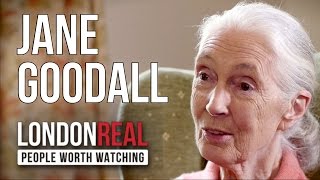 Jane Goodall on Wartime Childhood: Books, Africa, and Gombe2016 · 44 min · full transcriptBest for the childhood roots of her story: animals, books, Africa, and her mother’s influence.
 Jane Goodall on Hope and Animal Intelligence: Life Lessons from a Good Heart2017 · 72 min · full transcriptBest for how curiosity, patience, and observation became both her method and her life lesson.
 Jane Goodall on Hope and Conservation: Follow Your Heart2022 · 61 min · full transcriptBest for the emotional arc from childhood calling to chimpanzee research and wider activism.
 Jane Goodall on Reasons for Hope: Why Small Actions Matter2021 · 61 min · full transcriptBest for how her personal story grows into a philosophy of responsibility, local action, and hope.
 Jane Goodall on Message of Hope: Storytelling for Conservation2020 · 8 min · full transcriptBest short watch for the link between her life story, storytelling, and the need to give people hope.
Questions people ask
- What advice did Jane Goodall's mother give her about doing important work?
- What did Jane Goodall learn from her mother about curiosity and learning?
- What did Jane Goodall say about becoming an activist instead of just a scientist?
- What did Jane Goodall say about how to persuade people to care about conservation?
- What did Jane Goodall say empathy does for scientific discovery?
- What did Jane Goodall say people can do to help the planet?
Sources
Every quote above, word for word from the transcripts. Numbers match the text.
“I was literally born loving animals…”
How this guide was made: drafted with AI from the full transcripts of the recordings cited, then checked: every quotation must match a transcript word for word and be the speaker's own words, and an independent review gates accuracy. Methodology and corrections.


