Follow Curiosity
How a child’s questions became a scientific life.

“This is what I meant to be doing. This is what I'm here for.”Templeton Prize speech, 2021 · 6:54
The lesson
Goodall’s scientific path began in a very simple way: with a child who kept asking questions and wanted to find things out firsthand. Across these talks, she describes curiosity not as a vague personality trait but as a practice: ask, investigate, make mistakes, and stay with the question long enough to learn something real12. That habit mattered because it turned interest in animals and nature into the beginnings of a scientific way of seeing3.
Just as important, that curiosity was protected rather than shut down. Goodall repeatedly credits her mother’s response to her questions and ambitions, and she contrasts that encouragement with the possibility that an adult could have crushed her early drive to explore. The lesson is that talent often needs permission to grow: support, patience, and belief can help a child keep following questions until they become a life’s work56.
Books and imagination helped give her curiosity a direction. In these recordings, she traces a line from a childhood love of animals and stories about living with them to a clear dream of going to Africa. Even though she was shy and living in difficult wartime conditions, the dream stayed concrete enough to guide her choices rather than remain fantasy7.
But the dream did not come true through wishing alone. Goodall’s account emphasizes work, using opportunities, and persistence; her mother’s advice appears again and again because it became the practical bridge between childhood longing and adult action56. The path to Africa was shaped by ordinary preparation and determination, which shows that curiosity becomes a career when it is joined to effort and patience8.
When Goodall finally reached Gombe, she experienced a strong sense that this work fit who she was and what she was for9. That feeling did not replace science; it deepened her commitment to observing living beings carefully and respectfully, with both rigor and empathy10. In her story, curiosity leads to knowledge, but also to a larger sense of connection and purpose that helps explain why she kept going11.
4 principles from Jane Goodall
Treat curiosity as a method
Don’t stop at wondering. Ask questions, test your assumptions, learn from mistakes, and stay patient long enough to discover something for yourself. That is how interest becomes understanding.
“…it's the making of a little scientist: curiosity, asking questions, not getting the right answer, deciding to find out for yourself, making a mistake, not giving up, and learning patience.”
Protect early questions
Encouragement matters because curiosity is fragile when it is young. If you are raising, teaching, or mentoring someone, take their questions seriously and help them keep exploring.
“…if you really want to do this thing you're going to have to work really hard take advantage of opportunity and never give up…”
Let books and imagination point you somewhere real
Stories and reading can do more than entertain; they can help form a direction for your life. Pay attention to the subjects that keep returning to you, because they may reveal what you want to pursue seriously.
“I was very shy very retiring and All I wanted to do was go and live with animals and write books about them…”
Pair dreams with hard work and opportunity
A strong dream is not enough on its own. Progress comes from preparing, working hard, noticing openings, and refusing to give up when the path is indirect.
“If you really want something, you're going to have to work really hard and take advantage of opportunity and never give up.”
Moments to watch
In her own words
The quotes behind the lesson, word for word from the transcripts. Numbers match the lesson above.
“…it's the making of a little scientist: curiosity, asking questions, not getting the right answer, deciding to find out for yourself, making a mistake, not giving up, and learning patience.”
“Curiosity, asking questions, not getting the right answer, deciding to find out for yourself, making a mistake, not giving up, and learning patience.”
“…curiosity, asking questions, not getting the right answer, deciding to find out for yourself…”
“…if you really want to do this thing you're going to have to work really hard take advantage of opportunity and never give up…”
“If you really want something, you're going to have to work really hard and take advantage of opportunity and never give up.”
“I was very shy very retiring and All I wanted to do was go and live with animals and write books about them…”
“I just have to carry on and learn all I can.”
“This is what I meant to be doing. This is what I'm here for.”
“You watch behavior and don't really know what it means, but you have empathy and so you think you know what it means [and] that's that's really important this once you think you know what it means, then you can start Finding out if that's true. You can ask the right questions But if you never get to that point through empathy you can never ask the right questions So it's actually a critical part of the scientific method to me because the mobility vehicle there must be passion there must be interest, okay other important Observations you made about the chimpanzees you started with the tools what were some of the other big ones now the yoke back. [oh] Maternal Behavior is one of the really important ones good mothers and bad mothers infant development You know how they develop differently?”
“I felt this spiritual power in every living thing.”
Reflect
- What question or interest have you kept returning to over the years, and what would it look like to investigate it more seriously?
- Who encouraged your curiosity when you were young, or where was it discouraged? How has that shaped the way you learn now?
- What is one dream you could move closer to through ordinary preparation, patience, or better use of opportunity?
Check your understanding
Go deeper
 Jane Goodall on Spirituality and Nature: Life as a Tapestry2021 · 9 min · full transcript
 Jane Goodall on Hope and Purpose: Keep Going, Keep Giving Back2025 · 50 min · full transcript
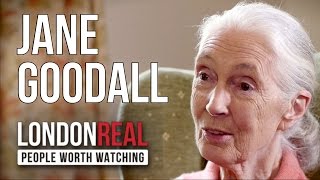 Jane Goodall on Wartime Childhood: Books, Africa, and Gombe2016 · 44 min · full transcript
 Jane Goodall on Hope and Conservation: Follow Your Heart2022 · 61 min · full transcript
 Jane Goodall on Hope and Animal Intelligence: Life Lessons from a Good Heart2017 · 72 min · full transcript
 Jane Goodall on Seeds of Hope: Each Person Makes a Difference2014 · 55 min · full transcript