Chimpanzee Minds
Tools, culture, emotions, and the discovery that changed science.
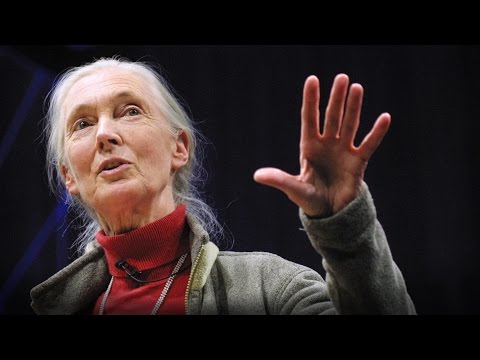
“What we find is that over these 40-odd years that I and others have been studying chimpanzees and the other great apes, and, as I say, other mammals with complex brains and social systems, we have found that after all, there isn't a sharp line dividing humans from the rest of the animal kingdom. It's a very wuzzy line. It's getting wuzzier all the time as we find animals doing things that we, in our arrogance, used to think was just human. The chimps -- there's no time to discuss their fascinating lives -- but they have this long childhood, five years of suckling and sleeping with the mother, and then another three, four or five years of emotional dependence on her, even when the next child is born.”TED talk, 2000 · 8:56
The lesson
Goodall’s chimpanzee research changed science because it challenged the old idea that humans stood apart in a clear, unique category. Across her talks, she argues that the boundary between humans and other animals is not sharp but blurred, especially when you watch chimpanzees closely over time123. For her, the important move was to study living behavior carefully, because behavior can reveal evolutionary continuity that fossils cannot show, a point emphasized in the recordings about why observing chimpanzees matters for understanding ourselves.
The most famous break with earlier assumptions came from tool use. Goodall observed a chimpanzee using grass stems to gather termites and modifying a twig by stripping its leaves, which meant chimpanzees were not only using objects but also making tools4. That discovery mattered because science had treated toolmaking as a defining human trait, so the evidence forced a rethink of either the definition of tools, the definition of humans, or the exclusivity of the trait itself.
Goodall’s findings went beyond tools to culture and learning. She describes young chimpanzees watching elders and learning behaviors, and she notes that chimp communities in different parts of Africa show different tool-using traditions5. That means chimpanzee life is not just driven by instinct alone; some behaviors are socially transmitted across generations, which is why she argues that chimpanzees have culture in a meaningful sense5.
She also pushed back against the claim that personality, mind, and emotion belong only to humans. In multiple recordings, Goodall insists that chimpanzees are individuals with distinct personalities and emotional lives, and she points to affectionate, cooperative, and compassionate behavior as part of the evidence678. Her method mattered here too: by treating chimpanzees as individuals rather than interchangeable specimens, she was able to notice patterns in family bonds, communication, learning, and social relationships that a more distant approach might miss.
These discoveries did not just expand what scientists knew about chimpanzees; they narrowed the gap many people assumed separated humans from other animals. Goodall still says there is a difference in the extraordinary development of human intellect and language-related capacities, but she argues that this difference should not blind us to deep continuity in minds, feelings, and social life95. The larger lesson of this chapter is that better observation can overturn bad categories: once scientists looked carefully, they had to rethink both chimpanzees and human uniqueness.
3 principles from Jane Goodall
Question sharp human-animal boundaries
Do not start with the assumption that humans and other animals differ in absolute kind. Look for continuities in behavior, emotion, and social life before deciding which differences are truly distinctive.
“…after all, there isn't a sharp line dividing humans from the rest of the animal kingdom…”
Let observation overturn theory
Goodall’s key advances came from sustained attention to what chimpanzees actually did, not from defending accepted definitions. In your own work, treat surprising evidence as a reason to revise categories rather than force facts into old ideas.
“It was very exciting. And it was the first chimpanzee who began to lose his fear of me who I saw one day break off grass stems, push them into termite mounds, pull them out, and bite off the termites and then, breaking off a leafy twig. So, to use that as a tool, he had to strip the leaves, that's the beginning of tool making. And it was that observation, because we were, as you say, the only creature to make and use tools. We were "man the toolmaker." And it was that observation that enabled Leakey to go to National Geographic Society. And they agreed A, to fund the research when my six months money ran out, and B, they sent a photographer and filmmaker to document what, by that time, I was learning.”
Take animal individuality seriously
Goodall noticed personalities, emotions, and relationships because she treated chimpanzees as individuals. In any field study, naming and tracking individuals can reveal patterns that disappear when subjects are treated as anonymous units.
“Of course, we are not the only beings with personalities, minds, and emotions.”
Moments to watch
In her own words
The quotes behind the lesson, word for word from the transcripts. Numbers match the lesson above.
“…after all, there isn't a sharp line dividing humans from the rest of the animal kingdom…”
“It's a very wuzzy line…”
“What we find is that over these 40-odd years that I and others have been studying chimpanzees and the other great apes, and, as I say, other mammals with complex brains and social systems, we have found that after all, there isn't a sharp line dividing humans from the rest of the animal kingdom. It's a very wuzzy line. It's getting wuzzier all the time as we find animals doing things that we, in our arrogance, used to think was just human. The chimps -- there's no time to discuss their fascinating lives -- but they have this long childhood, five years of suckling and sleeping with the mother, and then another three, four or five years of emotional dependence on her, even when the next child is born.”
“It was very exciting. And it was the first chimpanzee who began to lose his fear of me who I saw one day break off grass stems, push them into termite mounds, pull them out, and bite off the termites and then, breaking off a leafy twig. So, to use that as a tool, he had to strip the leaves, that's the beginning of tool making. And it was that observation, because we were, as you say, the only creature to make and use tools. We were "man the toolmaker." And it was that observation that enabled Leakey to go to National Geographic Society. And they agreed A, to fund the research when my six months money ran out, and B, they sent a photographer and filmmaker to document what, by that time, I was learning.”
“They can, they can. They can learn sign language. They can learn 400 signs or more of American sign language, they can do amazing things on a computer. Chimps in different parts of Africa show different tool-using behaviors. And the young ones watch and learn. So, if we accept a definition of human culture, as behavior passed from one generation to the next through observation. Chimps have culture. I think that you know, the thing that makes us more different, some point in our evolution, we developed this ability to communicate with, with words, spoken, written. And once you have speech, our kind of speech, you can teach children about things that aren't present.”
“Of course, we are not the only beings with personalities, minds, and emotions.”
“We know that chimpanzees can be gentle and loving and compassionate.”
“They kiss; they embrace; they hold hands…”
“The main difference is the fact that we have developed this extraordinarily sophisticated intellect.”
Reflect
- What category or assumption in your field do people treat as obvious, and what kind of direct observation might reveal a blurrier reality?
- Have you ever dismissed differences between groups as instinct or fixed nature when they might instead reflect learning or culture? What evidence would help you tell the difference?
- Where in your work would paying closer attention to individuals, rather than averages alone, change what you notice?
Check your understanding
Go deeper
 Jane Goodall on Human-Chimp Differences: We’re Not So Separate2000 · 29 min · full transcript
 Jane Goodall on Chimpanzee Behavior: What We Share2024 · 47 min · full transcript
 Jane Goodall on Conservation and Hope: Young People Can Change the World2017 · 60 min · full transcript
 Jane Goodall on Reasons for Hope: Why Small Actions Matter2021 · 61 min · full transcript
 Jane Goodall on Chimpanzee Conservation: Hope, Habitat, and Action2021 · 33 min · full transcript
 Jane Goodall on Hope and Animal Intelligence: Life Lessons from a Good Heart2017 · 72 min · full transcript
 Jane Goodall on Chimpanzee Behavior: How chimps greet, learn, and feel2014 · 46 min · full transcript
 Jane Goodall on Roots & Shoots: Young People Can Change the World2015 · 42 min · full transcript