Jane Goodall on Women In Science
Jane Goodall’s view of women in science centers on curiosity, persistence, supportive encouragement, and trusting careful observation even when institutions doubt you.
- Curiosity is the beginning of a scientific life, and it must be protected, not crushed.
- Goodall’s path shows that women can enter science through persistence, unconventional routes, and patient observation.
- She faced skepticism and sexism, but careful evidence changed minds.
- Science should join intellect with empathy and ethics, not detach facts from humane concern.
- Equality matters because every person has a role to play, and society rises when women are fully included.
A scientist begins with curiosity, not permission
Goodall treats the start of science as deeply human and very early: asking questions, not accepting incomplete answers, making mistakes, and learning patience. In her account, that is the making of a scientist, and it depends on whether a child’s curiosity is encouraged rather than shut down.123
That matters for women in science because her own life shows how easily a different response could have narrowed a girl’s ambitions. She links her future to a mother who encouraged her interests and taught her to work hard, seize opportunity, and keep going.45
Goodall also makes clear that scientific promise does not have to look bold or conventional at the start. She describes herself as shy and focused on animals, yet that private fascination became a world-changing scientific career.67

“Anyway, the point of that is that was the making of a little scientist. Asking questions, not getting the answer, deciding to find out for yourself, making a mistake, not giving up, and learning patience. And a different mother might have crushed that early curiosity and I might not be talking to you now.”Call Her Daddy interview, 2025 · full transcript →
Persistence can carry women through unconventional paths
Goodall’s story is a direct challenge to the idea that there is only one proper route into science. She began without formal scientific qualifications, held onto a lifelong love of animals, and still built a research career through work, patience, and opportunity.
Her advice is practical rather than romantic: if you want something, work hard, take advantage of opportunities, and do not give up. That principle appears again and again in how she explains her own path from childhood dream to field research.4589
She does not deny the importance of degrees for most scientists, but her example widens the imagination of what is possible. For girls and women who feel outside the usual mold, her life says that commitment, preparation, and persistence can still open doors.
Trust careful observation, even when experts dismiss you
One of Goodall’s strongest lessons for women in science is to trust what rigorous observation shows. Her early fieldwork documented tool use in chimpanzees and helped overturn the assumption that only humans made and used tools.10
She also insisted on realities many scientists resisted at the time: that chimpanzees have personalities, minds, and emotions. Her willingness to stand by what she saw, even when it cut against accepted thinking, is central to her example.1112
This is especially relevant for women facing skepticism, because Goodall describes early criticism from scientists and a field that was eventually moved by evidence. Her model is not defiance for its own sake, but patience, close attention, and confidence in well-grounded findings.10
Good science needs empathy, ethics, and the head and heart together
Goodall does not separate scientific seriousness from empathy. She argues that empathy helps a researcher ask better questions, because it is part of how one begins to interpret behavior and test whether those interpretations are true.13
She also draws a moral line around how science is practiced. For her, science is wonderful when it seeks facts rightly, but not when knowledge is pursued through inhumane behavior.
That broader vision is one reason her example speaks so powerfully to women in science. She presents scientific work as compatible with feeling, ethical concern, and care, and even suggests that real progress comes when intellect and compassion work together.1415
Women in science matter because every voice and every wing matters
Goodall’s comments on equality are brief but pointed: society cannot fully rise while women are held back. She frames equality not as a side issue, but as part of whether humanity can meet its responsibilities.
That fits her broader belief that every individual matters and has a role to play. In her worldview, solving human and environmental problems requires the contribution of all people, not a narrow elite.16171819
She also connects hope to action. For women in science, that means not waiting for perfect conditions: stay hopeful, act, collaborate, and help heal damage in communities, institutions, and the natural world.202122
Goodall on women in science, in her own words
“Anyway, the point of that is that was the making of a little scientist. Asking questions, not getting the answer, deciding to find out for yourself, making a mistake, not giving up, and learning patience. And a different mother might have crushed that early curiosity and I might not be talking to you now.”
Where to watch
 Jane Goodall on Conservation and Hope: Young People Can Change the World2017 · 60 min · full transcriptBest for seeing how Goodall handled skepticism, trusted her observations, and built authority without a conventional start.
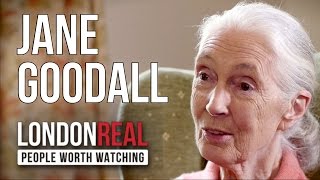 Jane Goodall on Wartime Childhood: Books, Africa, and Gombe2016 · 44 min · full transcriptBest for her childhood formation, her mother’s influence, and the persistence behind her path into science.
 Jane Goodall on Seeds of Hope: Each Person Makes a Difference2014 · 55 min · full transcriptBest for her clear explanation of curiosity, patience, and not giving up as the roots of a scientific life.
 Jane Goodall on Hope and Action: Climate, Feminism, Equality2020 · 22 min · full transcriptBest for her direct comments linking hope, action, feminism, and equality.
 Jane Goodall on Roots & Shoots: Young People Can Change the World2015 · 42 min · full transcriptBest for how she connects scientific perseverance with empowering the next generation to act.
Questions people ask
Sources
Every quote above, word for word from the transcripts. Numbers match the text.
“Curiosity, asking questions, not getting the right answer, deciding to find out for yourself, making a mistake, not giving up, and learning patience.”
“Curiosity, asking questions, not getting the right answer, deciding to find out for yourself…”
“Anyway, the point of that is that was the making of a little scientist. Asking questions, not getting the answer, deciding to find out for yourself, making a mistake, not giving up, and learning patience. And a different mother might have crushed that early curiosity and I might not be talking to you now.”
“…if you really want to do this thing you're going to have to work really hard take advantage of opportunity and never give up…”
“If you really want something, you're going to have to work really hard and take advantage of opportunity and never give up.”
“I was very shy very retiring and All I wanted to do was go and live with animals and write books about them…”
“I was literally born loving animals…”
“If there's something you really want, you're going to have to work hard and take advantage of opportunities, and most important of all, don't give up.”
“The best advice I've ever received was from my mother when she said, "If you really want to do something, work hard, take advantage of opportunity, and don't give up.”
“It was very exciting. And it was the first chimpanzee who began to lose his fear of me who I saw one day break off grass stems, push them into termite mounds, pull them out, and bite off the termites and then, breaking off a leafy twig. So, to use that as a tool, he had to strip the leaves, that's the beginning of tool making. And it was that observation, because we were, as you say, the only creature to make and use tools. We were "man the toolmaker." And it was that observation that enabled Leakey to go to National Geographic Society. And they agreed A, to fund the research when my six months money ran out, and B, they sent a photographer and filmmaker to document what, by that time, I was learning.”
“Of course, we are not the only beings with personalities, minds, and emotions.”
“We are not the only species with personalities, minds, and emotions…”
“You watch behavior and don't really know what it means, but you have empathy and so you think you know what it means [and] that's that's really important this once you think you know what it means, then you can start Finding out if that's true. You can ask the right questions But if you never get to that point through empathy you can never ask the right questions So it's actually a critical part of the scientific method to me because the mobility vehicle there must be passion there must be interest, okay other important Observations you made about the chimpanzees you started with the tools what were some of the other big ones now the yoke back. [oh] Maternal Behavior is one of the really important ones good mothers and bad mothers infant development You know how they develop differently?”
“…the head and heart working in harmony is what's going to heal the world.”
“And quite honestly, if an intelligent alien looks at us now, they would think, "What on Earth has gone on?" This, what separates us most from the chimps and other animals is this intellect that designs technology that enables you to learn about the stars. So how on Earth is this most intellectual creature to ever walk on the planet, why is it destroying its only home? Why are we polluting and cutting down the rainforest, acidifying the ocean? Why on Earth are we doing all this?”
“Every single individual matters, has a role to play.”
“…every single one of us matters…”
“…each one of us makes an impact on the planet every single day…”
“…each and every one of us makes a difference each and every day…”
“…if you're not hopeful, things are going to get less hopeful…”
“Hope is something tied into action…”
“If we get together, then we can start to heal some of the scars that we've inflicted.”
How this guide was made: drafted with AI from the full transcripts of the recordings cited, then checked: every quotation must match a transcript word for word and be the speaker's own words, and an independent review gates accuracy. Methodology and corrections.


