Geoffrey Hinton on Symbolic AI
Geoffrey Hinton sees symbolic AI as the wrong model of intelligence: minds and modern AI work by learning distributed representations and connection strengths from data, not by manipulating hand-written rules.
- He rejects hand-coded symbolic rules as the core of intelligence and argues learning should happen through changing connection strengths.
- He thinks meaning is represented in large sets of interacting features, not discrete symbols with fixed definitions.
- He argues language models learn structure rather than store sentences or texts verbatim.
- He sees modern large language models as genuine understanders of language, in broadly the same kind of way humans understand.
- He believes neural nets beat symbolic approaches largely because scale, data, compute, and backprop made learning practical.
Hinton thinks symbolic AI starts from the wrong idea
Hinton’s basic disagreement with symbolic AI is that intelligence is not mainly about applying explicit rules over symbols. He says the core mechanism has to be learning by changing connection strengths, which is why he stayed committed to neural networks rather than hand-built symbolic systems.
That difference matters because symbolic software is written to do specific things, while neural networks are written to learn from experience. In his account, modern AI is powerful precisely because instead of programming every competence directly, you train a system so it discovers the needed internal structure for itself.
For Hinton, meaning lives in feature vectors, not symbols
Hinton argues that the meaning of a word is not a dictionary-style symbol with a fixed definition. He describes meaning as a large collection of features, and sentence understanding as finding feature representations for words that fit together coherently in context.
This is a direct alternative to symbolic AI. Instead of assuming intelligence needs neat symbolic expressions and explicit logical forms, his view is that understanding comes from many interacting numerical features that shift with context and support prediction.
He says language models learn structure rather than memorize rules or text
A common symbolic critique is that language competence must come from stored rules or retrieved text. Hinton pushes back on that directly, arguing that large chatbots do not literally store language, and that next-word prediction drives them to learn features and interactions that capture structure.
He also explains this as compression through shared structure: a model gets efficient by finding common patterns across many cases. That is why he thinks these systems can answer unusual analogy-like questions that many people have never explicitly rehearsed.
Why he thinks neural nets won over symbolic AI
Hinton does not present the success of neural nets as a philosophical preference alone; he treats it as an empirical result. Once data, compute, bigger models, and training methods improved, neural networks started outperforming older approaches on speech, vision, and translation, including tasks that had resisted rule-based systems.
He often stresses that the old setbacks for neural nets were largely about scale, not about the approach being conceptually wrong. In that picture, symbolic AI looked stronger for a time because learned systems were too small and too hard to train, but bigger well-regularized models changed the outcome.
Hinton applies this view all the way to understanding and reasoning
Hinton goes beyond saying neural nets are useful engineering tools. He argues that large language models really do understand what they are saying, and that their understanding is importantly similar to ours rather than to conventional software.
That claim is what makes his criticism of symbolic AI so deep. If understanding, reasoning, and meaning can emerge from learned representations and prediction, then the symbolic picture is not just incomplete; it may be pointing to the wrong basic ingredients for intelligence.
Where to watch
 Geoffrey Hinton on How AI Works: Why Neural Nets Learn Meaning2021 · 61 min · full transcriptBest single talk for his full case against symbolic meanings and for feature-vector understanding.
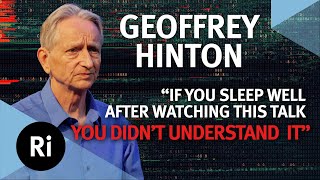 Geoffrey Hinton on Deep Learning and Understanding: AI, language, minds2021 · 47 min · full transcriptBest for seeing how he connects language models, prediction, and learned internal structure instead of stored symbolic rules.
 Geoffrey Hinton on Deep Learning: Why Neural Nets Won2019 · 39 min · full transcriptBest concise account of why he believed neural nets would beat alternatives once scale and training caught up.
 Geoffrey Hinton on Backpropagation: Can the Brain Do It?2019 · 82 min · full transcriptBest for the practical side: how backprop made learning from examples outperform hand-coded approaches.
 Geoffrey Hinton on Deep Learning Limits: Scale, Reasoning, and Brain-Like Learning2021 · 46 min · full transcriptBest for his stronger claim that large models can genuinely understand and improve further with scale.
Questions people ask
- What did Geoffrey Hinton say about creativity in large language models?
- What did Geoffrey Hinton say about how large language models work?
- What did Geoffrey Hinton say about whether large language models understand language?
- Why does Geoffrey Hinton think deep learning is changing computer science so much?
How this guide was made: drafted with AI from the full transcripts of the recordings cited, then checked: every quotation must match a transcript word for word and be the speaker's own words, and an independent review gates accuracy. Methodology and corrections.