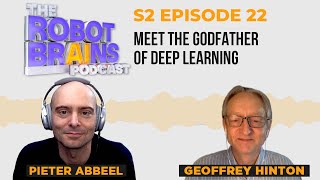
Geoffrey Hinton on Neural Networks
Geoffrey Hinton sees neural networks as systems that learn intelligence by adjusting connection strengths to build internal features and representations from data.
- Neural networks work by learning connection strengths rather than following hand-coded rules.
- Deep learning matters because multiple layers let simple detectors combine into richer internal representations.
- Backpropagation made it practical to improve huge numbers of weights efficiently, and scaling data and compute made the approach win.
- Hinton thinks neural nets capture meaning with distributed features, including in language models.
- He treats neural networks as closer to how people learn than standard symbolic software, while still thinking current methods can improve.

Neural networks learn by changing connections, not by following explicit rules
Hinton’s starting point is simple: intelligence in a neural net comes from learned connection strengths. For him, the central mechanism is not a library of hand-written rules, but a network that adjusts weights from experience until it behaves intelligently on a task. That is why he keeps returning to the idea that the key question is how the weights change.12
He contrasts this with older symbolic approaches that tried to encode intelligence directly. His view is that modern systems became powerful when people stopped trying to specify every rule and instead trained large networks from examples. In his phrasing, the relationship changed from programming computers to showing them and letting them figure things out.3
That also explains why he thinks neural nets are a better model of intelligence than standard software. He says they are much more like us than conventional programs are, because their abilities come from learned patterns in many connections rather than brittle explicit instructions.4
Depth lets networks build concepts from simple features
Hinton explains deep learning as stacked layers that progressively build up representations. In vision, he uses the concrete picture of moving from pixels to edges, then shapes, then object parts, and then whole objects. The core idea is that useful concepts are constructed from simpler detectors arranged across layers.
He defines deep learning very plainly: the deep part just means a neural net has multiple layers. But for him that simple definition matters because the extra layers let the network form internal features that would be hard to specify by hand. Instead of directly coding a bird detector, the system can learn lower-level pieces and combine them.6
This feature-building story is not limited to perception. Hinton extends the same logic to language, where words and sentences are represented by interacting features rather than by fixed symbols with hand-written meanings.78
Backpropagation is the practical breakthrough
Hinton treats backpropagation as the method that made large neural nets trainable. The importance is not just that it updates weights, but that it updates huge numbers of them efficiently in the direction that improves performance. That is the step that turns a promising idea into a practical learning system.9
He is also clear that backpropagation is not the final word. He says some of what he used to believe about backpropagation was wrong, which shows a recurring theme in his thinking: the broad neural-network picture is right, but the details of the best learning algorithms can change. He still calls gradient descent learning for big neural networks a very sensible thing to do.1112
When people question whether this kind of learning is too artificial, Hinton pushes back. He argues that it would be surprising if the brain were not doing something related, even if the biological implementation differs from textbook backprop.1314
Neural networks won because scale finally matched the idea
Hinton’s view of the history is that neural nets did not suddenly become good because the basic idea changed from wrong to right. They won because the world finally had enough scale: more data, faster computers, and training tricks that let large models work. He says the setback was mainly a scale problem.15
That framing matters because it explains his long confidence in the approach. He believed the principle of learning in networks was sound even when the field was skeptical, and later progress in speech, vision, translation, and other domains confirmed that belief.16
He also emphasizes that large models are not automatically a mistake. His view is that big models are good when they are regularized properly, which fits his broader argument that capacity plus the right learning procedure is what unlocks strong generalization.17
Representation is the real point: networks learn meaning and memory
For Hinton, the deepest reason neural networks matter is that they learn internal representations. In language, he says meaning is a large set of features, and understanding a sentence means assigning mutually compatible feature vectors to its words. This is his answer to the question of how a network can know anything without explicit symbolic rules.78
That is why he is willing to say language models really do understand what they are saying. His claim rests on the idea that knowledge can be stored in weights and activated as rich feature patterns, not only in explicit symbols.18
The same representational view appears in his older work on memory and perception. Hopfield nets show how a network can retrieve a memory from partial input by settling toward an energy minimum, and hidden units let networks infer interpretations instead of merely storing patterns. Neural networks, in this picture, are systems for representing structure in data and using it to complete, interpret, and generalize.2021
Hinton on neural networks, in his own words
“It's just a question of how you change the weights.”
“The meaning of a word was just a big set of features.”
Where to watch
 Geoffrey Hinton on How Neural Networks Learn: Beaks, Pings, and Backprop2023 · 98 min · full transcriptBest plain-language walkthrough of how neural networks learn from pings, edges, features, and backpropagation.
 Geoffrey Hinton on Deep Learning: Why Neural Nets Won2019 · 39 min · full transcriptBest short overview of why neural nets won: learning weights, scale, and practical success.
 Geoffrey Hinton on How AI Works: Why Neural Nets Learn Meaning2021 · 61 min · full transcriptBest explanation of Hinton’s view that neural nets represent meaning through feature vectors and context.
 Geoffrey Hinton on Backpropagation: Can the Brain Do It?2019 · 82 min · full transcriptBest for understanding why backpropagation works and why Hinton thinks something related may matter in brains.
 Geoffrey Hinton on Neural Network Foundations: Hopfield Nets and Boltzmann Machines2024 · 79 min · full transcriptBest foundation on associative memory, hidden units, and the older neural-network ideas behind later deep learning.
Questions people ask
- What did Geoffrey Hinton say backpropagation does?
- How did Geoffrey Hinton explain edge detectors in computer vision?
- What did Geoffrey Hinton say about capsules and routing by agreement?
- What did Geoffrey Hinton say about how AI has changed our understanding of the brain?
- What did Geoffrey Hinton say about how neural networks learn from examples?
- Why does Geoffrey Hinton think deep learning is changing computer science so much?
Sources
Every quote above, word for word from the transcripts. Numbers match the text.
“It has to work by learning the strengths of connections.”
“It's just a question of how you change the weights.”
“I kind of agree with you that it's not quite a Second Industrial Revolution, but it's something on nearly that scale, and there's a huge sea change going on basically because our relationship to computers has changed. Instead of programming them, we now show them and they figure it out. That's a completely different way of using computers, and computer science departments are built around the idea of programming computers, and they don't understand that sort of—this showing computers is going to be as big as programming computers, and so they don't understand that half the people in the department should be people who get computers to do things by showing them.”
“They're much more like us than standard computer software's like us.”
“The deep in learning just means it's a neural net that has multiple layers.”
“The meaning of a word was just a big set of features.”
“Understanding a sentence consists of associating mutually compatible feature vectors with the words in the sentence.”
“And the amazing thing is it works.”
“…almost everything I used to believe about backpropagation is wrong.”
“So the idea is, gradient descent learning for big neural networks is a very sensible thing to do.”
“I think it'd be crazy if the brain wasn't somehow doing this.”
“…the neuroscientist's idea that it doesn't look plausible is just silly.”
“It turned out it was mainly a question of scale.”
“I just kept on doing what I believed in.”
“Big models are good if you regularize them, if you stop them doing crazy things.”
“I think LLMs really do understand what they're saying.”
“The whole point of a Hopfield net is that each neuron can locally compute what it needs to do in order to reduce the energy…”
“Settling to energy minimum when they represent memories is a way of having a content addressable memory.”
How this guide was made: drafted with AI from the full transcripts of the recordings cited, then checked: every quotation must match a transcript word for word and be the speaker's own words, and an independent review gates accuracy. Methodology and corrections.