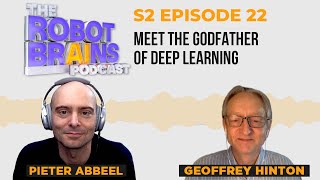
Geoffrey Hinton on Scaling And Compute
Hinton’s view is that many of deep learning’s biggest breakthroughs came from a simple pattern: larger models trained on more data with more compute often discover capabilities that smaller systems never reach.
- Hinton thinks modern deep learning worked largely because the field finally reached the necessary scale in model size, data, and compute.
- He repeatedly says bigger models tend to work better, especially when paired with enough data and training compute.
- He treats ImageNet, GPUs, and large-scale distributed training as practical turning points that unlocked results older methods could not match.
- He also adds an important caveat: large models need training discipline and regularization, not just brute force.
- For Hinton, scaling matters because neural nets learn internal structure from examples rather than relying on hand-built rules, and scale lets that learning become powerful enough to generalize.
For Hinton, deep learning’s rise was mainly a scale story
Hinton’s core claim is that neural networks did not suddenly become good because the basic idea changed; they became good because the field finally had enough scale. He says the long period when neural nets seemed weaker than rival approaches was mostly explained by limited data and slow computers, not by a failure of the underlying learning idea.
That is why he keeps returning to the same ingredients: larger models, more data, and more compute. In his telling, these were not secondary engineering details. They were the conditions that let neural nets show what they could do on speech, vision, and later language.
Bigger models usually work better, if you can support them
Hinton is strikingly direct on the value of size. He says bigger models tend to work better, and he describes the field as having learned this lesson gradually through experience rather than from elegant theory first.
But he does not present scaling as magical. Bigger models help when they are paired with enough data and enough computation to train them well, and when they are kept under control during training. He explicitly notes that large models are good when you regularize them and stop them from behaving badly.
This is one reason his comments about scaling are practical rather than ideological. He likes the empirical result even if it is not the sort of tidy scientific explanation one might prefer, which helps explain his mix of surprise and enthusiasm about what large-scale systems can do.
Data scale changed what was possible, and ImageNet became the proof
Hinton ties compute scaling to data scaling. A larger model is only part of the story; the model also needs a large enough stream of examples to shape useful internal representations, which is why he highlights the importance of big datasets in the breakthroughs that changed the field.
ImageNet stands out in this story because it gave neural nets a problem large enough to reveal their strengths. Hinton’s joking remark that the dataset should have been even bigger captures a serious point: when learning systems are data-hungry, increasing the scale of the task can expose capabilities that smaller benchmarks hide.
This fits his broader view that intelligence in machines comes from learning from examples rather than hand-designing rules. If the system is going to learn the strengths of connections from experience, then giving it enough varied experience becomes central, not optional.
GPUs and distributed computation turned scaling from theory into practice
Hinton does not talk about compute as an abstract resource. He points to concrete changes in hardware and training setup that made deep learning practical at scale, especially GPUs and large parallel systems.
That matters because the success of backpropagation depends on actually being able to run large experiments. Hinton’s recurring point is that the learning procedure was powerful, but only once computers became fast enough and datasets large enough did it become obvious to the rest of the field how effective it could be.
This also explains why he credits persistence and engineering realities alongside ideas. In his account, breakthroughs came from combining the learning algorithm with enough hardware, enough examples, and enough willingness to keep scaling when earlier generations of researchers could not yet do so economically.
Why scaling works: larger nets can learn richer structure, not just memorize
Hinton rejects the idea that large neural nets are useful only because they memorize vast datasets. His view is that they work because learning from many examples pushes them to discover common structure and build useful internal representations.
That is why he is willing to attribute real understanding-like abilities to large systems. In his view, when a model compresses broad regularities across many examples, scale can produce reasoning, analogy, and generalization rather than mere lookup behavior.
So for Hinton, scaling and compute matter not just because they improve benchmark scores. They matter because they allow the representation-learning approach to get deep enough and broad enough to capture patterns that smaller systems miss.
Where to watch
 Geoffrey Hinton on Deep Learning Scaling: Bigger Models, More Data2021 · 54 min · full transcriptBest single overview of Hinton’s scaling view: bigger models, more data, more compute, plus parallel training and efficiency improvements.
 Geoffrey Hinton on Deep Learning: Why Neural Nets Won2019 · 39 min · full transcriptShows his historical argument that deep learning won largely because the field finally reached the right scale.
 Geoffrey Hinton on Deep Learning Origins: ImageNet, ChatGPT, and Risk2021 · 108 min · full transcriptBest for understanding why ImageNet-scale data changed vision and accelerated the field’s shift to neural nets.
 Geoffrey Hinton on Deep Learning Limits: Scale, Reasoning, and Brain-Like Learning2021 · 46 min · full transcriptUseful for his strong claim that making models bigger often improves them and can lead to understanding-like abilities.
 Geoffrey Hinton on Backpropagation: Can the Brain Do It?2019 · 82 min · full transcriptBest if you want the link between backprop, faster computers, larger datasets, and why big models work when trained carefully.
Questions people ask
- What did Geoffrey Hinton say about creativity in large language models?
- What did Geoffrey Hinton say about how AI can be creative and understand analogies?
- What did Geoffrey Hinton say about students beating teachers?
- What did Geoffrey Hinton say about noisy labels and phase transitions?
- Why did Geoffrey Hinton support ImageNet and data-driven machine learning?
- Why does Geoffrey Hinton think deep learning is changing computer science so much?
How this guide was made: drafted with AI from the full transcripts of the recordings cited, then checked: every quotation must match a transcript word for word and be the speaker's own words, and an independent review gates accuracy. Methodology and corrections.