Geoffrey Hinton on Large Language Models
Geoffrey Hinton argues that large language models learn genuine meaning and understanding by building internal feature-based representations through next-word prediction, not by memorizing text or following hand-coded rules.
- Hinton says LLMs learn meaning by predicting the next word, using features and their interactions rather than stored rules or sentences.
- He thinks strong next-word prediction requires real understanding and intelligence, not mere autocomplete.
- For Hinton, understanding a sentence means making the meanings of its words fit together as compatible feature vectors in context.
- He sees LLMs as more like human minds than conventional software because they learn from data into weights instead of executing explicit symbolic instructions.
- Because digital models can copy and share what they learn efficiently, Hinton thinks systems built this way could become more intelligent than humans and pose serious risks.

“You have to be really intelligent to predict the next word really accurately.”60 Minutes interview, 2022 · 8:43
Hinton thinks large language models really understand language
Hinton’s central claim is unusually strong: large language models are not just imitating the surface of language. He says they genuinely understand what they are saying, and he rejects the idea that a system can answer questions well without understanding the question first.1
His reason is simple but deep. If a model can predict the next word very accurately across many contexts, that task itself demands intelligence. On his view, next-word prediction is not a cheap trick; it forces the system to learn how language, situations, and ideas hang together.34
“You have to be really intelligent to predict the next word really accurately.”60 Minutes interview, 2022 · full transcript →
Prediction builds meaning through features, not stored sentences
Hinton says big chatbots do not work by storing language the way a database stores sentences. Instead, they represent words with many features and learn how those features interact so the model can keep predicting what comes next.56
This feature-based view is his answer to what meaning is. He says the meaning of a word is a large bundle of features, and understanding a sentence means assigning mutually compatible feature vectors to the words in it. In other words, meaning is not a lookup table or a set of explicit logic rules; it is a dynamic fit among representations.78
That is why he treats language as a powerful modeling medium. On his account, language lets a system build complicated internal models, and prediction trains those models by constantly testing whether they capture the structure needed for the next step.96

“Understanding a sentence consists of associating mutually compatible feature vectors with the words in the sentence.”Hobart public lecture, 2021 · full transcript →
Why he rejects the 'statistical parrot' picture
Hinton pushes back against the idea that language models are merely parroting correlations. He argues that neural nets succeed because they discover common structure and encode it efficiently, rather than memorizing strings. That is also why he thinks they can make analogies and show creativity.10
He often contrasts this with standard software. Ordinary software follows lines of code written to do specific things, but neural nets are different: the code mainly specifies how the system learns, while the actual knowledge ends up distributed in the weights. That makes them far more like people than traditional programs.612
This is also why scale matters so much in his story. Once the learning setup is right, making models bigger can improve what they are able to represent and infer. He explicitly says that bigger models worked better than many researchers expected.13

“You're trying to predict the next word. You do it in a more complicated way, it's all done with features and then interactions, when you get it wrong, you back propagate information that learns all these features and then interactions. That's how language works for us, and it's how it works for these large language models. We are basically the same. So the point here is they're very like us. They're very unlike computer software. Computer software, someone wrote lines of code to do something, and you can look at a line of code, and say, "What was that meant to do?" These aren't like that at all. Someone wrote lines of code to tell the simulated neural network how to learn. That was the backpropagation algorithm. But then you just give it data and it learns.”Royal Institution lecture, 2021 · full transcript →
Large language models are part of a broader theory of mind
Hinton does not treat LLMs as an isolated engineering trick. He sees them as descendants of earlier language models built to explain how humans learn the meanings of words from context, only now expanded with far more data, layers, and the ability to resolve ambiguity in context.15
That is why he repeatedly links them to human cognition. He says these systems understand in much the same way we do, and he stresses that they are not at all like the object imagined by many linguists who expect symbolic sentence rules to be primary.416
He even calls current large language models the closest thing we have to a theory of language understanding. That does not mean he thinks the brain is fully explained, but it does mean he sees LLMs as the strongest working account so far of how meaningful language use can arise from learned representations.17
“The tiny language model is built to try and model how humans understand the meanings of words. It's now got a lot better as technology's got a lot faster and data sets have got bigger. But that is understanding. So my claim is that the large language models, which I like to think are descendants of my tiny language model, although most of the people who make them have never heard of my tiny language model, (audience laughing) they use many more words as input. They use many more layers of neurons. They have to do things I didn't do like disambiguate words. If you have a word like "May," it could be a month, it could be a woman's name, it could be a modal like would and should.”Royal Institution lecture, 2021 · full transcript →
Why this makes LLMs powerful and dangerous
Because Hinton thinks LLMs really understand, he also thinks they could become far more capable than many people assume. He warns that humanity may be entering a time when we build things more intelligent than ourselves, and he does not see a guaranteed path to safety.1819
Part of the reason is the nature of digital intelligence. Unlike humans, digital systems can share what they learn directly and exactly, which could let many agents improve together much faster than biological minds can. Hinton contrasts this with human cognition as a more fragile, mortal kind of computation.202122
So for Hinton, the same property that makes LLMs impressive—their ability to learn rich internal models from prediction—also makes them a serious long-term concern. If they can understand us, reason, and eventually exceed our intelligence, then they are not just tools to optimize but agents whose capabilities may outrun our control.231819
“I think we're moving into a period when, for the first time ever, we may have things more intelligent than us.”60 Minutes interview, 2022 · full transcript →
Hinton on large language models, in his own words
“I think LLMs really do understand what they're saying.”
“You have to be really intelligent to predict the next word really accurately.”
“Understanding a sentence consists of associating mutually compatible feature vectors with the words in the sentence.”
“Big chat bots don't actually store any language at all.”
“They're much more like us than standard computer software's like us.”
Where to watch
 Geoffrey Hinton on How AI Works: Why Neural Nets Learn Meaning2021 · 61 min · full transcriptBest single explanation of Hinton’s view that LLMs learn meaning as feature vectors and genuinely understand language.
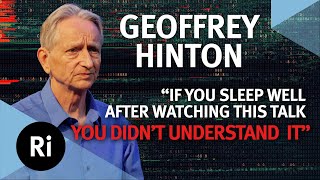 Geoffrey Hinton on Deep Learning and Understanding: AI, language, minds2021 · 47 min · full transcriptShows how Hinton connects his early language-model ideas to modern chatbots and explains why they do not store sentences.
 Geoffrey Hinton on AI Risks: “These Things Do Understand”2022 · 13 min · full transcriptMost concise statement of why Hinton thinks next-word prediction itself requires real intelligence and why that worries him.
 Geoffrey Hinton on AI Safety and Superintelligence: Hobart Lecture2021 · 63 min · full transcriptBest for his account of sentence understanding as compatible feature vectors and for the link from LLMs to AI risk.
 Geoffrey Hinton on Deep Learning Limits: Scale, Reasoning, and Brain-Like Learning2021 · 46 min · full transcriptUseful for his argument that scale, representation learning, and common structure lead to reasoning and creativity.
Questions people ask
- What did Geoffrey Hinton say about creativity in large language models?
- What did Geoffrey Hinton say about how AI can be creative and understand analogies?
- What did Geoffrey Hinton say about how large language models work?
- What did Geoffrey Hinton say about whether large language models understand language?
Sources
Every quote above, word for word from the transcripts. Numbers match the text.
“I think LLMs really do understand what they're saying.”
“You have to be really intelligent to predict the next word really accurately.”
“I think it's understanding in much the same way we are.”
“Big chat bots don't actually store any language at all.”
“You're trying to predict the next word. You do it in a more complicated way, it's all done with features and then interactions, when you get it wrong, you back propagate information that learns all these features and then interactions. That's how language works for us, and it's how it works for these large language models. We are basically the same. So the point here is they're very like us. They're very unlike computer software. Computer software, someone wrote lines of code to do something, and you can look at a line of code, and say, "What was that meant to do?" These aren't like that at all. Someone wrote lines of code to tell the simulated neural network how to learn. That was the backpropagation algorithm. But then you just give it data and it learns.”
“The meaning of a word was just a big set of features.”
“Understanding a sentence consists of associating mutually compatible feature vectors with the words in the sentence.”
“The main point is, language is a wonderful way to build a particular kind of complicated model.”
“What these big language models are doing is they're looking for common structure, and by finding common structure they can encode things using the common structure and that's more efficient. So let me give you an example. If you ask GPT-4, "Why is a compost heap like an atom bomb?" Most people can't answer that. Most people haven't thought they think atom bomb and compost heaps are very different things. But GPT-4 will tell you, well, the energy scales are very different and the timescales are very different. But the thing that's the same is that when the compost heep gets hotter, it generates heat faster. And when the atom bomb produces more neutrons, it produces more neutrons faster. And so it gets the idea of a chain reaction. And I believe it's understood they're both forms of chain reaction. It's using that understanding to compress all that information into its weights. And if it's doing that, then it's gonna be doing that for hundreds of things where we haven't seen the analogies yet, but it has and that's where you get creativity from, from seeing these analogies between apparently very different things. And so I think GPT-4 is gonna end up—when it gets bigger—being very creative.”
“They're much more like us than standard computer software's like us.”
“You just make it bigger and it'll work better.”
“The tiny language model is built to try and model how humans understand the meanings of words. It's now got a lot better as technology's got a lot faster and data sets have got bigger. But that is understanding. So my claim is that the large language models, which I like to think are descendants of my tiny language model, although most of the people who make them have never heard of my tiny language model, (audience laughing) they use many more words as input. They use many more layers of neurons. They have to do things I didn't do like disambiguate words. If you have a word like "May," it could be a month, it could be a woman's name, it could be a modal like would and should.”
“They're not at all like most linguists think they are.”
“I think the brain's just too complicated for us just at the moment.”
“I think we're moving into a period when, for the first time ever, we may have things more intelligent than us.”
“I can't see a path that guarantees safety.”
“That is, they work in exactly the same way, they use the weights in exactly the same way. And you can't do that with analogue hardware. It has to be digital, which means it has to be high power. So these things are immortal, but they use a lot of power. So the conclusion of this bit of the talk, which I raced through faster than I intended is the digital computation requires a lot of energy, but it makes it very easy for agents to have the same model of the world, have the same model, share what they've learned, so they can all go off and learn different things and share.”
“We do what I call mortal computation.”
“What we have is what I call mortal computation.”
“We have to think that they're very like us.”
How this guide was made: drafted with AI from the full transcripts of the recordings cited, then checked: every quotation must match a transcript word for word and be the speaker's own words, and an independent review gates accuracy. Methodology and corrections.


