Geoffrey Hinton on Backpropagation
Hinton sees backpropagation as the practical breakthrough that lets neural networks learn rich internal features from data, even though he doubts the brain uses the same exact mechanism.
- Backpropagation made large neural networks practical by changing huge numbers of weights efficiently at once.
- Hinton treats it as the engine that turns examples into learned features and feature interactions, especially in language and vision.
- He thinks gradient descent in big neural networks is fundamentally sensible, even though some of his earlier beliefs about backprop changed over time.
- He does not think the brain literally uses standard end-to-end backprop, but he argues it would be surprising if the brain were not doing something related to credit assignment.
- For Hinton, the deeper shift is from programming computers with rules to showing networks data and letting learning shape the system.
Backpropagation is the trick that made neural nets practical
Hinton describes backpropagation as the point where neural networks stopped being just an appealing idea and became a workable learning method. Instead of adjusting one connection at a time, it lets a network adjust vast numbers of weights together using error signals, which is why it scales to large models.
That practical jump matters because neural networks learn by changing connection strengths rather than by following hand-coded rules. In Hinton’s telling, once you can efficiently push learning signals through many layers, the network can discover useful internal structure on its own from examples.
What backpropagation actually learns is features, not rules
Hinton repeatedly frames neural learning as the discovery of features and their interactions. In vision, simple detectors build into more complex ones; in language, words are represented by large sets of features that get combined and reshaped by context.
This is why he rejects the idea that successful models are just storing text or lookup rules. He says modern chatbots do not work by memorizing language directly, but by learning distributed representations that support prediction, and backpropagation is the process that tunes those representations when the model gets things wrong.
Why Hinton thinks backprop works so well
Hinton’s broad view is that gradient-based learning in large neural networks is simply a very good idea. He says directly that gradient descent learning for big neural networks is sensible, and he points to its success across tasks that earlier symbolic systems struggled with, including speech, vision, and translation.
He also emphasizes that deep learning’s success was not just the algorithm in isolation. Faster computers, more data, and training improvements made backpropagation far more effective than it looked in earlier decades, and later systems benefited from learned features before supervised fine-tuning as well.
At the same time, Hinton is unusually candid that his own thinking evolved. He says almost everything he used to believe about backpropagation was wrong, which signals not a rejection of the method, but a willingness to revise how he understands when and why it works best.
Backpropagation changed AI because it replaced hand-coding with learning from examples
One of Hinton’s central contrasts is between standard software and neural networks. In ordinary software, people write explicit instructions; in neural networks, people write the learning procedure and then the system acquires its competence from data.
That change is why he sees modern AI as a major shift in how computers are used. Instead of telling the machine exactly what to do, you show it many examples, let backpropagation alter the weights, and the model builds internal machinery that can perform tasks once thought to require carefully designed symbolic rules.
He doubts the brain uses standard backprop, but not the need for credit assignment
Hinton draws a clear line between the success of backpropagation in artificial networks and the open question of biological plausibility. He says the key issue is how the brain would obtain the equivalent of gradients, and he leans toward the view that biological learning may rely on more local objectives and local signals rather than one global end-to-end loss.
Even so, he does not accept the stronger claim that backprop-like ideas are irrelevant to neuroscience. He argues that dismissing the idea on plausibility grounds is misguided, and he says it would be crazy if the brain were not somehow doing this, meaning some form of effective credit assignment for improving behavior.
This is where his later interests in local learning, contrastive methods, agreement, and biologically motivated alternatives fit in. The point is not that backprop failed, but that its success raises a deeper question: what is the brain’s version of the same functional achievement.
Where to watch
 Geoffrey Hinton on Backpropagation: Can the Brain Do It?2019 · 82 min · full transcriptBest single place to hear Hinton explain what backpropagation does, why it worked so well, and whether the brain might do something related.
 Geoffrey Hinton on How Neural Networks Learn: Beaks, Pings, and Backprop2023 · 98 min · full transcriptBest intuitive walkthrough of how neural networks learn features in plain language, including why backprop made that learning practical.
 Geoffrey Hinton on Deep Learning: Intro to Deep Belief Nets2016 · 65 min · full transcriptBest for Hinton’s more technical, historical view of backpropagation, including what he later changed his mind about.
 Geoffrey Hinton on Deep Learning and Understanding: AI, language, minds2021 · 47 min · full transcriptBest concise lecture linking backpropagation to learned internal representations, language models, and the modern deep learning era.
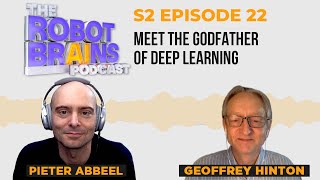 Geoffrey Hinton on Deep Learning and Brain-Like AI: Spikes, Learning, and Safety2023 · 88 min · full transcriptBest for Hinton’s view that the brain probably does not use standard backprop, and for the alternatives he finds promising.
 Geoffrey Hinton on Deep Learning Origins: Backprop, Boltzmann Machines2017 · 40 min · full transcriptBest for the origins story: how Hinton sees the role of backpropagation in the rise of deep learning and why he defended it early.
Questions people ask
- What did Geoffrey Hinton say about how large language models work?
- What did Geoffrey Hinton say about whether large language models understand language?
- What did Geoffrey Hinton say backpropagation does?
- What did Geoffrey Hinton say sleep is for?
- What did Geoffrey Hinton say about capsules and routing by agreement?
- Why does Geoffrey Hinton think deep learning is changing computer science so much?
How this guide was made: drafted with AI from the full transcripts of the recordings cited, then checked: every quotation must match a transcript word for word and be the speaker's own words, and an independent review gates accuracy. Methodology and corrections.


