Meaning in Vectors
How words become features, and why prediction can require understanding.

“The meaning of a word was just a big set of features.”Winter 2026 George and Moren UN Lecture Series, 2021 · 11:51
The lesson
Hinton’s core claim in this chapter is that word meaning is not a dictionary entry or a hand-written rule set. In his view, a word is represented as a large bundle of features, and sentence understanding comes from making the feature vectors of the words fit together in a mutually compatible way12. That is why he treats neural language understanding as a problem of learned representations rather than symbolic manipulation.
This leads to his rejection of the idea that language models succeed by storing sentences or replaying text. He argues that large chatbots do not literally keep language inside them as strings; instead, they learn internal structure that lets them encode regularities efficiently and use them for prediction34. On this view, the model’s knowledge lives in weights and learned features, shaped by data and training rather than explicit rules5.
Prediction is central because next-word learning forces the model to build these representations. Hinton says that getting the next word right requires feature learning and feature interactions, and that backpropagation is what adjusts the network so those features become useful for prediction5. That is also why he argues strong prediction can require real intelligence and not mere autocomplete: to predict well across many contexts, the system must capture meaning and structure6.
Hinton connects this directly to human language understanding. His early small language model was intended as a model of how people learn word meanings from context, and he sees modern large language models as scaled-up descendants of that same basic idea7. He therefore argues that these systems understand in a way importantly similar to us: not by translating sentences into formal logic, but by shaping context-sensitive representations that work together inside a learned model of the world8910.
4 principles from Geoffrey Hinton
Treat meaning as a learned feature vector
When you analyze language, start from the idea that a word’s meaning is a pattern of many features, not a single label or rule. Apply this by asking what distinctions a model must encode for a word to behave correctly across many contexts.
“The meaning of a word was just a big set of features.”
Judge understanding by compatibility in context
For Hinton, understanding a sentence means assigning word representations that fit together coherently. In practice, this means evaluating whether a system can adapt meanings to context, disambiguate words, and preserve relations across a whole sentence.
“The tiny language model is built to try and model how humans understand the meanings of words. It's now got a lot better as technology's got a lot faster and data sets have got bigger. But that is understanding. So my claim is that the large language models, which I like to think are descendants of my tiny language model, although most of the people who make them have never heard of my tiny language model, (audience laughing) they use many more words as input. They use many more layers of neurons. They have to do things I didn't do like disambiguate words. If you have a word like "May," it could be a month, it could be a woman's name, it could be a modal like would and should.”
Do not confuse compression with memorization
A language model may know a lot without storing sentences verbatim, because it can capture common structure in its weights. Apply this by looking for generalization, analogy, and flexible reuse rather than assuming performance comes from retrieval alone.
“What these big language models are doing is they're looking for common structure, and by finding common structure they can encode things using the common structure and that's more efficient. So let me give you an example. If you ask GPT-4, "Why is a compost heap like an atom bomb?" Most people can't answer that. Most people haven't thought they think atom bomb and compost heaps are very different things. But GPT-4 will tell you, well, the energy scales are very different and the timescales are very different. But the thing that's the same is that when the compost heep gets hotter, it generates heat faster. And when the atom bomb produces more neutrons, it produces more neutrons faster. And so it gets the idea of a chain reaction. And I believe it's understood they're both forms of chain reaction. It's using that understanding to compress all that information into its weights. And if it's doing that, then it's gonna be doing that for hundreds of things where we haven't seen the analogies yet, but it has and that's where you get creativity from, from seeing these analogies between apparently very different things. And so I think GPT-4 is gonna end up—when it gets bigger—being very creative.”
Use prediction as a test of representation quality
Next-word prediction matters because it pressures the model to learn useful internal features and interactions. If a system predicts well in varied settings, that is evidence it has built representations rich enough to support understanding.
“You have to be really intelligent to predict the next word really accurately.”
In his own words
The quotes behind the lesson, word for word from the transcripts. Numbers match the lesson above.
“The meaning of a word was just a big set of features.”
“Understanding a sentence consists of associating mutually compatible feature vectors with the words in the sentence.”
“Big chat bots don't actually store any language at all.”
“What these big language models are doing is they're looking for common structure, and by finding common structure they can encode things using the common structure and that's more efficient. So let me give you an example. If you ask GPT-4, "Why is a compost heap like an atom bomb?" Most people can't answer that. Most people haven't thought they think atom bomb and compost heaps are very different things. But GPT-4 will tell you, well, the energy scales are very different and the timescales are very different. But the thing that's the same is that when the compost heep gets hotter, it generates heat faster. And when the atom bomb produces more neutrons, it produces more neutrons faster. And so it gets the idea of a chain reaction. And I believe it's understood they're both forms of chain reaction. It's using that understanding to compress all that information into its weights. And if it's doing that, then it's gonna be doing that for hundreds of things where we haven't seen the analogies yet, but it has and that's where you get creativity from, from seeing these analogies between apparently very different things. And so I think GPT-4 is gonna end up—when it gets bigger—being very creative.”
“You're trying to predict the next word. You do it in a more complicated way, it's all done with features and then interactions, when you get it wrong, you back propagate information that learns all these features and then interactions. That's how language works for us, and it's how it works for these large language models. We are basically the same. So the point here is they're very like us. They're very unlike computer software. Computer software, someone wrote lines of code to do something, and you can look at a line of code, and say, "What was that meant to do?" These aren't like that at all. Someone wrote lines of code to tell the simulated neural network how to learn. That was the backpropagation algorithm. But then you just give it data and it learns.”
“You have to be really intelligent to predict the next word really accurately.”
“The tiny language model is built to try and model how humans understand the meanings of words. It's now got a lot better as technology's got a lot faster and data sets have got bigger. But that is understanding. So my claim is that the large language models, which I like to think are descendants of my tiny language model, although most of the people who make them have never heard of my tiny language model, (audience laughing) they use many more words as input. They use many more layers of neurons. They have to do things I didn't do like disambiguate words. If you have a word like "May," it could be a month, it could be a woman's name, it could be a modal like would and should.”
“The main point is, language is a wonderful way to build a particular kind of complicated model.”
“I think it's understanding in much the same way we are.”
“I think LLMs really do understand what they're saying.”
Reflect
- Pick a word with multiple senses, like “bank” or “May.” What features would a model need to shift correctly between its meanings in different sentences?
- Think of a task in your work where people explain behavior with rules. How would the explanation change if you treated success as emerging from learned representations instead?
- Have you ever mistaken compression for memorization in a human or machine learner? What evidence would help you tell the difference?
Check your understanding
Go deeper
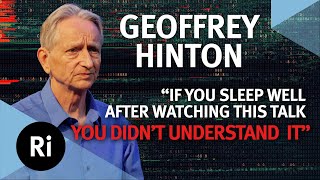 Geoffrey Hinton on Deep Learning and Understanding: AI, language, minds2021 · 47 min · full transcript
 Geoffrey Hinton on AI Safety and Superintelligence: Hobart Lecture2021 · 63 min · full transcript
 Geoffrey Hinton on How AI Works: Why Neural Nets Learn Meaning2021 · 61 min · full transcript
 Geoffrey Hinton on How Neural Networks Learn: Beaks, Pings, and Backprop2023 · 98 min · full transcript
 Geoffrey Hinton on Deep Learning Limits: Scale, Reasoning, and Brain-Like Learning2021 · 46 min · full transcript
 Geoffrey Hinton on AI Risks: “These Things Do Understand”2022 · 13 min · full transcript
- What did Geoffrey Hinton say about how large language models work?
- What did Geoffrey Hinton say about whether large language models understand language?
- What did Geoffrey Hinton say about creativity in large language models?
- What did Geoffrey Hinton say about how AI can be creative and understand analogies?