Teaching Smaller Nets
How large models pass their knowledge to smaller students.

“Understanding a sentence consists of associating mutually compatible feature vectors with the words in the sentence.”Winter 2026 George and Moren UN Lecture Series, 2021 · 26:23
The lesson
Hinton’s starting point is simple: a large model often knows more than the single correct label written in a dataset. When a network has learned rich internal structure, its outputs can reflect relationships among alternatives, not just the top choice. That fits his broader view that meaning is represented in patterns of compatible features rather than isolated symbols, so useful teaching should preserve more of that structure than hard labels do12.
This matters because scale helps models learn those richer patterns in the first place. Hinton repeatedly argues that performance improves when you combine larger models with more data and compute, and he even admits that this scaling result won him over despite his initial resistance345. Distillation becomes valuable because once a big model has learned something expensive, you can try to transfer that competence into a smaller student that is cheaper to run.
He also gives a reason this can work even when the teacher’s labels are imperfect. The student is not just memorizing labels; it is learning the relationship between inputs and outputs, and once that relationship is clear enough, some wrong labels become obviously wrong and do not have to dominate learning. In that sense, the usefulness of a teaching signal depends on how much information it carries, not on perfect correctness in every example, and Hinton points to cases where a student trained on imperfect labels can outperform the teacher67.
Hinton connects this idea to brain-like learning too. He doubts the brain uses weight sharing in the way convolutional nets do, which pushes him toward alternatives based on local learning and local agreement rather than one globally shared mechanism8. A teacher-student picture fits that instinct: knowledge can be passed along and compressed from one system into another without assuming the brain does standard backpropagation everywhere in the same way.
The larger lesson is practical and conceptual. Practically, distillation helps turn the strengths of very large models into systems that are more efficient to deploy. Conceptually, it suggests that learning can happen through structured guidance from another learned system, not only from clean external labels, which is one reason Hinton sees modern neural nets as capturing something real about understanding rather than merely matching patterns97.
4 principles from Geoffrey Hinton
Use soft knowledge, not just hard answers
A trained model can express relationships among possibilities that a single correct label throws away. When teaching a smaller model, preserve as much of that structure as you can so the student learns similarities and confusions, not just final decisions.
“Understanding a sentence consists of associating mutually compatible feature vectors with the words in the sentence.”
Let big models learn first, then compress
Hinton’s view is that larger models with more data and compute usually learn better. Distillation matters because it lets you harvest that expensive learning and transfer it into a smaller, cheaper model.
“…bigger model, more data, more compute…”
Imperfect labels can still teach
A student can learn the underlying input-label relationship rather than blindly copying every target. Once it has the pattern, some random mistakes in the teacher’s supervision stop being decisive, and the student may even surpass the teacher.
“So, if there's like a 1/50th of the mutual information, I have 50 times as many examples, do I now get the same performance? And the answer is yes, you do to within a factor of two. I mean, the training set actually needs to be twice that big, but roughly speaking, you can see how useful a training example is by the amount of mutual information between the label and the truth. And I've noticed recently you have something for doing sim-to-real where you're labeling real data using a neural net, and those labels aren't perfect. And then you take the student that learned from those labels, and the student is better than the teacher it learned from. And people are always puzzled by, "How could the student be better than the teacher?" But in neural nets, it's very easy.”
Think of learning as local transfer of competence
Hinton’s brain-like perspective pushes away from one uniform learning mechanism applied everywhere. Distillation is a useful way to imagine learned competence being passed from one part or system to another through local teaching signals.
“I think the brain doesn't do weight sharing…”
In his own words
The quotes behind the lesson, word for word from the transcripts. Numbers match the lesson above.
“The meaning of a word was just a big set of features.”
“Understanding a sentence consists of associating mutually compatible feature vectors with the words in the sentence.”
“…bigger model, more data, more compute…”
“…bigger models, they always work better.”
“I should not like it, but I love it.”
“So, if there's like a 1/50th of the mutual information, I have 50 times as many examples, do I now get the same performance? And the answer is yes, you do to within a factor of two. I mean, the training set actually needs to be twice that big, but roughly speaking, you can see how useful a training example is by the amount of mutual information between the label and the truth. And I've noticed recently you have something for doing sim-to-real where you're labeling real data using a neural net, and those labels aren't perfect. And then you take the student that learned from those labels, and the student is better than the teacher it learned from. And people are always puzzled by, "How could the student be better than the teacher?" But in neural nets, it's very easy.”
“The teacher is saying these labels, and the student has to, in some sense, understand which cases are right and which cases are wrong, and sort of see the relationship between the labels and the inputs. And then once the student's seen that relationship, a wrongly labeled thing is just very obviously wrong. So, it's fine if it's randomly wrongly labeled. But there is a phase transition where you have to have it good enough so the student can sort of get the idea. But that explains how our students are all smarter than us. Wait, how do you need to get it right a small fraction of the time? Right. And I'm sure the students do some of this data curation where you say something, and the student thinks, "Oh, that's rubbish. I'm not going to listen to that." Those are the very best students, you…”
“I think the brain doesn't do weight sharing…”
“I think LLMs really do understand what they're saying.”
Reflect
- Where in your own work do you rely on hard labels or binary judgments when a richer score or distribution would teach more?
- If you had one very strong but expensive model, what smaller system would you want it to teach, and what efficiency gain would matter most?
- Think of a time you learned from an imperfect teacher. What helped you extract the pattern instead of copying the mistakes?
Check your understanding
Go deeper
 Geoffrey Hinton on Deep Learning Scaling: Bigger Models, More Data2021 · 54 min · full transcript
 Geoffrey Hinton on How AI Works: Why Neural Nets Learn Meaning2021 · 61 min · full transcript
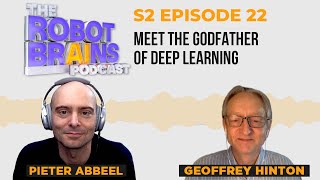 Geoffrey Hinton on Deep Learning and Brain-Like AI: Spikes, Learning, and Safety2023 · 88 min · full transcript